

The best synonyms for most depend on the sentence. Use majority for more than half of a group, greatest for the highest degree or amount, mainly or largely for something that is mostly true, and almost all when referring to nearly every person or thing. These alternatives are not interchangeable in every context.
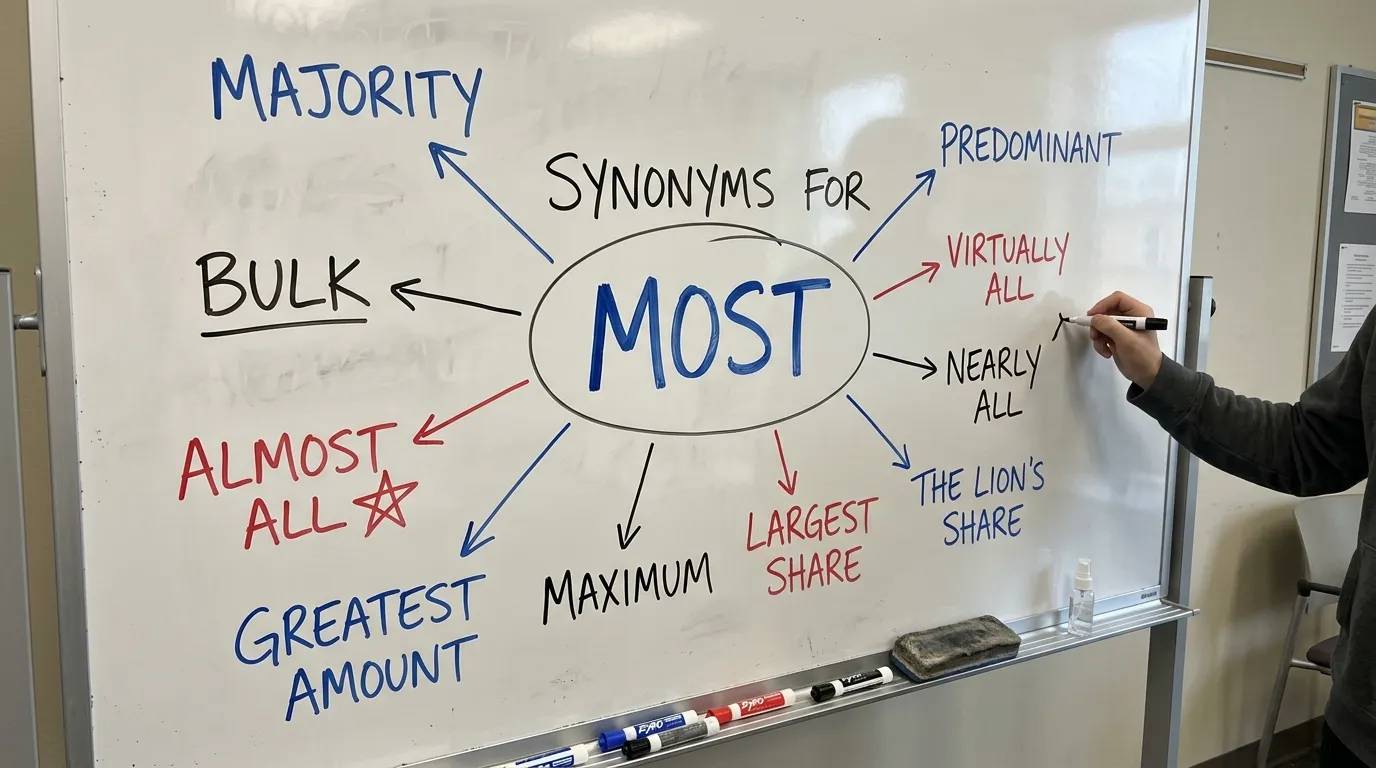
Quick Synonym List for Most
Here are useful alternatives to most, grouped by meaning and usage.
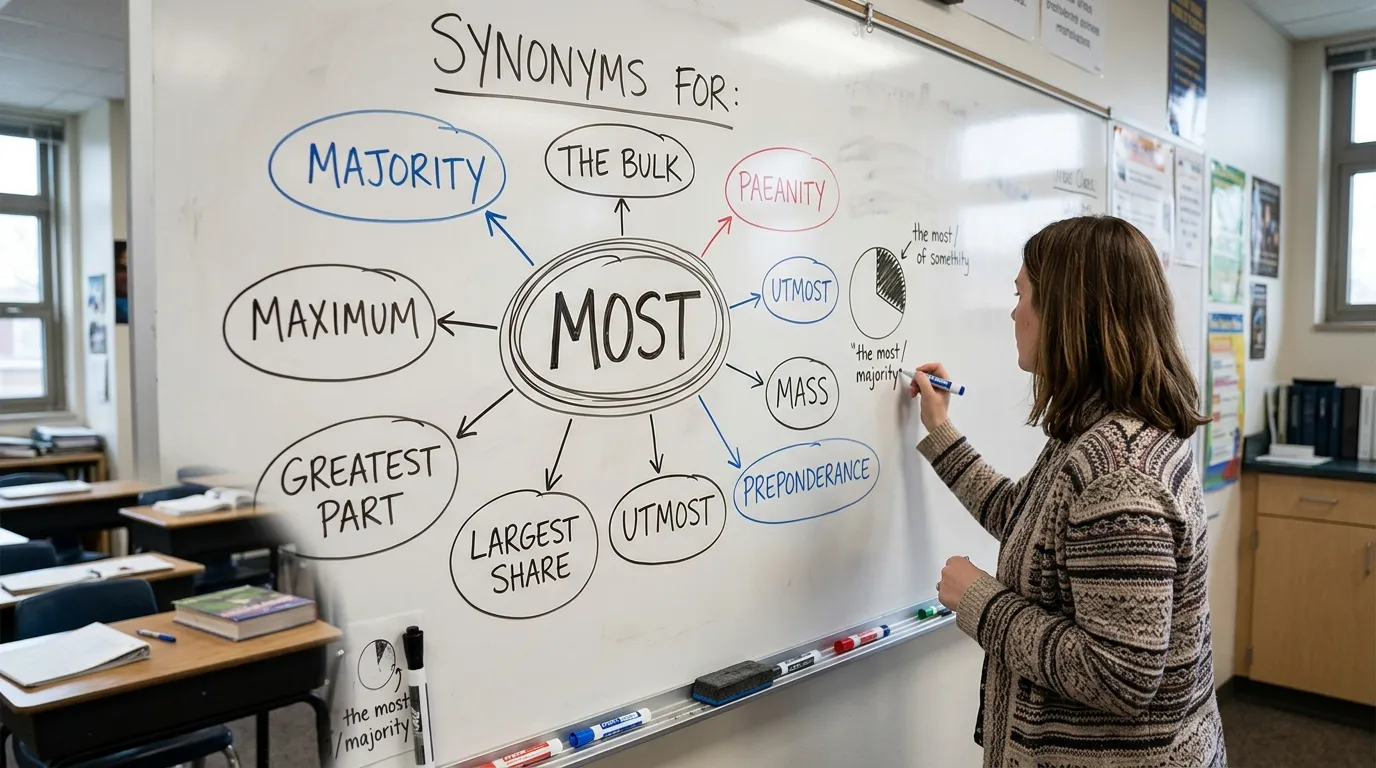
Quantity: majority, nearly all, almost all, the greater part, the bulk, a large proportion, the larger number
Degree or amount: greatest, highest, maximum, largest, biggest, fullest
Mainly or primarily: mainly, largely, primarily, chiefly, predominantly, principally
Nearly or almost: nearly all, almost every, practically all, virtually all
Common or frequent occurrence: usually, generally, mostly, for the most part, in general
Formal or academic use: the majority of, a substantial proportion, a significant number, predominantly, chiefly
Superlative emphasis: utmost, greatest possible, highest possible, maximum
Important: Some alternatives replace most directly, while others work only in specific sentence structures.
What Does Most Mean?
The word most has several meanings. It can refer to a large quantity, the largest degree, or something that happens in the main part of a situation.
1. Most meaning nearly all or a majority
Use most to describe more than half of a group or a large proportion of something.
Most students passed the exam.
Most of the water was gone.
Most people enjoy having free time.
Possible alternatives include the majority of, nearly all, almost all, and a large proportion of. The best choice depends on how much of the group you mean.
2. Most meaning the greatest or highest
Use most before certain adjectives and adverbs to form a superlative.
She is the most talented singer in the group.
This is the most useful tool for the job.
He worked most efficiently under pressure.
Depending on the sentence, alternatives may include greatest, highest, largest, or maximum. These words do not work with every adjective.
3. Most meaning mainly or for the most part
Use most or mostly to say that something is true in general, although exceptions may exist.
The audience was most impressed by her performance.
The project is mostly complete.
We spend most of our time studying.
Alternatives include mainly, largely, primarily, and for the most part. Choose one that fits the grammar and intended meaning.
Best Synonyms for Most With Meanings and Examples
1. Majority
Meaning: More than half of a group, or the greater number of its members.
Example: Most voters supported the proposal.
Alternative: A majority of voters supported the proposal.
Best for: Reports, surveys, elections, research, and group decisions.
Watch out: Majority usually means more than half. Most can sometimes suggest a very large proportion, so the words may not communicate exactly the same amount.
2. Greatest
Meaning: The highest in degree, quality, importance, or achievement.
Example: She showed the most courage during the crisis.
Alternative: She showed the greatest courage during the crisis.
Best for: Ability, importance, achievement, influence, and abstract qualities.
Watch out: Greatest does not normally replace most when you mean the largest number of people or objects.
3. Highest
Meaning: At the top level of a measurement, ranking, or scale.
Example: This region has the most unemployment.
Alternative: This region has the highest unemployment rate.
Best for: Scores, rates, rankings, levels, and measurements.
Watch out: Use highest when the subject can be measured or ranked. It may sound unnatural with qualities such as kindness or creativity.
4. Largest
Meaning: Greatest in size, number, volume, or extent.
Example: It was the most collection of books in the library.
Better alternative: It was the largest collection of books in the library.
Best for: Collections, populations, quantities, spaces, and physical size.
Watch out: Largest describes size or amount, while most has a wider range of uses.
5. Mainly
Meaning: For the most part; more than anything else.
Example: The event was attended mostly by students.
Alternative: The event was attended mainly by students.
Best for: Explaining the primary group, reason, activity, or purpose.
Watch out: Mainly identifies what is central or primary. It does not necessarily mean that something exceeds half by a measurable amount.
6. Mostly
Meaning: For the greater part; in most cases or to a large extent.
Example: The room was most empty after the event.
Better alternative: The room was mostly empty after the event.
Best for: Describing general conditions, incomplete states, and situations with exceptions.
Watch out: Mostly and most have different grammatical roles. You can say mostly empty, but normally say most people.
7. Largely
Meaning: To a great extent or mainly.
Example: The project’s success was most due to teamwork.
Alternative: The project’s success was largely due to teamwork.
Best for: Professional writing, explanations, analysis, and cause-and-effect statements.
Watch out: Largely describes the extent to which something is true. It does not automatically mean every part of a group.
8. Primarily
Meaning: Mainly or chiefly; more than anything else.
Example: The course is most designed for beginners.
Alternative: The course is primarily designed for beginners.
Best for: Academic writing, business documents, goals, audiences, and main purposes.
Watch out: Primarily often sounds more formal than mostly.
9. Chiefly
Meaning: Mainly or above all.
Example: The region is most known for its farming.
Alternative: The region is chiefly known for its farming.
Best for: Formal descriptions and explanations of a main feature or cause.
Watch out: Chiefly can sound formal or old-fashioned in casual conversation.
10. Predominantly
Meaning: Mostly or mainly, especially when one group or feature is dominant.
Example: The neighborhood is home to most young families.
Alternative: The neighborhood is home predominantly to young families.
Best for: Demographics, research, populations, and descriptions of dominant characteristics.
Watch out: Predominantly emphasizes dominance, not necessarily an exact percentage.
11. Almost all
Meaning: Nearly every member or part, with only a few exceptions.
Example: Most of the guests arrived on time.
Alternative: Almost all the guests arrived on time.
Best for: Situations where you mean a very high proportion of a group.
Watch out: Almost all is stronger than most when most simply means more than half.
12. Nearly all
Meaning: Very close to all, but not necessarily every single one.
Example: Most of the applications were approved.
Alternative: Nearly all the applications were approved.
Best for: Reports, summaries, and situations where only a few exceptions exist.
Watch out: Don’t use nearly all if a substantial part of the group was excluded.
13. The bulk
Meaning: The largest part of something.
Example: Most of the work is finished.
Alternative: The bulk of the work is finished.
Best for: Workloads, resources, money, materials, and large quantities.
Watch out: The bulk usually refers to the main or largest part, not necessarily every remaining item.
14. The greater part
Meaning: Most of a whole or a larger share of something.
Example: Most of the afternoon was spent reading.
Alternative: The greater part of the afternoon was spent reading.
Best for: Narrative writing and descriptions of time, resources, or a whole quantity.
Watch out: This expression is longer and more formal than most.
15. A large proportion
Meaning: A substantial share of a group or quantity.
Example: Most employees preferred flexible hours.
Alternative: A large proportion of employees preferred flexible hours.
Best for: Research, workplace reports, surveys, and statistical discussions.
Watch out: A large proportion does not necessarily mean more than half. Use a majority when that distinction matters.
16. Maximum
Meaning: The greatest amount, level, or limit possible.
Example: We need the most possible output from this machine.
Alternative: We need the maximum possible output from this machine.
Best for: Limits, capacity, performance, efficiency, and technical writing.
Watch out: Maximum often refers to a limit or upper boundary, not just a general comparison.
17. Utmost
Meaning: The greatest possible degree, often used with importance, care, or respect.
Example: The matter requires the most attention.
Alternative: The matter requires the utmost attention.
Best for: Formal statements such as utmost importance, utmost care, and utmost respect.
Watch out: Utmost is not a general substitute for most. It appears in specific expressions.
18. Generally
Meaning: In most cases or as a broad rule.
Example: Most people prefer clear instructions.
Alternative: Generally, people prefer clear instructions.
Best for: Broad observations, explanations, and statements with exceptions.
Watch out: Generally refers to what is usually true, not necessarily to the quantity of people or objects.
19. Usually
Meaning: In most instances or on most occasions.
Example: Most days, she walks to work.
Alternative: She usually walks to work.
Best for: Habits, routines, and repeated events.
Watch out: Usually focuses on frequency over time, while most can describe a portion of a group.
20. For the most part
Meaning: Mostly, although there may be exceptions.
Example: The presentation was most successful.
Alternative: The presentation was successful for the most part.
Best for: Balanced descriptions and evaluations that acknowledge exceptions.
Watch out: The phrase is longer than mostly and may make a concise sentence unnecessarily wordy.
Synonyms for Most in Different Contexts
The best alternative depends on what most describes.
Most people or things
When describing a group, consider these options:
The majority of: More than half of the group.
Almost all: Nearly every member.
Nearly all: A very high proportion, with few exceptions.
A large proportion of: A substantial share, without specifying that it exceeds half.
The bulk of: The largest part of a quantity or group.
Examples:
Most students completed the assignment.
The majority of students completed the assignment.
Almost all students completed the assignment.
These sentences may suggest different proportions. Choose the version that matches the facts.
Most important
When most describes importance or priority, these alternatives may work:
Greatest: Emphasizes degree or significance.
Highest: Fits a ranked level or priority.
Primary: Identifies the main concern or objective.
Chief: Identifies the leading concern or reason.
Utmost: Emphasizes the greatest possible degree.
Examples:
This is the most important issue.
This is the primary issue.
This issue is of the utmost importance.
The alternatives shift the sentence structure and emphasis. Primary issue means the main issue, while utmost importance stresses the highest degree of importance.
Most likely
When expressing probability, use alternatives that preserve the sense of likelihood:
Most probable: Very likely, often formal.
Most likely: The natural everyday expression.
Likeliest: The most likely among alternatives.
Highly likely: Very probable.
Most plausible: The most reasonable or believable option.
Examples:
This is most likely the correct answer.
This is the most probable explanation.
This is the most plausible explanation.
Watch out: Plausible means reasonable or believable, not necessarily more likely than every other option.
Most of the time
When referring to frequency, use:
Usually
Generally
Normally
Typically
For the most part
In most cases
Examples:
Most of the time, the system works well.
Usually, the system works well.
In most cases, the system works well.
These phrases describe frequency or general patterns rather than the size of a group.
Most in academic writing
For essays, reports, and research papers, useful alternatives include:
The majority of
A large proportion of
Predominantly
Primarily
Largely
A substantial number of
A significant proportion of
Examples:
Most participants reported improvement.
The majority of participants reported improvement.
A substantial proportion of participants reported improvement.
Use the more specific phrase only when the evidence supports it. Significant can also imply statistical significance in research, so don’t use it casually if that meaning could confuse readers.
Comparison Table: Most vs. Similar Words
| Word or phrase | Meaning | Tone | Best use | Interchangeable with most? |
|---|---|---|---|---|
| Majority | More than half | Neutral/formal | Groups and surveys | Sometimes |
| Greatest | Highest degree | Neutral | Qualities and achievement | Only in degree comparisons |
| Highest | Top level | Neutral/formal | Scores, rates, rankings | Only in measurable comparisons |
| Mainly | Primarily | Neutral | Main purpose or feature | Sometimes |
| Mostly | For the greater part | Neutral | General conditions | Often, depending on grammar |
| Largely | To a great extent | Formal | Explanations and analysis | Sometimes |
| Primarily | Mainly | Formal | Purpose and priority | Sometimes |
| Predominantly | Dominant or most common | Formal | Groups and characteristics | Sometimes |
| Almost all | Nearly every one | Neutral | Very high proportions | Only if the intended amount fits |
| The bulk | Largest part | Neutral/formal | Work, resources, quantities | Sometimes |
| Maximum | Greatest possible amount | Technical/formal | Limits and capacity | Rarely |
| Utmost | Greatest possible degree | Formal | Care, importance, respect | Only in set expressions |
How to Choose the Right Synonym for Most
Use this simple guide to select the most accurate alternative.
Choose majority when you mean more than half of a group.
Choose almost all or nearly all when very few exceptions exist.
Choose greatest when comparing qualities, achievements, or degrees.
Choose highest when discussing a score, rate, level, or ranking.
Choose mainly or primarily when identifying the principal purpose or feature.
Choose largely when describing the extent to which something is true.
Choose mostly when describing a general state that is not complete.
Choose usually when talking about a repeated action or habit.
Choose predominantly when one group or characteristic is dominant.
Choose maximum when referring to the highest possible amount or limit.
Keep most when it is the shortest, clearest, and most natural choice.
10 Before-and-After Examples Using Synonyms for Most
These examples show how to replace most without changing the intended meaning more than necessary.
1. Describing a group
Before: Most employees agreed with the decision.
After: The majority of employees agreed with the decision.
Why it works: The majority of sounds suitable for reports and formal workplace writing.
2. Describing nearly everyone
Before: Most guests arrived before the ceremony.
After: Almost all guests arrived before the ceremony.
Why it works: Use almost all if only a few guests arrived late.
3. Describing importance
Before: This is the most important part of the report.
After: This is the primary part of the report.
Why it works: Primary emphasizes that the part is central, although it does not always convey the same degree of importance as most important.
4. Describing a high score
Before: She received the most score in the class.
After: She received the highest score in the class.
Why it works: Highest score is the natural expression for a top result.
5. Describing a large amount
Before: Most of the budget went toward equipment.
After: The bulk of the budget went toward equipment.
Why it works: The bulk emphasizes the largest share of the budget.
6. Describing the main reason
Before: The problem was most caused by poor planning.
After: The problem was largely caused by poor planning.
Why it works: Largely fits an explanation of cause and effect.
7. Describing a main purpose
Before: The program is most intended for new employees.
After: The program is primarily intended for new employees.
Why it works: Primarily clearly identifies the main audience.
8. Describing a habit
Before: Most of the time, he works from home.
After: He usually works from home.
Why it works: Usually makes a statement about a recurring habit more concise.
9. Describing a general condition
Before: The building was most empty after closing.
After: The building was mostly empty after closing.
Why it works: Mostly is the correct adverb for describing a condition that is true for the greater part.
10. Describing a dominant feature
Before: The area is most populated by young families.
After: The area is predominantly populated by young families.
Why it works: Predominantly emphasizes the dominant group, though the sentence may be more naturally phrased as “Young families make up most of the area’s population.”
Common Mistakes When Using Synonyms for Most
1. Treating majority and most as exact equivalents
Most can describe a large proportion, while majority normally means more than half.
Better approach: Use majority when the more-than-half meaning is accurate.
2. Using almost all when you mean most
Almost all suggests that very few people or things are excluded.
Incorrect if many are excluded: Almost all students passed when only 60% passed.
Better: Most students passed.
3. Confusing most and mostly
Use most before a noun phrase: “Most people agreed.”
Use mostly to modify an adjective or verb phrase: “The room was mostly empty.”
4. Replacing most with greatest in every sentence
Greatest works for degree, importance, and achievement. It does not naturally replace most in “most people” or “most of the food.”
5. Using maximum when you mean a large amount
Maximum means the greatest possible amount or limit. It is not a general substitute for a large quantity.
6. Using significant without evidence
In academic or statistical writing, significant may suggest a meaningful or statistically significant result.
Better approach: Use large, substantial, or majority when those words more accurately describe the evidence.
7. Choosing a formal synonym that makes the sentence awkward
Words such as chiefly, predominantly, and the greater part can sound overly formal in everyday writing.
Better approach: Prefer mostly, mainly, or most in simple, direct sentences.
8. Using usually for quantities
Usually describes frequency, not the number of people or objects.
Quantity: Most customers paid by card.
Frequency: Customers usually pay by card.
9. Assuming primarily means more than half
Primarily identifies the main purpose, cause, or feature. It does not provide a precise numerical proportion.
10. Replacing most just to avoid repetition
Repeating most is not automatically a problem. If the word expresses the meaning clearly, keeping it may be better than choosing a less accurate alternative.
Grammar and Usage: How to Use Most Correctly
Most + noun
Use most before plural countable nouns or uncountable nouns when making a general statement.
Most children need enough sleep.
Most water is safe to drink after proper treatment.
Most of + determiner or pronoun
Use most of before a specific group introduced by words such as the, my, these, or them.
Most of the students passed.
Most of my friends live nearby.
Most of them arrived early.
In standard usage, avoid “most of students” when you mean a specific group. Say “most students” or “most of the students.”
The most + adjective or adverb
Use the most to form the superlative of many adjectives and adverbs.
This is the most helpful chapter.
She responded the most quickly.
Some short adjectives normally take -est: for example, the tallest building rather than the most tall building.
Most vs. mostly
Use most as a determiner or superlative marker. Use mostly as an adverb.
Most books were returned.
The books were mostly returned.
The second example means that the books were returned for the most part, but it is not as direct as “Most of the books were returned.”
Common collocations with most
These natural combinations are useful in everyday and professional English:
most people
most students
most of the time
most of the work
most likely
most important
most effective
most common
most useful
most recent
most of all
for the most part
Usage tip: In many sentences, most is the clearest choice. Select a synonym only when it makes the intended meaning more precise.
Frequently Asked Questions
1. What is the best synonym for most?
There is no single best synonym for every sentence. Majority works for more than half of a group, greatest for degree, mainly for primary focus, and almost all for nearly every member of a group.
2. What is a formal synonym for most?
Formal alternatives include the majority of, a substantial proportion of, primarily, predominantly, and chiefly. Choose one that fits the sentence and does not overstate the evidence.
3. What is another word for most people?
Depending on the intended meaning, use the majority of people, almost everyone, nearly everyone, or a large proportion of people. These expressions imply different proportions.
4. What is another word for most important?
Possible alternatives include primary, principal, chief, paramount, and of the utmost importance. Paramount and utmost importance strongly emphasize importance, while primary identifies the main concern.
5. What is the difference between most and mostly?
Most usually identifies a large part of a group or forms a superlative, as in “most people” or “the most useful tool.” Mostly is an adverb meaning “for the most part,” as in “The work is mostly finished.”
6. Can I use majority instead of most?
Often, but not always. Most people agreed can become the majority of people agreed. However, most important cannot become majority important. The grammar and meaning must fit.
7. What is another word for most of the time?
Use usually, generally, normally, typically, or in most cases. These expressions describe what happens on most occasions.
Editor’s Choice: The 5 Best Alternatives to Most
Majority: Best for groups, surveys, and reports when more than half is meant.
Mainly: Best for simple explanations of the principal purpose or feature.
Largely: Best for formal explanations of causes or the extent to which something is true.
Almost all: Best when nearly every member or part is included.
Greatest: Best when comparing degrees, achievements, or qualities.
These choices cover common meanings without suggesting that all synonyms are interchangeable.
Key Takeaways
Most can describe quantity, degree, or what is generally true.
Use majority for more than half of a group and almost all for nearly every member.
Use greatest for degree and highest for levels, scores, and rankings.
Use mainly, primarily, or largely when describing a principal feature or extent.
Keep most when it communicates your meaning more naturally than a longer or less precise alternative.