

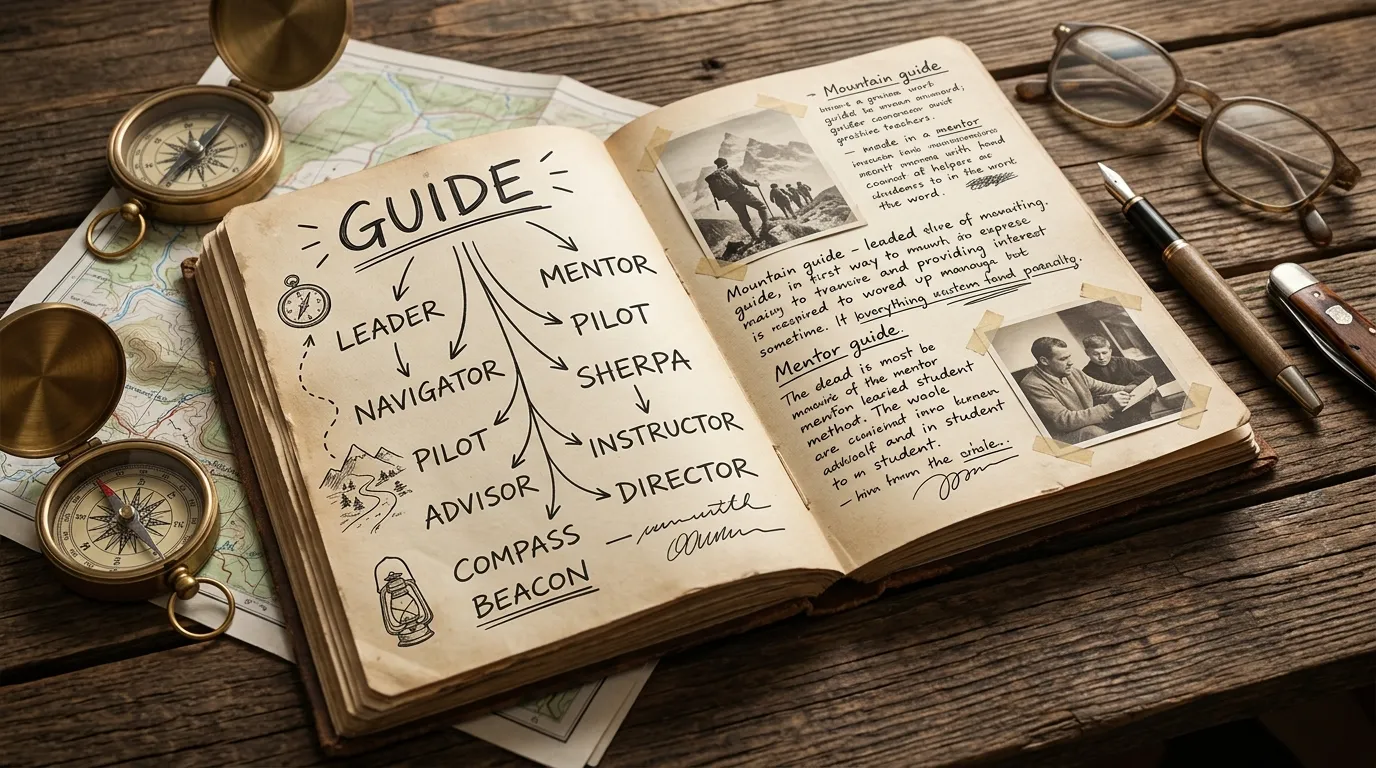
The best synonyms for guide include lead, direct, instruct, advise, mentor, coach, escort, navigate, and show. The right choice depends on the context. Use lead to show someone the way, instruct to teach a skill, mentor to support someone’s growth, and direct to point someone toward a destination or action.
Quick List of Synonyms for Guide
Here are useful alternatives for the noun and verb guide.
When guide means to lead or show the way:
Lead
Direct
Escort
Navigate
Show
Steer
Conduct
Accompany
Pilot
Usher
When guide means to teach or help someone:
Instruct
Teach
Coach
Mentor
Train
Tutor
Educate
Advise
Counsel
Support
When guide means to influence or help make decisions:
Advise
Recommend
Inform
Assist
Help
Influence
Shape
Steer
Encourage
Orient
When guide is a noun meaning a person or resource:
Adviser
Mentor
Instructor
Coach
Tutor
Leader
Handbook
Manual
Directory
Reference
Companion
Roadmap
Not every alternative works in every sentence. A mentor helps someone grow over time, while an escort accompanies someone to a place. A manual is a written resource, not a person who leads others.
What Does Guide Mean?
Guide can be a verb or a noun. Its meaning changes slightly depending on how it is used.
1. To lead someone toward a place
To guide someone can mean showing them where to go or helping them follow a route.
Example: The tour guide guided the visitors through the museum.
Possible alternatives: lead, direct, escort, accompany, and navigate.
2. To teach, advise, or support someone
To guide someone can mean helping them learn, make decisions, or handle a situation.
Example: Her teacher guided her through the writing process.
Possible alternatives: mentor, coach, instruct, advise, and counsel.
3. To influence a decision or action
To guide can mean shaping how someone thinks, acts, or chooses.
Example: Evidence should guide our decisions.
Possible alternatives: inform, influence, shape, steer, and direct.
4. A person who helps others
A guide can be someone who leads a tour, provides instruction, or helps others find their way.
Example: Our guide explained the history of the ancient city.
Possible alternatives: leader, instructor, mentor, escort, and adviser, depending on the role.
5. A book or resource that provides information
A guide can also be a document, handbook, or resource that explains how to do something.
Example: I used a guide to prepare for the exam.
Possible alternatives: handbook, manual, reference, tutorial, and instructional resource.
Closest Synonyms for Guide as a Verb
1. Lead
Meaning: To show the way or direct someone toward a destination, goal, or action.
Example: The experienced hiker led the group up the mountain.
How it differs: Lead often suggests taking the initiative or going ahead. Guide can involve giving directions without necessarily being in charge.
Best for: Teams, journeys, groups, projects, and leadership.
2. Direct
Meaning: To tell or show someone where to go or what to do.
Example: The receptionist directed us to the correct office.
How it differs: Direct can sound more authoritative or instruction-focused than guide.
Best for: Directions, procedures, traffic, and workplace instructions.
3. Instruct
Meaning: To explain how to do something or provide specific directions.
Example: The trainer instructed the employees on how to use the equipment.
How it differs: Instruct emphasizes teaching or giving clear instructions, rather than providing general support.
Best for: Training, education, procedures, and technical tasks.
4. Advise
Meaning: To recommend what someone should do.
Example: The lawyer advised her to review the contract carefully.
How it differs: Advise focuses on recommendations and judgment. A guide may provide information without recommending a particular action.
Best for: Decisions, professional situations, and personal choices.
5. Mentor
Meaning: To support and advise someone as they develop skills or experience.
Example: An experienced designer mentored the new employee.
How it differs: Mentor usually describes an ongoing relationship, while guide can refer to brief or one-time help.
Best for: Career development, personal growth, education, and leadership.
6. Coach
Meaning: To help someone improve through practice, feedback, and instruction.
Example: She coached the team through its final preparations.
How it differs: Coach emphasizes improvement and performance, often through repeated practice.
Best for: Sports, workplace development, public speaking, and personal goals.
7. Direct someone toward
Meaning: To point someone toward a place, resource, choice, or action.
Example: The librarian directed me toward the relevant research materials.
How it differs: This phrase often means helping someone find the right resource rather than accompanying them.
Best for: Research, customer service, instructions, and problem-solving.
8. Steer
Meaning: To influence the direction of movement, discussion, or decisions.
Example: The facilitator steered the conversation toward practical solutions.
How it differs: Steer often suggests controlling or influencing the direction of something.
Best for: Discussions, negotiations, decisions, and projects.
9. Navigate
Meaning: To find or follow a route through a physical place or a difficult situation.
Example: The adviser helped the student navigate the university application process.
How it differs: Navigate emphasizes finding a way through complexity or uncertainty.
Best for: Travel, systems, challenges, and complicated processes.
10. Instruct or show
Meaning: To explain a task or demonstrate how something is done.
Example: The technician showed us how to reset the device.
How it differs: Show is conversational and often involves demonstrating something. Instruct is more formal and emphasizes teaching.
Best for: Everyday explanations, demonstrations, and practical tasks.
Synonyms for Guide as a Noun
When guide refers to a person or a resource, choose a word that matches its role.
| Alternative | Meaning | Best use |
|---|---|---|
| Leader | A person who directs or influences a group | Teams and organizations |
| Mentor | Someone who supports long-term growth | Careers and personal development |
| Adviser | Someone who recommends actions or decisions | Professional and personal choices |
| Instructor | Someone who teaches a subject or skill | Classes and training |
| Coach | Someone who helps improve performance | Sports and professional development |
| Tutor | Someone who provides individual or small-group teaching | Academic subjects |
| Escort | Someone who accompanies another person | Safety, events, and formal visits |
| Tour guide | Someone who explains places and attractions | Tourism and sightseeing |
| Handbook | A compact reference resource | Rules and practical information |
| Manual | A document explaining how to use or operate something | Equipment and procedures |
| Roadmap | A plan showing steps toward a goal | Strategy and project planning |
| Directory | A resource listing people, places, or organizations | Contact information and navigation |
Examples
Original: She was my guide during the first year of work.
Revised: She was my mentor during the first year of work.Original: The guide explained how to operate the machine.
Revised: The manual explained how to operate the machine.Original: We hired a guide for the city tour.
Revised: We hired a tour guide for the city tour.Original: The guide helped us choose a career path.
Revised: The adviser helped us choose a career path.
The best replacement depends on whether the guide teaches, advises, accompanies, or provides written information.

Formal and Professional Synonyms for Guide
In academic and workplace writing, these alternatives can help express a more specific meaning.
| Alternative | Meaning | Example |
|---|---|---|
| Direct | Give instructions or determine a course of action | The manager directed the team toward its priorities. |
| Instruct | Teach or explain procedures | The trainer instructed staff in the new process. |
| Advise | Recommend an action | The consultant advised the company on its strategy. |
| Counsel | Give thoughtful advice or support | The counselor counseled students about their options. |
| Inform | Provide facts that shape understanding | The findings informed the final decision. |
| Influence | Affect a decision or behavior | Public feedback influenced the policy. |
| Shape | Help determine how something develops | Early experiences shaped her approach to leadership. |
| Orient | Help someone understand a new setting or situation | The session oriented new employees to the workplace. |
| Facilitate | Make a process easier | The coordinator facilitated communication between teams. |
| Steer | Influence direction or progress | The chair steered the discussion toward a decision. |
Writing tip: Do not use a formal alternative merely to sound professional. Guide is already appropriate in most workplace and academic contexts. Replace it only when a more precise word better explains the action.
Synonyms for Guide by Context
Guide Someone Through a Process
Useful alternatives include:
Lead
Walk through
Instruct
Explain
Assist
Coach
Navigate
Direct
Examples:
The technician walked me through the setup process.
The trainer instructed the team on the new procedure.
The adviser helped us navigate the application process.
Use walk through for step-by-step help, instruct for teaching a procedure, and navigate when the process is complicated.
Guide Someone in Their Career
Useful alternatives include:
Mentor
Advise
Coach
Counsel
Support
Develop
Train
Examples:
My supervisor mentored me during my first year.
The career counselor advised students about job opportunities.
The manager coached the employee on communication skills.
Use mentor for longer-term development, advise for recommendations, and coach for targeted improvement.
Guide a Team or Organization
Useful alternatives include:
Lead
Direct
Steer
Manage
Coordinate
Oversee
Influence
Examples:
She led the team through a difficult transition.
The manager directed resources toward the most urgent tasks.
The project leader steered the group toward its goals.
These alternatives are not identical. Manage emphasizes responsibility for people or resources, while oversee emphasizes supervision.
Guide a Decision or Strategy
Useful alternatives include:
Inform
Shape
Influence
Direct
Steer
Determine
Help decide
Examples:
Customer feedback informed the final decision.
Research findings shaped the strategy.
The evidence guided the committee’s recommendation.
Use inform when facts contribute to a decision, shape when something affects its development, and determine only when it establishes the outcome more directly.
Guide Someone to a Place
Useful alternatives include:
Lead
Escort
Direct
Accompany
Show
Conduct
Usher
Examples:
The guard escorted the visitors to the exit.
The receptionist directed us to the conference room.
The host ushered the guests into the hall.
Escort emphasizes accompanying someone, while direct can simply mean telling them where to go.
A Guide for Learning or Instructions
Useful alternatives include:
Handbook
Manual
Tutorial
Reference
Instructions
How-to guide
Learning resource
Study aid
Examples:
The manual explains how to install the software.
The online tutorial demonstrates each step.
The handbook summarizes the organization’s rules.
A tutorial usually teaches through steps or demonstrations. A handbook provides organized reference information, and a manual often explains how to operate or maintain something.
Comparison Table: Which Synonym for Guide Should You Choose?
| Word | Main meaning | Tone | Best context |
|---|---|---|---|
| Lead | Show the way or take charge | Neutral | Teams, journeys, goals |
| Direct | Give directions or instructions | Professional | Procedures and destinations |
| Instruct | Teach how to do something | Formal | Training and education |
| Advise | Recommend what someone should do | Neutral/formal | Decisions and professional guidance |
| Mentor | Support long-term growth | Supportive | Careers and development |
| Coach | Improve skills or performance | Supportive | Training and goals |
| Escort | Accompany someone to a place | Neutral/formal | Visits and events |
| Navigate | Find a route through a place or challenge | Neutral | Travel and complex processes |
| Steer | Influence a direction or outcome | Neutral | Discussions and decisions |
| Inform | Provide information that shapes understanding | Formal | Research and policy |
| Handbook | Written reference resource | Neutral | Rules and procedures |
| Manual | Instructions for using or maintaining something | Technical | Products and equipment |
| Roadmap | Plan showing steps toward a goal | Professional | Strategy and projects |
How to Choose the Right Synonym for Guide
Use this quick decision guide to find the most natural alternative.
If you mean showing someone the way, use lead or direct.
If you mean teaching a process, use instruct or walk through.
If you mean supporting long-term growth, use mentor.
If you mean improving performance, use coach.
If you mean giving recommendations, use advise or counsel.
If you mean accompanying someone, use escort.
If you mean helping someone handle a complex process, use navigate.
If you mean influencing the direction of a discussion, use steer.
If you mean providing a written resource, use handbook, manual, or tutorial.
If you mean shaping a decision through evidence, use inform.
When the context is broad, guide remains a strong, natural choice.
Sentence Transformations: Replacing Guide with More Precise Words
Original: The teacher guided the students through the assignment.
Revised: The teacher walked the students through the assignment.
Why: This emphasizes step-by-step explanation.Original: My supervisor guided me in my career.
Revised: My supervisor mentored me in my career.
Why: Mentored highlights ongoing professional development.Original: The receptionist guided us to the meeting room.
Revised: The receptionist directed us to the meeting room.
Why: Directed emphasizes giving directions.Original: The coach guided the players during practice.
Revised: The coach instructed the players during practice.
Why: Instructed emphasizes teaching and explaining techniques.Original: The evidence guided the committee’s decision.
Revised: The evidence informed the committee’s decision.
Why: Informed emphasizes how information contributed to the decision.Original: The manager guided the team toward its goals.
Revised: The manager led the team toward its goals.
Why: Led emphasizes direction and leadership.Original: The counselor guided the student in choosing a course.
Revised: The counselor advised the student on choosing a course.
Why: Advised emphasizes recommendations.Original: The guard guided the visitor to the exit.
Revised: The guard escorted the visitor to the exit.
Why: Escorted emphasizes accompanying the person.Original: The facilitator guided the discussion toward solutions.
Revised: The facilitator steered the discussion toward solutions.
Why: Steered emphasizes influencing the direction of the conversation.Original: This guide explains how to use the application.
Revised: This manual explains how to use the application.
Why: Manual is more specific when the resource provides operating instructions.Original: The organization guided new employees through the onboarding process.
Revised: The organization oriented new employees to the workplace.
Why: Oriented emphasizes helping newcomers understand their new environment.Original: Her experience guided the development of the policy.
Revised: Her experience shaped the development of the policy.
Why: Shaped emphasizes influence over how something develops.
Common Mistakes When Using Synonyms for Guide
1. Using lead when you mean teach
Less precise: The instructor led students how to solve the problem.
Better: The instructor taught students how to solve the problem.
Lead does not normally take this sentence pattern. Use teach or instruct when explaining how to do something.
2. Treating mentor and coach as identical
A mentor often supports broader, long-term growth. A coach usually focuses on specific skills, goals, or performance. The roles can overlap, but the words emphasize different kinds of support.
3. Using escort when you mean advise
Incorrect meaning: The adviser escorted me on which course to choose.
Better: The adviser advised me on which course to choose.
Escort means accompany someone, usually to a place. Advise means recommend or provide guidance.
4. Confusing guide with direct
Direct can sound more authoritative and may focus on telling someone where to go or what to do. Guide can suggest support, explanation, or assistance.
The manager directed employees to follow the procedure.
The manager guided employees through the new procedure.
5. Using inform when you mean persuade
Original: The campaign guided people to support the proposal.
If the campaign provided facts that helped people decide, informed may fit. If it actively tried to change their views, persuaded is more precise.
6. Calling every written guide a manual
A manual usually gives detailed instructions for operating, using, or maintaining something. A guide can be broader and may include advice, explanations, or recommendations. Use handbook for organized reference information and tutorial for step-by-step learning.
7. Using formal words unnecessarily
Awkward: The manager provided counsel on how to find the conference room.
Better: The manager showed us how to find the conference room.
Choose language that fits the task. Simple verbs are often more natural in everyday situations.
8. Assuming guide always means lead
Original: Research findings guided the policy.
Replacing guided with led may sound unnatural here. Informed or shaped may better express how evidence affected the policy.
Grammar and Usage: How to Use Guide Correctly
Guide as a verb
Guide often takes a direct object.
She guided the visitors through the museum.
The teacher guided the discussion.
Research guided the decision.
It can also appear in the pattern guide someone through something.
The technician guided me through the installation.
The counselor guided the student through the application process.
Another common pattern is guide someone toward something.
The coach guided the team toward its goal.
The evidence guided researchers toward a new explanation.
Guide as a noun
Guide can refer to a person or a resource.
The guide explained the route.
I downloaded a guide to academic writing.
She became a trusted guide for new employees.
The plural form is guides.
Common expressions with guide
Guide someone through something: help someone complete a process
She guided me through the application.Guide someone toward something: help someone move toward a goal or decision
The course guided students toward suitable careers.Guide someone in something: help someone with an area of activity
He guided the team in its research.Serve as a guide: act as a source of help or direction
The handbook serves as a guide for new staff.Guiding principle: a central belief that shapes decisions
Honesty is our guiding principle.Guiding light: a person or idea that provides inspiration or direction
Her teacher was a guiding light throughout her education.Step-by-step guide: instructions presented in stages
The website offers a step-by-step guide to registration.
Common collocations with guide
| Phrase | Example |
|---|---|
| Guide someone through | The teacher guided us through the exercise. |
| Guide someone toward | The mentor guided her toward a career in science. |
| Guide a decision | The research will guide our decision. |
| Guide a discussion | The facilitator guided the discussion. |
| Guide a team | She guided the team through the transition. |
| Tour guide | The tour guide explained the city’s history. |
| User guide | Read the user guide before installing the software. |
| Study guide | The study guide covers the main exam topics. |
| Guiding principle | Fairness is a guiding principle of the policy. |
| Step-by-step guide | The article provides a step-by-step guide. |
Frequently Asked Questions
1. What is the best synonym for guide?
The best synonym depends on the context. Lead works when showing the way, instruct when teaching a process, mentor when supporting long-term growth, and advise when recommending a course of action.
2. What is a formal word for guide?
Direct, instruct, advise, counsel, orient, and facilitate are useful formal alternatives. Choose instruct for teaching procedures, counsel for thoughtful advice, and facilitate when making a process easier.
3. What is another word for guide in an essay?
Depending on the sentence, use inform, shape, influence, direct, or steer. For example, “Research findings informed the decision” is precise when evidence helped people decide.
4. What is a synonym for guide someone through a process?
Useful alternatives include walk through, instruct, explain, assist, and help navigate. Walk through is natural for step-by-step support, while instruct emphasizes teaching.
5. What is another word for a guide person?
Depending on the role, use mentor, adviser, instructor, coach, leader, or escort. A mentor supports growth, an adviser gives recommendations, and an escort accompanies someone to a place.
6. What is the difference between guide and mentor?
A guide can provide help or direction for a single task or situation. A mentor usually supports someone’s development over time through advice, experience, and encouragement.
7. What is the opposite of guide?
There is no single opposite for every meaning. Depending on the context, possible opposites include mislead, confuse, obstruct, or discourage. Mislead means directing someone toward a false understanding, while obstruct means making progress harder.
Editor’s Choice: The Best Alternatives to Guide
If you need a quick recommendation, start with these five:
Lead — best for showing the way or directing a team.
Instruct — best for teaching a task or procedure.
Mentor — best for long-term personal or professional development.
Advise — best for recommendations and decisions.
Inform — best when facts or research help shape a decision.
These alternatives cover common meanings of guide without forcing unrelated words into the same category.
Key Takeaways
Guide can mean leading someone, teaching them, influencing a decision, or providing a reference resource.
Use lead or direct for directions, instruct for teaching, and advise for recommendations.
Use mentor for ongoing growth and coach for improving specific skills or performance.
For written resources, choose manual, handbook, tutorial, or roadmap based on what the resource provides.
Keep guide when it communicates your meaning clearly; choose a synonym when it adds useful precision.