
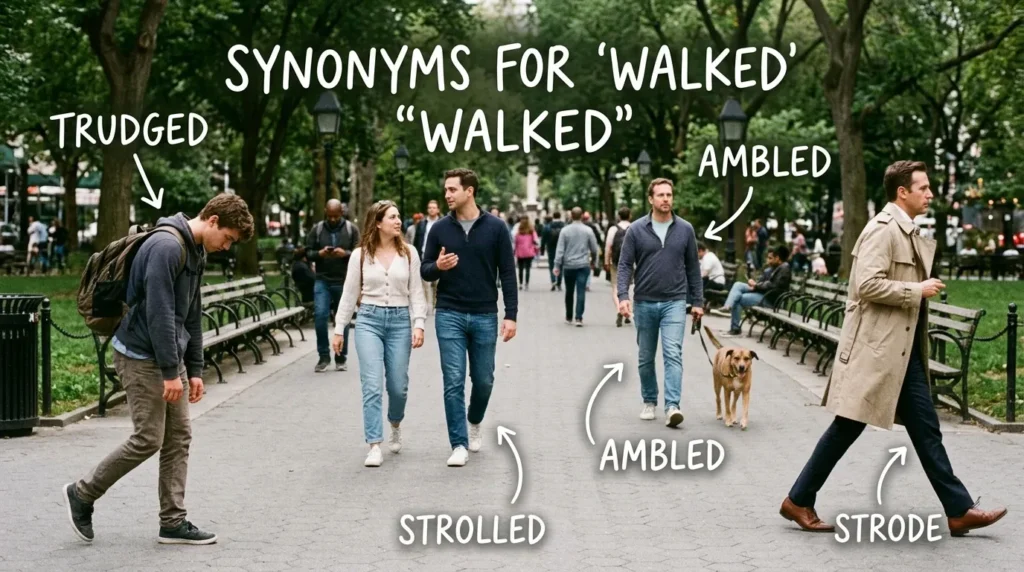
Synonyms for walked include strolled, marched, paced, wandered, ambled, hiked, trudged, strode, shuffled, and sauntered. The best alternative depends on how someone moves. Use strolled for a relaxed walk, marched for firm steps, trudged for a tiring walk, and wandered for walking without a clear destination.
Quick List of Synonyms for Walked
Here are useful alternatives for different situations:
Strolled
Marched
Strode
Ambled
Wandered
Meandered
Sauntered
Trudged
Shuffled
Paced
Hiked
Roamed
Treked
Strutted
Tiptoed
Crept
Limped
Sprinted
Rushed
Plodded
Shambled
Moseyed
Stepped
Treaded
Tramped
Paraded
Filed
Processed
Circled
Roamed about
Moved along
Made one’s way
Headed
Proceeded
Advanced
Reached
Crossed
Traversed
Wandered around
Walked briskly
Walked slowly
Walked carefully
Walked confidently
Walked quietly
Walked aimlessly
Walked wearily
Walked awkwardly
Walked proudly
Walked nervously
Walked steadily
Note: Not all these words are exact synonyms. Sprinted describes running, hiked usually involves walking outdoors over a route, and limped describes walking with difficulty. These words work as alternatives only when the context supports their specific meaning.
What Does “Walked” Mean?
Walked is the past tense and past participle of walk. It usually means moving on foot by taking steps.
Examples:
She walked to school yesterday.
He walked across the room.
They walked through the park after dinner.
Writers often replace walked with a more descriptive verb to show a person’s speed, mood, purpose, or physical condition.
For example:
Basic: She walked into the room.
More descriptive: She strode into the room confidently.
The second sentence suggests a confident, purposeful movement rather than simply describing the action.
Closest Synonyms for Walked
These words are among the most useful replacements for walked.
1. Strolled
Meaning: Walked slowly and casually, usually for pleasure.
Example: We strolled along the beach at sunset.
Best for: Relaxed scenes, peaceful settings, and leisurely activities.
Difference: Strolled suggests a calm, unhurried pace. It is not suitable when someone is rushing or walking under pressure.
2. Marched
Meaning: Walked with firm, regular steps, often with determination or in a group.
Example: The students marched toward the auditorium.
Best for: Military scenes, protests, demonstrations, and determined movement.
Difference: Marched sounds more forceful and organized than walked.
3. Strode
Meaning: Walked with long, confident steps.
Example: The lawyer strode into the courtroom.
Best for: Fiction, formal descriptions, and scenes involving confidence or authority.
Difference: Strode often suggests purpose, confidence, or a commanding presence.
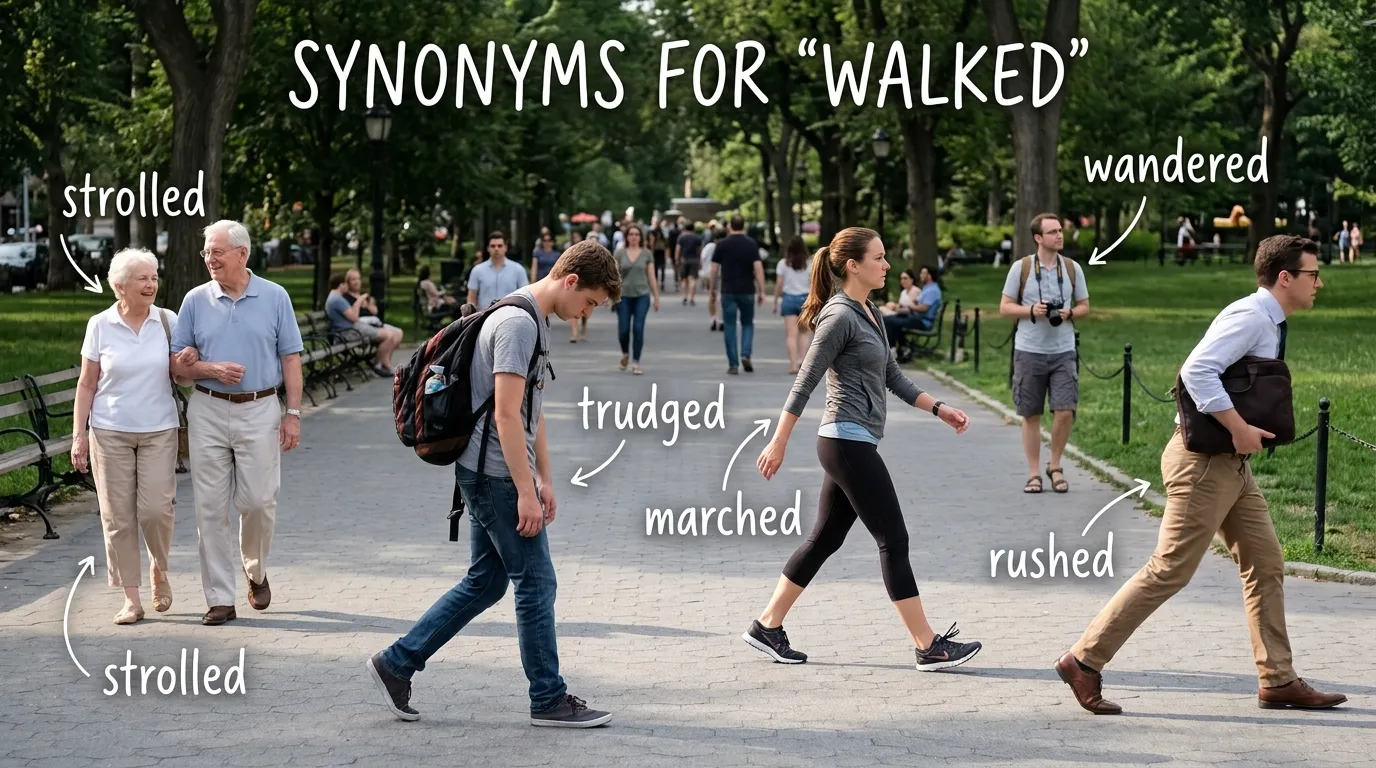
4. Ambled
Meaning: Walked at a relaxed, unhurried pace.
Example: The old man ambled down the quiet street.
Best for: Gentle, leisurely movement and descriptive storytelling.
Difference: Similar to strolled, but ambled often emphasizes an easy, unhurried manner.
5. Wandered
Meaning: Walked without a fixed route or clear destination.
Example: We wandered through the old town for hours.
Best for: Travel writing, exploration, and scenes where someone moves without a specific plan.
Difference: Wandered focuses on direction or purpose rather than speed.
6. Meandered
Meaning: Moved along a winding or indirect route.
Example: She meandered through the garden paths.
Best for: Descriptive writing, nature scenes, and leisurely journeys.
Difference: Meandered emphasizes an indirect route, while wandered emphasizes a lack of a fixed destination.
7. Sauntered
Meaning: Walked slowly and casually, often with a relaxed or confident attitude.
Example: He sauntered into the café as if he had all the time in the world.
Best for: Fiction, casual scenes, and descriptions of relaxed confidence.
Difference: Sauntered can suggest self-assurance or a carefree attitude.
8. Trudged
Meaning: Walked slowly and heavily, usually because of tiredness or difficult conditions.
Example: The hikers trudged through the mud after hours of rain.
Best for: Difficult journeys, exhaustion, bad weather, and emotionally heavy scenes.
Difference: Unlike strolled, trudged suggests that walking requires effort.
9. Shuffled
Meaning: Walked by sliding the feet along or taking small, dragging steps.
Example: He shuffled across the room in his slippers.
Best for: Showing tiredness, old age, uncertainty, or reluctance.
Difference: Shuffled describes the way the feet move, not just the pace.
10. Paced
Meaning: Walked back and forth repeatedly, often because of worry, impatience, or nervousness.
Example: She paced the hallway while waiting for the results.
Best for: Suspense, anxiety, frustration, and scenes involving waiting.
Difference: Paced usually implies repeated movement over a limited area rather than a journey from one place to another.
11. Hiked
Meaning: Walked a long distance outdoors, often on trails or in natural areas.
Example: We hiked through the mountains last weekend.
Best for: Outdoor activities, travel writing, and nature descriptions.
Difference: Hiked usually implies a planned outdoor journey and may suggest physical effort.
12. Roamed
Meaning: Walked around freely without a fixed route.
Example: The children roamed around the spacious garden.
Best for: Exploration, freedom, and movement over a broad area.
Difference: Roamed often suggests freedom to explore a larger space.
13. Plodded
Meaning: Walked slowly and heavily, taking steady but often laborious steps.
Example: He plodded home through the snow.
Best for: Showing exhaustion, slow progress, or a dull, repetitive journey.
Difference: Plodded emphasizes heavy, steady movement and can suggest a lack of energy.
14. Shambled
Meaning: Walked awkwardly, with uneven or dragging steps.
Example: The exhausted player shambled toward the bench.
Best for: Fiction and descriptions of awkwardness or extreme tiredness.
Difference: Shambled is more negative or vivid than walked and often suggests poor coordination.
15. Strutted
Meaning: Walked proudly and confidently, sometimes in a way that seems boastful.
Example: He strutted across the stage after winning the competition.
Best for: Showing pride, arrogance, confidence, or showiness.
Difference: Strutted adds an attitude that the neutral word walked does not convey.
Synonyms for Walked Based on Speed
Choose a word that reflects how quickly someone moves.
| Synonym | Meaning | Example |
|---|---|---|
| Strolled | Walked slowly and casually | They strolled beside the river. |
| Ambled | Walked at an easy pace | She ambled down the lane. |
| Sauntered | Walked casually, often confidently | He sauntered into the office. |
| Plodded | Walked slowly with heavy steps | He plodded up the hill. |
| Trudged | Walked slowly with effort | We trudged through the snow. |
| Walked briskly | Walked quickly and purposefully | She walked briskly to the station. |
| Rushed | Moved quickly because of urgency | He rushed toward the exit. |
| Sprinted | Ran at full speed | She sprinted across the field. |
Usage tip: Rushed and sprinted are not exact synonyms for walked. Use them only when the person moves faster than an ordinary walking pace.
Synonyms for Walked Based on Emotion or Attitude
A character’s movement can reveal how they feel.
| Synonym | Emotion or attitude | Example |
|---|---|---|
| Strode | Confidence | She strode into the meeting. |
| Strutted | Pride or arrogance | He strutted around the room. |
| Sauntered | Relaxed confidence | They sauntered toward the café. |
| Shuffled | Nervousness, reluctance, or tiredness | He shuffled toward the door. |
| Paced | Anxiety or impatience | She paced while waiting. |
| Trudged | Exhaustion or discouragement | He trudged home after work. |
| Crept | Fear or caution | She crept past the sleeping dog. |
| Tiptoed | Carefulness or secrecy | He tiptoed into the bedroom. |
| Limped | Pain or injury | She limped back to the car. |
| Paraded | Pride or a desire to display something | They paraded through the hall. |
These verbs help readers infer a character’s state of mind from their actions. However, use them only when the scene supports the emotion they suggest.
Synonyms for Walked in Stories and Creative Writing
When writing fiction, a precise verb can make a scene more vivid without adding a long description.
For a peaceful scene
Strolled
Ambled
Sauntered
Meandered
Example: The couple strolled beneath the trees as the sun began to set.
For a tense or frightening scene
Crept
Tiptoed
Shuffled
Paced
Example: She crept toward the door, careful not to make a sound.
For a tired character
Trudged
Plodded
Shambled
Shuffled
Example: After the long journey, he trudged up the final hill.
For a confident character
Strode
Strutted
Marched
Advanced
Example: The captain strode into the room and addressed the team.
For aimless movement
Wandered
Roamed
Meandered
Moved about
Example: The traveler wandered through the market, stopping at every colorful stall.
Formal and Academic Alternatives for Walked
In essays and professional writing, choose a word that describes the movement accurately without making the sentence unnecessarily elaborate.
| Alternative | Best use | Example |
|---|---|---|
| Proceeded on foot | Formal description of movement | The visitors proceeded on foot to the entrance. |
| Traversed | Crossing an area or route | The team traversed the rocky terrain. |
| Advanced | Moving forward toward a goal | The soldiers advanced across the field. |
| Proceeded | Continuing along a route or with an action | The group proceeded to the next building. |
| Crossed | Moving from one side to another | She crossed the courtyard. |
| Made their way | Traveling toward a destination | They made their way through the crowd. |
| Roamed | Moving freely around an area | The researchers roamed the grounds. |
| Hiked | Walking outdoors over a route | The class hiked through the nature reserve. |
Important: These words are not always interchangeable. Traversed emphasizes crossing an area, advanced emphasizes forward movement, and proceeded often sounds formal. In ordinary writing, walked may be clearer.
Better Ways to Say “Walked Into the Room”
The phrase “walked into the room” is common and natural. Use a more specific verb when you want to show how the person enters.
Strode into the room: Entered with confident, long steps.
Marched into the room: Entered firmly or forcefully.
Sauntered into the room: Entered casually and without hurry.
Crept into the room: Entered quietly and carefully.
Tiptoed into the room: Entered using the toes to avoid making noise.
Shuffled into the room: Entered with small, dragging steps.
Burst into the room: Entered suddenly and energetically; this does not mean ordinary walking.
Stumbled into the room: Entered awkwardly, almost falling.
Limped into the room: Entered with difficulty because of pain or injury.
Wandered into the room: Entered casually, perhaps without a clear purpose.
Better Ways to Say “Walked Away”
The right alternative depends on whether the person simply leaves or shows a particular emotion.
Left: A neutral, direct alternative.
Strolled away: Left at a relaxed pace.
Marched away: Left firmly or angrily.
Stormed away: Left angrily and dramatically.
Wandered away: Left without a clear destination.
Trudged away: Left slowly and heavily, perhaps from exhaustion.
Turned and left: A clear description of the action.
Made one’s way away: A more descriptive phrase, especially through a crowd or difficult area.
Example:
Basic: He walked away after the argument.
More expressive: He stormed away after the argument.
Use stormed away only if the person’s anger is clear from the scene.
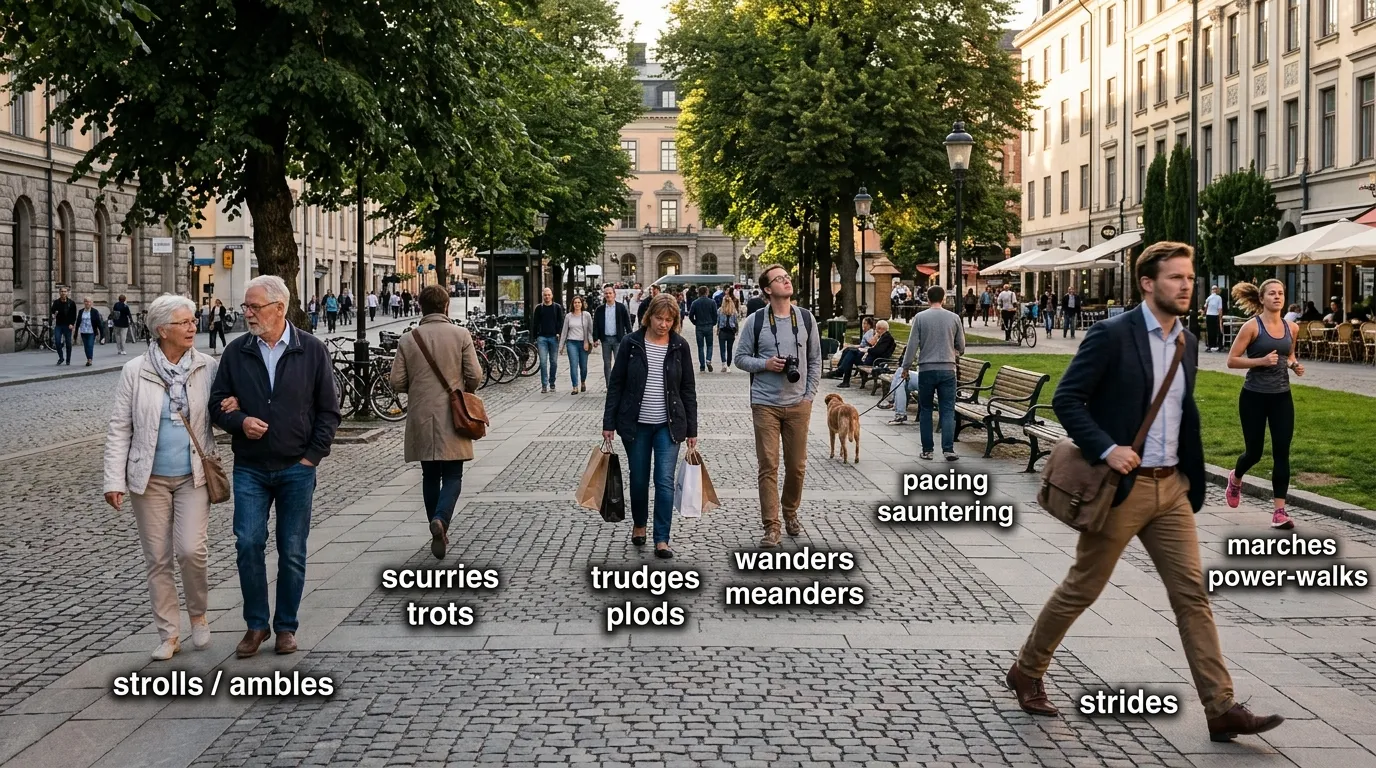
Comparison: Which Synonym for Walked Should You Choose?
| If you want to show… | Best choice | Why |
|---|---|---|
| A relaxed walk | Strolled | Suggests leisure |
| Confident movement | Strode | Suggests purpose and assurance |
| Firm, forceful steps | Marched | Suggests determination |
| No fixed destination | Wandered | Emphasizes direction and purpose |
| A winding route | Meandered | Emphasizes the path |
| Tired movement | Trudged | Suggests effort and exhaustion |
| Small dragging steps | Shuffled | Describes foot movement |
| Anxiety while waiting | Paced | Shows repeated movement |
| Careful, quiet movement | Tiptoed | Suggests avoiding noise |
| Movement caused by pain | Limped | Indicates difficulty walking |
| An outdoor journey | Hiked | Suggests a trail or long walk |
| Proud or showy movement | Strutted | Suggests pride or arrogance |
How to Choose the Right Synonym for Walked
Before replacing walked, ask yourself four questions:
How fast is the person moving? Choose strolled for a slow, relaxed pace or walked briskly for a quick one.
How do they feel? Choose trudged for exhaustion, paced for anxiety, or strode for confidence.
Where are they going? Choose hiked for an outdoor trail, wandered for aimless movement, or crossed when moving from one side to another.
What do you want readers to notice? Choose shuffled for dragging feet, tiptoed for quiet steps, or marched for forceful movement.
If none of these details matters, keep walked. A simple verb is often the best choice.
10 Sentence Transformations Using Synonyms for Walked
1. A relaxed walk
Original: We walked along the beach.
Revised: We strolled along the beach.
Why it works: Strolled adds a sense of relaxation.
2. A confident entrance
Original: She walked into the office.
Revised: She strode into the office.
Why it works: Strode suggests confidence and purpose.
3. A tiring journey
Original: He walked home through the snow.
Revised: He trudged home through the snow.
Why it works: Trudged emphasizes the effort required.
4. Nervous waiting
Original: She walked back and forth in the hallway.
Revised: She paced the hallway.
Why it works: Paced expresses repeated movement, often caused by worry.
5. Quiet movement
Original: He walked into the bedroom so he would not wake anyone.
Revised: He tiptoed into the bedroom so he would not wake anyone.
Why it works: Tiptoed explains how he moved quietly.
6. Aimless exploration
Original: They walked around the city all afternoon.
Revised: They wandered around the city all afternoon.
Why it works: Wandered suggests exploration without a strict plan.
7. Firm movement
Original: The protesters walked toward the government building.
Revised: The protesters marched toward the government building.
Why it works: Marched gives the movement a more organized and determined quality.
8. Walking with an injury
Original: She walked to the car despite her injured ankle.
Revised: She limped to the car despite her injured ankle.
Why it works: Limped identifies the physical difficulty.
9. An awkward walk
Original: The exhausted man walked toward the door.
Revised: The exhausted man shuffled toward the door.
Why it works: Shuffled suggests slow, dragging steps.
10. An outdoor adventure
Original: We walked through the hills for several hours.
Revised: We hiked through the hills for several hours.
Why it works: Hiked is more specific when describing a long outdoor walk.
Common Mistakes When Using Synonyms for Walked
1. Using a dramatic verb for an ordinary action
Not every person who enters a room storms, marches, or strides into it.
Better: Use walked into the room when no special mood or movement matters.
2. Confusing “strolled” with “wandered”
Strolled usually means walking leisurely. Wandered suggests a less fixed route or destination.
3. Using “paced” for a one-way journey
Paced often means walking back and forth repeatedly.
Natural: He paced the room while waiting for the call.
4. Using “hiked” for every outdoor walk
A short walk around a city park is not necessarily a hike. Use hiked when the activity involves a longer outdoor route or trail.
5. Confusing “strode” with “strutted”
Strode suggests long, purposeful steps. Strutted suggests a proud or showy manner.
6. Using “tiptoed” when quietness is not important
Tiptoed specifically describes walking on the toes, often to avoid making noise. For ordinary movement, walked quietly may be more accurate.
7. Replacing “walked” with “ran” when the action is different
Walking and running are different forms of movement. Use ran, sprinted, or rushed only when the context supports faster movement.
8. Overusing descriptive verbs
Using a different synonym in every sentence can make writing feel forced.
Better: Mix precise verbs with ordinary ones. Keep walked when it communicates the action clearly.
Grammar and Usage: How to Use “Walked”
Walked is the simple past tense and past participle of the verb walk.
Simple past: She walked to school.
Present perfect: She has walked to school many times.
Past perfect: She had walked several miles before noon.
With an adverb: He walked slowly toward the gate.
With a prepositional phrase: They walked through the forest.
Common collocations with walked
These combinations are natural and useful:
Walked slowly
Walked quickly
Walked quietly
Walked away
Walked across the street
Walked through the park
Walked into the room
Walked toward the door
Walked down the street
Walked home
Walked side by side
Walked with confidence
Is “walked” always the best choice?
No, but it is often the clearest choice. In academic writing, it may be the most neutral and accurate word. In storytelling, a more specific verb can reveal a character’s mood, pace, or physical condition.
Choose the word that conveys the detail you want readers to notice.
Frequently Asked Questions
What is the closest synonym for walked?
Strolled, ambled, and moved on foot can be suitable alternatives, depending on the sentence. Strolled suggests a relaxed walk, while moved on foot is more general and formal.
What is a more descriptive word for walked?
Words such as strode, trudged, shuffled, wandered, and sauntered are more descriptive because they show how someone walks rather than simply stating that they do.
What is a formal synonym for walked?
Proceeded on foot is a formal alternative. Traversed can work when someone crosses an area, while advanced emphasizes forward movement.
What is a synonym for walked slowly?
Useful alternatives include strolled, ambled, sauntered, and plodded. Use plodded when the slow pace seems heavy or tiring.
What is a synonym for walked confidently?
Strode is often the best choice. Marched can suggest firm determination, while strutted implies pride or showiness.
What is a synonym for walked sadly?
Trudged can suggest that someone is tired, discouraged, or burdened. You could also write walked dejectedly or dragged their feet, depending on the scene.
What is a synonym for walked away angrily?
Stormed away is a strong option when someone leaves in anger. Marched away suggests firm, forceful steps, while stomped away emphasizes heavy steps and frustration.
Editor’s Choice: The Best Synonyms for Walked
If you need only a few strong alternatives, start with these five:
Strolled — best for a relaxed walk.
Strode — best for confident, purposeful movement.
Wandered — best for walking without a clear destination.
Trudged — best for tired or difficult movement.
Marched — best for firm, determined steps.
These verbs cover several common situations without relying on obscure vocabulary. For a more specific scene, use paced for anxious back-and-forth movement, tiptoed for quiet steps, or limped for walking with an injury.
Key Takeaways
Walked is a clear, neutral word, but more specific verbs can show pace, mood, and purpose.
Use strolled for a relaxed walk, strode for confident movement, and marched for firm steps.
Choose wandered when the route or destination is uncertain and trudged when walking requires effort.
Words such as sprinted, limped, and tiptoed describe specific kinds of movement and are not exact synonyms.
Do not replace walked just to avoid repetition. Use a different verb when it adds meaningful detail.