
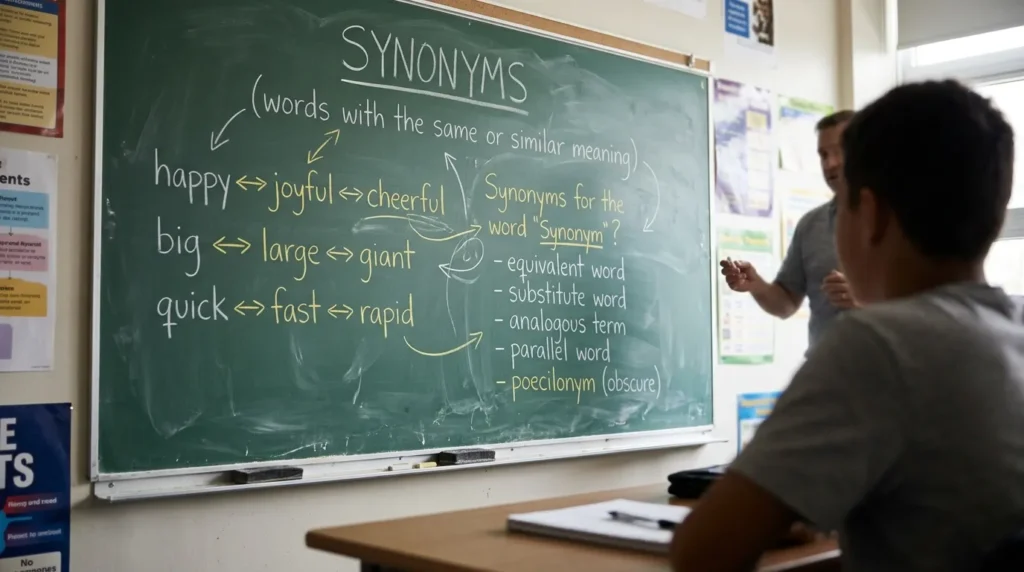
Quick Answer: What Are Synonyms for Synonym?
Synonyms for synonym include equivalent, alternative, substitute, similar word, and near-equivalent. The best choice depends on your meaning. Use equivalent for something with the same meaning or function, alternative for another option, and substitute for something used in place of another. In linguistics, near-synonym describes words with similar but not identical meanings.
Quick List of Synonyms for Synonym
Here are useful alternatives, grouped by how closely they match the meaning of synonym.
Closest alternatives
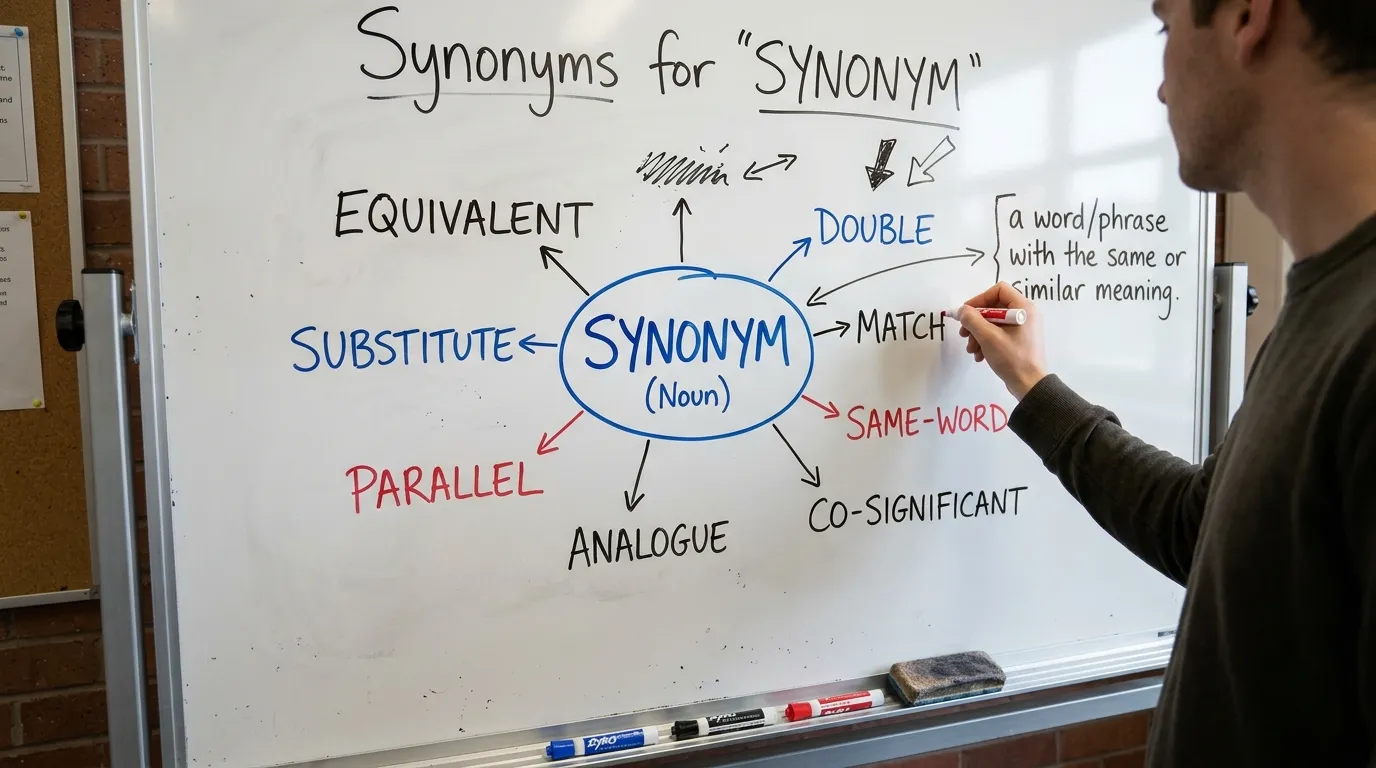
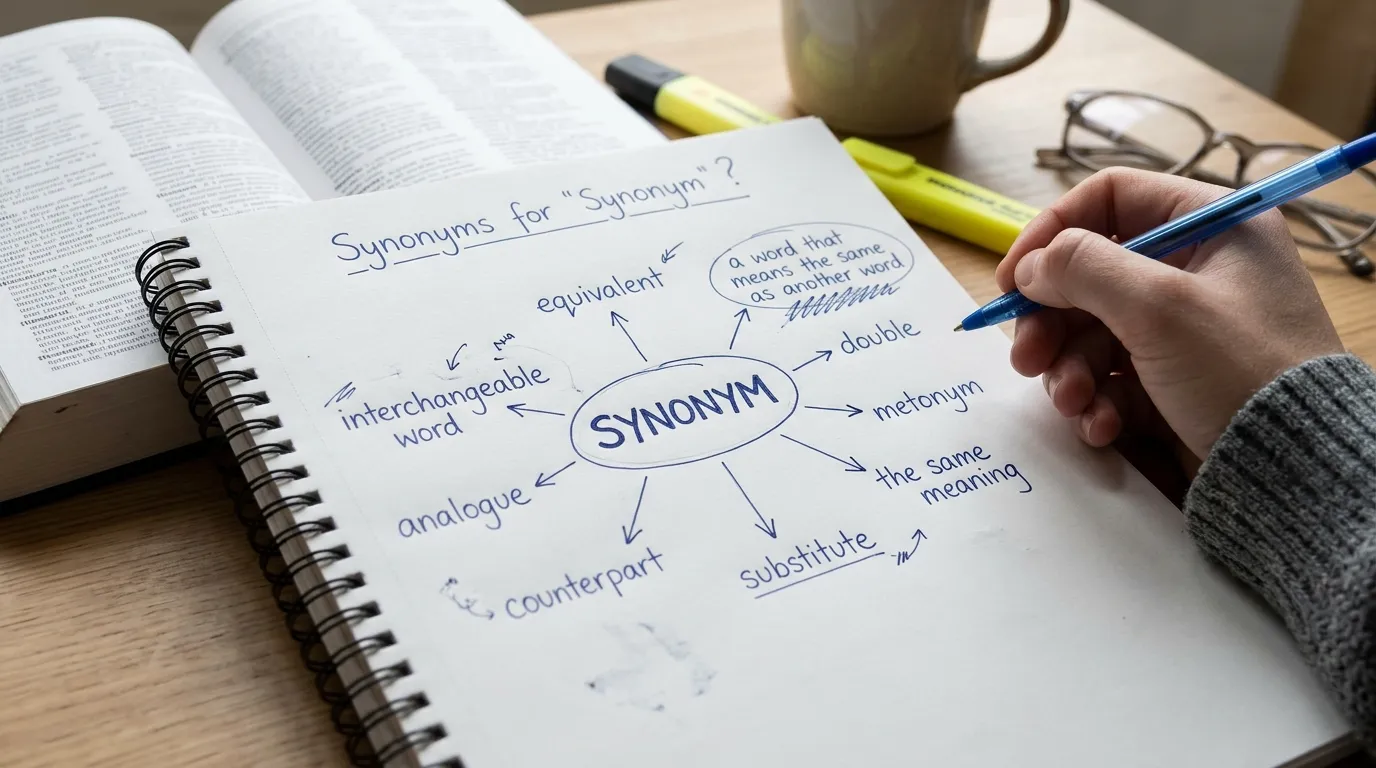
Equivalent
Near-equivalent
Similar word
Word with the same meaning
Semantic equivalent
Lexical equivalent
Words for another option or replacement
Alternative
Substitute
Replacement
Stand-in
Equivalent expression
Alternative expression
Corresponding term
Terms related to language and meaning
Near-synonym
Semantic counterpart
Related term
Similar expression
Parallel expression
Lexical counterpart
Paraphrase
Equivalent phrase
These words are not all exact synonyms of synonym. Some describe words with similar meanings, while others refer to alternatives, replacements, or expressions that convey a similar idea.
What Does Synonym Mean?
A synonym is a word or expression that has the same or nearly the same meaning as another word or expression.
For example:
Happy and glad are synonyms in many contexts.
Begin and start often mean the same thing.
Large and big are interchangeable in many everyday sentences.
However, synonyms do not always have identical meanings. Slim and skinny, for example, both describe a thin person, but slim often sounds positive while skinny can sound negative.
The word synonym is a noun. Its plural form is synonyms.
Example: “The writer used a synonym for important to make the sentence sound more natural.”
The Closest Synonyms for Synonym
1. Equivalent
An equivalent is something equal or comparable in meaning, value, function, or effect.
Example: “In this sentence, glad is an equivalent of happy.”
How it differs: Equivalent is broader than synonym. It can describe things other than words, including measurements, qualifications, and actions.
Best for: Formal writing, language instruction, and situations where two expressions have nearly the same meaning or function.
2. Near-Equivalent
A near-equivalent is something very similar in meaning or function but not perfectly identical.
Example: “The words confident and self-assured are near-equivalents in many contexts.”
How it differs: This term makes room for small differences in tone, meaning, or usage.
Best for: Explaining words that can replace each other in some sentences but not all.
3. Similar Word
A similar word is a word that shares some meaning or characteristics with another word.
Example: “Angry is a similar word to annoyed, but it usually expresses a stronger feeling.”
How it differs: A similar word is not necessarily a true synonym. The phrase is useful when the meanings overlap without being identical.
Best for: General readers, beginner English learners, and informal explanations.
4. Alternative
An alternative is another choice or option.
Example: “Start is a useful alternative to begin in this sentence.”
How it differs: An alternative does not have to share exactly the same meaning. It only needs to work in the relevant context.
Best for: Writing advice, editing, and suggestions for varying word choice.
5. Substitute
A substitute is a word, object, or action used in place of another.
Example: “The editor suggested assist as a substitute for help in the formal report.”
How it differs: Substitute emphasizes replacement, not necessarily identical meaning. A substitute may change the tone or meaning of a sentence.
Best for: Editing, rewriting, and explaining which word can replace another.
6. Replacement
A replacement is something that takes the place of something else.
Example: “The writer chose a replacement for the repeated word.”
How it differs: Replacement focuses on what takes the original’s place. It does not guarantee that the new word has the same meaning.
Best for: Editing instructions and discussions of word choice.
7. Near-Synonym
A near-synonym is a word with a meaning close to another word but not exactly the same.
Example: “House and home are near-synonyms because they overlap in meaning but carry different associations.”
How it differs: Unlike a strict synonym, a near-synonym may communicate a different feeling, emphasis, or context.
Best for: Linguistics, vocabulary study, and detailed word comparisons.
8. Semantic Equivalent
A semantic equivalent is a word or expression that conveys the same or a very similar meaning in a particular context.
Example: “In this passage, purchase is a semantic equivalent of buy.”
How it differs: The phrase sounds technical and is most useful when discussing meaning rather than general replacement.
Best for: Language analysis, translation, and academic writing.
9. Lexical Equivalent
A lexical equivalent is a word or vocabulary item that corresponds in meaning to another word or item.
Example: “The translator searched for a lexical equivalent that preserved the meaning of the original term.”
How it differs: This expression is more technical than synonym and can be useful when comparing vocabulary across languages or language systems.
Best for: Linguistics, translation, and specialized language discussions.
10. Alternative Expression
An alternative expression is another word or phrase that communicates a similar idea.
Example: “The phrase a large amount is an alternative expression for a lot in some contexts.”
How it differs: An alternative expression may contain several words and need not have exactly the same meaning.
Best for: Essay writing, paraphrasing, and improving sentence variety.
11. Semantic Counterpart
A semantic counterpart is a word or expression that corresponds in meaning to another, often within a particular context or language.
Example: “The translator identified a semantic counterpart for the original term.”
How it differs: It is more formal and technical than similar word. It does not automatically mean that the two expressions are interchangeable in every sentence.
Best for: Linguistic analysis and translation studies.
12. Paraphrase
A paraphrase expresses the meaning of something using different words.
Example: “The student paraphrased the sentence instead of repeating the original wording.”
How it differs: A paraphrase usually restates a full phrase, sentence, or passage. It is not simply another word with the same meaning.
Best for: Academic writing, summaries, explanations, and avoiding unnecessary repetition.
Synonym vs. Similar Terms: What’s the Difference?
| Word or phrase | Meaning | Can it replace synonym? | Best context |
|---|---|---|---|
| Equivalent | Something equal or comparable in meaning or function | Sometimes | General and formal writing |
| Near-synonym | A word with a closely related meaning | No, not in every context | Linguistics and vocabulary study |
| Alternative | Another option | Sometimes | Editing and word choice |
| Substitute | Something used in place of another | Sometimes | Replacement and rewriting |
| Replacement | Something that takes another’s place | Sometimes | Editing and revision |
| Similar word | A word with overlapping meaning | Informally | Beginner-friendly explanations |
| Semantic equivalent | An expression with the same or similar meaning | In technical contexts | Linguistics and translation |
| Paraphrase | A restatement in different words | Usually not | Academic writing and explanation |
| Related term | A term connected to the same topic | No, unless meanings overlap | Vocabulary and research |
The clearest choice for a general audience is usually equivalent or similar word. Use near-synonym when you want to stress that the meanings are close but not identical.
Synonyms for Synonym in Different Contexts
The best alternative depends on how you are using the word.
In Everyday Conversation
Choose simple expressions that readers understand immediately.
Similar word
Word with the same meaning
Alternative word
Another way to say it
Example: “Can you give me another way to say nice?”
This sounds more natural in conversation than “Can you provide a semantic equivalent of nice?”
In Academic Writing
Choose terms that describe the relationship between words precisely.
Near-synonym
Semantic equivalent
Lexical equivalent
Semantic counterpart
Example: “The study examines near-synonyms and the subtle differences in their meanings.”
Use technical terms only when they make your point clearer. A simple phrase such as words with similar meanings is often sufficient.
In Professional Editing
Use words that focus on improving or changing the original wording.
Alternative
Substitute
Replacement
Alternative expression
Example: “Consider an alternative to good that better reflects the project’s results.”
Remember that a replacement should improve precision or tone, not just make the sentence different.
In Translation
Choose terms that communicate the relationship between expressions in different languages.
Lexical equivalent
Semantic equivalent
Corresponding term
Equivalent expression
Example: “The translator searched for a semantic equivalent that preserved the original meaning.”
A word in one language may not have a perfect one-word match in another. The best equivalent may be a phrase or an explanation.
In Vocabulary Lessons
Use familiar wording when teaching beginners.
Similar word
Word with a similar meaning
Word that means nearly the same thing
Near-synonym
Example: “Glad is a synonym of happy in many sentences.”
For young learners, word with a similar meaning is often easier to understand than semantic equivalent.
How to Choose the Right Alternative
Use this simple guide to decide which expression fits your sentence.
Choose equivalent when two words or expressions have the same or a comparable meaning or function.
Choose near-synonym when their meanings overlap but differ in some situations.
Choose alternative when you mean another possible choice.
Choose substitute when one word or expression is used in place of another.
Choose similar word when explaining the idea to a general audience.
Choose semantic equivalent when discussing meaning in a technical or academic context.
Choose paraphrase when you are restating a longer expression, sentence, or passage.
If none of these alternatives is clearer than synonym, keep the original word. Synonym is already the standard, concise term for a word or expression with the same or a similar meaning.
Before-and-After Examples
These examples show how to use alternatives to synonym naturally.
1. Using “Equivalent”
Before: “Find a synonym for quick.”
After: “Find an equivalent for quick that fits the sentence.”
Why it works: Equivalent sounds natural when you want a word with a comparable meaning.
2. Using “Near-Synonym”
Before: “Angry and annoyed are synonyms.”
After: “Angry and annoyed are near-synonyms, but angry often expresses a stronger emotion.”
Why it works: The revised sentence acknowledges a difference in intensity.
3. Using “Alternative”
Before: “I need a synonym for important.”
After: “I need an alternative to important that sounds more precise.”
Why it works: Alternative emphasizes the search for another suitable word.
4. Using “Substitute”
Before: “What synonym can replace help?”
After: “What word can I use as a substitute for help in this formal email?”
Why it works: Substitute highlights the act of replacing one word with another.
5. Using “Similar Word”
Before: “A synonym is a word that means the same thing.”
After: “A similar word has the same or a related meaning.”
Why it works: The revision is accessible to readers who are unfamiliar with linguistic terminology.
6. Using “Semantic Equivalent”
Before: “The translator needed a synonym for the original word.”
After: “The translator needed a semantic equivalent that preserved the original meaning.”
Why it works: The technical term suits a discussion of translation and meaning.
7. Using “Alternative Expression”
Before: “Give me a synonym for a lot.”
After: “Suggest an alternative expression for a lot that suits formal writing.”
Why it works: The requested replacement may be a phrase rather than a single word.
8. Using “Paraphrase”
Before: “I used a synonym to rewrite the whole sentence.”
After: “I paraphrased the sentence to express the same idea in different words.”
Why it works: Paraphrase accurately describes rewriting an entire sentence.
9. Using “Replacement”
Before: “The repeated word needs a synonym.”
After: “The repeated word needs a replacement that fits the sentence’s meaning.”
Why it works: The revised sentence focuses on the editing task.
10. Keeping “Synonym”
Before: “Find a synonym for begin.”
After: “Find a synonym for begin.”
Why it works: No change is necessary. Synonym is the clearest and most direct word for this request.
Common Mistakes When Using Synonyms for Synonym
1. Treating Every Alternative as an Exact Synonym
Alternative and synonym do not mean the same thing. An alternative is another option, while a synonym has a similar meaning to another word or expression.
Better approach: Use synonym when discussing word meanings and alternative when discussing choices.
2. Confusing a Near-Synonym With a Perfect Synonym
Near-synonyms have overlapping meanings, but they may differ in tone, strength, or context.
Better approach: Check whether both words work naturally in the same sentence.
3. Using “Substitute” as if It Always Means “Synonym”
A substitute replaces something else but may not preserve its meaning exactly.
Better approach: Confirm that the replacement communicates the intended idea.
4. Using Technical Language for a General Audience
Phrases such as lexical equivalent and semantic counterpart can make a simple explanation harder to follow.
Better approach: Prefer similar word or word with a similar meaning for everyday readers.
5. Confusing a Paraphrase With a Single Word
A paraphrase restates an idea, often using a complete phrase or sentence. It is not necessarily a single-word synonym.
Better approach: Use paraphrase for a restatement and synonym for a related word.
6. Assuming Synonyms Work in Every Sentence
Even close synonyms may have different grammar, collocations, or connotations.
Better approach: Test the replacement in the original sentence and check whether the meaning and tone remain appropriate.
7. Replacing a Clear Word Just to Avoid Repetition
Changing every repeated word can make writing awkward or less precise.
Better approach: Repeat the original word when it is the clearest choice. Use a synonym only when it improves the writing.
8. Using “Related Term” as a Direct Synonym
A related term shares a topic or concept but may have a different meaning.
Better approach: Use related term for connected vocabulary and synonym for words with similar meanings.
Grammar, Usage, and Common Collocations
The word synonym is a countable noun. These common patterns help you use it correctly.
| Expression | Example |
|---|---|
| A synonym for | “Glad is a synonym for happy.” |
| A synonym of | “The dictionary lists a synonym of the original word.” |
| Synonyms and antonyms | “The lesson covers synonyms and antonyms.” |
| Find a synonym | “Find a synonym for strong.” |
| Provide a synonym | “Please provide a synonym that fits the context.” |
| A near-synonym | “House and home are near-synonyms.” |
| A list of synonyms | “The article includes a list of synonyms for important.” |
Is It “Synonym of” or “Synonym for”?
Both forms are used in standard English.
Synonym for: “What is a synonym for beautiful?”
Synonym of: “Purchase is a synonym of buy.”
Synonym for is especially common when asking someone to suggest another word. Synonym of is also correct when describing a relationship between two words.
What Is the Plural of Synonym?
The plural is synonyms.
Correct: “The dictionary provides several synonyms.”
Incorrect: “The dictionary provides several synonym.”
Can “Equivalent” Always Replace “Synonym”?
No. Equivalent has a broader meaning. It can describe things with comparable value, function, or effect, even when they are not words.
For example, equivalent measurement is natural, but synonym measurement is not.
Frequently Asked Questions
1. What is the best synonym for synonym?
Equivalent is a useful alternative in many contexts. However, similar word may be clearer for general readers, while near-synonym is more precise when two words have close but not identical meanings.
2. Is “equivalent” the same as “synonym”?
Not exactly. A synonym is a word or expression with the same or a similar meaning as another. An equivalent can be anything that has comparable meaning, value, function, or effect.
3. What is another word for synonym in academic writing?
Depending on the intended meaning, you can use near-synonym, semantic equivalent, lexical equivalent, or semantic counterpart. Choose the term that accurately describes the relationship between the words.
4. What is a simple way to explain synonym?
A synonym is a word that has the same or nearly the same meaning as another word. For example, start and begin are synonyms in many contexts.
5. What is the difference between a synonym and a near-synonym?
A synonym has the same or a very similar meaning as another word. A near-synonym has a closely related meaning but may differ in tone, intensity, or usage.
6. Can a phrase be a synonym?
Yes. An expression or phrase can convey the same or nearly the same meaning as another word or phrase. For example, give up and quit can be synonyms in some contexts.
7. Should I use “synonym” or “alternative”?
Use synonym when you mean a word with the same or a similar meaning. Use alternative when you mean another possible choice. An alternative may be useful without being an exact synonym.
Editor’s Choice: The Best Alternatives to Synonym
For most readers, these five options cover the most useful situations.
Equivalent: Best when two words or expressions have the same or a comparable meaning.
Similar word: Best for simple explanations and beginner-friendly vocabulary lessons.
Near-synonym: Best when two words have related but not identical meanings.
Alternative: Best when suggesting another possible word or expression.
Semantic equivalent: Best for technical discussions of language, meaning, or translation.
Editorial recommendation: Use equivalent for a concise alternative in many contexts, but keep synonym when it is the most accurate term. In everyday explanations, similar word is often easier to understand.
Key Takeaways
Equivalent, similar word, near-synonym, and alternative are useful alternatives, but they have different meanings.
Synonym specifically describes a word or expression with the same or a similar meaning.
Near-synonym highlights small differences in meaning, tone, or usage.
Substitute and replacement emphasize replacing something, not necessarily preserving its exact meaning.
Choose the clearest expression for your audience, and do not change a word simply to avoid repetition.