
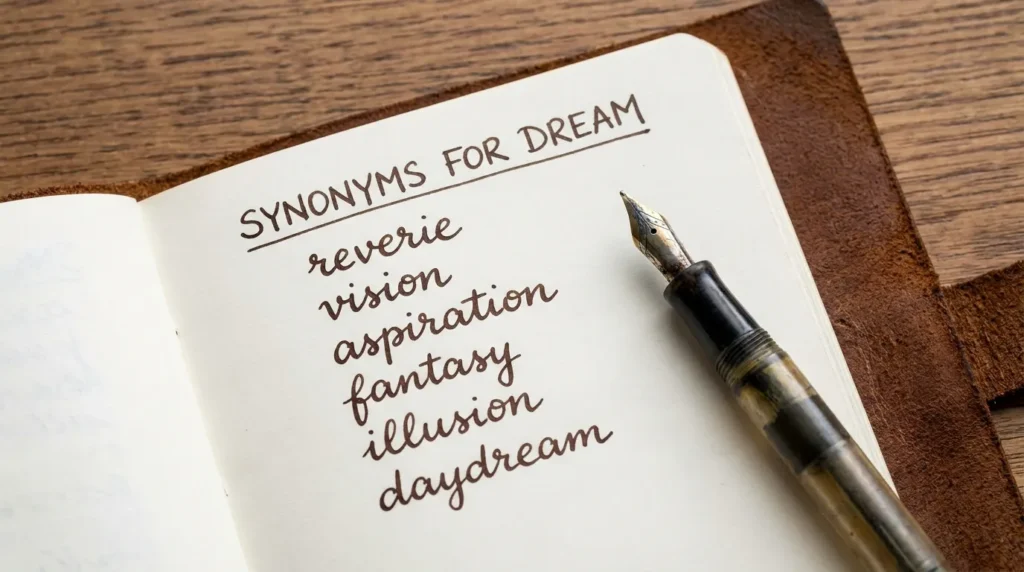
The best synonym for dream depends on what you mean. If you are talking about a goal for the future, words like aspiration, ambition, and goal may fit. If you mean something you experience while sleeping, vision or nightmare may be more appropriate in certain contexts. For an imagined or unrealistic idea, fantasy or daydream may work better.
This guide explains the most useful alternatives to dream, how they differ, and when to use each one naturally.
Quick Answer: What Are the Best Synonyms for Dream?
The best synonyms for dream include aspiration, ambition, goal, hope, vision, fantasy, daydream, wish, desire, and ideal. Use aspiration for something you hope to achieve, ambition for a strong desire to succeed, and vision for a picture of a possible future. For a sleeping experience, dream is often the clearest word.
Quick List of Synonyms for Dream
Choose an alternative based on the meaning you want to express.
Dreams as goals or future hopes
Aspiration
Ambition
Goal
Objective
Hope
Wish
Aim
Desire
Purpose
Ideal
Plan
Target
Dreams as imagined experiences
Fantasy
Daydream
Reverie
Imagination
Vision
Illusion
Make-believe
Imagining
Dreams as inspiring future possibilities
Vision
Aspiration
Ambition
Possibility
Hope
Ideal
Inspiration
Prospect
Dreams experienced during sleep
Sleeping vision
Dream sequence
Nightmare (a frightening dream)
Reverie (usually a waking, dreamlike state)
Dream as a verb
Imagine
Envision
Fantasize
Aspire
Hope
Wish
Picture
Long for
Not all these words are exact synonyms. For example, a goal is something you intend to achieve, while a fantasy may be an imagined situation with little connection to reality.
What Does Dream Mean?
The word dream has several related meanings. Understanding them helps you choose the right alternative.
1. An experience during sleep: A series of images, thoughts, or feelings that occur while you sleep.
Example: “I had a strange dream last night.”
2. A hope for the future: Something you strongly want to achieve or experience.
Example: “Her dream is to become a doctor.”
3. An imagined situation: Something you picture in your mind, whether realistic or not.
Example: “He spent the afternoon lost in a dream about traveling the world.”
4. An ideal or wonderful experience: Something that seems especially attractive or nearly perfect.
Example: “Their new home is a dream.”
As a verb, dream can mean experiencing images during sleep or imagining and hoping for something.
Example: “I dream of opening my own business.”
Closest Synonyms for Dream
These alternatives are especially useful when you want to express a hope, goal, imagined experience, or future possibility.
1. Aspiration
An aspiration is something you strongly hope to achieve, often because it reflects your personal values or long-term plans.
Example: “Becoming a successful writer has always been her aspiration.”
Best for: Education, career goals, personal growth, and formal writing.
How it differs: An aspiration is usually more practical and achievement-focused than a dream. It does not normally describe an experience during sleep.
2. Ambition
An ambition is a strong desire to achieve success, recognition, power, or a particular goal.
Example: “His ambition is to lead a successful technology company.”
Best for: Careers, leadership, achievement, and professional development.
How it differs: Ambition often emphasizes drive and determination. Dream can express a hope without suggesting the same level of effort or competitiveness.
3. Goal
A goal is a result someone intends to achieve.
Example: “My goal is to finish my degree within three years.”
Best for: Personal development, work, education, and planning.
How it differs: A goal is generally more specific and actionable than a dream. A dream may inspire a goal, but it does not always include a clear plan.
4. Hope
A hope is a feeling or belief that something good may happen.
Example: “Her dream of reuniting with her family became a source of hope.”
Best for: Personal wishes, uncertain outcomes, relationships, and encouraging messages.
How it differs: Hope emphasizes the possibility of a good outcome, while a dream often describes the desired outcome itself.
5. Vision
A vision is a clear mental picture of a possible future or a desired state of affairs.
Example: “The founder shared her vision for a more sustainable business.”
Best for: Leadership, business, creative projects, and long-term planning.
How it differs: Vision often suggests direction and a sense of what the future could look like. It can sound more strategic than dream.
6. Wish
A wish is a desire for something to happen or be true.
Example: “His wish was to see his childhood friends again.”
Best for: Personal desires, everyday conversation, and situations involving uncertainty.
How it differs: A wish can be brief or simple, while a dream often suggests a larger hope or long-term ambition.
7. Desire
A desire is a strong feeling of wanting something.
Example: “Her desire to learn another language inspired her to practice every day.”
Best for: Formal writing, personal motivation, and discussions of what people want.
How it differs: Desire emphasizes wanting something. It does not necessarily suggest that the person has a plan to achieve it.
8. Fantasy
A fantasy is an imagined situation that may be unrealistic or unlikely.
Example: “Winning the lottery was a fun fantasy, not a financial plan.”
Best for: Fiction, imagination, entertainment, and unrealistic wishes.
How it differs: A dream can be realistic and achievable. Fantasy more often suggests imagination that is detached from everyday reality.
9. Daydream
A daydream is a series of pleasant thoughts or imagined events that occupy your mind while you are awake.
Example: “She drifted into a daydream about living by the ocean.”
Best for: Casual writing, storytelling, and imagined future situations.
How it differs: A daydream happens while awake and often involves spontaneous imagination. It is not the same as a dream during sleep.
10. Ideal
An ideal is a standard, situation, or outcome that someone considers perfect or highly desirable.
Example: “A peaceful life near the mountains was his ideal.”
Best for: Describing a preferred future, perfect conditions, or personal values.
How it differs: An ideal emphasizes what would be perfect, while a dream emphasizes what someone hopes for or imagines.
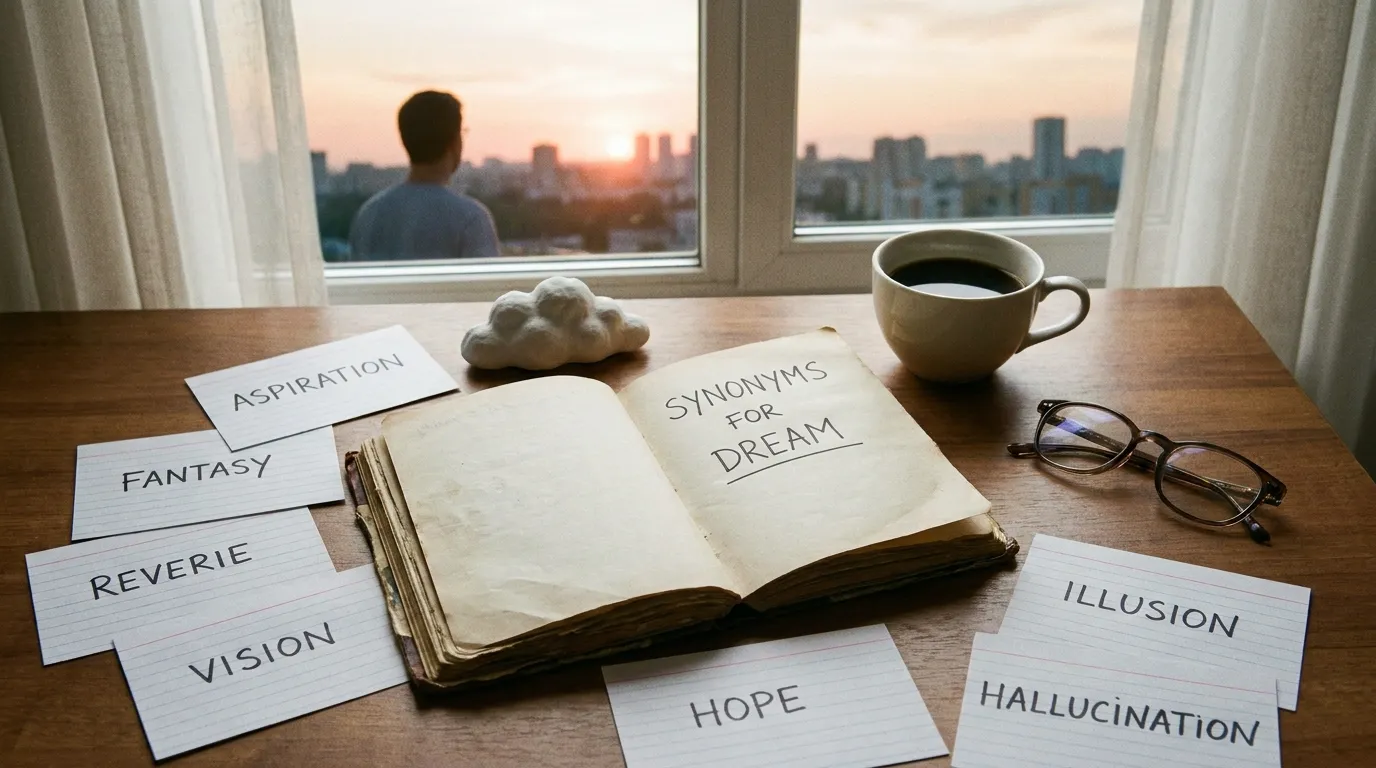
11. Reverie
A reverie is a state of being pleasantly lost in your thoughts.
Example: “She sat by the window in a quiet reverie.”
Best for: Literary writing, descriptive prose, and reflective scenes.
How it differs: Reverie describes a mental state rather than a specific goal. It is more literary and less common in everyday conversation.
12. Aim
An aim is an intended result or purpose.
Example: “His aim is to improve access to education.”
Best for: Plans, projects, academic writing, and professional communication.
How it differs: An aim is usually more direct and practical than a dream.
Synonyms for Dream by Context
The most natural replacement depends on the sentence and the meaning of dream.
Synonyms for a dream you want to achieve
Use these words when talking about a future achievement or something important you hope to accomplish.
| Synonym | Meaning | Best context |
|---|---|---|
| Aspiration | A hoped-for achievement | Career or personal growth |
| Ambition | A strong drive to succeed | Professional or personal success |
| Goal | A result you plan to reach | Action plans and progress |
| Objective | A specific intended result | Business and academic writing |
| Aim | A purpose or intended outcome | General and formal writing |
| Vision | A picture of a desired future | Leadership and long-term plans |
| Ideal | A perfect or preferred outcome | Values and lifestyle choices |
| Target | A result to reach or meet | Measurable achievements |
Examples:
Original: “My dream is to become a teacher.”
Alternative: “My aspiration is to become a teacher.”
Original: “Her dream is to start a company.”
Alternative: “Her ambition is to start a company.”
Original: “Our dream is to reduce waste.”
Alternative: “Our goal is to reduce waste.”
The last example sounds more practical because goal suggests an outcome that can be worked toward.
Synonyms for a dream about the future
Use these alternatives when describing the future you hope to experience.
Hope: “I hope to build a happy life with my family.”
Vision: “She has a vision of a community where everyone feels welcome.”
Aspiration: “His aspiration is to work in public service.”
Ideal: “Their ideal is a simple life with more time outdoors.”
Possibility: “Studying abroad became a real possibility.”
Prospect: “The prospect of a new career excited her.”
These terms are not identical. Hope emphasizes optimism, vision describes a picture of the future, and prospect focuses on something that may happen.
Synonyms for an unrealistic dream
When an idea seems unlikely or disconnected from reality, some words express that meaning more clearly.
| Word | Meaning | Tone |
|---|---|---|
| Fantasy | An imagined or unrealistic situation | Neutral or playful |
| Pipe dream | An unlikely hope or plan | Informal, often critical |
| Illusion | A mistaken belief or misleading appearance | Often negative |
| Wishful thinking | Believing something because you want it to be true | Critical |
| Daydream | An imagined situation while awake | Usually gentle or positive |
| Unrealistic ambition | A goal that may be impractical | Direct and critical |
Examples:
“Becoming a millionaire overnight was just a fantasy.”
“Without a workable plan, the proposal may be a pipe dream.”
“Believing the problem will disappear on its own is wishful thinking.”
Usage note: Pipe dream and wishful thinking are more critical than dream. Use them when you want to question whether an idea is realistic.
Synonyms for a dream during sleep
When dream refers to something experienced while sleeping, many alternatives are narrower or more descriptive rather than exact replacements.
Nightmare: A frightening or distressing dream.
Dream sequence: A scene in a film, play, or story that represents a dream.
Sleeping vision: A descriptive phrase for images experienced during sleep.
Dream experience: A broad phrase for the experience of dreaming.
Examples:
“I had a nightmare about being lost.”
“The movie opens with a dream sequence.”
“He described a vivid dream experience.”
In ordinary conversation, dream is usually the most natural word for a sleeping experience. Avoid replacing it with aspiration, ambition, or goal, which refer to different meanings.
Synonyms for Dream as a Verb
When dream describes an action, choose a verb that matches what the person is doing.
| Verb | Meaning | Example |
|---|---|---|
| Imagine | Form a picture or idea in your mind | “Imagine living near the sea.” |
| Envision | Picture a possible future | “She envisions a better education system.” |
| Fantasize | Imagine an unlikely or pleasurable situation | “He fantasized about traveling the world.” |
| Aspire | Aim for something important | “She aspires to become a surgeon.” |
| Hope | Want something good to happen | “I hope to visit Japan.” |
| Wish | Want something to be true or happen | “I wish for a peaceful future.” |
| Picture | Form a mental image | “I picture myself running my own studio.” |
| Long for | Want something deeply | “He longs for a fresh start.” |
Example sentences
“I dream of becoming a novelist.” → “I aspire to become a novelist.”
“She dreams of a better future.” → “She envisions a better future.”
“He dreams about traveling the world.” → “He fantasizes about traveling the world.”
“I dream that things will improve.” → “I hope things will improve.”
Be careful with grammar. You can say aspire to become, hope to become, imagine becoming, and long to become. The verb determines which structure sounds natural.
Dream vs. Aspiration vs. Ambition vs. Goal
These four words are common alternatives, but each highlights a different part of the idea.
| Word | Main meaning | Tone | Interchangeable with dream? |
|---|---|---|---|
| Dream | A hope, imagined experience, or desired future | Personal and flexible | Sometimes |
| Aspiration | A hoped-for achievement | Thoughtful or formal | Often for long-term hopes |
| Ambition | A strong desire to succeed | Driven and achievement-focused | Sometimes |
| Goal | A result someone intends to achieve | Practical and direct | Often when a dream becomes actionable |
| Vision | A mental picture of a desired future | Strategic or inspirational | Sometimes |
| Fantasy | An imagined situation, often unrealistic | Playful or skeptical | Only when imagination is the focus |
| Wish | A desired outcome | Personal and often simple | Sometimes |
| Ideal | A perfect or preferred situation | Reflective or formal | Sometimes |
Consider these examples:
Dream: “My dream is to open a bakery.”
Aspiration: “My aspiration is to build a successful bakery.”
Ambition: “My ambition is to grow the bakery into a national brand.”
Goal: “My goal is to open the bakery by next summer.”
Vision: “My vision is a bakery known for affordable, locally made food.”
Each sentence emphasizes something different: a personal hope, a hoped-for achievement, a drive for success, a specific result, or a picture of the future.
How to Choose the Right Synonym for Dream
Use these simple guidelines to find a natural alternative.
For a long-term hope, choose aspiration. It works well for education, careers, and personal growth.
For a strong desire to succeed, choose ambition. It emphasizes motivation and achievement.
For a clear, actionable result, choose goal or objective. These terms work well in plans and professional writing.
For a picture of the future, choose vision. It is useful for leadership, business, and creative work.
For a simple desire, choose wish or hope. These words are natural in everyday speech.
For an imagined situation, choose fantasy or daydream. Use fantasy for an imagined scenario and daydream for thoughts while awake.
For a sleeping experience, keep dream. It is usually the clearest and most accurate choice.
For an unlikely plan, consider pipe dream or wishful thinking. These terms signal doubt or criticism.
Remember that a synonym should make your meaning clearer. If dream already fits the sentence, there is no need to replace it.
Before-and-After Examples: Replacing Dream in Sentences
The examples below show how a suitable synonym can improve precision or adjust the tone.
1. Career plans
Before: “My dream is to become a doctor.”
After: “My aspiration is to become a doctor.”
Why it works: Aspiration sounds slightly more formal and emphasizes a hoped-for achievement.
2. A strong desire to succeed
Before: “Her dream is to run a successful business.”
After: “Her ambition is to run a successful business.”
Why it works: Ambition highlights determination and the desire to succeed.
3. A measurable outcome
Before: “Our dream is to increase sales by 20%.”
After: “Our goal is to increase sales by 20%.”
Why it works: Goal fits a specific, measurable result.
4. A future picture
Before: “He dreams of a city with cleaner streets.”
After: “He envisions a city with cleaner streets.”
Why it works: Envisions emphasizes the mental picture of the future.
5. A personal desire
Before: “Her dream was to see her family again.”
After: “Her wish was to see her family again.”
Why it works: Wish can sound more personal and immediate.
6. An imagined situation
Before: “He dreamed of living on a tropical island.”
After: “He daydreamed about living on a tropical island.”
Why it works: Daydreamed makes it clear that he was imagining the situation while awake.
7. An unrealistic plan
Before: “Their dream of finishing the project in one day was unrealistic.”
After: “Their plan to finish the project in one day was unrealistic.”
Why it works: Plan makes the intended action clear. If you want to emphasize that the hope was wildly unlikely, pipe dream could also fit.
8. A personal ideal
Before: “A quiet life in the countryside was her dream.”
After: “A quiet life in the countryside was her ideal.”
Why it works: Ideal emphasizes the kind of life she considers perfect.
9. A sleeping experience
Before: “I had a strange dream last night.”
After: “I had a strange nightmare last night.”
Why it works: This replacement works only if the dream was frightening. If it was merely unusual, keep dream.
10. A creative future
Before: “He dreams of writing a bestselling novel.”
After: “He hopes to write a bestselling novel.”
Why it works: Hopes to sounds natural and direct, while dreams of can feel more emotional or ambitious.
Common Mistakes When Using Synonyms for Dream
1. Treating every dream as a goal
A dream can be a sleeping experience or an imagined situation, not just an achievement.
Incorrect: “My goal last night was about flying.”
Better: “I had a dream about flying.”
2. Using ambition for every personal wish
Ambition often suggests a strong drive to achieve something.
Awkward: “My ambition is to spend a relaxing Sunday at home.”
More natural: “My wish is to spend a relaxing Sunday at home.”
3. Confusing a vision with a fantasy
A vision can describe a realistic and carefully considered future. A fantasy often refers to something imagined or unlikely.
Choose vision for a practical future plan and fantasy for an imagined scenario.
4. Using aspiration for a dream during sleep
Incorrect: “I had an aspiration about flying last night.”
Correct: “I had a dream about flying last night.”
Aspiration refers to something someone hopes to achieve, not a sleeping experience.
5. Assuming a goal and a dream are identical
A dream may be broad, emotional, or uncertain. A goal usually identifies a result someone intends to reach.
For example, “I dream of helping people” is broader than “My goal is to volunteer at a local shelter this month.”
6. Using fantasy when you mean a realistic hope
Calling a plan a fantasy can suggest that it is unrealistic.
If someone is working toward a realistic future, dream, aspiration, or goal may be more suitable.
7. Replacing dream with desire in every sentence
Desire emphasizes wanting something, but it may sound formal or intense in casual conversation.
Natural: “My dream is to travel the world.”
More formal: “My desire is to travel the world.”
The first is often more natural when describing a cherished personal hope.
8. Choosing a synonym only to avoid repetition
Repeating dream is not always a writing problem. Replacing it with ambition, vision, or fantasy can change the meaning.
Use a different word only when it adds precision, variety, or a useful shift in tone.
Grammar and Usage: How to Use Dream Correctly
The word dream can function as both a noun and a verb. Its grammar depends on how you use it.
Dream as a noun
Common patterns include:
A dream of + noun or -ing form: “She has a dream of becoming an artist.”
A dream to + verb: “He has a dream to start a business.” This is possible, though dream of starting a business is often more natural.
A dream about + topic: “I had a dream about my old school.”
A dream come true: “Winning the award was a dream come true.”
A lifelong dream: “Opening a bookstore was her lifelong dream.”
Dream as a verb
Common patterns include:
Dream of + noun or -ing form: “I dream of owning a home.”
Dream about + topic: “She dreamed about her childhood.”
Dream that + clause: “He dreamed that he could fly.”
Dream of + someone or something: “They dream of a better future.”
Natural collocations with dream
These combinations are common and useful:
| Phrase | Example |
|---|---|
| Lifelong dream | “Teaching has been my lifelong dream.” |
| Big dream | “She has a big dream for her future.” |
| Dream job | “He finally found his dream job.” |
| Dream come true | “The trip was a dream come true.” |
| Pursue a dream | “They saved money to pursue their dream.” |
| Fulfill a dream | “She fulfilled her dream of publishing a book.” |
| Chase a dream | “He moved to California to chase his dream.” |
| Dream of success | “Many young athletes dream of success.” |
| Pipe dream | “Without funding, the proposal may remain a pipe dream.” |
| Wildest dreams | “I never imagined this in my wildest dreams.” |
Usage tip: Pursue, fulfill, and chase often pair naturally with dream. In professional writing, work toward a goal or achieve an objective may be more precise.
Frequently Asked Questions
1. What is the best synonym for dream?
The best synonym depends on the meaning. Aspiration works for a hoped-for achievement, ambition for a strong desire to succeed, goal for a planned result, and fantasy for an imagined situation. For an experience during sleep, dream is usually best.
2. What is a formal synonym for dream?
Aspiration, objective, ambition, and vision can work in formal contexts. Choose aspiration for a long-term hope, objective for a specific result, and vision for a desired future state.
3. What is another word for a dream you want to achieve?
Useful alternatives include aspiration, ambition, goal, aim, and objective. Use goal when you can describe the result clearly and aspiration when you want to emphasize a larger personal or professional hope.
4. What is a positive synonym for dream?
Hope, aspiration, vision, ideal, and inspiration can express positive ideas. Aspiration emphasizes achievement, while hope emphasizes the possibility of a good outcome.
5. What is a synonym for an unrealistic dream?
Fantasy, pipe dream, and wishful thinking can describe unrealistic hopes. Fantasy can be neutral or playful, while pipe dream and wishful thinking often express doubt or criticism.
6. What is another word for dream as a verb?
Depending on the sentence, you can use imagine, envision, fantasize, aspire, hope, wish, or long for. For example, “I dream of becoming a writer” can become “I aspire to become a writer.”
7. Are dream, ambition, and aspiration the same?
No. A dream is a broad hope or imagined experience. An ambition is a strong desire to achieve something, often success. An aspiration is a hoped-for achievement or personal goal. They overlap when describing the future, but their emphasis differs.
Editor’s Choice: The Best Synonyms for Dream
If you need a quick recommendation, start with these five alternatives:
Aspiration: Best for a meaningful, long-term hope or achievement.
Goal: Best for a clear result you intend to reach.
Ambition: Best for a strong desire to succeed.
Vision: Best for describing a desired future or guiding idea.
Fantasy: Best for an imagined situation that may be unrealistic.
For everyday writing, hope and wish are also excellent choices. If you mean a sleeping experience, use dream unless you need a more specific term such as nightmare.
Key Takeaways
The best synonym for dream depends on whether you mean a sleeping experience, a future hope, or an imagined situation.
Use aspiration for a hoped-for achievement, ambition for a strong drive to succeed, and goal for a specific result.
Choose vision to describe a picture of a desired future and fantasy for an imagined or potentially unrealistic situation.
When dream is a verb, alternatives such as imagine, envision, hope, and aspire require different grammatical patterns.