
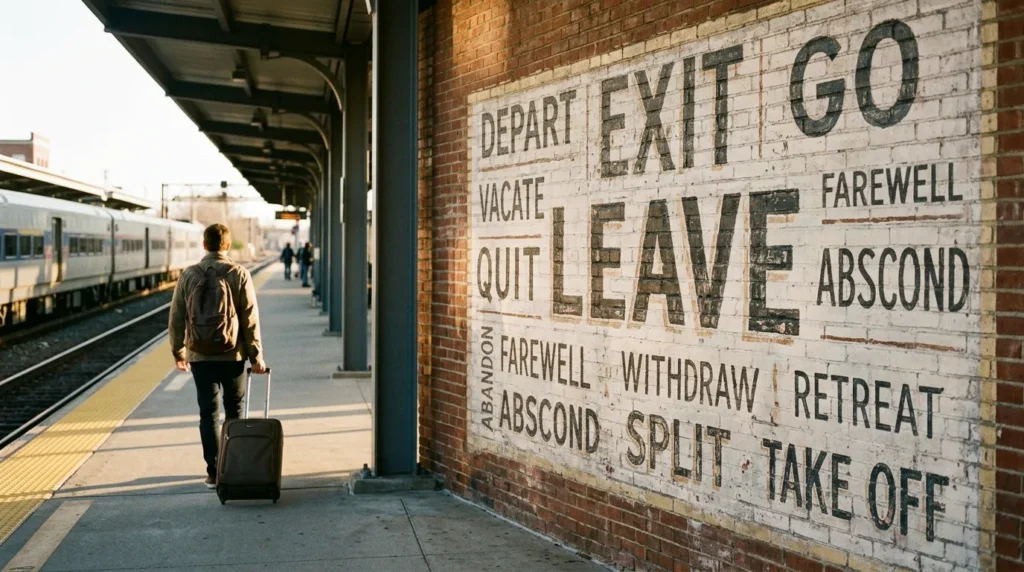
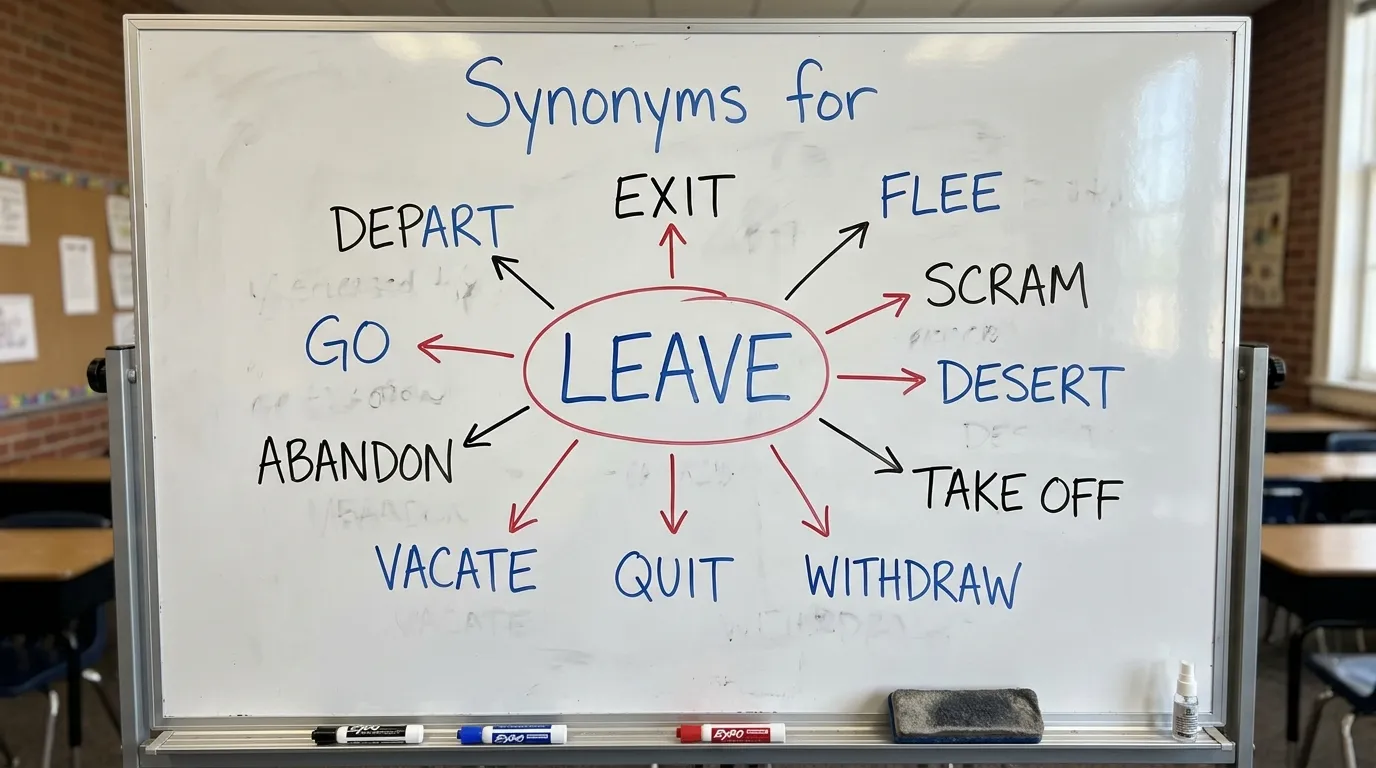
Common synonyms for leave include depart, exit, go, move on, withdraw, quit, abandon, vacate, resign, and head out. The best alternative depends on your meaning. Use depart for a formal way to say go away, quit for stopping a job or activity, and abandon for leaving something behind, often permanently.
Quick Synonym List for Leave
Here are useful alternatives to leave, grouped by meaning.
Go away: depart, go, exit, head out, take off
Move away from a place: vacate, withdraw, retreat, move out
Leave a job or position: resign, quit, step down, retire
Stop doing something: quit, give up, discontinue, drop
Leave someone or something behind: abandon, desert, forsake, walk away from
End a relationship: break up, separate, walk out
Allow something to remain: keep, retain, let remain, leave alone
Give something for later: save, set aside, reserve
Entrust something to someone: entrust, assign, hand over
Go temporarily: step out, slip away, take one’s leave
These words are not interchangeable in every sentence. For example, depart usually means going away, while allow can mean permitting something to happen. The intended meaning matters.
What Does Leave Mean?
Leave has several meanings, and each may require different synonyms.
To go away from a place: “We leave the office at five.”
To stop working for or participating in something: “She decided to leave her job.”
To go away from a person or relationship: “He chose to leave his partner.”
To put something somewhere and not take it with you: “I left my keys on the desk.”
To allow something to remain unchanged: “Leave the door open.”
To give or pass something to someone: “She left her savings to her children.”
To give someone permission or time off: “The manager granted him leave.”
Because these meanings differ, the best synonym depends on how leave is used.
Closest Synonyms for Leave
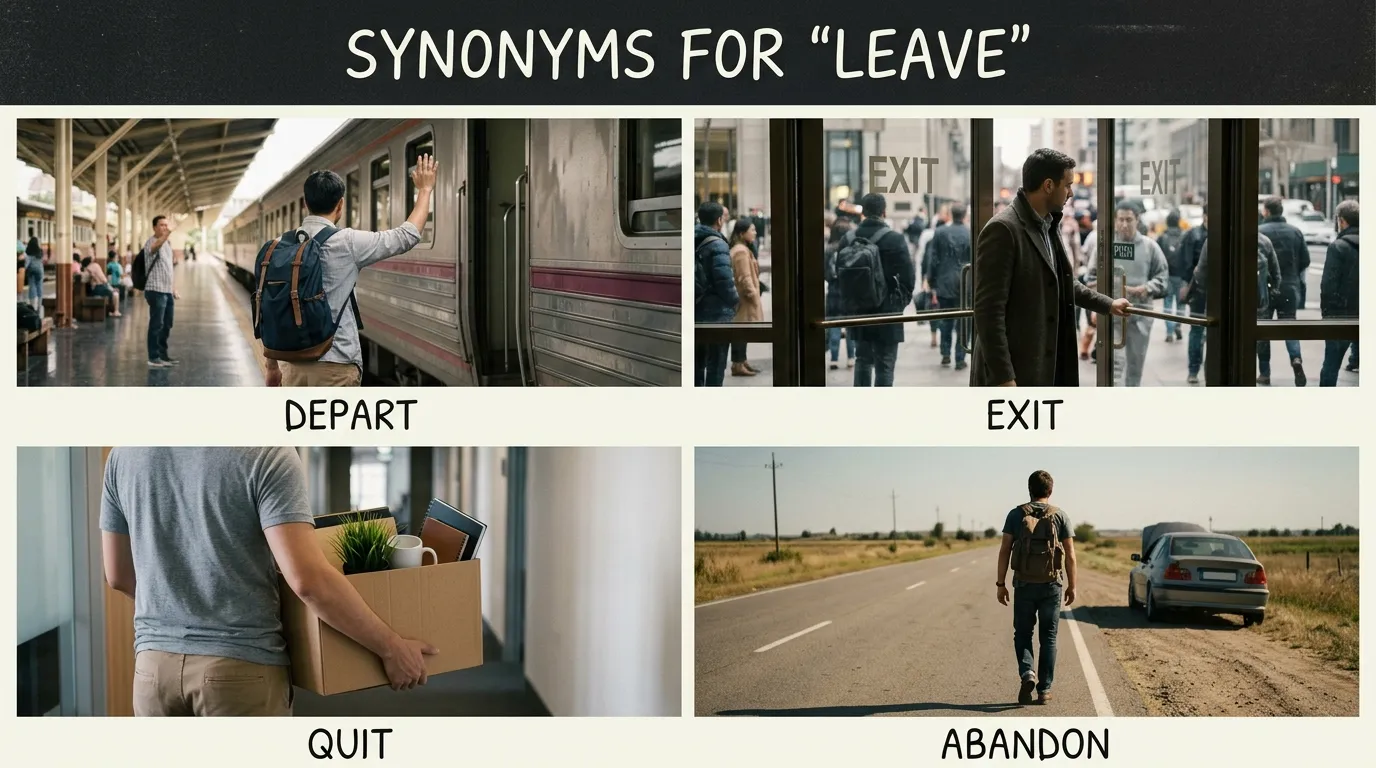
1. Depart
Meaning: To go away from a place, often in a formal or planned way.
Depart is a good alternative in formal writing, travel announcements, and professional communication.
Original: The train will leave at 8 p.m.
Revised: The train will depart at 8 p.m.
Best for: Travel, formal announcements, and official writing.
Watch out: Depart sounds more formal than everyday leave. In casual conversation, “I’m leaving now” usually sounds more natural than “I’m departing now.”
2. Exit
Meaning: To go out of a place or move away from it.
Exit often emphasizes going out of a building, room, vehicle, or system.
Original: Please leave the building through the rear door.
Revised: Please exit the building through the rear door.
Best for: Instructions, safety notices, and physical spaces.
Watch out: Exit can sound abrupt or technical when used in ordinary conversation.
3. Go
Meaning: To move away from a place or travel somewhere else.
Go is one of the simplest alternatives when you mean leaving a location.
Original: I need to leave now.
Revised: I need to go now.
Best for: Everyday conversation and simple writing.
Watch out: Go does not always emphasize the act of leaving. It can also describe movement toward another destination.
4. Head out
Meaning: To leave a place, usually to go somewhere.
This informal phrase sounds natural in conversation.
Original: We’re going to leave for the restaurant soon.
Revised: We’re going to head out for the restaurant soon.
Best for: Text messages, conversations, and informal writing.
Watch out: Avoid head out in highly formal reports or official documents.
5. Take off
Meaning: To leave suddenly or depart, often informally.
Original: He left before the meeting ended.
Revised: He took off before the meeting ended.
Best for: Casual speech and situations where someone leaves quickly.
Watch out: Take off can suggest suddenness or informality. It also has other meanings, such as an aircraft becoming airborne.
6. Vacate
Meaning: To leave a place, especially a room, building, or property.
Original: Tenants must leave the apartment by Friday.
Revised: Tenants must vacate the apartment by Friday.
Best for: Rental agreements, official notices, and property-related instructions.
Watch out: Vacate is more formal and specifically emphasizes leaving a space empty.
7. Withdraw
Meaning: To remove yourself from a situation, activity, agreement, or group.
Original: She decided to leave the competition.
Revised: She decided to withdraw from the competition.
Best for: Competitions, negotiations, applications, and formal situations.
Watch out: Withdraw often suggests a deliberate decision to stop participating, rather than simply going away.
8. Retreat
Meaning: To move away from a difficult, dangerous, or threatening situation.
Original: The team left when the situation became dangerous.
Revised: The team retreated when the situation became dangerous.
Best for: Military contexts, conflict, danger, and figurative descriptions of stepping back.
Watch out: Retreat suggests moving back to avoid danger or pressure. It is not a neutral synonym for every kind of departure.
9. Move out
Meaning: To leave a home or other place where you have been living or staying.
Original: They will leave their apartment next month.
Revised: They will move out of their apartment next month.
Best for: Housing, relocation, and changing living arrangements.
Watch out: Move out usually suggests ending your stay in a particular home or property, not simply going out for the evening.
10. Quit
Meaning: To stop doing something, such as a job, activity, or habit.
Original: He decided to leave his job.
Revised: He decided to quit his job.
Best for: Jobs, habits, activities, and commitments.
Watch out: Quit focuses on stopping or giving up something. It does not usually mean physically walking out of a room.
11. Resign
Meaning: To formally give up a job or official position.
Original: The director decided to leave her position.
Revised: The director decided to resign from her position.
Best for: Employment, leadership roles, and formal appointments.
Watch out: Resign is more specific than leave. It generally refers to voluntarily giving up a position rather than simply being absent.
12. Step down
Meaning: To give up a position of authority or responsibility.
Original: The chairperson will leave the role next month.
Revised: The chairperson will step down next month.
Best for: Executives, elected officials, managers, and organization leaders.
Watch out: Step down usually concerns a role or position, not leaving a physical location.
13. Abandon
Meaning: To leave someone or something behind, often permanently or without intending to return.
Original: They left the old building years ago.
Revised: They abandoned the old building years ago.
Best for: Empty properties, plans, projects, and situations where something is given up or left behind.
Watch out: Abandon can sound harsh or negative. It may suggest neglect, failure to provide support, or giving up responsibility.
14. Desert
Meaning: To leave a person, group, or responsibility when support or loyalty is expected.
Original: He left his team during a crisis.
Revised: He deserted his team during a crisis.
Best for: Situations involving loyalty, duty, or a serious failure to provide support.
Watch out: Desert has a much stronger negative meaning than leave. It is not a neutral replacement.
15. Forsake
Meaning: To give up or turn away from someone, something, or a belief.
Original: She refused to leave her principles.
Revised: She refused to forsake her principles.
Best for: Literary, emotional, religious, or moral contexts.
Watch out: Forsake is formal and less common in everyday American English. It can suggest deep betrayal or rejection.
16. Walk away
Meaning: To leave a person, situation, agreement, or problem, often by choice.
Original: He decided to leave the argument.
Revised: He decided to walk away from the argument.
Best for: Conflicts, difficult situations, relationships, and negotiations.
Watch out: Walk away can imply refusing to continue or choosing not to engage, rather than merely going somewhere else.
17. Separate
Meaning: To stop being together or to move apart.
Original: The couple decided to leave each other.
Revised: The couple decided to separate.
Best for: Relationships and situations where people or groups stop being together.
Watch out: Separate does not always mean a permanent breakup. It can describe a temporary arrangement or physical distance.
18. Discontinue
Meaning: To stop doing, using, producing, or providing something.
Original: The company decided to leave the service.
Revised: The company decided to discontinue the service.
Best for: Products, services, processes, and formal announcements.
Watch out: Discontinue focuses on stopping an activity or service, not on physically leaving a place.
19. Give up
Meaning: To stop trying to do something or stop pursuing a goal.
Original: She decided to leave the attempt after several failures.
Revised: She decided to give up after several failures.
Best for: Effort, goals, habits, and attempts.
Watch out: Give up can suggest surrender or loss of hope. Use withdraw if someone is simply choosing to stop participating.
20. Leave behind
Meaning: To go away without taking something or someone with you; it can also mean creating a lasting effect or legacy.
Original: He left his notebook at school.
Revised: He left behind his notebook at school.
Best for: Forgotten items, people or places someone moves away from, and lasting legacies.
Watch out: Leave behind emphasizes what remains after someone goes. It can also carry emotional meaning, depending on the context.
Synonyms for Leave in Different Contexts
The right alternative often depends on what you are leaving.
Leaving a Place
Use these words when you mean going away from a location.
Go: a common, simple alternative.
Depart: a formal or planned departure.
Exit: moving out of a building or space.
Head out: leaving informally.
Vacate: clearing a room or property.
Move out: ending your stay in a home.
Withdraw: removing yourself from a particular setting or situation.
Example: “Visitors must exit the building before closing time.”
Leaving a Job
Use these alternatives when ending employment or giving up a role.
Quit: stop working at a job, often in everyday language.
Resign: formally give up a position.
Step down: give up a leadership or authority role.
Retire: stop working, typically after a career.
Move on: transition to a different opportunity or stage.
Depart: a more formal, broad description of leaving an organization.
Example: “After ten years at the company, she resigned from her position.”
Important distinction: Retire usually implies ending a career or working life, while resign means giving up a particular position. Neither automatically means the person is leaving the profession forever.
Leaving a Relationship or Person
These alternatives express different emotional meanings.
Separate: stop living or being together.
Break up: end a romantic relationship.
Walk away: choose to leave a relationship or conflict.
Abandon: leave someone without the expected support.
Desert: leave someone in a way that suggests betrayal or failure of duty.
Example: “They decided to separate after years of disagreement.”
Important distinction: Use break up for a romantic relationship ending. Use abandon or desert only when the stronger negative implication is appropriate.
Leaving a Task, Plan, or Activity
Use these words when you mean stopping participation or ending an effort.
Quit: stop doing something.
Withdraw: formally remove yourself from participation.
Discontinue: stop an activity, service, or process.
Give up: stop trying to achieve something.
Drop: stop pursuing a course, subject, or activity.
Abandon: give up a plan or project, often completely.
Example: “The team decided to abandon the original plan after reviewing the risks.”
Leaving Something in a Place
Sometimes leave means putting an object somewhere or not taking it with you.
Put: place something somewhere.
Set down: put an item on a surface.
Keep: retain something.
Store: put something away for later use.
Forget: unintentionally fail to take something.
Leave behind: go away without taking an item.
Example: “I left behind my umbrella on the bus.”
Important distinction: “I left my umbrella on the bus” does not necessarily mean you deliberately abandoned it. If you forgot it, say “I accidentally left my umbrella on the bus.”
Leave Something Unchanged
When leave means allowing something to stay as it is, these alternatives may fit.
Keep: retain a condition or state.
Retain: continue to have or preserve something.
Preserve: protect something from change or damage.
Maintain: keep something at a particular level or condition.
Let remain: allow something to stay in place.
Leave alone: avoid interfering with someone or something.
Example: “Please keep the door open.”
Important distinction: These words are context-dependent. “Leave the evidence untouched” is not always the same as “preserve the evidence,” because preserve emphasizes protecting it.
Leave Something for Someone
When leave means giving, assigning, or making something available to another person, use more precise verbs.
Give: transfer something to someone.
Pass on: transfer something to another person, often informally.
Entrust: give someone responsibility for something.
Bequeath: leave property to someone in a will.
Assign: allocate a task or responsibility.
Set aside: reserve something for later or for a particular person.
Example: “She bequeathed her collection to the local library.”
Important distinction: Bequeath is specifically associated with leaving property through a will. It is not a general substitute for leave.
Leave vs. Similar Words: A Comparison Table
| Word or phrase | Meaning | Tone | Best use | Interchangeable with leave? |
|---|---|---|---|---|
| Depart | Go away | Formal | Travel, announcements | Often, for physical departure |
| Exit | Go out of a space | Neutral/formal | Buildings, instructions | Sometimes |
| Go | Move away or travel | Casual/neutral | Everyday speech | Often |
| Head out | Leave to go somewhere | Informal | Conversation | Often, informally |
| Vacate | Leave a space empty | Formal | Property, official notices | In specific contexts |
| Withdraw | Stop participating or pull back | Formal/neutral | Applications, events, negotiations | In specific contexts |
| Quit | Stop a job or activity | Direct | Work, habits, activities | Only when stopping something |
| Resign | Formally give up a position | Formal | Employment, leadership | Only for roles or positions |
| Abandon | Leave or give up, often permanently | Strong/negative | Plans, property, responsibilities | Only when the stronger meaning fits |
| Desert | Leave someone despite an expected duty | Strong/negative | Loyalty and responsibility | Rarely |
| Retire | Stop working, often after a career | Neutral/formal | Career endings | Only in relevant work contexts |
| Preserve | Keep something safe or unchanged | Neutral/formal | Objects, traditions, conditions | Only for certain senses |
| Bequeath | Leave property in a will | Formal/legal | Inheritance | Only for inheritance |
How to Choose the Best Synonym for Leave
Choose your word based on the action you want to describe.
Choose depart for a formal or planned departure.
Choose exit when someone goes out of a building, room, or other space.
Choose go for simple, natural everyday language.
Choose head out for a relaxed, conversational tone.
Choose vacate when a person must clear a room or property.
Choose quit when someone stops a job, habit, or activity.
Choose resign when someone formally gives up a job or position.
Choose withdraw when someone removes themselves from a competition, agreement, or process.
Choose abandon when a person gives up a plan or leaves something behind, especially permanently.
Choose walk away when someone chooses to stop engaging with a difficult situation.
Choose retain or preserve when leave means keeping something unchanged.
Choose bequeath when someone leaves property to another person in a will.
If none of these words fits better, keep leave. It is common, clear, and flexible.
Before-and-After Examples: Replacing Leave in Sentences
These examples show how the right synonym can make a sentence more precise.
Original: I need to leave the office now.
Revised: I need to go now.
Why: Go is simple and natural in everyday conversation.Original: The plane will leave at noon.
Revised: The plane will depart at noon.
Why: Depart fits travel announcements and formal contexts.Original: Please leave the room quietly.
Revised: Please exit the room quietly.
Why: Exit emphasizes moving out of a space.Original: She plans to leave her job next month.
Revised: She plans to resign next month.
Why: Resign is precise when someone formally gives up a position.Original: He decided to leave the competition.
Revised: He decided to withdraw from the competition.
Why: Withdraw emphasizes ending participation.Original: They had to leave their apartment by Friday.
Revised: They had to vacate their apartment by Friday.
Why: Vacate fits formal property-related instructions.Original: She chose to leave the project unfinished.
Revised: She chose to abandon the project.
Why: Abandon emphasizes giving up the project rather than simply stepping away.Original: He left his family during a difficult time.
Revised: He abandoned his family during a difficult time.
Why: Abandoned conveys a stronger sense of neglect or lack of support.Original: I left my phone on the kitchen counter.
Revised: I left behind my phone on the kitchen counter.
Why: Left behind emphasizes the item that was not taken. In everyday American English, “I left my phone on the kitchen counter” is already natural.Original: The manager decided to leave his leadership role.
Revised: The manager decided to step down from his leadership role.
Why: Step down specifically describes giving up a position of authority.Original: The couple decided to leave each other.
Revised: The couple decided to separate.
Why: Separate is more natural when describing a relationship ending or changing.Original: The company will leave the service next year.
Revised: The company will discontinue the service next year.
Why: Discontinue clearly means stopping the service.Original: She left the door open.
Revised: She kept the door open.
Why: Kept works if the door remained open intentionally.Original: He left his savings to his daughter in his will.
Revised: He bequeathed his savings to his daughter in his will.
Why: Bequeath is a formal term for leaving property through a will.Original: We should leave the original plan unchanged.
Revised: We should retain the original plan.
Why: Retain emphasizes keeping something rather than replacing it.
Common Mistakes When Using Synonyms for Leave
1. Using depart in every situation
Depart is correct for leaving a place, but it can sound stiff in casual speech.
Awkward: “I’m departing for home now.”
Natural: “I’m heading home now.”
2. Treating quit and resign as identical
Both can describe leaving a job, but resign is more formal and specifically refers to giving up a position.
“I quit my job” is common and direct.
“I resigned from my position” is more formal.
3. Using abandon when you only mean go away
Abandon often suggests permanently giving something up or failing to provide support.
Neutral: “She left the building.”
Stronger: “She abandoned the building.”
Use the stronger word only if it fits the situation.
4. Confusing leave and leave behind
Leave can describe going away or putting something somewhere. Leave behind emphasizes what remains after someone goes.
“I left my bag in the car.”
“I left my bag behind when I moved.”
The second sentence stresses that the bag was not taken.
5. Using vacate for ordinary departures
Vacate is suitable for rooms, buildings, and property, but it sounds overly formal in casual situations.
Formal: “Guests must vacate the premises by 11 a.m.”
Casual: “We need to leave by 11 a.m.”
6. Confusing leave with let
Leave can mean allow something to remain, while let usually means allow an action or state.
“Leave the window open” means keep it open.
“Let the window stay open” means allow it to remain open.
The meanings overlap, but the grammar and emphasis differ.
7. Using withdraw without the correct preposition
The usual construction is withdraw from something.
Correct: “She withdrew from the race.”
Incorrect: “She withdrew the race.”
However, withdraw can take a direct object when it means removing something, as in “He withdrew his application.”
8. Assuming step down means leaving a place
Step down usually means giving up a position or responsibility.
Correct: “The CEO stepped down.”
More natural for a physical departure: “The CEO left the room.”
9. Confusing leave with retire
Retire usually means stopping work after a career or leaving a position because of retirement. It is not a general synonym for leaving a job.
“She resigned from the company” means she gave up her position.
“She retired from the company” suggests she ended her working career or retired from that employer.
Grammar and Usage: How to Use Leave Correctly
Leave + place
Use leave with the location someone moves away from.
“They left the office early.”
“We left the restaurant after dinner.”
You can also say leave for when naming a destination.
“We leave for Chicago tomorrow.”
Leave + person or thing
Use leave with a person or object that remains behind.
“She left her coat in the car.”
“He left his friends at the station.”
The exact meaning depends on the context.
Leave + object + adjective
Use this structure when something remains in a particular state.
“Leave the door open.”
“Please leave the room clean.”
“Don’t leave the lights on.”
Leave + object + to/for someone
Use leave something to someone when assigning or transferring something, especially through a will.
“She left the house to her son.”
Use leave something for someone when setting it aside or making it available.
“I left a message for you.”
“They left some food for the guests.”
Leave vs. leave out
Leave out means to omit or exclude something.
“Don’t leave out the final step.”
“The editor left out one paragraph.”
Use omit in more formal writing when you mean excluding information.
Common collocations with leave
| Phrase | Meaning | Example |
|---|---|---|
| Leave early | Go before the usual time | “We left early to avoid traffic.” |
| Leave behind | Not take something or someone along | “She left her notebook behind.” |
| Leave out | Omit or exclude | “Please don’t leave out any details.” |
| Leave alone | Avoid interfering | “Leave the computer alone.” |
| Leave open | Keep something open or undecided | “They left the question open.” |
| Leave a job | Stop working in a job | “He left his job last year.” |
| Leave for work | Depart to go to work | “She leaves for work at seven.” |
| Leave a message | Record or give information for someone | “Please leave a message after the tone.” |
| Leave something to someone | Give or assign something | “He left his books to the school.” |
| Leave on | Keep a device or light operating | “Please leave the hallway light on.” |
Frequently Asked Questions
1. What is the most common synonym for leave?
Go is one of the most common alternatives when leave means going away from a place. Depart is more formal, while head out is common in casual American English.
2. What is a formal synonym for leave?
Depart, vacate, withdraw, resign, and discontinue can work in formal contexts, depending on the meaning. Use depart for going away, vacate for clearing a space, and resign for giving up a position.
3. What is another word for leave a job?
Use quit for a direct, everyday expression and resign for a formal departure from a position. Step down is especially suitable for a leadership role, while retire refers to ending a working career or retiring from a position.
4. What is a stronger word for leave someone?
Abandon or desert can express a stronger meaning than leave. Both may suggest a failure to provide expected support, although desert often emphasizes duty or loyalty. Choose them only when that negative meaning is intended.
5. What is a synonym for leave something unchanged?
Depending on the sentence, use keep, retain, preserve, maintain, or let remain. Keep is often the simplest choice; preserve emphasizes protecting something from change or damage.
6. What is the difference between leave and depart?
Both can mean going away from a place. Leave is more common and natural in everyday speech, while depart sounds more formal and often appears in travel announcements or official communication.
7. What is a synonym for leave out?
Omit, exclude, and skip can replace leave out in different contexts. Omit is common in formal writing, exclude emphasizes keeping something or someone out, and skip often means choosing not to include or do something.
Editor’s Choice: The Best Alternatives to Leave
These five alternatives are useful in a wide range of situations, provided the intended meaning matches.
Go — best for simple, natural everyday language.
Depart — best for formal departures and travel announcements.
Resign — best for formally leaving a job or position.
Withdraw — best for leaving a competition, process, or agreement.
Abandon — best for giving up a plan or leaving something behind when the stronger meaning is intended.
For general writing, leave is often the best word because it is clear, familiar, and flexible. Choose a synonym when it adds precision or conveys a meaning that the original word does not.
Key Takeaways
Leave has several meanings, including going away, quitting a job, allowing something to remain, and giving something to another person.
Go, depart, exit, and head out are useful alternatives for physical departure.
Quit, resign, and step down describe different ways of giving up work or a position.
Abandon and desert carry stronger negative meanings than leave.
Choose the word that fits your meaning and tone; don’t replace leave when it is already the clearest option.