

Quick Answer
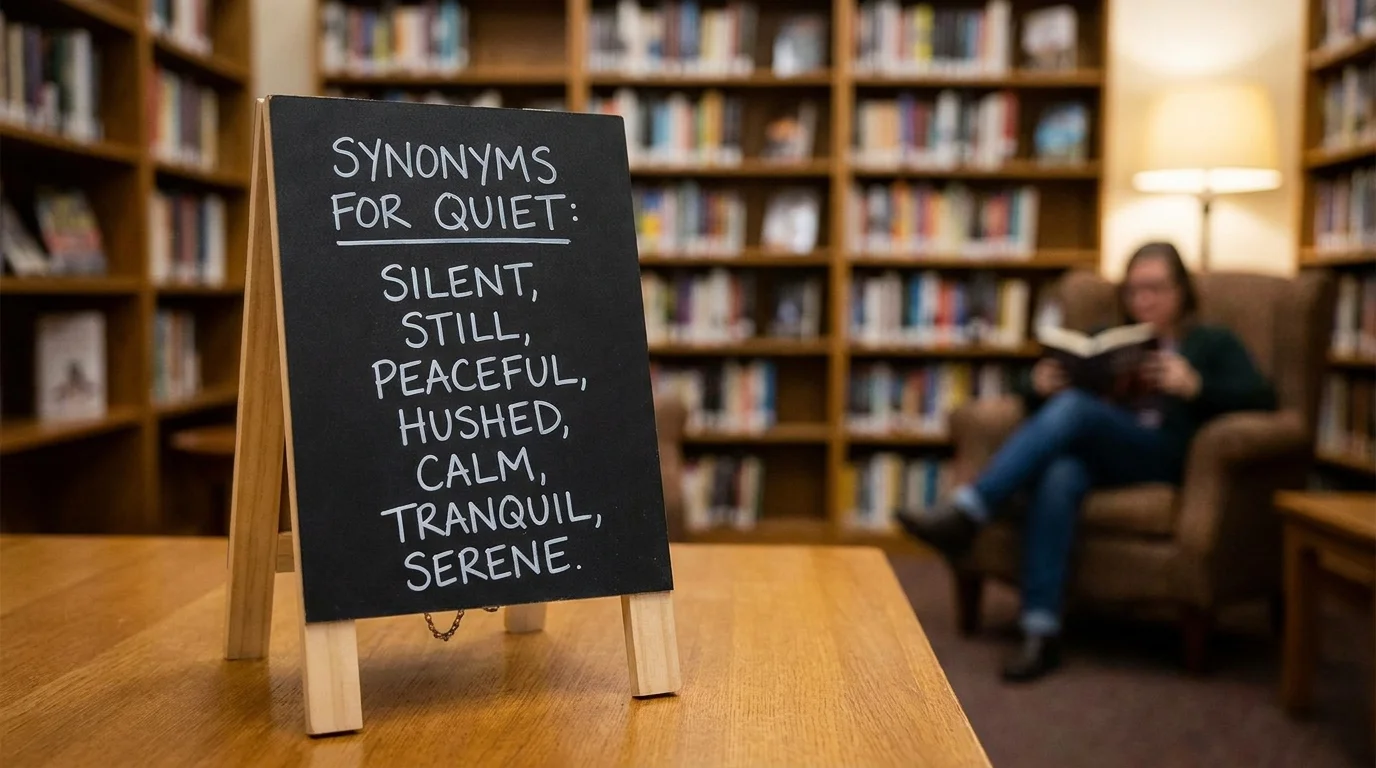
The best synonym for quiet depends on context. Use silent for little or no sound, peaceful for a calm environment, calm for a person or situation without agitation, still for a lack of movement, and reserved for someone who does not talk or express themselves much. Other useful alternatives include tranquil, hushed, subdued, serene, soft-spoken, and restful.
Quick List of Synonyms for Quiet
For little or no sound
- silent
- hushed
- noiseless
- soundless
- mute
- still
- soft
- low
For peaceful places or situations
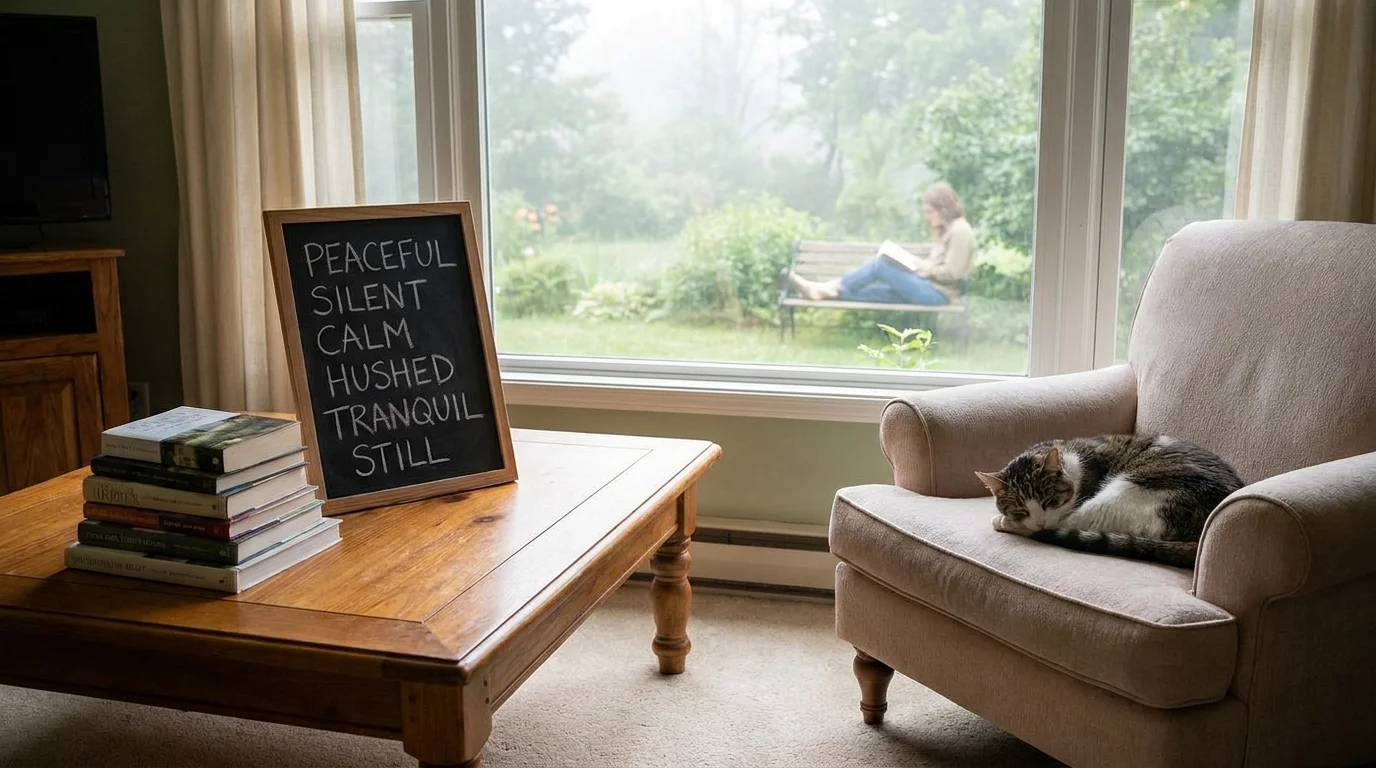
- peaceful
- tranquil
- serene
- calm
- restful
- undisturbed
- placid
- soothing
For quiet people
- reserved
- reticent
- taciturn
- withdrawn
- soft-spoken
- uncommunicative
- subdued
For little activity
- uneventful
- inactive
- slow
- subdued
- restful
- calm
What Does “Quiet” Mean?
Quiet has several meanings, which is why it has so many possible alternatives.
1. Making little sound
The classroom was quiet.
Here, quiet means there was little noise.
Possible alternatives include silent, hushed, noiseless, and soundless.
2. Peaceful or free from disturbance
We spent a quiet evening at home.
Here, quiet suggests a relaxed, peaceful experience.
Possible alternatives include peaceful, tranquil, serene, and restful.
3. Not talking much
She is a quiet person.
Here, quiet describes someone’s communication or personality.
Possible alternatives include reserved, reticent, taciturn, and soft-spoken.
4. Without much movement
The sea was quiet this morning.
Depending on the intended meaning, still or calm may be more precise.
5. Having little activity
It was a quiet day at work.
Here, quiet means there was not much happening.
Possible alternatives include slow, uneventful, inactive, and subdued.
Closest Synonyms for “Quiet”
Silent
Silent is one of the closest alternatives when quiet refers to sound.
The room was silent after the announcement.
Difference: Silent is stronger than quiet. A quiet room may have some background noise; a silent room has virtually none.
Best for: Rooms, people, conversations, machines, and moments.
Tone: Neutral.
Hushed
Hushed describes a place, crowd, or environment where sound is very low.
The audience grew hushed as the speaker approached the stage.
Difference: Hushed often suggests that something has caused people to become quiet.
Best for: Crowds, rooms, conversations, and atmospheric descriptions.
Tone: Neutral to literary.
Peaceful
Peaceful means calm and free from disturbance, conflict, or stress.
We found a peaceful place to relax.
Difference: Peaceful is more positive than quiet. It focuses on the pleasant quality of the situation, not simply the absence of noise.
Best for: Places, experiences, evenings, neighborhoods, and situations.
Tone: Positive.
Calm
Calm means free from agitation, excitement, or disturbance.
She remained calm during the interview.
Difference: Calm usually describes emotional or physical stability rather than sound.
Best for: People, situations, weather, water, and environments.
Tone: Neutral to positive.
Still
Still means without movement or activity.
The lake was completely still.
Difference: Still emphasizes lack of movement rather than lack of sound.
Best for: Water, air, surroundings, and moments.
Tone: Neutral or literary.
Tranquil
Tranquil means extremely calm and peaceful.
The garden was a tranquil place to read.
Difference: It has a more polished or literary tone than quiet.
Best for: Gardens, landscapes, retreats, settings, and descriptive writing.
Tone: Formal/literary and positive.
Serene
Serene describes something calm, peaceful, and undisturbed.
The lake looked serene at sunrise.
Difference: Serene often creates a stronger sense of beauty and emotional calmness.
Best for: Landscapes, places, expressions, moods, and descriptive writing.
Tone: Positive and literary.
Synonyms for Quiet When Describing Sound
If you specifically mean not loud, these are the most useful choices.
Silent
Use silent when there is no sound.
The hallway was silent.
Hushed
Use hushed when people or an environment are unusually quiet.
The room became hushed when the results were announced.
Noiseless
Use noiseless when emphasizing the absence of noise.
She made a noiseless exit.
This word is correct but less common in everyday speech.
Soundless
Soundless emphasizes the complete absence of audible sound.
The snow created a soundless landscape.
It is more descriptive and literary than everyday quiet.
Soft
Use soft when something can be heard but is low in volume.
He spoke in a soft voice.
Unlike silent, soft does not mean there is no sound.
Low
Low works well with words such as voice, sound, and volume.
They spoke in low voices.
Synonyms for a Quiet Place
When describing a place, the best choice depends on the feeling you want to create.
Peaceful
They live in a peaceful neighborhood.
Suggests low disturbance and a pleasant atmosphere.
Tranquil
The hotel sits beside a tranquil lake.
Suggests deep calmness and often has a more elegant tone.
Serene
The countryside was serene in the early morning.
Adds a sense of beauty and emotional calm.
Restful
The cabin provided a restful environment.
Focuses on the ability of the place to help someone relax.
Undisturbed
She wanted some undisturbed time to study.
Emphasizes freedom from interruptions.
Synonyms for a Quiet Person
When quiet describes a person, be careful. Many alternatives carry additional meanings.
Reserved
Reserved describes someone who does not readily express their thoughts or feelings.
Mark is friendly but reserved around strangers.
Best for: Personality descriptions.
Watch out: A reserved person is not necessarily shy or unfriendly.
Reticent
Reticent means reluctant to speak or reveal information.
She was reticent about her personal life.
Best for: Formal and professional writing.
Watch out: It often suggests reluctance, not simply a naturally quiet personality.
Taciturn
Taciturn describes someone who speaks very little.
His taciturn nature made him difficult to understand.
Best for: Formal descriptions of personality.
Watch out: It can sound negative or critical.
Soft-spoken
Soft-spoken means speaking in a gentle or quiet voice.
She is a soft-spoken teacher.
Best for: Describing someone’s voice or manner.
Watch out: A soft-spoken person can still be highly talkative.
Withdrawn
Withdrawn suggests avoiding social interaction or keeping away from others.
He became increasingly withdrawn after the disagreement.
Watch out: This is much stronger than quiet and can imply emotional or social isolation.
Uncommunicative
Uncommunicative describes someone who does not communicate readily.
The witness remained uncommunicative.
Watch out: This usually has a negative or critical tone.
Synonyms for a Quiet Situation
Sometimes quiet means that little is happening.
Uneventful
It was a quiet weekend.
It was an uneventful weekend.
Uneventful specifically means that nothing notable or exciting happened.
Slow
It was a quiet day at the store.
It was a slow day at the store.
Slow is particularly useful when there is little business or activity.
Subdued
The celebration was surprisingly subdued.
Subdued suggests reduced energy, excitement, sound, or intensity.
Inactive
The normally busy area was relatively inactive.
Inactive focuses on a lack of activity rather than sound.
Formal and Professional Alternatives
There is no single formal synonym for quiet. The appropriate choice depends on the meaning.
| Intended meaning | Precise alternative |
|---|---|
| Little sound | silent, hushed |
| Peaceful atmosphere | tranquil, serene |
| Calm behavior | composed, calm |
| Limited speech | reticent, reserved |
| Gentle voice | soft-spoken |
| No interruption | undisturbed |
| Little activity | inactive, slow |
| Reduced energy | subdued |
For example:
The office was quiet today.
If you mean the environment was calm:
The office was calm today.
If you mean there was little work:
The office had a slow day.
If you mean employees were not speaking:
The office was unusually silent.
The more specific sentence is usually the better sentence.
Synonyms for “Quiet” in an Essay
In academic writing, avoid replacing quiet with an unusual word simply to sound sophisticated.
Choose based on your intended meaning:
- silent — no sound or speech
- calm — no agitation
- subdued — reduced intensity
- reserved — restrained personality
- undisturbed — free from interruption
- tranquil — deeply peaceful
- inactive — little activity
For example:
Less precise:
The participants were quiet during the discussion.
Possible alternatives:
The participants remained silent during the discussion.
This means they did not speak.
The participants remained reserved during the discussion.
This suggests they were reluctant to express themselves.
The discussion remained calm throughout the session.
This describes the atmosphere rather than the participants’ speech.
Casual Alternatives for “Quiet”
In everyday English, the simplest alternatives are usually the most natural:
- silent
- calm
- peaceful
- still
- soft
- low
- hushed
For example:
It’s really quiet here.
It’s really peaceful here.
It’s completely silent here.
It’s pretty calm here.
Each sentence gives a slightly different meaning.
True Synonyms vs Related Alternatives
| Alternative | Relationship | Can Replace Original? | Tone | Best Context |
|---|---|---|---|---|
| Silent | Close synonym | Usually | Neutral | No sound |
| Hushed | Close synonym | Often | Neutral/literary | Quiet environments |
| Peaceful | Contextual synonym | Sometimes | Positive | Places and situations |
| Calm | Contextual synonym | Sometimes | Neutral/positive | People and situations |
| Still | Related alternative | Sometimes | Neutral/literary | Lack of movement |
| Tranquil | Near synonym | Sometimes | Formal/literary | Peaceful settings |
| Serene | Near synonym | Sometimes | Positive/literary | Places and moods |
| Reserved | Contextual alternative | No | Neutral | Quiet personalities |
| Reticent | Contextual alternative | No | Formal | Reluctant speakers |
| Taciturn | Contextual alternative | No | Formal/slightly negative | People who speak little |
| Soft-spoken | Specific alternative | No | Positive | Voices and manner |
| Subdued | Near synonym | Sometimes | Neutral | Mood, activity, sound |
| Uneventful | Contextual alternative | No | Neutral | Periods with little happening |
Comparison Table
| Word/Phrase | Meaning | Tone | Strength | Best Use | Interchangeable? |
|---|---|---|---|---|---|
| Quiet | Low sound/activity | Neutral | Medium | General use | — |
| Silent | No sound | Neutral | Strong | Sound/speech | Often |
| Hushed | Very quiet | Neutral/literary | Strong | Rooms/crowds | Often |
| Peaceful | Free from disturbance | Positive | Medium | Places/experiences | Sometimes |
| Calm | Free from agitation | Neutral/positive | Medium | People/situations | Sometimes |
| Still | No movement | Neutral/literary | Medium | Water/surroundings | Sometimes |
| Tranquil | Deeply peaceful | Formal/literary | Strong | Settings | Sometimes |
| Serene | Calm and peaceful | Positive/literary | Strong | Places/moods | Sometimes |
| Reserved | Not openly expressive | Neutral | Medium | People | No |
| Reticent | Reluctant to speak | Formal | Strong | People | No |
| Taciturn | Speaks very little | Formal | Strong | People | No |
| Soft-spoken | Speaks gently/quietly | Positive | Medium | People/voices | No |
| Subdued | Reduced in intensity | Neutral | Medium | Mood/activity | Sometimes |
| Uneventful | Little noteworthy happens | Neutral | Medium | Periods/events | No |
Quiet vs Silent
Quiet means there is little noise.
Silent means there is no sound or virtually no sound.
The restaurant was quiet.
There may still be conversations and background noise.
The restaurant was silent.
This suggests an unusually complete absence of sound.
So, silent is generally stronger than quiet.
Quiet vs Calm
Quiet commonly refers to sound or activity.
Calm refers more often to emotional or physical disturbance.
The child was quiet.
The child was not making much noise.
The child was calm.
The child was not upset, agitated, or excited.
A person can be quiet but nervous. A person can also be calm while talking a lot.
Quiet vs Peaceful
Quiet focuses mainly on low sound or activity.
Peaceful suggests a pleasant absence of disturbance.
We found a quiet café.
This tells us the café was not noisy.
We found a peaceful café.
This suggests the café felt relaxing and pleasant.
Quiet vs Still
Quiet usually concerns sound or activity.
Still usually concerns movement.
The room was quiet.
The lake was still.
A room can be quiet while people are moving around. A lake can be still while birds or insects are making sounds.
Quiet vs Reserved
These words are especially easy to confuse when describing people.
She is quiet.
She does not talk much.
She is reserved.
She tends not to openly express her thoughts or feelings.
Reserved says more about someone’s social or emotional behavior than quiet does.
How to Choose the Right Alternative
Use this simple decision guide:
Do you mean little or no sound?
→ quiet, silent, hushed
Do you mean a relaxing environment?
→ peaceful, tranquil, serene, restful
Do you mean someone who does not talk much?
→ quiet, reserved, reticent, taciturn
Do you mean someone with a gentle voice?
→ soft-spoken
Do you mean emotional composure?
→ calm, composed
Do you mean no movement?
→ still, motionless
Do you mean little business or activity?
→ slow, inactive
Do you mean nothing interesting happened?
→ uneventful
Do you mean reduced energy or excitement?
→ subdued
Sentence Transformations
1. Original
The library was quiet.
Better alternative:
The library was silent.
Why: Silent works when the intended meaning is an absence of sound.
2. Original
We spent a quiet afternoon at home.
Better alternative:
We spent a peaceful afternoon at home.
Why: Peaceful emphasizes relaxation rather than simply low noise.
3. Original
She is a quiet person.
Better alternative:
She is reserved.
Why: Reserved is more precise if she does not openly express herself.
4. Original
He spoke in a quiet voice.
Better alternative:
He spoke in a soft voice.
Why: Soft directly describes a low-volume voice.
5. Original
The lake was quiet.
Better alternative:
The lake was still.
Why: Still emphasizes the lack of movement.
6. Original
The office had a quiet day.
Better alternative:
The office had a slow day.
Why: Slow is more precise when little business or activity occurred.
7. Original
The audience became quiet.
Better alternative:
The audience became hushed.
Why: Hushed naturally describes a group becoming unusually quiet.
8. Original
He remained quiet during the meeting.
Better alternative:
He remained silent during the meeting.
Why: Silent makes it clear that he did not speak.
9. Original
The garden was quiet and relaxing.
Better alternative:
The garden was tranquil.
Why: Tranquil efficiently expresses deep peace and calm.
10. Original
His quiet manner made people comfortable.
Better alternative:
His calm manner made people comfortable.
Why: Calm is more appropriate if the intended meaning is composed and reassuring behavior.
Common Mistakes
Mistake 1: Treating “quiet” and “silent” as exact equivalents
They overlap, but silent is stronger.
Better approach: Use quiet for low noise and silent for no sound.
Mistake 2: Using “peaceful” for a quiet person
He is a peaceful person.
This usually describes someone who avoids conflict, not someone who simply talks very little.
For personality, quiet, reserved, or soft-spoken may be more accurate.
Mistake 3: Using “calm” when you mean low volume
Please be calm.
This normally means control your emotions or behavior.
Please be quiet.
This means make less noise.
Mistake 4: Using “still” to mean silent
The classroom was still.
This can mean that there was no movement. It does not necessarily mean that there was no sound.
Mistake 5: Using “taciturn” as a direct replacement everywhere
Tactiturn specifically describes someone who speaks very little and can sound critical.
For a warmer description, soft-spoken or reserved may be better.
Mistake 6: Calling a quiet person “withdrawn”
Withdrawn can suggest social isolation or emotional distance.
It is considerably stronger than quiet.
Mistake 7: Overusing literary words
Words such as serene and tranquil can improve descriptive writing, but they may sound unnatural in ordinary conversation.
Mistake 8: Choosing a synonym only to avoid repetition
Changing quiet to tranquil does not automatically make writing better.
The quiet, tranquil, serene garden was beautiful.
This is unnecessarily repetitive.
Choose an alternative when it adds precision or a useful shade of meaning.
When Not to Replace “Quiet”
Sometimes quiet is the best word.
For example:
Please keep quiet during the test.
This is direct and natural.
Replacing it with:
Please remain tranquil during the examination.
would not improve the sentence. In fact, it changes the intended meaning and sounds unnatural.
Likewise:
It was a quiet morning.
is perfectly effective when you simply mean that there was little noise or activity.
Good writing is not about using a synonym every time a word appears. It is about choosing the clearest word for the intended meaning.
Writing Tips for Using “Quiet” Effectively
Choose the meaning first
Before searching for a synonym, ask whether you mean:
- low sound
- no sound
- calmness
- peacefulness
- little movement
- limited speech
- low activity
- reduced intensity
This prevents inaccurate substitutions.
Prefer precision over sophistication
Compare:
It was a quiet day.
with:
It was an uneventful day.
The second sentence is better if you mean that nothing notable happened.
Match the tone
For everyday writing, use familiar words such as:
- quiet
- calm
- peaceful
- silent
For formal or descriptive writing, words such as:
- reticent
- taciturn
- tranquil
- serene
- subdued
may be appropriate.
Don’t force variety
Repeating quiet is sometimes better than replacing it with a word that changes the meaning.
A natural sentence is more valuable than an unnecessarily complicated one.
Editor’s Choice: Best Synonyms for Quiet
If you need a quick recommendation, these five alternatives are especially useful:
- Silent — best for no sound.
- Peaceful — best for a relaxing place or situation.
- Calm — best for people, situations, weather, and water.
- Reserved — best for someone who does not openly express themselves.
- Hushed — best for a place or group that has become very quiet.
Related Questions
- What are the best synonyms for quiet in an essay?
- What is a formal synonym for quiet?
- What is a good synonym for a quiet person?
- What are synonyms for quiet and peaceful?
- What is the difference between quiet and silent?
- What is the difference between quiet and calm?
- What is a stronger word for quiet?
- What is a poetic word for quiet?
- What is a professional way to say quiet?
- What are synonyms for a quiet place?
Frequently Asked Questions
What is the best synonym for “quiet”?
Silent is often the closest choice when quiet refers to sound. Peaceful, calm, still, hushed, or reserved may be better when the meaning is different.
What is a stronger word for “quiet”?
Silent is stronger when referring to sound because it suggests an absence of noise. Hushed can also describe an unusually quiet environment.
What is a formal synonym for “quiet”?
Depending on the meaning, tranquil, serene, reticent, taciturn, subdued, and undisturbed can work in formal writing.
What is a synonym for “quiet” when describing a person?
Useful alternatives include reserved, reticent, taciturn, soft-spoken, withdrawn, and uncommunicative. Each carries a slightly different meaning.
What is a synonym for “quiet” in an essay?
Use silent for an absence of sound or speech, subdued for reduced intensity, reserved for restrained behavior, and undisturbed for something free from interruption.
Is “peaceful” the same as “quiet”?
No. Quiet usually refers to low sound or activity, while peaceful suggests freedom from disturbance, conflict, or stress and often has a positive emotional tone.
Is “calm” the same as “quiet”?
No. Calm usually describes a lack of agitation or disturbance, while quiet often describes low sound. Someone can be calm and still talkative.
Internal Link Opportunities
| Anchor Text | Suggested Topic | Why It Fits |
|---|---|---|
| synonyms for calm | Synonyms for Calm | Closely related to quiet in emotional and situational contexts |
| synonyms for peaceful | Synonyms for Peaceful | Covers the positive meaning of quiet |
| synonyms for silent | Synonyms for Silent | Explores the sound-related meaning in greater depth |
| synonyms for still | Synonyms for Still | Connects with quiet environments and lack of movement |
| synonyms for reserved | Synonyms for Reserved | Supports the personality-related meaning of quiet |
| synonyms for serene | Synonyms for Serene | Expands the descriptive vocabulary around peaceful settings |
| synonyms for gentle | Synonyms for Gentle | Useful for describing quiet voices and mannerisms |
Key Takeaways
- Quiet has several meanings, so the best alternative depends on the context.
- Use silent for little or no sound, peaceful for relaxing environments, and calm for a lack of agitation.
- Use reserved, reticent, taciturn, or soft-spoken when describing a quiet person.
- Still emphasizes lack of movement, while subdued emphasizes reduced intensity or activity.
- Choose a synonym for greater precision and clarity, not simply to make your writing sound more sophisticated.