
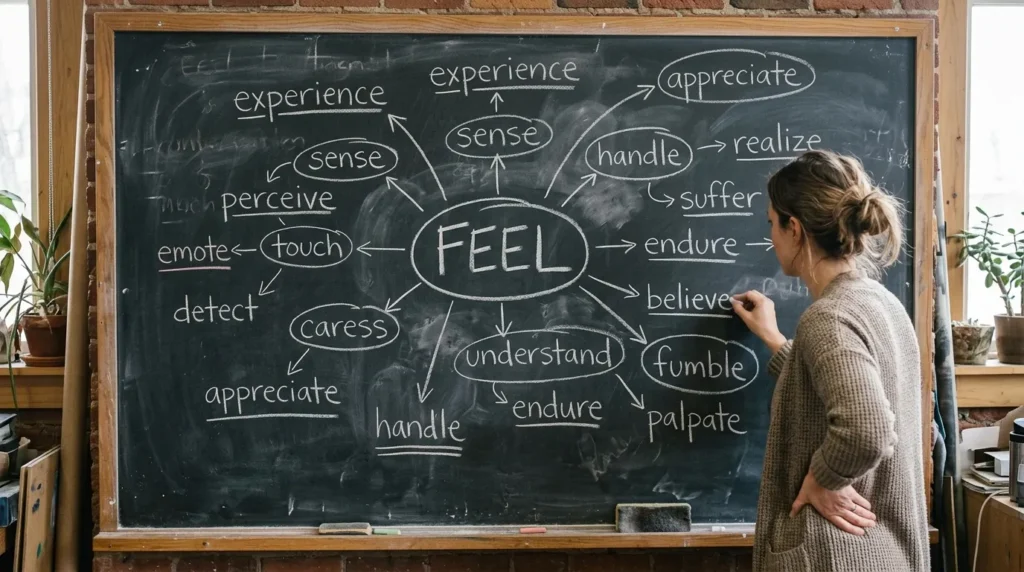
Quick Answer: What Are Synonyms for Feel?
Common synonyms for feel include sense, experience, perceive, notice, believe, think, seem, touch, and experience emotionally. The best alternative depends on the meaning. Use sense for an impression, experience for an emotion or event, believe for an opinion, and touch for physical contact. Since feel has several meanings, no single synonym works in every sentence.
Quick Synonym List for Feel
Choose from these alternatives based on what you want to express.
Experience: Have an emotion, sensation, or event happen to you.
Sense: Become aware of something through the senses or intuition.
Perceive: Become aware of or interpret something.
Notice: Become aware of something.
Detect: Discover the presence of something.
Recognize: Identify or acknowledge something.
Touch: Make physical contact with something.
Handle: Touch or hold something, often to examine it.
Examine: Inspect something carefully.
Grope: Search by touch, often without seeing clearly.
Experience emotionally: Undergo an emotional state.
Undergo: Experience a process, change, or condition.
Suffer: Experience pain, distress, or hardship.
Enjoy: Experience pleasure or satisfaction.
Savor: Enjoy an experience or sensation fully.
Sustain: Experience or endure something over time.
Endure: Continue through pain or difficulty.
Believe: Accept something as true.
Think: Hold an opinion or consider an idea.
Suppose: Believe something is likely or possible.
Consider: Think carefully about an idea or possibility.
Suspect: Believe something may be true without certainty.
Assume: Accept something as true without full proof.
Imagine: Form an idea or mental picture.
Sense intuitively: Recognize something without clear evidence.
Seem: Give a particular impression.
Appear: Give the impression of being something.
Sound: Give a particular impression when heard or described.
Resemble: Have a similar appearance or quality.
Perceive emotionally: Interpret something through an emotional response.
React: Respond emotionally or physically to something.
Respond: React to a situation or stimulus.
Connect with: Feel an emotional relationship with someone or something.
Relate to: Understand or identify with an experience.
Empathize: Understand or share another person’s feelings.
Appreciate: Recognize the value or significance of something.
Experience firsthand: Encounter something personally.
Be aware of: Know or recognize that something exists.
Be conscious of: Be aware of something.
Be affected by: Experience an impact from something.
Be moved by: Feel a strong emotional response.
Be troubled by: Feel worried or distressed about something.
Be pleased by: Feel satisfaction or happiness because of something.
Be overwhelmed by: Experience an emotion or situation very intensely.
Feel inclined to: Have a tendency or desire to do something.
These words have different grammatical patterns and meanings. For example, you can feel cold, believe an argument, touch a surface, or seem tired. Replacing feel without considering the sentence can change its meaning.
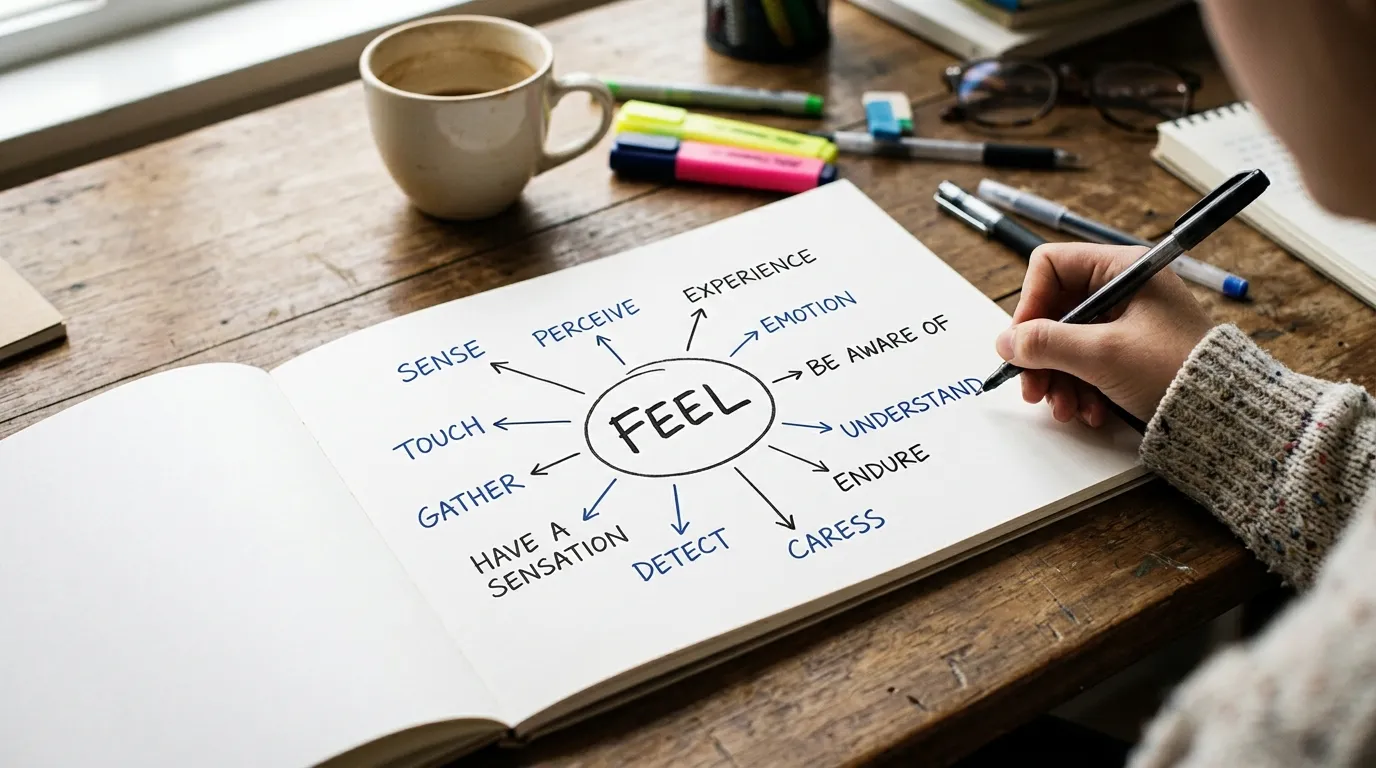
What Does Feel Mean?
Feel is a versatile English verb. It can describe physical sensations, emotional states, physical contact, opinions, or impressions. It can also function as a noun, as in “a feeling of relief” or “the feel of the fabric.”
Its main meanings include:
Physical sensation: Experiencing something such as warmth, pain, pressure, or softness.
Emotion: Experiencing happiness, sadness, fear, excitement, or another feeling.
Opinion or belief: Expressing what you think about a situation.
Intuition or awareness: Sensing that something is true without knowing exactly why.
Physical contact: Touching something to learn about its texture, shape, or condition.
Impression or atmosphere: Describing the character or mood of a place, object, or situation.
Examples:
Physical: I feel cold.
Emotional: She feels nervous before presentations.
Opinion: I feel that the policy needs improvement.
Intuition: I feel something is wrong.
Touch: Feel the fabric before you buy it.
Atmosphere: The room feels peaceful.
The right synonym depends on which meaning is intended.
Closest Synonyms for Feel
1. Experience
Meaning: To undergo an emotion, sensation, event, or situation.
Example: She experienced a sense of relief after the exam.
How it differs: Experience often refers to an emotion or event as something that happens to you. Feel can describe an immediate sensation or emotional state.
Best for: Formal writing, personal experiences, emotional descriptions, and reports.
Watch out: “I experience cold” may sound less natural than “I feel cold.” Use experience when referring to a broader event or state.
2. Sense
Meaning: To become aware of something through your senses or intuition.
Example: I sensed tension in the room.
How it differs: Sense often suggests awareness without a clear explanation. Feel can describe a direct physical sensation or a specific emotion.
Best for: Intuition, subtle changes, atmosphere, and observations.
Watch out: “I sense pain” can work in certain contexts, but “I feel pain” is more natural for a physical sensation.
3. Perceive
Meaning: To become aware of or interpret something through the senses or the mind.
Example: Employees may perceive the change as unfair.
How it differs: Perceive emphasizes how someone interprets or understands something. Feel is often more personal and conversational.
Best for: Academic writing, psychology, analysis, and formal discussion.
Watch out: Perceive can sound formal in everyday conversation.
4. Believe
Meaning: To accept something as true or likely.
Example: I believe the proposal will benefit the community.
How it differs: Believe clearly expresses a view about truth. Feel can introduce an opinion, but it may also suggest emotion or intuition.
Best for: Arguments, essays, opinions, and professional communication.
Watch out: Use believe when you mean an actual belief, not a physical sensation or emotion.
5. Think
Meaning: To have an opinion or consider an idea.
Example: I think the second option is more practical.
How it differs: Think usually communicates an opinion or reasoning. Feel can suggest a personal judgment based more on intuition or emotion.
Best for: Everyday conversation, essays, discussions, and recommendations.
Watch out: “I think sad” is incorrect. Use “I feel sad” because sad describes an emotional state.
6. Notice
Meaning: To become aware of something through observation or attention.
Example: She noticed a change in his mood.
How it differs: Notice emphasizes becoming aware of something. Feel may describe the sensation or emotion itself.
Best for: Observations, descriptions, and narratives.
7. Touch
Meaning: To make physical contact with a person or object.
Example: Touch the surface to see whether it is smooth.
How it differs: Touch describes contact, while feel can describe contact as well as the sensation that contact produces.
Best for: Physical instructions, texture descriptions, and sensory experiences.
Watch out: “I touched cold” is not a natural substitute for “I felt cold.”
8. Seem
Meaning: To give a particular impression or appear to have a quality.
Example: The plan seems reasonable.
How it differs: Seem describes an impression rather than directly naming an emotion or sensation. It is often useful when the subject is a situation or object.
Best for: Describing impressions, uncertainty, and appearances.
Watch out: “I seem nervous” means that you appear nervous, while “I feel nervous” describes your actual emotional state.
9. Undergo
Meaning: To experience a process, change, or difficult situation.
Example: The community underwent a major transformation.
How it differs: Undergo is more formal and usually describes a process or event, not an immediate sensation.
Best for: Academic writing, reports, medical contexts, and formal descriptions.
10. Relate to
Meaning: To understand or identify with another person’s experience or situation.
Example: Many readers can relate to the character’s fear of failure.
How it differs: Relate to describes understanding or identifying with someone else’s experience. It does not simply mean experiencing the same emotion.
Best for: Relationships, literature, personal stories, and discussions of empathy.
Synonyms for Feel by Context
Feel Emotions
When feel describes an emotional state, the best alternative often names the emotion more precisely.
Experience: Undergo an emotional state.
Experience emotionally: Feel an emotional response.
Suffer: Experience distress or pain.
Enjoy: Experience pleasure.
Savor: Enjoy something deeply.
React: Respond emotionally to an event.
Be moved by: Experience a strong emotional response.
Be troubled by: Feel concern or distress.
Be pleased by: Feel happiness or satisfaction.
Be overwhelmed by: Experience an emotion with great intensity.
Empathize: Understand or share another person’s feelings.
Connect with: Feel an emotional bond.
Examples:
Original: She felt happy about the results.
Alternative: She was delighted with the results.
Original: He felt sad after the conversation.
Alternative: He was saddened by the conversation.
Original: I felt worried about the deadline.
Alternative: I was concerned about the deadline.
Tip: When you know the specific emotion, naming it directly is often stronger than replacing feel with another general verb.
Feel Physically
When describing bodily sensations, use words that identify the sensation or the way it is detected.
Sense: Become aware of a physical sensation.
Experience: Undergo a sensation.
Notice: Become aware of a bodily change.
Detect: Identify a physical signal.
Touch: Make physical contact.
Examine: Inspect by touch or another method.
Ache: Experience a dull or persistent pain.
Hurt: Experience pain or cause pain.
Tingle: Experience a slight prickling sensation.
Throb: Experience a rhythmic or pulsing pain.
Burn: Experience a burning sensation.
Tremble: Shake slightly, often because of cold, fear, or excitement.
Examples:
Original: I feel pain in my shoulder.
Alternative: My shoulder aches.
Original: She felt the fabric.
Alternative: She touched the fabric to check its texture.
Original: He felt a tingling sensation in his fingers.
Alternative: His fingers tingled.
These are not universal synonyms. Ache, burn, and tingle describe particular sensations, so use them only when they accurately fit.
Feel That Something Is True
When feel introduces an opinion, belief, or intuition, choose a word that communicates your level of certainty.
Think: Have an opinion.
Believe: Accept something as true.
Suppose: Consider something likely.
Assume: Accept something without full proof.
Suspect: Believe something may be true.
Sense: Become intuitively aware.
Perceive: Interpret something in a particular way.
Consider: Think carefully about something.
Gather: Infer from available information.
Conclude: Reach a judgment after considering evidence.
Examples:
Original: I feel that this decision is unfair.
Alternative: I believe this decision is unfair.
Original: I feel something is wrong.
Alternative: I sense that something is wrong.
Original: I feel he may be mistaken.
Alternative: I suspect he may be mistaken.
Important: Believe, suspect, and conclude express different levels or kinds of certainty. A conclusion usually suggests reasoning or evidence, while a suspicion can be less certain.
Feel in Academic Writing
In academic writing, replacing feel with a precise verb can make an argument clearer.
| Alternative | Meaning | Example |
|---|---|---|
| Believe | Accept as true | The authors believe the findings are significant. |
| Argue | Present a reasoned position | The researchers argue that the policy needs revision. |
| Suggest | Indicate a possibility or interpretation | The results suggest a link between the variables. |
| Perceive | Interpret or become aware of | Participants perceived the process as unfair. |
| Experience | Undergo a condition or event | Students experienced increased stress. |
| Report | State or describe information | Participants reported feeling anxious. |
| Indicate | Point to or show something | The results indicate a change in behavior. |
| Conclude | Reach a judgment based on reasoning | The authors conclude that further research is needed. |
| Sense | Become aware of something | Participants sensed tension during the discussion. |
| Regard | Consider or view in a particular way | Respondents regarded the policy as ineffective. |
Academic writing tip: “The evidence suggests that…” is usually more precise than “The evidence feels like…”. Evidence does not literally feel; it supports, indicates, suggests, or fails to support a claim.
Feel the Atmosphere of a Place
Sometimes feel describes the character or mood of a place, event, or experience.
Seem: Give a particular impression.
Appear: Look or present itself in a certain way.
Have the atmosphere of: Possess a particular mood or character.
Resemble: Have qualities similar to something else.
Evoke: Bring a feeling or memory to mind.
Radiate: Give off a strong quality or emotion.
Exude: Display a noticeable quality.
Suggest: Give an impression of something.
Examples:
Original: The café feels welcoming.
Alternative: The café has a welcoming atmosphere.
Original: The house feels old-fashioned.
Alternative: The house has an old-fashioned character.
Original: The room feels peaceful.
Alternative: The room radiates calm.
These alternatives shift the sentence from a personal sensation to a description of the place itself.
Feel Synonyms: Comparison Table
| Word | Main meaning | Tone | Can it replace feel? |
|---|---|---|---|
| Experience | Undergo a state or event | Neutral | Often, for emotions and events |
| Sense | Become aware through sensation or intuition | Neutral | Often, for impressions |
| Perceive | Interpret or become aware of | Formal | In certain contexts |
| Believe | Accept as true | Neutral | For opinions, not sensations |
| Think | Hold an opinion | Conversational | For opinions |
| Notice | Become aware of something | Neutral | For observations |
| Touch | Make physical contact | Neutral | For physical contact only |
| Seem | Give an impression | Neutral | For appearances, not actual emotions |
| Undergo | Experience a process or condition | Formal | For events or changes |
| Relate to | Identify with an experience | Conversational | For empathy or identification |
| Suffer | Experience distress or pain | Strong | For unpleasant experiences |
| Enjoy | Experience pleasure | Positive | For pleasurable experiences |
| Empathize | Understand another person’s feelings | Neutral or formal | For emotional understanding |
| Evoke | Bring a feeling or memory to mind | Formal | For creating an emotional response |
| Conclude | Reach a judgment | Formal | For reasoned opinions |
How to Choose the Best Synonym for Feel
Ask yourself what feel means in your sentence.
Are you describing an emotion? Name the emotion, such as fear, joy, relief, or frustration.
Are you describing physical contact? Use touch, handle, or examine.
Are you describing a bodily sensation? Use ache, hurt, tingle, or sense, depending on the sensation.
Are you expressing an opinion? Use think, believe, consider, or argue.
Are you describing intuition? Use sense or suspect.
Are you describing an impression? Use seem, appear, or give the impression.
Are you describing a personal event? Use experience or undergo.
Are you describing understanding another person? Use relate to or empathize.
Are you writing an academic argument? Use suggest, indicate, report, or conclude when appropriate.
Are you describing a place’s mood? Use have the atmosphere of, evoke, or radiate.
The most effective replacement often changes the whole sentence. Instead of searching for a single synonym, identify the exact emotion, sensation, opinion, or impression you want to communicate.
10 Before-and-After Sentence Transformations
1. Expressing an Opinion
Before: I feel that the plan will work.
After: I believe the plan will work.
Why: Believe clearly communicates an opinion about what is likely to happen.
2. Describing an Emotion
Before: She felt happy when she received the news.
After: She was delighted when she received the news.
Why: Delighted communicates a stronger and more specific positive emotion.
3. Describing Physical Pain
Before: My back feels painful after work.
After: My back aches after work.
Why: Aches is a more natural verb for a dull or persistent pain.
4. Describing Intuition
Before: I feel that something is wrong.
After: I sense that something is wrong.
Why: Sense emphasizes intuition or awareness without a clear explanation.
5. Describing a Place
Before: The room feels peaceful.
After: The room has a peaceful atmosphere.
Why: The revised sentence directly describes the mood of the room.
6. Describing an Opinion in an Essay
Before: I feel that social media affects communication.
After: I argue that social media affects communication.
Why: Argue that presents a position for discussion. Use it when the essay develops reasons to support the claim.
7. Describing a Physical Sensation
Before: I felt a sharp pain in my hand.
After: A sharp pain shot through my hand.
Why: The revision gives a more vivid description of the sensation.
8. Describing Empathy
Before: I feel what other people are going through.
After: I empathize with what other people are going through.
Why: Empathize with emphasizes understanding another person’s emotional experience.
9. Describing an Impression
Before: The explanation feels confusing.
After: The explanation seems confusing.
Why: Seems describes the impression the explanation creates. If you mean that you personally cannot understand it, “I find the explanation confusing” may be clearer.
10. Describing a Reaction
Before: He felt angry when he heard the accusation.
After: He became angry when he heard the accusation.
Why: Became angry emphasizes the change into an emotional state.
Common Mistakes When Using Synonyms for Feel
1. Treating all synonyms as interchangeable
Feel, believe, touch, and experience have different meanings.
Better approach: Identify whether the sentence describes a sensation, emotion, opinion, or action.
2. Using think when describing an emotion
“I think sad” is not standard English when you mean that you are experiencing sadness.
Better approach: Say “I feel sad” or “I am sad.”
3. Using feel when a more specific emotion would be clearer
“She felt bad” does not explain whether she felt guilty, disappointed, sick, or upset.
Better approach: Name the specific feeling when you know it.
4. Confusing feel with seem
“I feel tired” describes your experience. “I seem tired” means you appear tired to yourself or others.
Better approach: Use feel for the internal state and seem for an impression or appearance.
5. Using believe for physical sensations
“I believe cold” does not communicate the same meaning as “I feel cold.”
Better approach: Use feel or experience for physical sensations.
6. Overusing feel in academic writing
Repeating “I feel that” can make an argument sound personal rather than analytical.
Better approach: Use argue, suggest, indicate, or conclude when those verbs accurately describe your reasoning.
7. Confusing sensing with knowing
“I sense that he is upset” suggests an impression. “I know that he is upset” expresses greater certainty.
Better approach: Match the verb to the evidence and your confidence.
8. Replacing feel with a formal word unnecessarily
“Experience a sensation of warmth” may sound less natural than “feel warm” in everyday writing.
Better approach: Choose the simplest word that communicates your meaning clearly.
Grammar and Usage: How to Use Feel Correctly
Feel can function as a linking verb, an action verb, and a noun. Its meaning and grammar depend on how it is used.
1. Feel + adjective
Use feel with an adjective to describe a physical or emotional state.
I feel tired.
She feels confident.
The fabric feels soft.
We felt nervous before the presentation.
In these examples, feel connects the subject with a description of its state.
2. Feel + noun
Use feel with a noun to describe a sensation, emotion, or opinion.
I feel pain in my shoulder.
She felt relief after the exam.
He felt a strong sense of responsibility.
3. Feel that + clause
Use this pattern to express an opinion, belief, or impression.
I feel that the decision was unfair.
They feel that the policy should change.
She felt that something was missing.
In formal writing, believe, argue, or consider may communicate the intended meaning more directly.
4. Feel like + noun or gerund
Use feel like to express a desire, impression, or resemblance.
I feel like a break would help.
She feels like going for a walk.
It feels like winter today.
Do not confuse “I feel like going” with “I feel that I should go.” The first usually expresses a desire; the second expresses a belief or judgment.
5. Feel + object
Use feel as an action verb when touching something or exploring it by touch.
Feel the fabric.
She felt the wall for a switch.
The doctor felt the patient’s pulse.
In these examples, touch may replace feel when the emphasis is on contact rather than examining or sensing something.

Common collocations with feel
| Phrase | Example |
|---|---|
| Feel happy | I feel happy with the outcome. |
| Feel confident | She feels confident about the interview. |
| Feel nervous | He felt nervous before speaking. |
| Feel pain | I feel pain in my wrist. |
| Feel pressure | Employees may feel pressure to meet deadlines. |
| Feel responsible | She feels responsible for the team’s success. |
| Feel strongly about | They feel strongly about protecting the environment. |
| Feel at ease | The guests felt at ease in the welcoming room. |
| Feel connected to | He feels connected to his community. |
| Feel a sense of relief | We felt a sense of relief after the announcement. |
Grammar tip: The past tense of feel is felt, not feeled. The present participle is feeling: “I am feeling better today.”
Frequently Asked Questions
1. What is the best synonym for feel?
There is no single best synonym for every meaning. Experience works for emotions and events, sense for intuition, believe for opinions, and touch for physical contact.
2. What is a formal word for feel?
Perceive, experience, undergo, and regard can work in formal contexts. For academic arguments, suggest, indicate, or conclude may be more precise when discussing evidence or reasoning.
3. What is another word for feel emotionally?
Depending on the emotion, use experience, suffer, enjoy, empathize, react, or be moved by. For greater precision, name the emotion itself, such as fear, joy, disappointment, or relief.
4. What is a synonym for feel in an essay?
Use believe for a belief, argue for a position supported by reasons, suggest for a possible interpretation, and experience for an event or emotional state. The best option depends on the sentence.
5. What is another word for feel physically?
Sense, experience, notice, touch, ache, hurt, and tingle can work in different situations. Use ache for a dull pain and touch for physical contact.
6. What is the difference between feel and sense?
Feel can describe physical sensations, emotions, opinions, or impressions. Sense usually emphasizes becoming aware of something through the senses or intuition, often without direct or complete evidence.
7. How can I avoid repeating the word feel?
Use the specific emotion, sensation, or thought whenever possible. Instead of “She felt happy,” write “She was delighted.” Instead of “I feel that this is unfair,” write “I believe this is unfair” or “I consider this unfair,” depending on your meaning.
Editor’s Choice: The Best Alternatives to Feel
Experience — best for emotions, events, and personal situations.
Sense — best for intuition and subtle impressions.
Believe — best for expressing a view or opinion.
Perceive — best for formal descriptions of awareness or interpretation.
Name the emotion directly — best for vivid, precise writing, such as delighted, anxious, frustrated, or relieved.
For most everyday sentences, feel is already natural and clear. Replace it only when another word makes the meaning more precise.
Key Takeaways
Feel can describe physical sensations, emotions, opinions, intuition, touch, and atmosphere.
Experience, sense, perceive, believe, and think are useful alternatives, but they express different meanings.
For emotional writing, naming the exact emotion is often clearer than using a general verb.
In academic writing, choose argue, suggest, indicate, or conclude only when the verb accurately reflects your reasoning or evidence.
Do not replace feel just to avoid repetition; clarity and natural phrasing matter more than variety.