
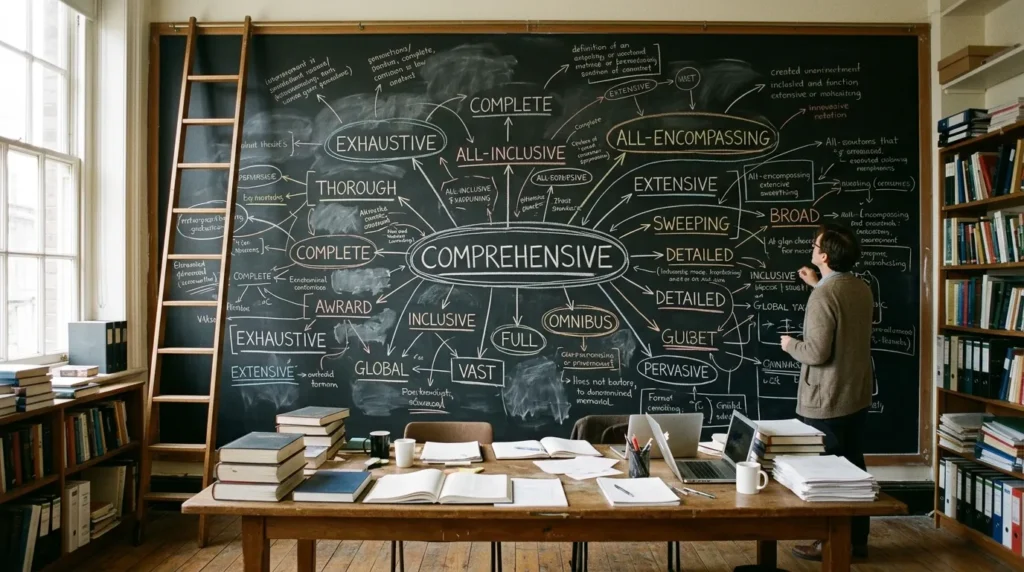
The best synonym for comprehensive depends on what you want to describe. If something covers every important part of a subject, thorough, complete, or all-inclusive may fit. If it contains a lot of information, detailed or extensive may be more accurate. In academic and professional writing, choosing the right alternative helps you communicate the scope and depth of your work.
This guide explains the most useful synonyms for comprehensive, shows how they differ, and helps you choose a word that fits your sentence naturally.
Quick Answer: What Are the Best Synonyms for Comprehensive?
The best synonyms for comprehensive include thorough, complete, detailed, extensive, inclusive, exhaustive, broad, wide-ranging, and all-encompassing. Use thorough when something examines a subject carefully, complete when nothing important is missing, and detailed when it provides specific information. Choose exhaustive when the coverage is exceptionally extensive, and inclusive when people, perspectives, or groups are represented.
Quick List of Synonyms for Comprehensive
Choose an alternative based on the kind of coverage you want to emphasize.
Meaning: covering all important parts
Complete
Thorough
All-inclusive
All-encompassing
Entire
Full
Total
Inclusive
Meaning: covering a wide range
Extensive
Broad
Wide-ranging
Far-reaching
Sweeping
Expansive
Broad-based
General
Meaning: containing many details
Detailed
In-depth
Elaborate
Informative
Well-documented
Thoroughly researched
Carefully prepared
Meaning: examining every relevant part
Exhaustive
Meticulous
Rigorous
Systematic
Holistic
Complete
In-depth
Formal and academic alternatives
Extensive
Thorough
In-depth
Exhaustive
Holistic
All-encompassing
Systematic
Wide-ranging
Not every word is interchangeable with comprehensive. For example, detailed emphasizes the amount of information, while inclusive emphasizes who or what is included. The right synonym depends on the sentence.
What Does Comprehensive Mean?
Comprehensive is an adjective that describes something that covers a subject, task, or set of information broadly and thoroughly, including all or most important parts.
Examples:
“The report provides a comprehensive overview of the problem.”
“Students must complete a comprehensive examination.”
“The company introduced a comprehensive training program.”
The word often suggests both breadth and sufficient depth. A comprehensive report covers the main aspects of a subject, while a comprehensive review examines the relevant evidence and details.
However, comprehensive does not always mean absolutely everything. The exact meaning depends on the subject and the expectations of the task.
Closest Synonyms for Comprehensive
1. Thorough
Thorough means careful and complete, with attention to all important parts of a task or subject.
Example: “The inspector conducted a thorough examination of the building.”
Best for: Reviews, inspections, research, investigations, and explanations.
How it differs: Thorough emphasizes care and depth. Comprehensive often emphasizes the range of topics covered.
2. Complete
Complete means having all the necessary parts or leaving nothing important unfinished or missing.
Example: “Please submit a complete list of your expenses.”
Best for: Lists, records, documents, forms, and finished tasks.
How it differs: Complete focuses on whether anything is missing. Comprehensive often focuses on the range and coverage of the information.
3. Detailed
Detailed means containing many specific facts, descriptions, or pieces of information.
Example: “The guide offers detailed instructions for setting up the software.”
Best for: Reports, instructions, descriptions, research, and explanations.
How it differs: Something can be detailed without covering every major aspect of a subject. Comprehensive emphasizes broader coverage.
4. Extensive
Extensive means large in range, amount, or scope.
Example: “The team conducted extensive research before making a decision.”
Best for: Research, experience, damage, resources, and large-scale projects.
How it differs: Extensive emphasizes size or range, not necessarily completeness or careful examination.
5. Exhaustive
Exhaustive means covering every relevant possibility, detail, or aspect, or examining a subject with exceptional thoroughness.
Example: “The researchers performed an exhaustive review of the available evidence.”
Best for: Research reviews, investigations, lists, and formal analysis.
How it differs: Exhaustive is often stronger than comprehensive. It suggests that very little relevant material has been left out.
6. All-inclusive
All-inclusive means including everything relevant within a defined group, package, or scope.
Example: “The resort offers an all-inclusive vacation package.”
Best for: Packages, plans, services, costs, and lists of included items.
How it differs: All-inclusive often emphasizes what is included, while comprehensive can emphasize how fully a subject is covered.
7. Wide-ranging
Wide-ranging means covering many different subjects, areas, or topics.
Example: “The committee held wide-ranging discussions about education reform.”
Best for: Discussions, policies, research, reviews, and interviews.
How it differs: Wide-ranging emphasizes variety and breadth, but it does not necessarily suggest deep analysis of each topic.
8. In-depth
In-depth means examining a subject in considerable detail.
Example: “The article provides an in-depth analysis of climate policy.”
Best for: Analysis, interviews, research, reviews, and explanations.
How it differs: In-depth emphasizes depth rather than broad coverage. An in-depth article can focus on one narrow issue.
9. Inclusive
Inclusive means making sure relevant people, groups, ideas, or perspectives are included.
Example: “The organization developed an inclusive approach to employee training.”
Best for: Education, workplaces, public policy, accessibility, and community programs.
How it differs: Inclusive focuses on participation and representation. It does not automatically mean that every aspect of a topic is covered.
10. All-encompassing
All-encompassing means covering or including nearly everything within a particular scope.
Example: “The course provides an all-encompassing introduction to digital marketing.”
Best for: Broad strategies, theories, plans, and descriptions of scope.
How it differs: All-encompassing is often more emphatic than comprehensive and can sound overstated if the coverage is not genuinely broad.
11. Holistic
Holistic means considering a whole system or situation rather than looking at its parts separately.
Example: “The school adopted a holistic approach to student development.”
Best for: Healthcare, education, organizational planning, and complex problems.
How it differs: Holistic emphasizes how parts relate to the whole. It does not necessarily mean every detail has been covered.
12. Systematic
Systematic means organized and carried out according to a planned method.
Example: “The team used a systematic process to evaluate each application.”
Best for: Research, testing, investigations, and procedures.
How it differs: Systematic describes the method or organization of the work, not how much information it includes.
Synonyms for Comprehensive by Context
The best replacement often depends on the type of document, task, or idea you are describing.
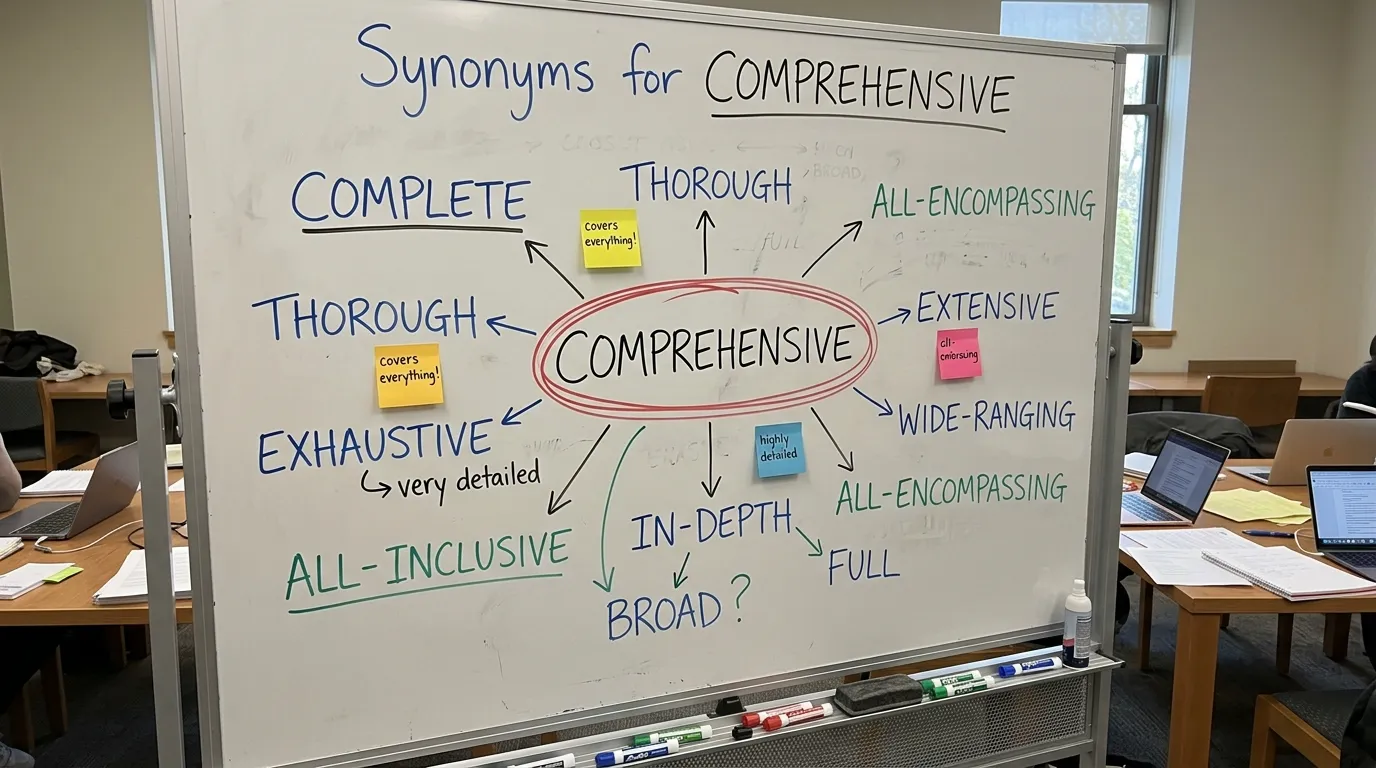
Synonyms for a comprehensive report
When describing a report, choose a word that reflects its coverage, evidence, or level of detail.
| Synonym | Meaning | Best use |
|---|---|---|
| Thorough | Carefully covers important aspects | Evaluations and investigations |
| Detailed | Includes specific information | Findings and instructions |
| Extensive | Covers a broad range or large amount | Research and analysis |
| In-depth | Examines issues closely | Analytical reports |
| Exhaustive | Covers nearly every relevant aspect | Evidence reviews |
| Well-documented | Supported by records or evidence | Research and formal reports |
| Wide-ranging | Includes many different topics | Policy and industry reports |
Examples:
Original: “The team prepared a comprehensive report.”
Alternative: “The team prepared a detailed report.”
Use detailed if the report contains many specific facts. Use thorough if the emphasis is on careful examination.
Synonyms for comprehensive research
Research may be comprehensive because it covers many sources, examines a topic carefully, or follows a structured method.
Thorough research: Research that examines the relevant evidence carefully.
Extensive research: Research involving a large amount of work or a broad range of sources.
In-depth research: Research that investigates a subject closely.
Exhaustive research: Research intended to cover every relevant source or possibility within a defined scope.
Systematic research: Research conducted using a planned, organized method.
Wide-ranging research: Research that considers many topics or areas.
Examples:
“The author conducted extensive research into the subject.”
“The team carried out a systematic review of the evidence.”
“The article presents an in-depth examination of the issue.”
Usage note: Do not call research exhaustive unless the scope supports that claim. Thorough or extensive may be more accurate.
Synonyms for a comprehensive guide
A guide can be comprehensive because it covers the main topics, gives detailed instructions, or helps readers understand a subject from several angles.
| Synonym | Best meaning | Example |
|---|---|---|
| Complete | Contains all necessary sections | “A complete guide to applying for college” |
| Detailed | Explains steps and specifics | “A detailed guide to using the software” |
| In-depth | Explores the subject closely | “An in-depth guide to personal finance” |
| All-inclusive | Includes all relevant components | “An all-inclusive guide to the course” |
| Thorough | Covers important points carefully | “A thorough guide to preparing for an interview” |
| Beginner-friendly | Designed for new learners | “A beginner-friendly guide to coding” |
Beginner-friendly is not a direct synonym for comprehensive. It describes the guide’s accessibility, not its scope.
Synonyms for a comprehensive understanding
When describing someone’s understanding of a topic, use terms that emphasize depth, breadth, or command of the subject.
Thorough understanding: A strong understanding of the important parts.
In-depth understanding: Detailed knowledge of a particular subject.
Broad understanding: Knowledge that spans several aspects of a topic.
Well-rounded understanding: Knowledge that includes different perspectives or areas.
Extensive knowledge: A large amount of knowledge about a subject.
Holistic understanding: An understanding of how the parts fit together.
Examples:
“The course gave students a thorough understanding of the process.”
“She has an in-depth understanding of the legal issues.”
“The training helped employees develop a well-rounded understanding of the business.”
Synonyms for a comprehensive approach
When describing a plan or method, choose a term based on how it works.
Holistic approach: Considers the whole system and the relationships among its parts.
Systematic approach: Follows an organized method.
Integrated approach: Combines different parts or methods into a coordinated whole.
Wide-ranging approach: Addresses many areas or concerns.
Thorough approach: Examines important parts carefully.
All-encompassing approach: Attempts to include every relevant area.
Examples:
“The organization adopted a holistic approach to employee well-being.”
“The researchers used a systematic approach to data collection.”
“The team developed an integrated approach to customer support.”
These alternatives describe different qualities. A method can be systematic without being comprehensive, or holistic without examining every detail.
Synonyms for comprehensive in academic writing
For essays, reports, research papers, and formal analysis, these alternatives are often useful:
Thorough
Extensive
In-depth
Systematic
Exhaustive
Wide-ranging
Holistic
Detailed
Examples:
“This paper provides a thorough review of the literature.”
“The study offers an in-depth analysis of the results.”
“The researchers used a systematic method to collect the data.”
Choose the word that accurately describes the work. Academic writing benefits from precision more than from using formal-sounding vocabulary.
Comprehensive vs. Thorough vs. Complete vs. Extensive
These four words are common alternatives, but each emphasizes a different quality.
| Word | Main meaning | Tone | Interchangeable with comprehensive? |
|---|---|---|---|
| Comprehensive | Covers the important parts of a subject broadly | Formal and neutral | Original word |
| Thorough | Examines important parts carefully | Neutral to formal | Often |
| Complete | Has all required parts | Direct and neutral | Sometimes |
| Extensive | Covers a large range or amount | Neutral to formal | Sometimes |
| Detailed | Contains specific information | Neutral | When detail is the focus |
| Exhaustive | Covers nearly every relevant detail or possibility | Strong and formal | When very broad coverage is intended |
| Holistic | Considers a whole system and its relationships | Formal | When the whole-system perspective matters |
| Systematic | Follows an organized method | Formal | Only when method is the focus |
Consider these examples:
Comprehensive: “The report covers the major causes, effects, and possible solutions.”
Thorough: “The report carefully examines the major causes and effects.”
Complete: “The report includes every required section.”
Extensive: “The report draws on a large number of studies.”
Detailed: “The report explains each step and provides examples.”
Systematic: “The report follows a structured process for evaluating the evidence.”
Each word communicates a different strength. A report can be detailed but narrow, extensive but uneven, or complete without being especially thorough.
How to Choose the Right Synonym for Comprehensive
Use these guidelines to find the best word for your sentence.
Choose thorough when care and depth matter. Best for reviews, checks, investigations, and examinations.
Choose complete when nothing required is missing. Best for forms, records, lists, and finished work.
Choose detailed when specific information matters. Best for instructions, explanations, and reports.
Choose extensive when the scope or amount is large. Best for research, experience, and large projects.
Choose exhaustive when coverage is exceptionally broad. Use it only when the claim is justified.
Choose wide-ranging when many different subjects are covered. Best for discussions, reviews, and policies.
Choose holistic when the parts must be understood together. Best for complex systems, education, and healthcare.
Choose systematic when the method is organized. Best for research and formal procedures.
Choose inclusive when representation or participation matters. Best for programs, policies, and group settings.
If comprehensive already describes the subject accurately, keep it. A synonym should make your meaning more precise, not simply make the sentence sound different.
Before-and-After Examples: Replacing Comprehensive in Sentences
1. A report covering many important areas
Before: “The committee prepared a comprehensive report on school safety.”
After: “The committee prepared a thorough report on school safety.”
Why it works: Thorough emphasizes careful coverage of the important issues.
2. A guide with detailed instructions
Before: “The website offers a comprehensive guide to using the software.”
After: “The website offers a detailed guide to using the software.”
Why it works: Detailed highlights specific instructions and explanations.
3. A list with no missing items
Before: “Please provide a comprehensive list of expenses.”
After: “Please provide a complete list of expenses.”
Why it works: Complete emphasizes that all required expenses are included.
4. Research covering a large amount of material
Before: “The researchers conducted a comprehensive review of previous studies.”
After: “The researchers conducted an extensive review of previous studies.”
Why it works: Extensive highlights the scale and range of the review.
5. An analysis examining a subject closely
Before: “The article provides a comprehensive analysis of the policy.”
After: “The article provides an in-depth analysis of the policy.”
Why it works: In-depth emphasizes detailed examination rather than breadth alone.
6. A method considering the whole person
Before: “The clinic developed a comprehensive approach to patient care.”
After: “The clinic developed a holistic approach to patient care.”
Why it works: Holistic emphasizes the patient’s overall needs and how different factors relate.
7. A process with organized steps
Before: “The team used a comprehensive method to evaluate the applications.”
After: “The team used a systematic method to evaluate the applications.”
Why it works: Systematic emphasizes an organized and consistent process. It does not necessarily mean every possible factor was included.
8. A review covering nearly every relevant detail
Before: “The team completed a comprehensive review of the evidence.”
After: “The team completed an exhaustive review of the evidence.”
Why it works: Exhaustive makes a stronger claim about the extent of the review. Use it only if that claim is accurate.
9. A policy addressing many areas
Before: “The government introduced a comprehensive reform plan.”
After: “The government introduced a wide-ranging reform plan.”
Why it works: Wide-ranging emphasizes the number of areas addressed by the plan.
10. A program including different groups
Before: “The school introduced a comprehensive support program.”
After: “The school introduced an inclusive support program.”
Why it works: Inclusive works if the program is designed to include different students or meet varied needs. It does not necessarily mean the program covers every type of support.
Common Mistakes When Using Synonyms for Comprehensive
1. Treating comprehensive and complete as identical
Complete means all necessary parts are present. Comprehensive usually emphasizes broad coverage of a subject.
A complete form may contain every required field without offering a comprehensive explanation of the topic.
2. Using extensive when you mean detailed
Extensive describes a large range or amount. Detailed emphasizes specific information.
A report can be extensive because it covers many topics but still provide little detail about each one.
3. Using exhaustive for work that is not exhaustive
Exhaustive is a strong claim. It suggests that every relevant possibility, source, or detail within the defined scope has been considered.
If you have not verified that level of coverage, thorough or extensive is safer.
4. Confusing holistic with comprehensive
A holistic approach considers how different parts fit together. It does not automatically cover every topic or detail.
Use holistic when the relationships among parts matter.
5. Using inclusive when you mean complete
Inclusive often refers to participation, access, or representation. It does not necessarily mean that a report or list is complete.
6. Using systematic as a direct replacement
Systematic describes an organized method. A systematic review can still have a narrow scope.
Choose systematic when you want to highlight the process, not the breadth of coverage.
7. Overusing formal alternatives
Words such as exhaustive, all-encompassing, and holistic can make writing sound heavy if simpler language works.
Instead of “an all-encompassing explanation,” you may only need “a complete explanation” or “a detailed explanation.”
8. Replacing comprehensive when it is already precise
“The report provides a comprehensive overview” is clear and natural. You do not need to replace comprehensive simply to avoid repetition.
Use an alternative only when it better expresses the kind of coverage you mean.
Grammar and Usage: How to Use Comprehensive Correctly
Comprehensive is an adjective. It usually appears before a noun or after a linking verb.
Common grammatical patterns
Comprehensive + noun: “The company offers comprehensive training.”
A comprehensive review of: “The paper includes a comprehensive review of the evidence.”
A comprehensive approach to: “They developed a comprehensive approach to waste reduction.”
Comprehensive coverage of: “The guide provides comprehensive coverage of the subject.”
Comprehensive understanding of: “Students developed a comprehensive understanding of the topic.”
Be comprehensive: “The final report must be comprehensive.”
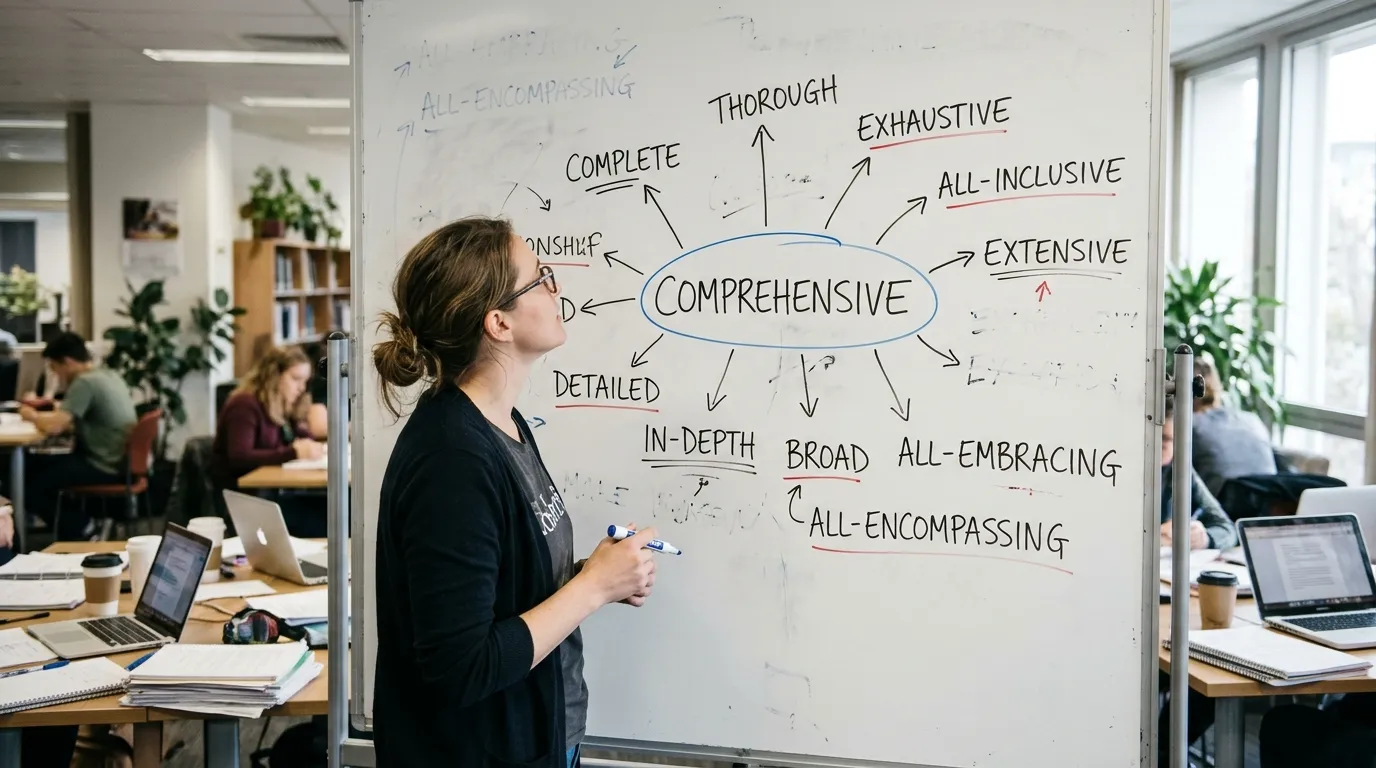
Natural collocations with comprehensive
| Phrase | Example |
|---|---|
| Comprehensive report | “The team submitted a comprehensive report.” |
| Comprehensive analysis | “The study provides a comprehensive analysis of the data.” |
| Comprehensive review | “The panel conducted a comprehensive review of the policy.” |
| Comprehensive guide | “This comprehensive guide explains the application process.” |
| Comprehensive plan | “The city introduced a comprehensive development plan.” |
| Comprehensive assessment | “Each student received a comprehensive assessment.” |
| Comprehensive coverage | “The course offers comprehensive coverage of the subject.” |
| Comprehensive approach | “The company adopted a comprehensive approach to security.” |
| Comprehensive training | “New employees receive comprehensive training.” |
| Comprehensive understanding | “The course helps learners develop a comprehensive understanding of grammar.” |
Usage tip: Comprehensive is common in academic, business, educational, and technical writing. In everyday writing, complete, thorough, or detailed may sound simpler and more natural.
Frequently Asked Questions
1. What is the best synonym for comprehensive?
The best synonym depends on the context. Thorough emphasizes careful examination, complete means nothing required is missing, detailed emphasizes specific information, and extensive emphasizes a large scope.
2. What is a more professional word for comprehensive?
Thorough, extensive, in-depth, systematic, and wide-ranging can work in professional writing. Choose the word that describes the work accurately rather than using a formal alternative just to sound more professional.
3. What is a simple word for comprehensive?
Complete or thorough is often a good choice. Use complete when all necessary parts are present and thorough when something has been examined carefully.
4. What is the difference between comprehensive and exhaustive?
Comprehensive means covering the important parts of a subject broadly. Exhaustive suggests covering every relevant detail or possibility within a defined scope. Exhaustive is usually the stronger claim.
5. What is a synonym for comprehensive in academic writing?
Useful choices include thorough, in-depth, extensive, systematic, and wide-ranging. For example, “a comprehensive review of the literature” may become “a systematic review of the literature” if the review follows a defined method.
6. What is another word for a comprehensive understanding?
You could use thorough understanding, in-depth understanding, broad understanding, well-rounded understanding, or holistic understanding. Each emphasizes a different quality: depth, breadth, balance, or connections among ideas.
7. Is comprehensive the same as detailed?
No. Comprehensive emphasizes coverage of a subject’s important parts, while detailed emphasizes specific information. A comprehensive overview may be broad without explaining every point in detail.
Editor’s Choice: The Best Synonyms for Comprehensive
Thorough: Best for careful reviews, investigations, and examinations.
Complete: Best when every necessary part must be included.
Detailed: Best for instructions, reports, and explanations with specific information.
Extensive: Best for a large scope, quantity, or range.
In-depth: Best for close analysis of a subject.
For academic work, systematic may be best when describing a structured method, while holistic is useful when the relationships among parts matter. If you want a broadly applicable replacement, thorough is often the strongest starting point.
Key Takeaways
Comprehensive means covering the important parts of a subject broadly and thoroughly.
Use thorough for careful examination, complete for all necessary parts, and detailed for specific information.
Choose extensive or wide-ranging when emphasizing the size or breadth of the coverage.
Exhaustive, holistic, inclusive, and systematic have more specific meanings and are not interchangeable in every context.
The best synonym is the one that accurately describes the work, not necessarily the most formal-sounding word.