

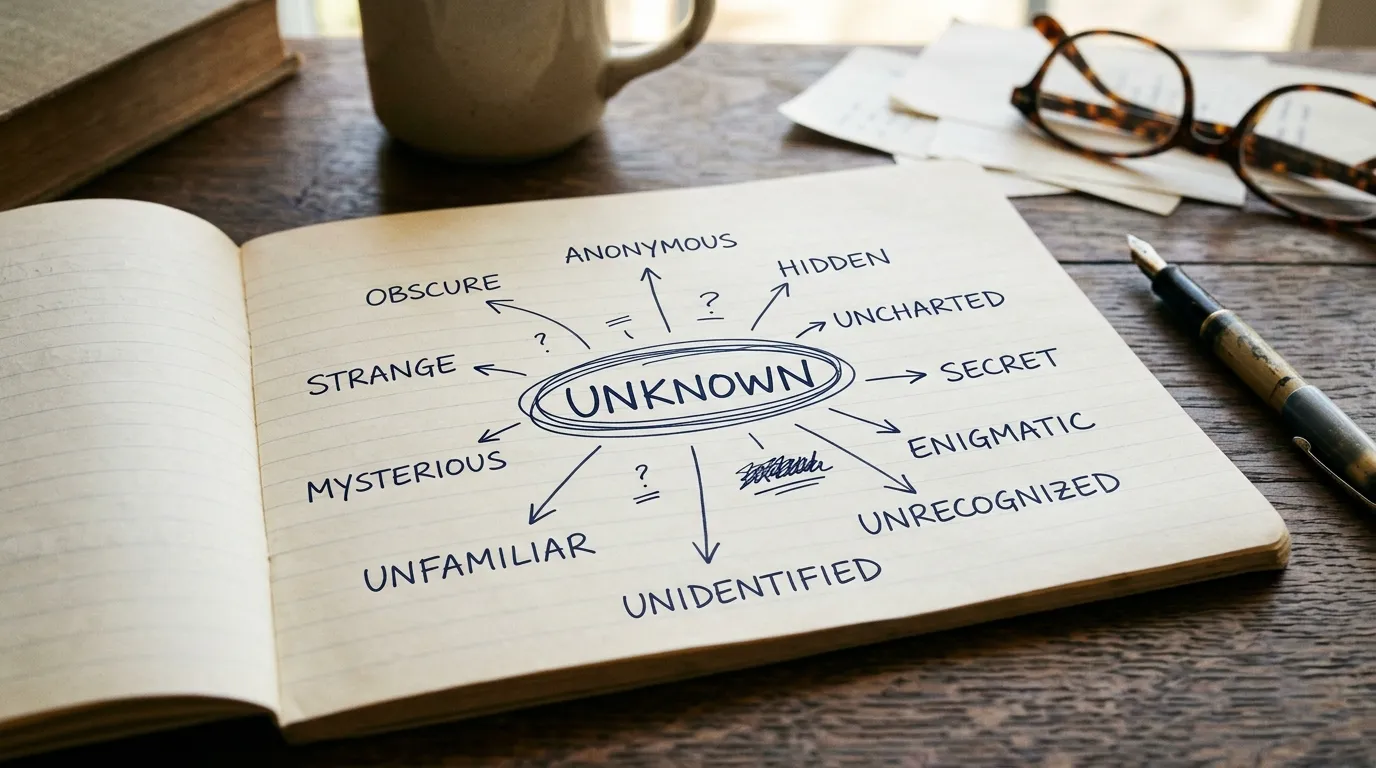
The best synonyms for unknown include unfamiliar, unidentified, unrecognized, obscure, mysterious, undiscovered, unconfirmed, anonymous, and uncertain. The right choice depends on what you mean. Use unidentified when something has not been identified, unfamiliar when something is not known to you, and obscure when something is not widely known or understood.
Quick List of Synonyms for Unknown
Here are useful alternatives to unknown, grouped by meaning and context.
Unfamiliar — not known or recognized by someone
Unidentified — not yet identified
Unrecognized — not acknowledged or identified
Unfounded — not supported by evidence; not a general synonym
Uncertain — not known or definite
Unconfirmed — not verified as true
Undiscovered — not yet found
Unexplored — not yet investigated or visited
Uncharted — not mapped or fully explored
Obscure — not widely known or easily understood
Mysterious — difficult to explain or understand
Enigmatic — puzzling or hard to interpret
Anonymous — having an unknown or undisclosed identity
Unnamed — not given a name
Unspecified — not clearly stated
Unreported — not formally reported
Unrecorded — not documented
Unacknowledged — not recognized or admitted
Unnoticed — not observed or given attention
Unfamiliarized — not commonly used; usually replace with unfamiliar
Hidden — kept out of sight or knowledge
Concealed — deliberately kept secret or out of view
Secret — intentionally kept from others
Unrevealed — not made known
Unpublished — not made publicly available in print or online
Unexplained — lacking an explanation
Unsolved — not yet resolved
Indeterminate — not able to be determined precisely
Undetermined — not yet decided or established
Unpredictable — difficult to foresee
Uncertain — not known with confidence
Unfamiliar to the public — not widely known
Little-known — known by few people
Lesser-known — less famous or less widely recognized
Unpopular — not liked by many; not a synonym for unknown
Not all these words are interchangeable. For example, unknown, unpopular, and unconfirmed describe different things: a person may be unknown but popular, while a claim may be unconfirmed without being mysterious.
What Does Unknown Mean?
Unknown is an adjective that describes a person, thing, fact, place, cause, or situation that is not known, identified, recognized, or understood.
It can refer to several different ideas:
Not identified: The identity of a person or object is not known.
Example: The police questioned an unknown individual.
Not familiar: Someone has little or no knowledge of a person, place, or subject.
Example: We entered an unknown neighborhood.
Not widely recognized: Something has received little public attention or recognition.
Example: The author was unknown before publishing her first novel.
Not established or certain: A fact, result, cause, or outcome has not been determined.
Example: The long-term effects remain unknown.
Mysterious or unexplained: Something is difficult to explain or understand.
Example: The source of the strange sound remains unknown.
Understanding these meanings helps you choose a more precise alternative.
Closest Synonyms for Unknown
These words are among the most useful replacements for unknown, but each emphasizes a different meaning.
1. Unfamiliar
Meaning: Not known, recognized, or experienced by someone.
Use unfamiliar when a person lacks knowledge or experience of something.
Example: The new software may seem unfamiliar to beginners.
How it differs: Unknown can describe something whose identity or existence is not established. Unfamiliar usually focuses on a person’s lack of experience or recognition.
Best for: New places, subjects, people, systems, and experiences.
2. Unidentified
Meaning: Not yet recognized or established as a particular person or thing.
Example: An unidentified object appeared on the radar.
How it differs: Unidentified is more precise than unknown when the specific identity of something has not been determined.
Best for: Police reports, scientific investigations, objects, people, and evidence.
3. Obscure
Meaning: Not widely known, noticed, or understood.
Example: She discovered an obscure book about ancient history.
How it differs: Obscure often means that something is known by only a small group or is difficult to understand. It does not necessarily mean nobody knows about it.
Best for: Literature, history, academic subjects, references, and lesser-known facts.
4. Mysterious
Meaning: Difficult to explain, understand, or identify.
Example: A mysterious light appeared above the hills.
How it differs: Unknown simply indicates a lack of knowledge. Mysterious adds a sense of curiosity, secrecy, or puzzlement.
Best for: Stories, unexplained events, unusual behavior, and strange discoveries.

5. Unrecognized
Meaning: Not identified, acknowledged, or given proper recognition.
Example: The artist’s early work went unrecognized for years.
How it differs: Unrecognized may imply that someone or something has not received the acknowledgment it deserves. Unknown does not necessarily carry that implication.
Best for: Achievements, talent, faces, voices, and contributions.
6. Uncertain
Meaning: Not known, settled, or definite.
Example: The outcome of the investigation remains uncertain.
How it differs: Uncertain emphasizes doubt or a lack of confidence. Unknown emphasizes missing information.
Best for: Results, plans, causes, predictions, and future events.
7. Anonymous
Meaning: Having an identity that is not known or disclosed.
Example: An anonymous donor contributed money to the school.
How it differs: Anonymous specifically concerns identity. An unknown person may have an identity that has simply not been discovered; an anonymous person may deliberately withhold it.
Best for: Donations, surveys, sources, online comments, and confidential reports.
8. Undiscovered
Meaning: Not yet found, noticed, or brought to public attention.
Example: The researchers believe the region contains undiscovered plant species.
How it differs: Undiscovered suggests that something exists but has not yet been found or recognized.
Best for: Places, talents, species, resources, and opportunities.
9. Unconfirmed
Meaning: Not verified or established as true.
Example: Reports of a delay remain unconfirmed.
How it differs: Unconfirmed is appropriate when information has not been verified. It does not mean the information is necessarily false or mysterious.
Best for: News, reports, rumors, claims, and announcements.
10. Enigmatic
Meaning: Difficult to interpret or understand; puzzling.
Example: The writer’s enigmatic message left readers searching for clues.
How it differs: Enigmatic suggests something puzzling or cryptic. It is more literary and formal than unknown.
Best for: Literature, personalities, messages, behavior, and complex ideas.
11. Unexplored
Meaning: Not yet examined, investigated, or visited.
Example: The team traveled into an unexplored part of the forest.
How it differs: Unexplored describes a lack of investigation, not simply a lack of knowledge.
Best for: Research, travel, science, new ideas, and unfamiliar territory.
12. Unspecified
Meaning: Not clearly named, stated, or described.
Example: The meeting was postponed for an unspecified reason.
How it differs: Unspecified means that a detail has not been provided. The detail may be known to someone but omitted from the information.
Best for: Reports, instructions, dates, amounts, and reasons.
Formal and Academic Synonyms for Unknown
In professional or academic writing, the best alternative depends on the type of uncertainty you want to express.
| Alternative | Meaning | Best context |
|---|---|---|
| Unidentified | Identity has not been established | Investigations and reports |
| Undetermined | A result or fact has not been established | Research and analysis |
| Indeterminate | Not precisely measurable or decidable | Technical and scientific writing |
| Unconfirmed | Not verified | News and formal updates |
| Unspecified | A detail has not been stated | Reports and instructions |
| Undocumented | Not recorded in available documentation | Research and historical writing |
| Unreported | Not formally reported | Journalism and administration |
| Unrecognized | Not identified or acknowledged | Professional achievements |
| Unexplored | Not investigated in depth | Research and development |
| Little-known | Not widely known | Academic introductions and general writing |
Examples in formal writing:
Original: The cause of the problem is unknown.
More precise: The cause of the problem remains undetermined.
Original: The source of the data is unknown.
More precise: The data source is unidentified.
Original: The results are unknown.
More precise: The results are unconfirmed pending further testing.
Original: The reason for the change is unknown.
More precise: The reason for the change was unspecified in the report.
Choose the more technical term only when it accurately describes the situation. For general readers, unknown is often clearer.
Synonyms for Unknown by Context
Unknown Person
Use these alternatives when describing someone whose identity, background, or reputation is not known.
Unidentified person — someone whose identity has not been established
Anonymous person — someone whose identity is withheld or undisclosed
Stranger — someone you do not know personally
Unfamiliar person — someone you do not recognize or know well
Nameless person — someone not identified by name
Unrecognized individual — someone not identified or acknowledged
Examples:
An unidentified person left a package outside the building.
An anonymous person submitted the complaint.
A stranger asked me for directions.
These terms are not identical. A stranger is unknown to you, but their identity may be perfectly clear.
Unknown Information or Facts
Use these alternatives when a fact has not been established, verified, or explained.
Undetermined
Unconfirmed
Unspecified
Unverified
Undocumented
Unexplained
Unestablished
Indeterminate
Examples:
The exact cause is undetermined.
The report contains unverified information.
The document gives an unspecified reason for the delay.
The event remains unexplained.
Unknown Place or Territory
Use these terms for places that are unfamiliar, unmapped, or not fully investigated.
Unfamiliar
Unexplored
Uncharted
Undiscovered
Remote
Unmapped
Unvisited
Examples:
The explorers crossed into uncharted territory.
We visited an unfamiliar town.
Scientists are studying an unexplored region of the ocean.
Remote means far away or difficult to reach, not necessarily unknown. A remote location can be well documented.
Unknown Author, Source, or Identity
Use these alternatives when the person behind a work, message, or contribution is not named or disclosed.
Anonymous
Unnamed
Unidentified
Unattributed
Uncredited
Examples:
The poem was published by an anonymous author.
The article includes an unattributed quotation.
The photograph appeared with an uncredited image source.
Unattributed and uncredited are especially useful when a source or creator has not been acknowledged.
Unknown Outcome or Future
Use these words when the result of a situation has not been determined or cannot be predicted confidently.
Uncertain
Undetermined
Unpredictable
Unsettled
Indeterminate
Examples:
The project’s future remains uncertain.
The final result is still undetermined.
Demand may be unpredictable next year.
Unpredictable means difficult to forecast, while unknown may simply mean the outcome has not happened or been revealed yet.
Unknown or Little-Known Person in Public Life
If you mean someone who has little public recognition, consider:
Little-known
Lesser-known
Obscure
Uncelebrated
Unrecognized
Not widely known
Example: The little-known filmmaker gained attention after the festival.
Use unrecognized when the focus is on a lack of acknowledgment, rather than simply a lack of fame.
Comparison Table: Which Synonym for Unknown Should You Choose?
| Word | Main meaning | Tone | Interchangeable with unknown? |
|---|---|---|---|
| Unfamiliar | Not known to someone | Neutral | Sometimes |
| Unidentified | Identity not established | Neutral/formal | Yes, for identity |
| Obscure | Not widely known or understood | Neutral/formal | Sometimes |
| Mysterious | Difficult to explain | Intriguing | Only when mystery is implied |
| Uncertain | Not definite | Neutral | Only for uncertain facts or outcomes |
| Anonymous | Identity withheld or unknown | Neutral/formal | Only for identity |
| Undiscovered | Not yet found | Neutral | Only when discovery is relevant |
| Unconfirmed | Not verified | Formal | Only for unverified information |
| Enigmatic | Puzzling or hard to interpret | Literary/formal | Only when something is puzzling |
| Unexplored | Not investigated | Neutral/formal | Only when investigation is relevant |
| Unspecified | Not stated clearly | Formal | Only for missing details |
| Uncharted | Not mapped or explored | Descriptive | Only for territory or figurative territory |
| Unreported | Not formally reported | Formal | Only for reporting contexts |
| Uncredited | Not acknowledged as the creator or source | Neutral/formal | Only for attribution |
How to Choose the Right Synonym for Unknown
Use this quick decision guide to select a word that fits your sentence.
If you mean you do not know or recognize something, use unfamiliar.
If you mean nobody has established an identity, use unidentified.
If you mean few people know about something, use little-known or obscure.
If you mean something is puzzling or hard to explain, use mysterious or enigmatic.
If you mean a claim has not been verified, use unconfirmed or unverified.
If you mean a result has not been decided, use undetermined.
If you mean a person’s identity is hidden, use anonymous.
If you mean something has not been found yet, use undiscovered.
If you mean a place has not been explored or mapped, use unexplored or uncharted.
If you mean a detail has not been provided, use unspecified.
When none of these distinctions matters, keep unknown. It is short, natural, and widely understood.
Sentence Transformations: Replacing Unknown with More Precise Words
The examples below show how choosing a more specific synonym can improve clarity.
Original: The identity of the caller is unknown.
Revised: The caller is unidentified.
Why: Emphasizes that the caller’s identity has not been established.Original: The subject was unknown to me.
Revised: The subject was unfamiliar to me.
Why: Highlights a lack of personal knowledge.Original: She wrote about an unknown historical figure.
Revised: She wrote about a little-known historical figure.
Why: Suggests that the person is not widely recognized, rather than completely unknown.Original: The cause of the accident is unknown.
Revised: The cause of the accident remains undetermined.
Why: Fits formal reports and investigations.Original: An unknown donor paid for the new library.
Revised: An anonymous donor paid for the new library.
Why: Suggests that the donor’s identity was not disclosed.Original: They entered an unknown part of the forest.
Revised: They entered an unexplored part of the forest.
Why: Emphasizes that the area has not been investigated.Original: The news about the closure is unknown.
Revised: The news about the closure is unconfirmed.
Why: Appropriate if the information has not been verified.Original: The author used an unknown reference.
Revised: The author used an obscure reference.
Why: Suggests that the reference is difficult for most readers to recognize.Original: The future of the company is unknown.
Revised: The company’s future is uncertain.
Why: Focuses on doubt about what will happen.Original: The meaning of the symbol is unknown.
Revised: The meaning of the symbol remains unexplained.
Why: Emphasizes the lack of an explanation.Original: The document gives an unknown reason for the delay.
Revised: The document gives an unspecified reason for the delay.
Why: Makes clear that the reason was not stated.Original: The explorer traveled through unknown waters.
Revised: The explorer traveled through uncharted waters.
Why: A natural expression for waters that have not been mapped; it can also refer figuratively to a new situation.
Common Mistakes When Using Synonyms for Unknown
1. Using unfamiliar when you mean unidentified
Incorrect: The unidentified software was difficult for beginners to use.
If the software is known but new to beginners, write:
Better: The unfamiliar software was difficult for beginners to use.
Use unidentified when its identity has not been established.
2. Treating unknown and mysterious as exact synonyms
Incorrect: The unknown answer made the question exciting.
Better: The mysterious answer made the question exciting.
Use mysterious when something creates curiosity or seems puzzling. Use unknown when you simply lack information.
3. Using anonymous for every unknown person
Incorrect: The police searched for an anonymous suspect whose identity had not yet been established.
Better: The police searched for an unidentified suspect.
Anonymous often implies that a name or identity has been withheld. Unidentified is usually more accurate when investigators have not determined who someone is.
4. Using obscure to mean completely unknown
Incorrect: The identity of the missing person was obscure.
Better: The identity of the missing person was unknown.
Obscure usually describes something not widely known or easily understood. It does not necessarily mean the identity is entirely missing.
5. Confusing unknown with uncertain
Incorrect: The researcher is uncertain to the public.
Better: The researcher is unknown to the public.
Use unknown to describe a lack of public recognition. Use uncertain to describe doubt or a lack of confidence.
6. Using undiscovered when something has only been forgotten
Incorrect: The forgotten historical document was undiscovered by the archivist.
Better: The historical document had been overlooked by the archivist.
Undiscovered usually suggests that something has not yet been found or recognized. Overlooked suggests that someone failed to notice it.
7. Replacing unknown with unconfirmed without evidence
Incorrect: The identity of the painting’s artist is unconfirmed.
This is appropriate only if a proposed identity exists but has not been verified. If no identity is known, use:
Better: The identity of the painting’s artist is unknown.
8. Using overly formal words in everyday writing
Awkward: The details of our weekend destination remain indeterminate.
Better: We have not decided where to go this weekend.
A synonym should make a sentence more precise or natural, not more complicated.
Grammar and Usage: How to Use Unknown Correctly
Unknown as an adjective
Unknown commonly appears before a noun or after a linking verb.
An unknown author wrote the letter.
The cause is unknown.
They discovered an unknown species.
Common expressions with unknown
Unknown to someone: not known by a particular person
The rule was unknown to most students.Of unknown origin: whose source is not known
The package was of unknown origin.For unknown reasons: for reasons that have not been established
The meeting was canceled for unknown reasons.An unknown quantity: a person or thing whose abilities, effects, or characteristics are not yet understood
The new competitor remains an unknown quantity.Into the unknown: into a situation with an uncertain outcome
Starting a new career can feel like stepping into the unknown.The great unknown: something important that remains uncertain
The long-term impact is still the great unknown.
Common collocations with unknown
A collocation is a combination of words that naturally appear together.
| Common phrase | Example |
|---|---|
| Unknown person | An unknown person entered the building. |
| Unknown cause | The unknown cause delayed the investigation. |
| Unknown origin | The artifact was of unknown origin. |
| Unknown source | The information came from an unknown source. |
| Unknown author | The poem’s unknown author remains a mystery. |
| Unknown territory | The team ventured into unknown territory. |
| Unknown outcome | The outcome remains unknown. |
| Unknown risks | Researchers are investigating unknown risks. |
| Unknown factor | An unknown factor affected the results. |
| Unknown quantity | The candidate remains an unknown quantity. |
Frequently Asked Questions
1. What is the best synonym for unknown?
There is no single best synonym for every situation. Unfamiliar works when something is not known to a person, unidentified when an identity has not been established, obscure when something is not widely known, and uncertain when a result is not definite.
2. What is a formal word for unknown?
Undetermined, unidentified, unconfirmed, indeterminate, and unspecified are useful formal alternatives. Choose the one that describes the exact problem: missing identity, unverified information, an undecided result, or an unstated detail.
3. What is another word for unknown in an essay?
For an essay, consider unfamiliar, unidentified, little-known, obscure, undetermined, or unconfirmed. The best choice depends on the sentence. Do not use a more formal word simply to make your writing sound academic.
4. What is a synonym for unknown person?
Common alternatives include unidentified person, stranger, anonymous individual, unnamed person, and unfamiliar person. Use unidentified person when their identity has not been established, and stranger when you mean someone you do not know.
5. What is a positive synonym for unknown?
Undiscovered can have a positive tone when describing hidden talent, new opportunities, or unexplored possibilities. For example, “She has undiscovered talent” suggests potential that has not yet been recognized.
6. What is the difference between unknown and obscure?
Unknown means not known or identified. Obscure usually means not widely known, difficult to understand, or not easily noticed. An obscure book may be known to a small group of readers, while an unknown author may have no established public identity.
7. What is the opposite of unknown?
Depending on the context, antonyms include known, familiar, identified, recognized, established, and confirmed. For example, identified is the opposite of unidentified, while familiar is the opposite of unfamiliar.
Editor’s Choice: The Best Alternatives to Unknown
If you need a quick recommendation, start with these five words:
Unfamiliar — best for something new or not known to someone.
Unidentified — best for a person, object, or source whose identity has not been established.
Obscure — best for a subject, reference, or person that is not widely known.
Uncertain — best for an outcome, future event, or fact that is not definite.
Mysterious — best for something that seems puzzling or difficult to explain.
These choices cover the most common meanings of unknown without forcing unrelated words into the same category.
Key Takeaways
Unknown can describe missing identity, unfamiliarity, limited recognition, or a lack of certainty.
Use unfamiliar for something new to someone and unidentified when its identity has not been established.
Use obscure for something not widely known and mysterious for something puzzling.
Choose unconfirmed for information that has not been verified and undetermined for a result that has not been established.
Keep unknown when it is the clearest, most natural word for your sentence.