
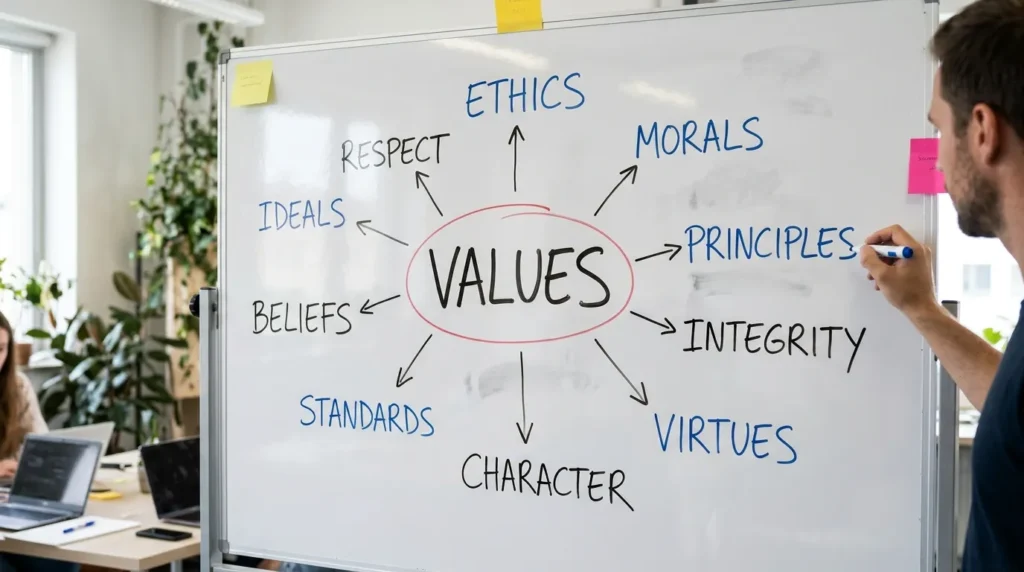
Quick Answer: What Are Synonyms for Values?
Common synonyms for values include principles, beliefs, morals, ethics, ideals, standards, priorities, convictions, worth, and importance. The best alternative depends on the meaning. Use principles for guiding rules, beliefs for ideas someone accepts as true, morals for right and wrong, and worth for monetary or practical value.
Quick Synonym List for Values
The word values has several meanings, so choose a synonym that fits your context.
Principles: Rules or ideas that guide behavior.
Beliefs: Ideas accepted as true.
Morals: Ideas about right and wrong.
Ethics: Standards of acceptable conduct.
Ideals: Standards or goals worth pursuing.
Standards: Levels of quality or acceptable behavior.
Convictions: Strongly held beliefs.
Priorities: Things considered most important.
Virtues: Positive moral qualities.
Creeds: Sets of guiding beliefs.
Tenets: Core principles of a belief system.
Guidelines: Recommendations for behavior or decisions.
Commitments: Principles or goals someone pledges to uphold.
Philosophy: A system of beliefs or guiding ideas.
Code of conduct: Rules for appropriate behavior.
Character traits: Qualities that describe a person’s character.
Integrity: Honesty and consistency in moral behavior.
Respect: Recognition of another person’s worth or rights.
Responsibility: A commitment to fulfilling duties.
Fairness: Treating people impartially.
Compassion: Concern for others’ suffering.
Loyalty: Faithfulness to a person, group, or cause.
Honesty: Truthfulness and sincerity.
Worth: The importance or usefulness of something.
Merit: The quality that makes something deserving of praise or reward.
Importance: The significance of something.
Significance: The meaning or importance of something.
Benefit: An advantage or useful result.
Utility: The usefulness of something.
Price: The amount of money charged for something.
Cost: The amount paid or spent to obtain something.
Market price: The price at which something is traded.
Numerical results: Numbers produced by a calculation or measurement.
Measurements: Quantities determined by measuring.
Data points: Individual pieces of information in a dataset.
Quantities: Amounts of something.
Ratings: Scores used to assess quality or performance.
Scores: Numerical results used for evaluation.
Parameters: Measurable factors or limits in a system.
Indicators: Measurements that provide information about a condition.
Preferences: Choices or options someone favors.
Aspirations: Goals or ambitions someone hopes to achieve.
Tastes: Personal preferences, especially in art, style, or entertainment.
Beloved principles: Guiding ideas someone cares deeply about.
Cultural norms: Shared expectations within a community.
Not all these words are interchangeable. Values can mean moral beliefs, numerical amounts, or the worth of something. A synonym that fits one meaning may be incorrect in another.
What Does Values Mean?
Values is the plural form of value. It can refer to the beliefs that guide behavior, the importance or worth of something, or numerical amounts used in calculations and data.
The word commonly has five meanings.
Personal values: Beliefs and principles that guide a person’s choices, such as honesty, kindness, and responsibility.
Moral or ethical values: Standards that help people decide what is right or wrong.
Social or cultural values: Shared ideas about what a community considers important.
Worth or importance: The usefulness, significance, or monetary worth of something.
Numerical values: Numbers assigned to variables, measurements, calculations, or data points.
Examples:
Personal: Honesty and respect are important values in our family.
Ethical: The organization promotes ethical values.
Cultural: The community’s values emphasize cooperation.
Financial: The property has increased in value.
Mathematical: Substitute the given values into the equation.
The best synonym depends on which meaning you intend.
Closest Synonyms for Values
These alternatives are particularly useful when values refers to beliefs, principles, and standards that guide behavior.
1. Principles
Meaning: Basic rules or ideas that guide decisions and behavior.
Example: Her principles prevent her from taking credit for someone else’s work.
How it differs: Principles usually emphasizes rules that guide actions. Values can include broader beliefs about what matters in life.
Best for: Personal development, leadership, professional conduct, and essays.
Watch out: Use principles when you mean guiding rules, not numerical amounts or market prices.
2. Beliefs
Meaning: Ideas that a person or group accepts as true.
Example: His beliefs influence how he approaches education and community service.
How it differs: Beliefs focuses on what someone thinks is true. Values focuses more on what someone considers important or desirable.
Best for: Personal identity, culture, religion, philosophy, and social discussions.
3. Morals
Meaning: Ideas about right and wrong behavior.
Example: The story explores the morals that guide the main character’s decisions.
How it differs: Morals specifically concerns judgments about right and wrong. Values covers a wider range of priorities and ideals.
Best for: Literature, ethics, personal conduct, and character analysis.
4. Ethics
Meaning: Principles or standards that guide acceptable conduct.
Example: The company established clear ethics policies for handling customer information.
How it differs: Ethics often refers to organized standards of conduct in professional or social settings. Values may be more personal or general.
Best for: Business, medicine, research, law, and professional writing.
5. Ideals
Meaning: Standards, goals, or qualities that someone hopes to achieve.
Example: Equality and freedom are central ideals in the movement.
How it differs: Ideals often describes desired conditions or aspirations. Values may guide everyday decisions even when they are not fully achieved.
Best for: Personal goals, politics, social movements, and academic writing.
6. Standards
Meaning: Accepted levels of quality or rules for behavior.
Example: The school maintains high standards of honesty and academic work.
How it differs: Standards often establish expectations against which behavior or performance is judged. Values explain what people consider important.
Best for: Education, workplace policies, quality control, and organizational culture.
7. Convictions
Meaning: Strongly held beliefs that someone is unlikely to abandon easily.
Example: She stood by her convictions despite pressure from her colleagues.
How it differs: Convictions emphasizes the strength of a belief. Values can include preferences or priorities that are less firmly held.
Best for: Personal narratives, leadership, public debates, and persuasive writing.
8. Priorities
Meaning: The things someone considers most important and gives attention to first.
Example: Family and health are her main priorities.
How it differs: Priorities emphasizes ranking or choosing between competing demands. Values are broader beliefs that may shape those priorities.
Best for: Time management, career planning, personal growth, and decision-making.
9. Virtues
Meaning: Positive moral qualities, such as patience, courage, honesty, and kindness.
Example: Patience and generosity are virtues that strengthen relationships.
How it differs: Virtues describes admirable qualities or habits. Values includes the principles people believe are important, even when those principles are not personal traits.
Best for: Character development, philosophy, ethics, and education.

10. Tenets
Meaning: Core principles or beliefs that form part of a system or philosophy.
Example: Mutual respect is one of the central tenets of the organization.
How it differs: Tenets usually refers to foundational ideas within a belief system, movement, or philosophy. It is more formal than values.
Best for: Academic writing, religion, political theory, and organizational missions.
Synonyms for Values by Context
Personal Values
When discussing the beliefs that shape someone’s choices, relationships, and lifestyle, these alternatives can help.
Principles: Rules that guide behavior.
Beliefs: Ideas accepted as true.
Convictions: Strongly held beliefs.
Priorities: What matters most.
Ideals: Qualities or goals worth pursuing.
Virtues: Positive moral qualities.
Commitments: Goals or principles someone promises to uphold.
Philosophy: A broader system of guiding beliefs.
Character traits: Qualities that describe a person’s character.
Moral compass: A person’s internal sense of right and wrong.
Example:
Original: My values guide the way I treat others.
Alternative: My principles guide the way I treat others.
Another option: My moral compass guides the way I treat others.
Principles is a direct alternative, while moral compass emphasizes the process of making ethical choices.
Moral and Ethical Values
Use these words when discussing right and wrong, fairness, responsibility, or professional conduct.
Morals: Beliefs about right and wrong.
Ethics: Standards for acceptable conduct.
Integrity: Honesty and consistency in actions.
Virtues: Admirable moral qualities.
Standards: Expectations for behavior.
Code of conduct: Formal rules for appropriate behavior.
Duties: Responsibilities a person is expected to fulfill.
Obligations: Moral, legal, or social responsibilities.
Fairness: Impartial treatment.
Accountability: Responsibility for one’s actions.
Example:
Original: The organization promotes strong values among its employees.
Alternative: The organization promotes ethical standards among its employees.
The revised sentence is especially suitable when the focus is on professional behavior.
Cultural and Social Values
When describing the shared beliefs of a community, society, or group, consider these alternatives.
Cultural norms: Shared expectations about behavior.
Social principles: Ideas that guide social conduct.
Traditions: Practices passed down over time.
Customs: Common practices within a community.
Shared beliefs: Ideas accepted by members of a group.
Collective ideals: Goals or standards shared by a community.
Social expectations: Behaviors a group expects from its members.
Community principles: Ideas that guide community life.
Cultural priorities: Things a culture considers important.
Example:
Original: The book explores traditional family values.
Alternative: The book explores traditional family beliefs and expectations.
Be careful with traditions and customs: these refer mainly to practices, not necessarily the underlying beliefs.
Business and Organizational Values
Businesses often use values to describe the principles that guide workplace culture, decision-making, and relationships with customers.
Core principles: Fundamental rules that guide decisions.
Ethical standards: Expectations for responsible conduct.
Organizational principles: Ideas that shape the organization.
Mission commitments: Promises related to the organization’s purpose.
Guiding principles: Rules used to direct decisions.
Corporate philosophy: The organization’s overall approach and beliefs.
Workplace standards: Expectations for employee behavior.
Organizational culture: Shared practices, assumptions, and behaviors in a workplace.
Commitments: Promises the organization intends to honor.
Professional ethics: Standards for responsible professional conduct.
Example:
Original: The company lists integrity, innovation, and teamwork as its core values.
Alternative: The company lists integrity, innovation, and teamwork as its guiding principles.
Organizational culture is broader than values: it includes the way people actually behave, not just the principles an organization states.
Values in Mathematics, Science, and Data
In technical contexts, values often means numbers, measurements, or results. Moral synonyms such as principles and beliefs do not fit here.
Numbers: Mathematical quantities.
Measurements: Quantities obtained by measuring.
Data points: Individual pieces of information.
Results: Outputs from calculations or experiments.
Readings: Measurements recorded by an instrument.
Quantities: Amounts of something.
Variables: Quantities that can change.
Entries: Individual items in a list or dataset.
Parameters: Factors or quantities that define a model or system.
Scores: Numerical results used for evaluation.
Examples:
Original: Enter the values into the formula.
Alternative: Enter the numbers into the formula.
Original: The sensor records temperature values every minute.
Alternative: The sensor records temperature readings every minute.
Original: The dataset contains missing values.
Alternative: The dataset contains missing entries.
Use technical terms carefully. A variable is not the same as a value: a variable can take different values.
Values Meaning Worth or Importance
When value means how useful, important, or financially worthwhile something is, choose an alternative that matches the intended meaning.
Worth: The amount or degree of value something has.
Importance: How significant something is.
Significance: The meaning or importance of something.
Benefit: An advantage gained.
Utility: Usefulness for a particular purpose.
Merit: A quality that deserves recognition.
Usefulness: The ability to serve a purpose.
Price: The amount charged for something.
Cost: The amount spent or required.
Market value: The amount an asset could reasonably sell for in a market.
Examples:
Original: The values of the properties increased.
Alternative: The market prices of the properties increased.
Original: We should recognize the values of community service.
Alternative: We should recognize the benefits of community service.
Original: The values of honesty and trust are often overlooked.
Alternative: The importance of honesty and trust is often overlooked.
These examples show why context matters: financial value, personal values, and the benefits of an action are different concepts.
Values Synonyms: Comparison Table
| Word | Main meaning | Tone | Can it replace values? |
|---|---|---|---|
| Principles | Rules guiding behavior | Neutral or formal | Often, for guiding beliefs |
| Beliefs | Ideas accepted as true | Neutral | Sometimes |
| Morals | Ideas about right and wrong | Ethical | For moral standards |
| Ethics | Standards of acceptable conduct | Formal | For ethical rules |
| Ideals | Desired standards or goals | Positive | Sometimes |
| Standards | Accepted levels or expectations | Neutral | For rules or benchmarks |
| Convictions | Strongly held beliefs | Strong | For firm beliefs |
| Priorities | Things considered most important | Neutral | For ranked concerns |
| Virtues | Admirable moral qualities | Positive | For character qualities |
| Worth | Importance or monetary value | Neutral | For value in the worth sense |
| Benefits | Advantages or positive outcomes | Neutral | For useful effects |
| Measurements | Quantities determined by measuring | Technical | For measured amounts |
| Data points | Individual pieces of data | Technical | For dataset entries |
| Cultural norms | Shared social expectations | Academic | For social values in some contexts |
| Guiding principles | Rules that direct decisions | Formal | Often, in organizations |
How to Choose the Best Synonym for Values
Ask yourself what values means in your sentence.
Are you describing personal beliefs? Use principles, beliefs, or convictions.
Are you discussing right and wrong? Use morals, ethics, or virtues.
Are you describing what matters most? Use priorities or ideals.
Are you talking about expected behavior? Use standards, guidelines, or code of conduct.
Are you describing an organization’s mission? Use core principles or guiding principles.
Are you discussing society or culture? Use cultural norms, shared beliefs, or traditions, depending on the meaning.
Are you talking about money? Use worth, price, cost, or market value.
Are you discussing a calculation or dataset? Use numbers, measurements, readings, or data points.
Are you describing usefulness? Use benefits, utility, or usefulness.
Are you describing personal preferences? Use preferences, tastes, or priorities.
The best substitute is the one that preserves the intended meaning. If the sentence refers to ethical beliefs, changing values to worth would confuse the reader. If it refers to a spreadsheet, changing values to morals would be incorrect.
10 Before-and-After Sentence Transformations
1. Personal Beliefs
Before: Her values influence every important decision she makes.
After: Her principles influence every important decision she makes.
Why: Principles emphasizes the ideas guiding her actions.
2. Moral Behavior
Before: The school teaches students important values.
After: The school teaches students important moral principles.
Why: The revision makes the ethical focus clearer.
3. Workplace Culture
Before: Honesty is one of our company’s core values.
After: Honesty is one of our company’s guiding principles.
Why: This phrasing emphasizes how the company should make decisions and behave.
4. Strong Beliefs
Before: He refused to compromise his values.
After: He refused to compromise his convictions.
Why: Convictions emphasizes firmly held beliefs. Principles would also work if the focus is on rules guiding behavior.
5. Personal Priorities
Before: Her values changed after she became a parent.
After: Her priorities changed after she became a parent.
Why: Use priorities if you mean that she began ranking responsibilities differently. Keep values if her underlying beliefs changed.
6. Cultural Beliefs
Before: The novel explores the values of the community.
After: The novel explores the community’s shared beliefs and social expectations.
Why: This version explains the specific social ideas being examined.
7. Financial Worth
Before: The values of the houses rose last year.
After: The market prices of the houses rose last year.
Why: Market prices is more precise if you mean the amounts buyers would pay.
8. Mathematical Data
Before: Calculate the values of the variables.
After: Calculate the numerical results for the variables.
Why: This wording makes sense when the task is to determine the numbers assigned to variables. In technical writing, “calculate the values of the variables” is already standard and may be preferable.
9. Benefits of an Activity
Before: We should understand the values of regular exercise.
After: We should understand the benefits of regular exercise.
Why: Benefits refers to positive effects, not moral principles.
10. Professional Conduct
Before: The organization expects employees to follow its values.
After: The organization expects employees to follow its ethical standards.
Why: Ethical standards is a more precise choice when the rules concern responsible conduct.
Common Mistakes When Using Synonyms for Values
1. Treating values and beliefs as identical
Beliefs are ideas someone accepts as true. Values are ideas or qualities someone considers important.
Better approach: Use beliefs for what someone thinks is true and values for what guides their choices or priorities.
2. Confusing values with morals
Morals specifically concern right and wrong. Values can also include ambition, creativity, independence, and achievement.
Better approach: Use morals when the ethical meaning is central.
3. Using ethics when you mean personal preferences
Ethics concerns standards of conduct, while preferences are choices someone favors.
Better approach: Use preferences for likes and dislikes and ethics for standards of right conduct.
4. Confusing values with priorities
A value may shape a priority, but the two are not identical. Someone may value health but temporarily prioritize work.
Better approach: Use priorities when describing what receives attention first.
5. Using worth when discussing moral principles
“Honesty and worth guide her decisions” does not mean the same thing as “Honesty and values guide her decisions.”
Better approach: Use principles, beliefs, or values for guiding ideas.
6. Replacing numerical values with moral terms
In mathematics, values refers to quantities or numbers, not ethical beliefs.
Better approach: Use numbers, measurements, or data points when the context is technical.
7. Confusing traditions with values
Traditions are practices passed down through generations. Values are beliefs about what matters.
Better approach: Use traditions for repeated cultural practices and values for the ideas that may influence them.
8. Assuming an organization’s stated values reflect its actual behavior
A company’s published values describe its intended principles, but they do not prove that employees consistently follow them.
Better approach: Distinguish between stated values, guiding principles, and organizational culture when analyzing a business.

Grammar and Usage: How to Use Values Correctly
Values is usually a plural noun, but it can refer to different kinds of things depending on the context.
1. Personal values
Use values to describe beliefs and principles that guide behavior.
My values guide my career decisions.
They share similar values.
Respect and honesty are important values in our family.
2. Values in an organization
Use values to describe the principles an organization promotes.
The company published its core values.
The team discussed the values that shape its workplace culture.
Integrity is one of the organization’s guiding principles.
3. Values in mathematics and data
Use values for numbers assigned to variables, measurements, or recorded data.
Enter the values into the equation.
The table contains several missing values.
The sensor records temperature values every minute.
4. Value as a singular noun
Use value when discussing one amount, principle, or instance of worth.
Honesty is an important value.
The value of the property increased.
The variable has a value of ten.
5. Values as a verb
Values can also be the third-person singular form of the verb value, meaning considers something important or appreciates it.
She values honesty.
The company values customer feedback.
He values the time he spends with his family.
Grammar tip: In “She values honesty,” values is a verb. In “Honesty is one of her values,” values is a plural noun. The surrounding sentence determines the correct meaning.
Common collocations with values
| Phrase | Example |
|---|---|
| Core values | Respect and trust are our core values. |
| Personal values | Her personal values shape her decisions. |
| Moral values | The story explores moral values. |
| Ethical values | Researchers must follow ethical values and standards. |
| Cultural values | Cultural values can vary between communities. |
| Shared values | Shared values can strengthen teamwork. |
| Family values | Their family values emphasize care and responsibility. |
| Numerical values | The numerical values are shown in the table. |
| Market values | The market values of the properties changed. |
| Values and beliefs | The course examines students’ values and beliefs. |
Frequently Asked Questions
1. What is the best synonym for values?
Principles is one of the best alternatives when values refers to ideas that guide behavior. Beliefs works for ideas accepted as true, morals for right and wrong, and priorities for what matters most.
2. What is a formal word for values?
Principles, ethical standards, tenets, convictions, and guiding principles can work in formal writing. Choose based on whether you mean general beliefs, professional conduct, or the core ideas of a particular system.
3. What is another word for personal values?
Useful alternatives include principles, beliefs, convictions, ideals, priorities, and moral compass. Each highlights a slightly different aspect of a person’s guiding ideas.
4. What is a synonym for values in business?
Core principles, guiding principles, ethical standards, and organizational commitments are common alternatives. Organizational culture is broader because it includes shared behaviors and practices, not just stated principles.
5. What is another word for values in mathematics?
Depending on the context, use numbers, measurements, quantities, readings, or data points. In many mathematical contexts, however, values is already the most accurate and standard term.
6. What is the difference between values and principles?
Values describe what someone considers important. Principles are rules or ideas that guide actions. For example, fairness may be a value, while treating people impartially may be a principle based on that value.
7. What is the opposite of values?
There is no single opposite for every meaning of values. For personal values, terms such as lack of principles or disregard for ethics may express the opposite idea. For financial value, worthlessness or lack of value may fit. The correct choice depends on context.
Editor’s Choice: The Best Alternatives to Values
Principles — best for beliefs that guide actions and decisions.
Beliefs — best for ideas someone accepts as true.
Ethical standards — best for professional conduct and right-and-wrong decisions.
Priorities — best for what a person or organization considers most important.
Worth — best for the importance or monetary value of something.
For academic writing, tenets, convictions, or guiding principles may fit more specific contexts. For mathematical and scientific writing, measurements, numbers, or data points may be more precise.
Key Takeaways
Values can refer to personal principles, ethical beliefs, cultural expectations, monetary worth, or numerical amounts.
Principles, beliefs, morals, ethics, and ideals are useful alternatives for different kinds of guiding ideas.
Priorities describes what matters most, while convictions emphasizes strongly held beliefs.
In business, guiding principles and ethical standards may be more precise than values in certain sentences.
In mathematics and data analysis, values is often the clearest term; use numbers, measurements, or data points only when they accurately describe the information.