
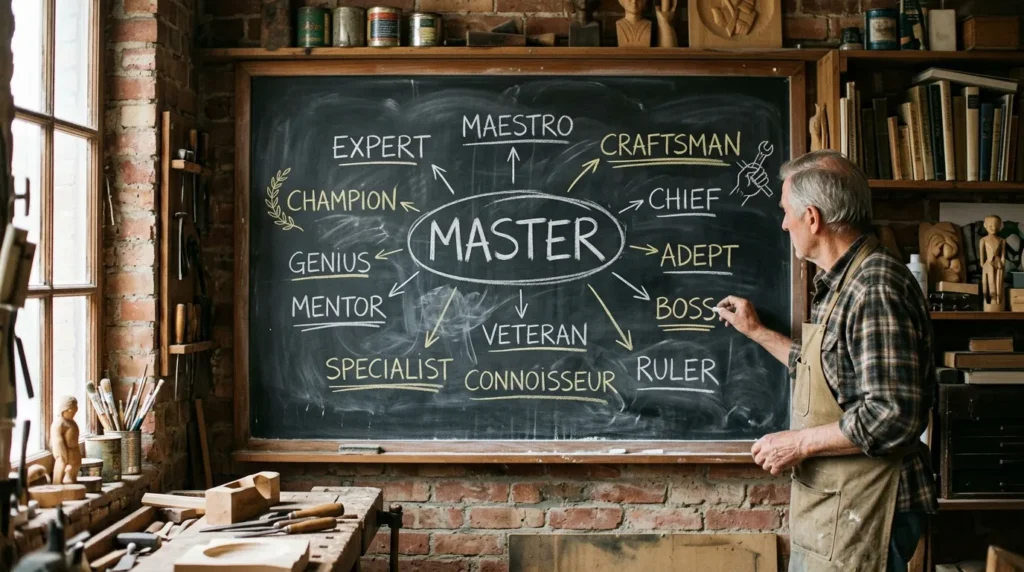
The best synonym for master depends on how you use the word. Expert describes someone with advanced knowledge or skill, excel means to perform exceptionally well, overcome means to succeed against a challenge, and dominate means to exercise strong control or perform better than others. Choosing the right alternative makes your writing clearer and more precise.
Quick Answer: What Are the Best Synonyms for Master?
Some of the best synonyms for master are expert, specialist, authority, learn, acquire, perfect, excel, command, control, dominate, overcome, and conquer. Use expert for a highly skilled person, learn for gaining knowledge, perfect for refining a skill, and overcome for successfully dealing with a challenge.
Quick List of Synonyms for Master
The word master has several meanings, so the best alternatives depend on its grammatical role and context.
As a verb meaning to learn: learn, acquire, understand, grasp, absorb, comprehend
As a verb meaning to become skilled: perfect, hone, develop, refine, excel at
As a verb meaning to control: control, command, govern, direct, manage, dominate
As a verb meaning to overcome: overcome, conquer, surmount, defeat, prevail over
As a noun meaning a skilled person: expert, specialist, professional, authority, virtuoso, maestro
As a noun meaning a person in charge: leader, supervisor, director, commander, owner
As an adjective meaning highly skilled: skilled, accomplished, proficient, adept, experienced
For academic or professional writing: demonstrate proficiency, gain expertise, achieve mastery, develop competence
Not all these words are exact synonyms. For example, learn means to gain knowledge, while master usually suggests a high level of understanding or skill.
What Does Master Mean?
Master can function as a verb, noun, or adjective. Its meaning changes depending on the sentence.
1. Master as a verb
To master something means to learn it thoroughly, become highly skilled at it, or gain control over it.
Examples:
She worked hard to master Spanish.
He mastered the techniques needed for the job.
The team learned to master its emotions under pressure.
2. Master as a noun
A master can be someone with exceptional skill, a person in authority, or someone who controls or owns something. Some uses are historical or specific to a profession.
Examples:
She is a master of classical piano.
The dog responded to its master’s voice.
He became a master craftsman after years of training.
3. Master as an adjective
Master can describe something that serves as an original, controlling, or principal version, such as a master copy or master plan.
Examples:
Save the master copy before editing the document.
The team prepared a master plan for the project.
For this meaning, alternatives such as original, primary, or comprehensive may fit, depending on the phrase.

Closest Synonyms for Master as a Verb
1. Learn
Meaning: To gain knowledge or skill through study, practice, or experience.
Example: She wants to learn how to code.
Best for: Education, new skills, languages, and practical knowledge.
Difference: Learn describes gaining knowledge or skill. Master suggests reaching a high level of proficiency.
2. Acquire
Meaning: To gain or develop something, such as knowledge, a skill, or an ability.
Example: He acquired the technical skills needed for the position.
Best for: Formal writing, education, professional development, and training.
Difference: Acquire emphasizes gaining something. It does not necessarily mean achieving mastery.
3. Perfect
Meaning: To improve something until it reaches a very high standard.
Example: She practiced daily to perfect her presentation.
Best for: Skills, techniques, performances, processes, and creative work.
Difference: Perfect emphasizes refinement and improvement. Master can include learning something from the beginning.
4. Hone
Meaning: To sharpen or improve a skill through practice.
Example: He spent years honing his writing skills.
Best for: Communication, leadership, creative abilities, and professional skills.
Difference: Hone usually means improving an existing ability rather than learning it from scratch.
5. Grasp
Meaning: To understand an idea or concept clearly.
Example: The students quickly grasped the main principle.
Best for: Abstract concepts, instructions, theories, and difficult subjects.
Difference: Grasp focuses on understanding. It does not necessarily imply the ability to apply a skill expertly.
6. Comprehend
Meaning: To understand something fully or clearly.
Example: It took time to comprehend the complexity of the problem.
Best for: Academic writing, reading, analysis, and complex ideas.
Difference: Comprehend is more formal than understand and generally concerns understanding rather than practical skill.
7. Develop
Meaning: To build or improve a skill, ability, or quality over time.
Example: She developed strong negotiation skills through experience.
Best for: Professional growth, education, sports, and personal improvement.
Difference: Develop emphasizes gradual progress, while master suggests a more advanced level of achievement.
8. Command
Meaning: To have a strong understanding or a high level of skill in something; it can also mean to exercise authority.
Example: He has mastered the subject and commands an impressive vocabulary.
Best for: Language ability, knowledge, technical skills, and leadership.
Difference: In the phrase command of a language, the word describes strong proficiency. As a verb meaning to order or direct, it has a different sense.
9. Overcome
Meaning: To successfully deal with a problem, obstacle, or difficulty.
Example: She overcame her fear of public speaking.
Best for: Challenges, fears, setbacks, and difficult situations.
Difference: Overcome means succeeding against a difficulty, not learning a subject or skill.
10. Conquer
Meaning: To defeat or gain control over something difficult.
Example: He worked hard to conquer his fear of heights.
Best for: Challenges, fears, difficult tasks, and obstacles.
Difference: Conquer often sounds stronger or more dramatic than overcome. It is not always appropriate for routine learning.
Synonyms for Master as a Noun: A Skilled Person
When master refers to someone with exceptional ability, these alternatives may fit.
1. Expert
Meaning: Someone with extensive knowledge or skill in a particular area.
Example: She is an expert in digital marketing.
Best for: Professional, academic, and technical contexts.
Difference: Expert is a widely understood, neutral term for someone with advanced knowledge or ability.
2. Specialist
Meaning: Someone who focuses on a particular subject or area of work.
Example: We consulted a cybersecurity specialist.
Best for: Careers, technical fields, medicine, research, and specialized services.
Difference: A specialist is defined by a focused area of expertise; the word does not automatically mean the person has mastered every aspect of that field.
3. Authority
Meaning: A person recognized for extensive knowledge or expertise in a subject.
Example: He is a leading authority on ancient history.
Best for: Research, academic writing, and professional descriptions.
Difference: Authority emphasizes recognition and credibility, not simply personal skill.
4. Virtuoso
Meaning: Someone with exceptional technical skill, especially in music or the arts.
Example: The virtuoso pianist amazed the audience.
Best for: Music, performance, and artistic achievement.
Difference: Virtuoso is more specialized and expressive than expert.
5. Maestro
Meaning: A distinguished musician or conductor; sometimes used figuratively for a highly skilled creator.
Example: The maestro led the orchestra with confidence.
Best for: Music and artistic contexts.
Difference: Maestro is not a general replacement for master in ordinary business or academic writing.
6. Professional
Meaning: Someone who works in a field, often with specialized training or skill.
Example: She handled the negotiation like a professional.
Best for: Work, business, sports, and skilled services.
Difference: A professional may be competent and experienced without being an exceptional master of the craft.
7. Craftsman
Meaning: Someone skilled at making or creating things by hand or through specialized techniques.
Example: The craftsman produced a beautifully detailed wooden table.
Best for: Trades, traditional skills, design, and making things.
Difference: Craftsman describes a skilled maker, while master can apply to many kinds of expertise.
Synonyms for Master as a Person in Authority
When master means someone who directs or controls others, choose a word that reflects the actual role.
| Word | Meaning | Best use |
|---|---|---|
| Leader | Someone who guides a group | Teams and organizations |
| Supervisor | Someone who oversees work | Workplaces and operations |
| Director | Someone who manages or leads an organization or activity | Business, film, and institutions |
| Commander | Someone with command authority | Military or formal command roles |
| Owner | Someone who legally possesses something | Property and businesses |
| Manager | Someone responsible for organizing work or people | Business and administration |
| Controller | Someone or something that exercises control | Systems, processes, and specific roles |
| Head | The person leading a group or department | Schools, departments, and organizations |
These words are not interchangeable in every context. For example, a manager organizes work, while an owner possesses a business. Use the specific title that matches the person’s role.
Synonyms for Master as an Adjective
When master describes an original version, principal item, or comprehensive plan, the best alternative depends on the noun it modifies.
| Expression | Possible alternative | Example |
|---|---|---|
| Master copy | Original copy | Keep the original copy in a safe place. |
| Master plan | Overall plan | The team created an overall plan for the project. |
| Master list | Main list | Add all participants to the main list. |
| Master key | Universal key or master key | The building uses a master key system. |
| Master recording | Original recording | The original recording was preserved. |
| Master document | Main document | Update the main document before sharing it. |
Important: Some technical phrases, such as master key and master recording, have established meanings. Replacing master may change the technical meaning, so check the context first.
Master vs. Similar Words: What’s the Difference?
| Word | Main meaning | Tone | Interchangeable with master? |
|---|---|---|---|
| Learn | Gain knowledge or skill | Neutral | Sometimes |
| Perfect | Refine to a very high standard | Strong | When improving a skill |
| Hone | Sharpen an existing skill | Professional | Sometimes |
| Grasp | Understand clearly | Neutral | For concepts, not every skill |
| Expert | A highly skilled person | Neutral | When master is a noun meaning a skilled person |
| Specialist | Someone focused on a field | Professional | In some professional contexts |
| Authority | Recognized expert | Formal | When recognition matters |
| Control | Direct or regulate | Neutral | When master means control |
| Overcome | Succeed against a difficulty | Positive | Only for challenges |
| Dominate | Have superior power or performance | Strong | When superiority or control is intended |
| Leader | Someone who guides others | Neutral | Only when referring to a leadership role |
| Original | The first or source version | Neutral | When master describes a source copy |
How to Choose the Right Synonym for Master
Choose a replacement according to the meaning you want to convey.
Use learn when someone is gaining knowledge or a new skill.
Use master when you want to emphasize a high level of proficiency.
Use perfect when refining a skill, performance, or technique.
Use hone when improving an ability that already exists.
Use grasp when someone understands a concept.
Use expert when describing a highly skilled person.
Use specialist when someone focuses on a particular field.
Use authority when a person is recognized for deep knowledge.
Use overcome when someone successfully deals with a challenge.
Use control when the meaning involves directing or regulating something.
Use dominate when someone has clear superiority or control.
Use original when master describes the source version of a file or recording.
If you mean learning a skill to a high level, master may be more precise than learn. For example, “She learned French” does not necessarily mean she became fluent, while “She mastered French” suggests a high level of proficiency.

Before-and-After Examples: Replacing Master in Sentences
Original: She wants to master French.
Revised: She wants to become proficient in French.
Why: This emphasizes developing a high level of language ability.Original: He mastered the basics of programming.
Revised: He grasped the basics of programming.
Why: Grasped emphasizes understanding the core concepts rather than achieving complete proficiency.Original: She worked hard to master the piano.
Revised: She worked hard to perfect her piano technique.
Why: Perfect emphasizes refining performance skills.Original: He mastered his fear of public speaking.
Revised: He overcame his fear of public speaking.
Why: Overcame is more natural for successfully dealing with fear.Original: She is a master of graphic design.
Revised: She is an expert in graphic design.
Why: Expert is a clear, professional description of advanced ability.Original: He mastered his communication skills.
Revised: He honed his communication skills.
Why: Honed emphasizes improving existing skills.Original: The manager mastered the team.
Revised: The manager led the team.
Why: Led is more natural if the intended meaning is guiding people rather than controlling them.Original: She mastered the difficult challenge.
Revised: She conquered the difficult challenge.
Why: Conquered emphasizes defeating an obstacle.Original: The company wants to master the market.
Revised: The company wants to dominate the market.
Why: Dominate communicates a goal of achieving strong market superiority.Original: Please save the master copy.
Revised: Please save the original copy.
Why: Original may be clearer when referring to the source version of a document.
Common Mistakes When Using Synonyms for Master
1. Treating learn and master as identical
Learning means gaining knowledge or skill. Mastering suggests reaching a high level of proficiency.
2. Using perfect when you mean learn
You usually perfect an ability that you already have. If you are starting from the beginning, learn or develop is more accurate.
3. Using expert as a verb
Expert is generally a noun or adjective, not a standard verb meaning to master something. Write “She mastered the technique” or “She became an expert.”
4. Confusing mastery with control
Mastery can mean advanced skill, but it can also refer to control. Use context to distinguish “master the subject” from “master the situation.”
5. Using dominate when you mean understand
“Dominate mathematics” does not normally mean understanding it well. Say “master mathematics” or “excel in mathematics.”
6. Using authority when you mean any skilled person
An authority is often recognized for expertise. Someone may be skilled without being widely acknowledged as an authority.
7. Replacing technical terms without checking their meaning
Expressions such as master copy and master key can have established technical meanings. Choose alternatives carefully.
8. Using overly formal words in everyday writing
Words such as virtuoso and maestro have specialized uses. For ordinary situations, expert or skilled person is often clearer.
Grammar and Usage: How to Use Master Correctly
Master can be a verb, noun, or adjective, so its grammar depends on the sentence.
Common verb patterns
| Pattern | Example |
|---|---|
| Master + noun | She mastered the technique. |
| Master + skill | He mastered public speaking. |
| Master + subject | They mastered the course material. |
| Master + language | She hopes to master Japanese. |
| Master the art of + noun or gerund | He mastered the art of negotiation. |
The verb master is generally transitive: it takes a direct object.
Correct: She mastered the technique.
Less natural: She mastered at the technique.
Do not add at after the verb master. However, you can say “She is excellent at the technique” or “She excels at the technique.”
What is the adjective form of master?
The most common adjective is masterful, which means highly skilled or accomplished, though it can also mean controlling or domineering in some contexts.
The musician gave a masterful performance.
The director delivered a masterful presentation.
Other useful forms include:
Mastered: Having learned or gained control of something, as in “a mastered technique” (less common than “a technique she has mastered”).
Mastery: The noun describing advanced skill or thorough understanding.
Masterfully: The adverb describing a highly skilled action.
Masterful does not always mean the same thing as mastered. “A masterful performance” describes an excellent performance, while “a mastered skill” is an uncommon way to say a skill has been learned thoroughly.
Frequently Asked Questions
1. What is the best synonym for master?
Expert is a strong alternative when master refers to a highly skilled person. When used as a verb, learn, perfect, hone, or overcome may fit, depending on the context.
2. What is another word for mastering a skill?
Useful alternatives include developing proficiency, perfecting, honing, becoming proficient in, and gaining expertise in. Use hone when improving an existing ability.
3. What is a formal synonym for master?
For a person, use expert, specialist, or authority. For the process of learning, use achieve mastery, develop proficiency, or gain expertise.
4. What is another word for master in an essay?
Academic alternatives include demonstrate proficiency in, gain expertise in, develop competence in, and achieve mastery of. Choose the phrase that matches the level of skill or understanding being described.
5. What is the difference between master and expert?
Master can be a verb meaning to learn thoroughly or a noun describing someone highly skilled. Expert usually refers to a person with advanced knowledge or skill.
6. What is a synonym for master that means control?
Control, command, govern, and dominate may fit. Dominate is stronger and often implies superiority, while control is more neutral.
7. What is the opposite of master?
It depends on the meaning. For the verb, possible opposites include struggle with, fail to learn, or lose control of. For a skilled person, beginner or novice is often the opposite.
Editor’s Choice: The 5 Best Synonyms for Master
Expert: Best for describing someone with advanced knowledge or skill.
Learn: Best for gaining knowledge or ability, especially at the beginning.
Perfect: Best for refining a technique or performance.
Hone: Best for improving an existing skill.
Overcome: Best for successfully dealing with a challenge or fear.
These alternatives cover common meanings of master while preserving important differences in skill, understanding, and control.
Key Takeaways
Master can mean to learn thoroughly, control something, or describe a highly skilled person.
Expert, specialist, and authority are useful alternatives when describing skilled people.
Learn, hone, and perfect describe different stages of gaining or improving a skill.
Overcome, conquer, and dominate have distinct meanings related to challenges, defeat, or control.
Choose the word that matches the context; master is often the clearest choice when you mean achieving a high level of proficiency.