

Quick Answer
The closest synonyms for destroy include demolish, ruin, wreck, devastate, obliterate, dismantle, damage, shatter, crush, eliminate, eradicate, and annihilate. The right choice depends on what is being destroyed and how completely. Use demolish for structures, ruin for plans or outcomes, devastate for severe damage, and eliminate for complete removal.
Quick List: Synonyms for Destroy
Physically damage or break
- Damage
- Break
- Wreck
- Smash
- Shatter
- Crush
- Ruin
- Demolish
- Tear apart
- Break apart
Completely destroy
- Obliterate
- Annihilate
- Eradicate
- Extinguish
- Wipe out
- Eliminate
- Decimate
- Lay waste to
- Reduce to rubble
- Level
Destroy buildings or structures
- Demolish
- Tear down
- Level
- Dismantle
- Knock down
- Flatten
- Pull down
- Deconstruct
Destroy plans, hopes, or opportunities
- Ruin
- Derail
- Foil
- Thwart
- Undermine
- Cripple
- Sabotage
- Defeat
- Disrupt
Destroy an organization, system, or institution
- Dismantle
- Disband
- Eliminate
- Overthrow
- Topple
- Abolish
- Disintegrate
- Break up
Destroy someone’s reputation or credibility
- Ruin
- Damage
- Discredit
- Undermine
- Disgrace
- Defame
- Tarnish
- Disparage
What Does “Destroy” Mean?
Destroy generally means to damage something so severely that it no longer exists, functions, or remains in its original condition.
1. Physically destroy something
The fire destroyed the building.
Here, “destroy” means to cause severe physical damage or complete loss.
Possible alternatives include:
- Demolish
- Wreck
- Ruin
- Level
- Flatten
- Smash
- Shatter
- Obliterate
2. Ruin something
Destroy can mean to make something unsuccessful, useless, or worthless.
The mistake destroyed his chances of winning.
Better alternatives may include:
- Ruin
- Derail
- Foil
- Thwart
- Undermine
- Cripple
3. Remove something completely
The treatment was designed to destroy the harmful cells.
Depending on the context, alternatives include:
- Eliminate
- Eradicate
- Remove
- Extinguish
- Wipe out
- Annihilate
4. Destroy a relationship or reputation
The scandal destroyed her reputation.
Possible alternatives:
- Ruin
- Damage
- Tarnish
- Discredit
- Undermine
- Shatter
5. Defeat or overwhelm an opponent
In informal contexts, “destroy” can mean to defeat someone decisively.
The team destroyed its opponent.
Alternatives include:
- Defeat
- Crush
- Overwhelm
- Rout
- Dominate
- Overpower
These words do not necessarily mean literal physical destruction.
Closest Synonyms for Destroy
1. Demolish
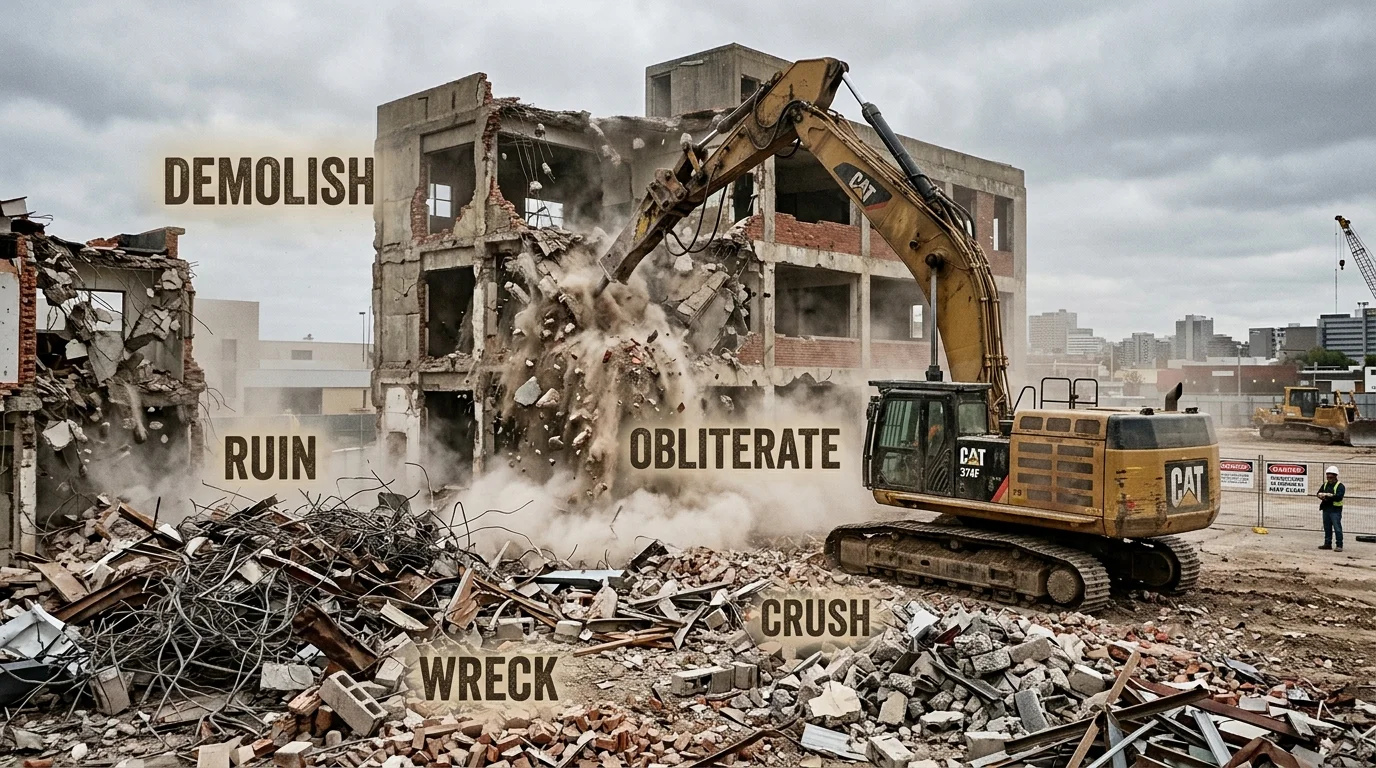
Demolish means to destroy a building or structure, usually deliberately.
Workers demolished the abandoned factory.
Best for: buildings, walls, bridges, and other structures.
Difference: “Demolish” is much more specific than “destroy.” You would not normally say you “demolished” someone’s hopes.
2. Ruin
Ruin means to damage something so badly that it loses its value, usefulness, success, or good condition.
The storm ruined the outdoor event.
Best for: plans, events, objects, finances, experiences, and reputations.
Difference: Something can be ruined without being physically destroyed.
3. Wreck
Wreck means to severely damage or destroy something.
The collision wrecked the car.
It can also be figurative:
The accident wrecked his plans.
Tone: Neutral to informal.
4. Devastate
Devastate means to cause extremely severe damage or destruction.
The earthquake devastated the region.
It can also describe a powerful emotional effect:
The news devastated her.
Best for: disasters, communities, economies, and emotional states.
Difference: “Devastate” suggests a very severe effect.
5. Obliterate
Obliterate means to destroy or remove something completely so that little or nothing remains.
The explosion obliterated the structure.
Best for: complete destruction, dramatic writing, and strong emphasis.
Tone: Very strong.
6. Dismantle
Dismantle means to take something apart, especially a machine, structure, organization, or system.
The engineers dismantled the old equipment.
Best for: systems, machines, organizations, and structures.
Difference: Dismantling involves taking something apart; destruction does not necessarily involve this process.
7. Eliminate
Eliminate means to remove or get rid of something completely.
The new process eliminated unnecessary steps.
Best for: problems, risks, errors, competitors, or unwanted elements.
Difference: Eliminate does not necessarily imply physical destruction.
8. Eradicate
Eradicate means to destroy or remove something completely, especially something harmful or unwanted.
The program aims to eradicate the disease.
Best for: diseases, pests, harmful practices, and serious problems.
Tone: Formal.
9. Annihilate
Annihilate means to destroy completely.
The force annihilated the enemy position.
It is an extremely strong word.
Best for: complete destruction, especially in historical, military, literary, or dramatic contexts.
10. Shatter
Shatter means to break something suddenly into many pieces.
The impact shattered the window.
It can also be figurative:
The news shattered her confidence.
Best for: glass, fragile objects, confidence, dreams, hopes, and illusions.
Synonyms for Destroy by Context
Destroy a Building
Use:
- Demolish
- Tear down
- Level
- Flatten
- Knock down
- Pull down
- Dismantle
- Reduce to rubble
The city decided to destroy the abandoned building.
More precise:
The city decided to demolish the abandoned building.
Demolish is usually the natural choice when a structure is intentionally torn down.
Destroy a Car or Machine
Use:
- Wreck
- Smash
- Crush
- Damage
- Total
- Break
- Disable
The accident destroyed the car.
The accident wrecked the car.
“Wreck” is especially natural for severe damage to vehicles.
Destroy Plans or Opportunities
Use:
- Ruin
- Derail
- Foil
- Thwart
- Undermine
- Sabotage
- Disrupt
- Crush
The unexpected delay destroyed their plans.
The unexpected delay derailed their plans.
“Derail” is particularly useful when something interrupts a plan or process.
Destroy Hopes or Dreams
Use:
- Crush
- Shatter
- Ruin
- Dash
- Destroy
- Extinguish
- Undermine
The rejection destroyed her hopes of getting the position.
The rejection crushed her hopes of getting the position.
“Crush” emphasizes emotional disappointment.
Destroy a Reputation
Use:
- Ruin
- Damage
- Tarnish
- Discredit
- Undermine
- Destroy
- Defame
The scandal destroyed his reputation.
The scandal tarnished his reputation.
Use ruin or destroy for severe harm; use tarnish for damage that affects reputation without necessarily completely eliminating it.
Destroy an Argument
Use:
- Refute
- Disprove
- Undermine
- Challenge
- Contradict
- Invalidate
- Discredit
The evidence destroyed the argument.
The evidence undermined the argument.
Be careful here. An argument is not physically destroyed. Words such as “refute” and “disprove” are usually more precise in academic writing.
Destroy a System or Organization
Use:
- Dismantle
- Abolish
- Disband
- Eliminate
- Overthrow
- Topple
- Break up
- Disintegrate
The reforms destroyed the old system.
The reforms dismantled the old system.
Use dismantle when something is deliberately taken apart piece by piece.
Destroy Evidence or Information
Depending on the situation:
- Erase
- Delete
- Remove
- Wipe
- Obliterate
- Discard
- Dispose of
The software destroyed the stored data.
More naturally:
The software deleted the stored data.
“Delete” is more precise for digital information.
Strong Synonyms for Destroy
When complete or near-complete destruction is intended, consider:
- Obliterate
- Annihilate
- Eradicate
- Wipe out
- Extinguish
- Eliminate
- Decimate
- Level
- Flatten
- Lay waste to
- Reduce to rubble
Intensity matters
These words do not all have the same strength.
Damage → some harm
Wreck → severe damage
Devastate → extremely severe damage
Obliterate → complete destruction
Annihilate → total destruction
Choose the strongest word only when the facts support it.
Formal Alternatives to Destroy
For formal or professional writing, consider:
- Eliminate
- Eradicate
- Dismantle
- Remove
- Demolish
- Extinguish
- Abolish
- Discontinue
- Invalidate
- Undermine
Example
Less precise:
The policy destroyed unnecessary procedures.
More precise:
The policy eliminated unnecessary procedures.
For an academic argument:
The new evidence undermined the original conclusion.
For a building:
The structure was demolished after engineers determined it was unsafe.
Synonyms for Destroy in Academic Writing
“Destroy” can sound overly dramatic in academic writing unless literal destruction is being discussed.
Instead, consider:
- Undermine
- Disprove
- Refute
- Invalidate
- Eliminate
- Eradicate
- Dismantle
- Disrupt
- Weaken
- Damage
Example
Too dramatic:
The study destroyed the previous theory.
More precise:
The study challenged the previous theory.
If the evidence actually demonstrates that the theory is false:
The study disproved the previous theory.
The correct word depends on the strength of the evidence.
Synonyms for Destroy in Professional Writing
Use context-specific verbs instead of relying on “destroy.”
| Situation | Better Alternative |
|---|---|
| Remove a problem | Eliminate |
| Remove a system | Dismantle |
| Tear down a building | Demolish |
| Damage a project | Derail |
| Harm a reputation | Tarnish |
| Defeat an argument | Refute |
| Remove a competitor | Eliminate |
| Remove harmful material | Eradicate |
| Delete information | Delete |
| End an organization | Disband |
Specific verbs make professional writing clearer.
True Synonyms vs. Related Alternatives
| Alternative | Relationship | Can Replace “Destroy”? | Tone | Best Context |
|---|---|---|---|---|
| Demolish | Context-specific synonym | Often | Neutral/formal | Buildings |
| Ruin | Close synonym | Often | Neutral | Plans, objects, outcomes |
| Wreck | Close synonym | Often | Informal/neutral | Cars, objects, plans |
| Devastate | Close synonym | Often | Strong | Areas, economies, emotions |
| Obliterate | Strong synonym | Sometimes | Very strong | Complete destruction |
| Dismantle | Contextual alternative | Sometimes | Neutral/formal | Systems/structures |
| Eliminate | Contextual synonym | Sometimes | Formal/neutral | Removal |
| Eradicate | Strong contextual synonym | Sometimes | Formal | Harmful things |
| Annihilate | Strong synonym | Sometimes | Extreme | Total destruction |
| Shatter | Contextual synonym | Sometimes | Strong | Fragile things/emotions |
| Undermine | Related alternative | Rarely | Formal | Arguments/plans |
| Derail | Related alternative | Rarely | Neutral | Plans/processes |
| Refute | Contextual alternative | No, usually | Formal | Arguments/claims |
| Tarnish | Related alternative | Sometimes | Neutral/formal | Reputation |
| Abolish | Contextual alternative | Sometimes | Formal | Laws/systems |
| Disband | Contextual alternative | Sometimes | Formal | Organizations |
Comparison Table
| Word | Meaning | Tone | Strength | Best Use | Interchangeable? |
|---|---|---|---|---|---|
| Destroy | Cause severe or complete damage | Neutral | Strong | General | — |
| Damage | Cause harm without necessarily destroying | Neutral | Mild–strong | Objects/systems | Sometimes |
| Ruin | Make something unusable or unsuccessful | Neutral | Strong | Plans/things | Often |
| Demolish | Deliberately tear down | Neutral/formal | Strong | Buildings | Context-dependent |
| Wreck | Severely damage | Informal/neutral | Strong | Cars/objects | Often |
| Devastate | Cause extreme damage | Strong | Very strong | Areas/emotions | Sometimes |
| Dismantle | Take apart | Neutral/formal | Moderate–strong | Systems/machines | Sometimes |
| Eliminate | Remove completely | Formal/neutral | Strong | Problems/unwanted things | Sometimes |
| Eradicate | Remove completely | Formal | Very strong | Diseases/problems | Sometimes |
| Obliterate | Destroy completely | Very strong | Extreme | Total destruction | Sometimes |
Destroy vs. Damage
Damage means causing harm or reducing condition, quality, or function.
Destroy usually implies much more severe damage.
The storm damaged the roof.
The storm destroyed the house.
Something damaged may still be usable. Something destroyed may no longer exist or function.
Destroy vs. Ruin
Ruin often means making something unsuccessful, worthless, or unusable.
The rain ruined our picnic.
Destroy can mean physical destruction or complete elimination.
The fire destroyed the building.
“Ruin” is often more natural for experiences, plans, opportunities, and objects whose value has been lost.
Destroy vs. Demolish
Demolish is specifically associated with intentionally tearing down structures.
The city demolished the old stadium.
You would not normally use “demolish” for a person’s reputation, dreams, or argument.
Destroy vs. Obliterate
Both can mean complete destruction, but obliterate is stronger and more dramatic.
The explosion destroyed the building.
The explosion obliterated the building.
The second sentence strongly suggests that little or nothing remained.
Destroy vs. Eliminate
Eliminate means remove something completely, but it does not necessarily involve physical destruction.
The company eliminated unnecessary expenses.
The company destroyed unnecessary expenses.
The first is natural; the second is not.
How to Choose the Right Alternative
Ask what exactly is being destroyed.
A building or structure?
→ Demolish, level, flatten, tear down
A vehicle or physical object?
→ Wreck, smash, crush, shatter
A plan or opportunity?
→ Ruin, derail, foil, thwart
A hope or dream?
→ Crush, shatter, dash
A community or region?
→ Devastate
A harmful thing or problem?
→ Eliminate, eradicate
A system or organization?
→ Dismantle, abolish, disband
An argument or claim?
→ Refute, disprove, undermine
A reputation?
→ Ruin, damage, tarnish, discredit
Something completely?
→ Obliterate, annihilate, eradicate
Sentence Transformations
1. Destroy a building
Original:
The company destroyed the old warehouse.
Better alternative:
The company demolished the old warehouse.
Why: “Demolish” is more precise for intentionally tearing down a structure.
2. Destroy a car
Original:
The accident destroyed the car.
Better alternative:
The accident wrecked the car.
Why: “Wrecked” is natural for severe damage to a vehicle.
3. Destroy a plan
Original:
The delay destroyed our plans.
Better alternative:
The delay derailed our plans.
Why: “Derail” clearly conveys that something interrupted a planned course of action.
4. Destroy hopes
Original:
The rejection destroyed his hopes.
Better alternative:
The rejection crushed his hopes.
Why: “Crushed” emphasizes emotional disappointment.
5. Destroy a region
Original:
The hurricane destroyed the coastal community.
Better alternative:
The hurricane devastated the coastal community.
Why: “Devastated” emphasizes widespread and severe damage.
6. Destroy a problem
Original:
The new process destroyed the source of the problem.
Better alternative:
The new process eliminated the source of the problem.
Why: “Eliminate” is the natural verb for completely removing a problem or cause.
7. Destroy a system
Original:
The reform destroyed the old system.
Better alternative:
The reform dismantled the old system.
Why: “Dismantle” suggests deliberately taking a system apart.
8. Destroy an argument
Original:
The evidence destroyed his argument.
Better alternative:
The evidence undermined his argument.
Why: “Undermine” is more measured and appropriate for academic writing.
9. Destroy a reputation
Original:
The scandal destroyed her reputation.
Better alternative:
The scandal tarnished her reputation.
Why: “Tarnish” communicates reputational damage without necessarily suggesting total ruin.
10. Completely destroy
Original:
The blast destroyed the structure completely.
Better alternative:
The blast obliterated the structure.
Why: “Obliterate” already carries the idea of complete destruction.
Common Mistakes
1. Using “destroy” when “damage” is more accurate
If something remains usable, damage may be more precise.
The storm damaged the roof.
2. Using “obliterate” for ordinary damage
“Obliterate” suggests near-total or total destruction. It is too strong for minor harm.
3. Using “demolish” for abstract ideas
You can demolish an argument metaphorically, but in formal writing refute or undermine may be more precise.
4. Confusing “destroy” and “dismantle”
Dismantling means taking something apart. Destruction does not necessarily involve disassembly.
5. Using “eradicate” for physical objects
“Eradicate” is usually used for something harmful or unwanted, such as disease, poverty, or pests.
6. Using “annihilate” too casually
“Annihilate” is extremely strong and can sound dramatic or exaggerated.
7. Assuming “ruin” always means complete destruction
Something can be ruined while still physically existing.
The rain ruined the painting.
8. Using “decimate” to mean any kind of destruction
Traditionally, “decimate” had a specific historical meaning involving one in ten, although modern English commonly uses it to mean severely reduce or devastate. In precise writing, choose a more direct verb when you mean complete destruction.
When Not to Replace “Destroy”
Keep destroy when it is the clearest general verb and the exact mechanism or effect does not need to be specified.
The fire destroyed several buildings.
There is no need to replace “destroy” with a more dramatic word simply to make the sentence sound stronger.
Likewise, use “destroy” when the sentence deliberately emphasizes total loss rather than a particular process.
The disaster destroyed the entire village.
Replacing it with “damaged” would weaken the meaning, while “obliterated” could make the claim more extreme than intended.
Writing Tips
Match the verb to the object
The strongest synonym often comes from identifying the object first.
- Building → demolish
- Car → wreck
- Plan → derail
- Hope → crush
- Region → devastate
- System → dismantle
- Disease → eradicate
- Argument → refute
- Reputation → tarnish
Avoid unnecessary dramatic language
The minor error obliterated his chances.
may sound exaggerated.
The minor error reduced his chances.
or
The minor error hurt his chances.
may be more accurate.
Use technical verbs when possible
In professional and academic writing, a precise verb often communicates more than “destroy.”
Instead of:
The policy destroyed the old process.
consider:
The policy eliminated the old process.
Instead of:
The study destroyed the theory.
consider:
The study challenged the theory.
Precision is more useful than intensity.
Editor’s Choice
These five alternatives cover many common meanings:
- Demolish — best for buildings and structures.
- Ruin — best for plans, experiences, and things made unsuccessful or unusable.
- Devastate — best for severe, widespread damage.
- Dismantle — best for systems, organizations, and machines.
- Eliminate — best for completely removing problems or unwanted elements.
For complete destruction, obliterate and annihilate are stronger choices, but they should be reserved for contexts that genuinely support that level of intensity.
Related Questions
- What is another word for destroy?
- What is a stronger word for destroy?
- What is a formal synonym for destroy?
- What is another word for completely destroy?
- What is another word for destroy in an essay?
- What is the difference between destroy and demolish?
- What is the difference between destroy and ruin?
- What is another word for destroy a plan?
- What is another word for destroy a reputation?
FAQs
What is the closest synonym for destroy?
There is no single synonym that works in every context. Ruin, demolish, wreck, devastate, and obliterate are close alternatives, but each fits different situations.
What is a stronger word for destroy?
Obliterate and annihilate are stronger alternatives that suggest complete destruction. Devastate is also strong but often emphasizes severe damage rather than total elimination.
What is a formal synonym for destroy?
Depending on the context, formal alternatives include demolish, eliminate, eradicate, dismantle, abolish, invalidate, and disprove.
What is another word for completely destroy?
Useful alternatives include obliterate, annihilate, eradicate, wipe out, extinguish, and level. The appropriate choice depends on what is being destroyed.
What is a synonym for destroy in an essay?
For academic writing, alternatives such as undermine, refute, disprove, eliminate, dismantle, or invalidate are often more precise than “destroy,” especially when discussing arguments, theories, or systems.
What is the difference between destroy and demolish?
Destroy is a broad verb for causing severe or complete damage. Demolish specifically means deliberately tearing down a building or structure.
What is the difference between destroy and ruin?
Destroy usually suggests severe physical or functional loss. Ruin can also describe making plans, experiences, opportunities, or objects unsuccessful or unusable.
Internal Link Opportunities
| Anchor Text | Suggested Topic | Why It Fits |
|---|---|---|
| Synonyms for damage | Synonyms for Damage | Closely related to physical destruction |
| Synonyms for ruin | Synonyms for Ruin | Covers damage to plans, objects, and outcomes |
| Synonyms for eliminate | Synonyms for Eliminate | Connects to complete removal |
| Synonyms for devastate | Synonyms for Devastate | Covers severe destruction and emotional impact |
| Synonyms for demolish | Synonyms for Demolish | Supports the building/structure sense |
| Synonyms for damage in an essay | Synonyms for Damage in an Essay | Useful for academic word choice |
| Synonyms for undermine | Synonyms for Undermine | Useful for arguments and abstract destruction |
| Synonyms for remove | Synonyms for Remove | Covers nonphysical meanings of destruction |
Semantic Topic Cluster
Related topics for a broader vocabulary cluster include:
- Destroy vs. demolish
- Destroy vs. ruin
- Destroy vs. damage
- Destroy vs. obliterate
- Words for complete destruction
- Words for severe damage
- Synonyms for eliminate
- Synonyms for demolish
- Synonyms for ruin
- Synonyms for devastation
- Words for destroying plans
- Words for damaging a reputation
- Words for defeating an argument
Key Takeaways
- Destroy has several meanings, so the best synonym depends on what is being affected.
- Use demolish for structures, wreck for severe physical damage, and ruin for plans or outcomes.
- Use devastate for severe widespread damage and dismantle for systems or organizations.
- Eliminate and eradicate emphasize complete removal, while obliterate and annihilate suggest extreme destruction.
- In academic and professional writing, specific verbs such as refute, undermine, eliminate, and dismantle are often clearer than the broad word “destroy.”