

The best synonym for beginning depends on the context. Start is a simple, everyday alternative, commencement sounds formal, onset often describes the arrival of a condition or event, and inception refers to the point when something is first established. Choosing the right word makes your writing clearer and more natural.
Quick Answer: What Are the Best Synonyms for Beginning?
Some of the best synonyms for beginning are start, outset, onset, commencement, inception, origin, opening, introduction, launch, initiation, dawn, and first stage. Use start for everyday situations, outset for the early part of a process, onset for something that begins to happen, and inception for the founding of an idea or organization.
Quick List of Synonyms for Beginning
Here are useful alternatives grouped by meaning and context.
General alternatives: start, outset, opening, first stage, initial point
Formal alternatives: commencement, inception, initiation, inauguration
For events and activities: launch, kickoff, opening, introduction
For conditions or changes: onset, emergence, arrival, advent
For origins and causes: origin, source, root, genesis
For stories and essays: introduction, opening, prologue, preface
For a new opportunity: fresh start, new beginning, clean slate
For the early part of a process: early stage, initial phase, starting point
These words are related, but they do not all mean exactly the same thing. For example, origin describes where something comes from, while start usually refers to when an activity begins.
What Does Beginning Mean?
Beginning is a noun that refers to the point at which something starts, the early part of a process, or the origin of something.
It can describe a moment, a period, or the first part of a written work or event.
Examples:
We arrived at the beginning of the meeting.
The beginning of the book introduces the main character.
The company has grown considerably since its beginning.
Every new skill has a beginning.
The best synonym depends on the intended meaning:
Starting point: The beginning of the race.
Early stage: The beginning of a relationship.
Origin: The beginning of an idea or tradition.
Opening section: The beginning of an essay or story.
Start of an event or condition: The beginning of winter or an illness.
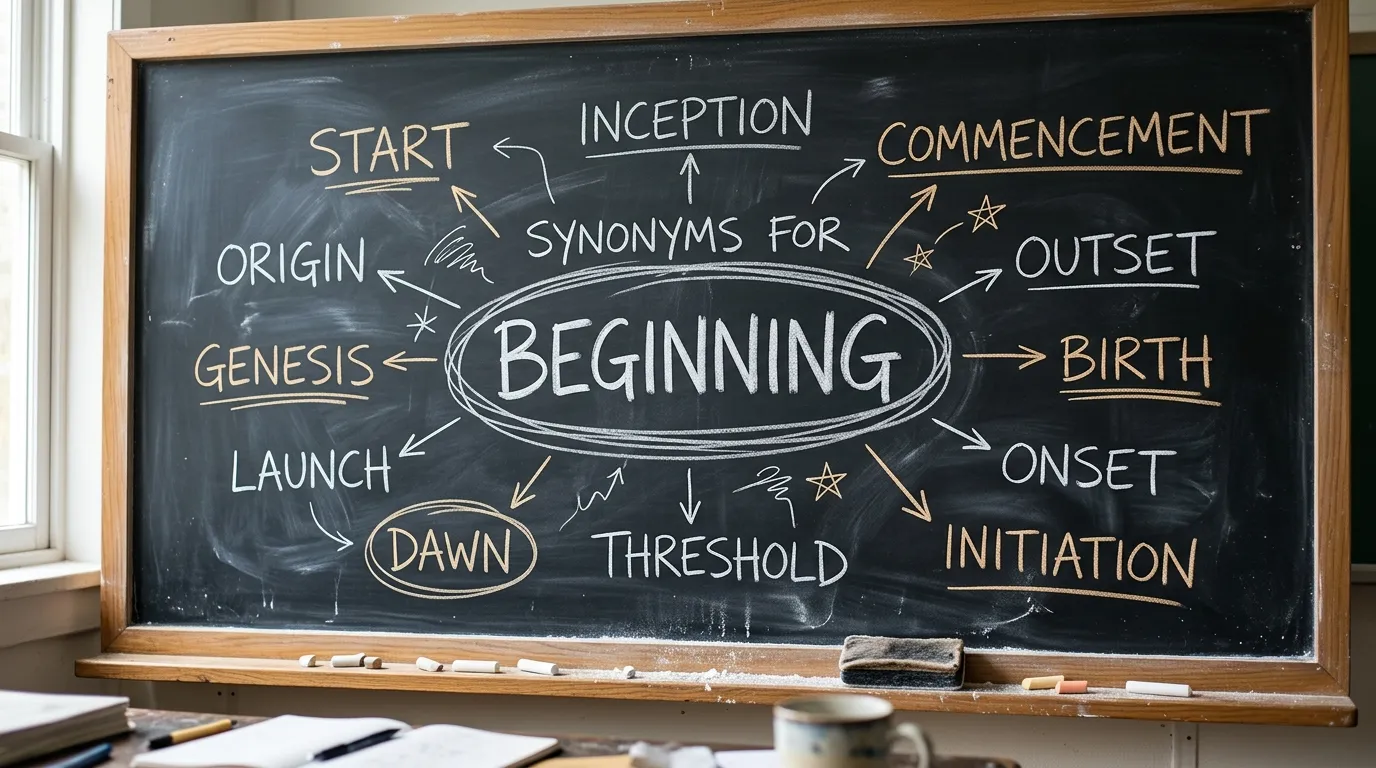
Closest Synonyms for Beginning
1. Start
Meaning: The point or moment when something begins.
Example: We arrived just before the start of the ceremony.
Best for: Everyday conversation, instructions, projects, and activities.
Difference: Start is usually the simplest and most natural alternative to beginning. It works in many contexts without sounding formal.
2. Outset
Meaning: The beginning of an activity, process, or period.
Example: From the outset, the team knew the project would be challenging.
Best for: Essays, reports, plans, and descriptions of processes.
Difference: Outset often appears in phrases such as “from the outset.” It emphasizes the early point of a process rather than a physical opening.
3. Onset
Meaning: The beginning or arrival of something, especially a condition, event, or change.
Example: The onset of winter brought colder temperatures.
Best for: Health, weather, scientific writing, and descriptions of changes.
Difference: Onset often sounds formal and is commonly used for conditions or events. It is less natural for ordinary activities such as a meeting or party.
4. Commencement
Meaning: The beginning of something, often a formal event, process, or period.
Example: The commencement of construction was delayed by heavy rain.
Best for: Formal writing, official events, education, and business.
Difference: Commencement is more formal than start. In American English, it is also commonly associated with a graduation ceremony.
5. Inception
Meaning: The point when something is first created, established, or conceived.
Example: The organization has supported local artists since its inception.
Best for: Business, institutions, projects, ideas, and formal writing.
Difference: Inception emphasizes the original establishment of something, rather than the start of a single activity.
6. Opening
Meaning: The beginning or first part of something, such as an event, performance, book, or speech.
Example: The opening of the presentation captured everyone’s attention.
Best for: Speeches, stories, events, ceremonies, and performances.
Difference: Opening often refers to the first section or moment presented to an audience. It can also mean an available opportunity or vacancy.
7. Origin
Meaning: The point, place, person, or cause from which something comes.
Example: Researchers traced the origin of the tradition to an ancient community.
Best for: History, culture, science, ideas, and causes.
Difference: Origin focuses on where or how something came into existence, not simply when it started.
8. Inauguration
Meaning: The formal introduction or beginning of a role, institution, project, or event.
Example: The inauguration of the new library attracted hundreds of visitors.
Best for: Official openings, public office, institutions, and formal ceremonies.
Difference: Inauguration usually involves a formal event or ceremony, so it is not a general substitute for every use of beginning.
9. Initiation
Meaning: The act or process of starting something.
Example: The initiation of the research project required approval from the committee.
Best for: Projects, procedures, programs, and formal processes.
Difference: Initiation emphasizes the act of setting something in motion. It can also refer to a person’s introduction into a group or practice.
10. Launch
Meaning: The start or public introduction of something new.
Example: The launch of the new website attracted considerable attention.
Best for: Products, businesses, campaigns, services, and initiatives.
Difference: Launch often suggests a deliberate start intended to introduce something to others.
11. Genesis
Meaning: The origin or formation of something.
Example: The documentary explores the genesis of the environmental movement.
Best for: History, ideas, research, literature, and formal writing.
Difference: Genesis emphasizes how something originated or developed. It sounds more literary or academic than start.
12. Dawn
Meaning: The first appearance or beginning of something, often a new period or era.
Example: The invention marked the dawn of a new technological age.
Best for: Creative writing, historical descriptions, and major changes.
Difference: Dawn is often metaphorical and suggests the emergence of something new.
13. Advent
Meaning: The arrival or introduction of an important event, period, or development.
Example: The advent of digital communication changed how people shared information.
Best for: History, technology, social change, and formal writing.
Difference: Advent emphasizes arrival and often describes a significant development, not an ordinary activity.
14. Introduction
Meaning: The first part of something or the act of presenting something new.
Example: The introduction of the report explains the main research question.
Best for: Essays, reports, books, presentations, and new products or ideas.
Difference: Introduction usually refers to a first section or the act of presenting something. It does not always mean the beginning of the entire process.
15. First Stage
Meaning: The earliest phase of a process or development.
Example: The first stage of the project involves collecting data.
Best for: Planning, research, education, business, and step-by-step processes.
Difference: First stage refers to an early period that may continue over time, rather than one exact starting moment.
Formal and Academic Synonyms for Beginning
In academic and professional writing, choose a word that describes the exact type of beginning you mean.
| Word or phrase | Meaning | Best use |
|---|---|---|
| Commencement | Formal beginning | Official processes and events |
| Inception | Point of original establishment | Organizations, ideas, and projects |
| Onset | Beginning or arrival of a condition | Health, science, and changing conditions |
| Initiation | Act of starting a process | Research and procedures |
| Genesis | Origin or formation | Historical and conceptual discussions |
| Advent | Arrival of an important development | Technology and social change |
| Initial phase | Earliest period of a process | Reports and research |
| Origin | Source or point of creation | History, causes, and ideas |
Example in academic writing:
Basic: The beginning of the study focused on gathering information.
More specific: The initial phase of the study focused on gathering information.
If describing the launch of a program: The initiation of the program required administrative approval.
If discussing how an idea developed: The study examines the genesis of the theory.
The best choice depends on whether you mean a moment, a stage, an official start, or an origin.
Synonyms for Beginning in Different Contexts
Synonyms for Beginning in an Essay
When writing an essay, the best alternatives depend on whether you mean the opening section or the start of an argument.
Introduction
Opening
Opening paragraph
Initial section
Starting point
Outset
Example: The introduction presents the main argument of the essay.
For a sentence that introduces an idea, you might use “At the outset” or “To begin with.” These are phrases rather than direct replacements for the noun beginning.
Synonyms for Beginning a Story
Use these words when referring to the first part of a narrative.
Opening
Introduction
Prologue
First scene
Opening passage
Exposition
Example: The novel’s opening introduces a mysterious character.
A prologue is a separate introductory section that comes before the main story. Exposition provides background information, often near the start, but it is not necessarily the opening itself.
Synonyms for the Beginning of a Project
Use these words when describing the first step or launch of planned work.
Start
Kickoff
Initiation
Launch
Inception
Initial phase
First stage
Example: The kickoff meeting marked the beginning of the project.
Kickoff is common in business and team settings. Inception is better when discussing when the project was first conceived or established.
Synonyms for the Beginning of a Period or Change
Use these words when describing the arrival of a new time, condition, or development.
Onset
Dawn
Advent
Emergence
Arrival
Start
Commencement
Example: The onset of the rainy season affected travel plans.
Dawn often sounds figurative, while onset is more suitable for a condition such as illness, winter, or symptoms.
Synonyms for a New Beginning
Use these phrases when describing a fresh opportunity or a chance to change direction.
Fresh start
Clean slate
New chapter
Second chance
New phase
Fresh beginning
Example: Moving to a new city gave her a fresh start.
A clean slate suggests leaving past mistakes or problems behind. A new chapter often describes a new period in someone’s life.
Synonyms for the Beginning of a Business or Organization
Use these words when describing how a company, group, or institution was established.
Founding
Establishment
Inception
Formation
Launch
Creation
Example: The founding of the nonprofit began with a small community initiative.
Founding and establishment are usually more precise than beginning when describing the creation of an organization.
Beginning vs. Similar Words: What’s the Difference?
| Word | Main meaning | Tone | Interchangeable with beginning? |
|---|---|---|---|
| Start | Point when something begins | Neutral | Often |
| Outset | Early point in a process | Neutral or formal | Often in process-related contexts |
| Onset | Arrival or start of a condition | Formal | Only for suitable conditions or events |
| Commencement | Formal beginning | Formal | In official contexts |
| Inception | Point when something is established | Formal | When discussing origins or establishment |
| Origin | Source or cause | Neutral or formal | Only when discussing where something comes from |
| Launch | Start or public introduction | Business-oriented | For products, projects, and initiatives |
| Genesis | Formation or origin | Literary or academic | In discussions of origins |
| Introduction | First section or act of presenting | Neutral | For a text, speech, or presentation |
| Dawn | Emergence of a new period | Figurative | In expressive or historical contexts |
| Initial phase | Earliest period | Formal | When referring to a stage rather than a moment |
| Kickoff | Start of a planned activity | Informal or professional | For meetings, projects, and events |
How to Choose the Right Synonym for Beginning
Choose the word that fits the situation and the type of beginning you want to describe.
Use start for a simple, natural alternative in everyday writing.
Use outset when referring to the early point of a process.
Use onset for the arrival of a condition, season, or event.
Use commencement for formal processes or ceremonies.
Use inception for the point when an idea, organization, or project was established.
Use origin when explaining where something came from.
Use launch for the introduction of a product, service, or initiative.
Use introduction for the first section of an essay, report, or presentation.
Use initial phase when describing the earliest stage of a longer process.
Use dawn for the emergence of a new era or period.
Use fresh start when describing a new opportunity to begin again.
If the meaning is straightforward, beginning or start is often the clearest option. Formal alternatives are useful only when they add precision.
Before-and-After Examples: Replacing Beginning in Sentences
Original: The beginning of the meeting was delayed.
Revised: The start of the meeting was delayed.
Why: Start is a simple, natural alternative.Original: From the beginning, she supported the idea.
Revised: From the outset, she supported the idea.
Why: Outset works well when describing support from the earliest point.Original: The beginning of winter brought heavy snow.
Revised: The onset of winter brought heavy snow.
Why: Onset commonly describes the arrival of a season or condition.Original: The beginning of construction is scheduled for June.
Revised: The commencement of construction is scheduled for June.
Why: Commencement gives the sentence a more formal tone.Original: The beginning of the company dates back to 2010.
Revised: The company’s inception dates back to 2010.
Why: Inception emphasizes when the company was first established.Original: The beginning of the story introduces the main character.
Revised: The story’s opening introduces the main character.
Why: Opening is natural when referring to the first section of a story.Original: The beginning of the idea came from a classroom discussion.
Revised: The origin of the idea was a classroom discussion.
Why: Origin emphasizes where the idea came from.Original: The beginning of the new product created excitement.
Revised: The launch of the new product created excitement.
Why: Launch is more precise for the public introduction of a product.Original: The beginning of a new era followed the invention.
Revised: The invention marked the dawn of a new era.
Why: Dawn is a vivid, figurative expression for a major change.Original: The beginning of the research involved reviewing earlier studies.
Revised: The initial phase of the research involved reviewing earlier studies.
Why: Initial phase emphasizes the first period of a longer process.Original: She wanted a beginning after a difficult year.
Revised: She wanted a fresh start after a difficult year.
Why: Fresh start emphasizes a new opportunity.Original: The beginning of the organization took place in a small office.
Revised: The founding of the organization took place in a small office.
Why: Founding is more specific when discussing the creation of an organization.
Common Mistakes When Using Synonyms for Beginning
1. Treating all synonyms as exact replacements
Origin, onset, and launch describe different kinds of beginnings. Choose the word that fits the event or process.
2. Using onset for an ordinary activity
“The onset of the meeting” sounds unnatural in most contexts. Use “the start of the meeting” or “the opening of the meeting.”
3. Using inception for every new activity
Inception usually refers to the point when something is conceived or established. It is often too formal for a routine task.
4. Confusing origin with start
The start is when something begins. The origin is where it comes from or how it began.
5. Using commencement in casual conversation
Commencement is formal. “The start of class” is usually more natural than “the commencement of class.”
6. Confusing introduction with the entire beginning
An introduction is often the first section of a text or presentation. A process may have a beginning that includes several stages beyond its introduction.
7. Using launch for something that is not being introduced
Launch is especially suitable for products, campaigns, programs, and initiatives. It may not fit a private activity that has no public introduction.
8. Using dawn too literally or too often
Dawn can mean sunrise, but in writing it often refers figuratively to the emergence of a new era. Use it when that expressive meaning fits.
9. Replacing beginning just to sound more formal
A phrase such as “at the beginning” is clear and natural. Do not replace it with at the inception unless the context truly concerns the establishment of something.
Grammar and Usage: How to Use Beginning Correctly
Beginning can be a noun, the -ing form of the verb begin, or part of a longer expression.
Common collocations with beginning
| Expression | Example |
|---|---|
| At the beginning | At the beginning of the lesson, the teacher explained the goal. |
| From the beginning | From the beginning, the plan seemed promising. |
| In the beginning | In the beginning, the work was difficult. |
| The beginning of | The beginning of the book is engaging. |
| A new beginning | The move gave him a new beginning. |
| A fresh beginning | They viewed the new year as a fresh beginning. |
| The very beginning | I knew the answer from the very beginning. |
| Beginning stages | The project is still in its beginning stages. |
| Beginning with | The course starts with basic concepts. |
| A promising beginning | The team made a promising beginning to the season. |

Is it “at the beginning” or “in the beginning”?
Both are correct, but they are used differently.
At the beginning: Refers to a specific point or the first part of something.
Example: At the beginning of the meeting, everyone introduced themselves.In the beginning: Often describes an early period, especially when contrasting it with what happened later.
Example: In the beginning, learning the software was difficult.
What is the adjective form of beginning?
There is no single adjective that works in every context. Related words include:
Initial: Occurring at the start.
Example: The initial stage took two weeks.Preliminary: Coming before the main activity or final step.
Example: The team completed a preliminary review.Early: Happening near the start of a period.
Example: Early results were promising.Starting: Used to describe something associated with a start.
Example: The starting point was easy to identify.
Use initial for a formal or technical description, and early for simpler everyday writing.
Frequently Asked Questions
1. What is the best synonym for beginning?
Start is the best general alternative. Use outset for the early point of a process, inception for the establishment of something, and onset for the arrival of a condition or event.
2. What is a formal word for beginning?
Commencement, inception, and initiation are formal alternatives. The right choice depends on whether you mean an official start, the establishment of something, or the act of starting a process.
3. What is another word for beginning in an essay?
Use introduction for the first section, outset when referring to the earliest point of an argument, or initial phase when describing the first stage of research or analysis.
4. What is another word for the beginning of a story?
Opening is the most common alternative. Prologue refers to a separate introductory section, while exposition describes background information presented in a narrative.
5. What is a synonym for a new beginning?
Common choices include fresh start, clean slate, new chapter, and second chance. Each emphasizes a new opportunity, often after a difficult or important change.
6. What is the difference between beginning and inception?
Beginning is a broad term for the point or early period when something starts. Inception more specifically refers to the point when an idea, organization, or project is first conceived or established.
7. What is the opposite of beginning?
Common opposites include end, ending, conclusion, finish, and termination. The best choice depends on whether you mean the end of an activity, a story, or a formal process.
Editor’s Choice: The 5 Best Synonyms for Beginning
Start: Best for everyday writing and general use.
Outset: Best for describing the earliest point in a process.
Inception: Best for the establishment of an idea, project, or organization.
Onset: Best for the arrival of a condition, season, or event.
Opening: Best for the first part of a story, speech, or event.
These five choices cover common meanings while helping you avoid alternatives that sound unnatural in the wrong context.
Key Takeaways
Start is the clearest general synonym for beginning.
Outset refers to the early point of a process, while inception emphasizes establishment.
Onset is commonly used for conditions, seasons, and significant events.
Opening suits stories, speeches, and events; initial phase suits longer processes.
Choose a synonym based on meaning and context instead of replacing beginning just to vary your wording.