
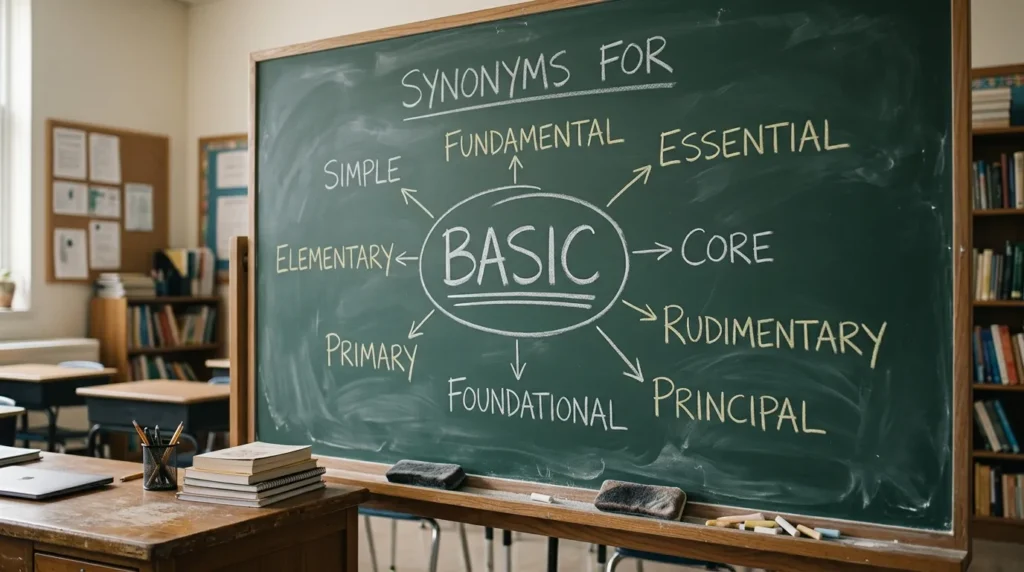
The best synonyms for basic include simple, fundamental, essential, elementary, primary, core, and introductory. The right choice depends on the meaning. Use simple for something easy to understand, fundamental for an underlying principle, essential for something necessary, and introductory for beginner-level learning.
Quick Synonym List
Here are useful alternatives to basic, grouped by their common meanings.
Simple
Fundamental
Essential
Elementary
Primary
Core
Introductory
Foundational
Main
Key
Central
Necessary
Required
Principal
Preliminary
Initial
Basic-level
Beginner
Beginner-friendly
Straightforward
Uncomplicated
Plain
Standard
Common
Ordinary
General
Underlying
Rudimentary
Minimal
Bare
Essential-level
Fundamental-level
Core-level
Starting
Introductory-level
Primary-level
Undeveloped
Simplified
Practical
Functional
Essential components
Not all these words mean exactly the same thing. Simple means easy to understand or do, essential means necessary, and rudimentary often describes something at an early or limited stage of development. The best replacement depends on your sentence.
What Does Basic Mean?
Basic is an adjective that describes something simple, fundamental, necessary, or at an introductory level.
It has several common meanings:
Simple or easy to understand: Something without much complexity.
The instructions explain the basic steps.
Fundamental or essential: Something that forms the foundation of a subject or system.
Students must understand basic mathematical principles.
Necessary or minimum: Something that meets the most important needs.
The shelter provides basic services.
Introductory or beginner-level: Something intended for people with little prior knowledge.
She enrolled in a basic computer course.
Ordinary or lacking originality: In informal speech, basic can describe something conventional or unoriginal, sometimes critically.
He joked that the outfit was too basic.
The meaning matters because fundamental, simple, essential, and ordinary are not interchangeable in every context.
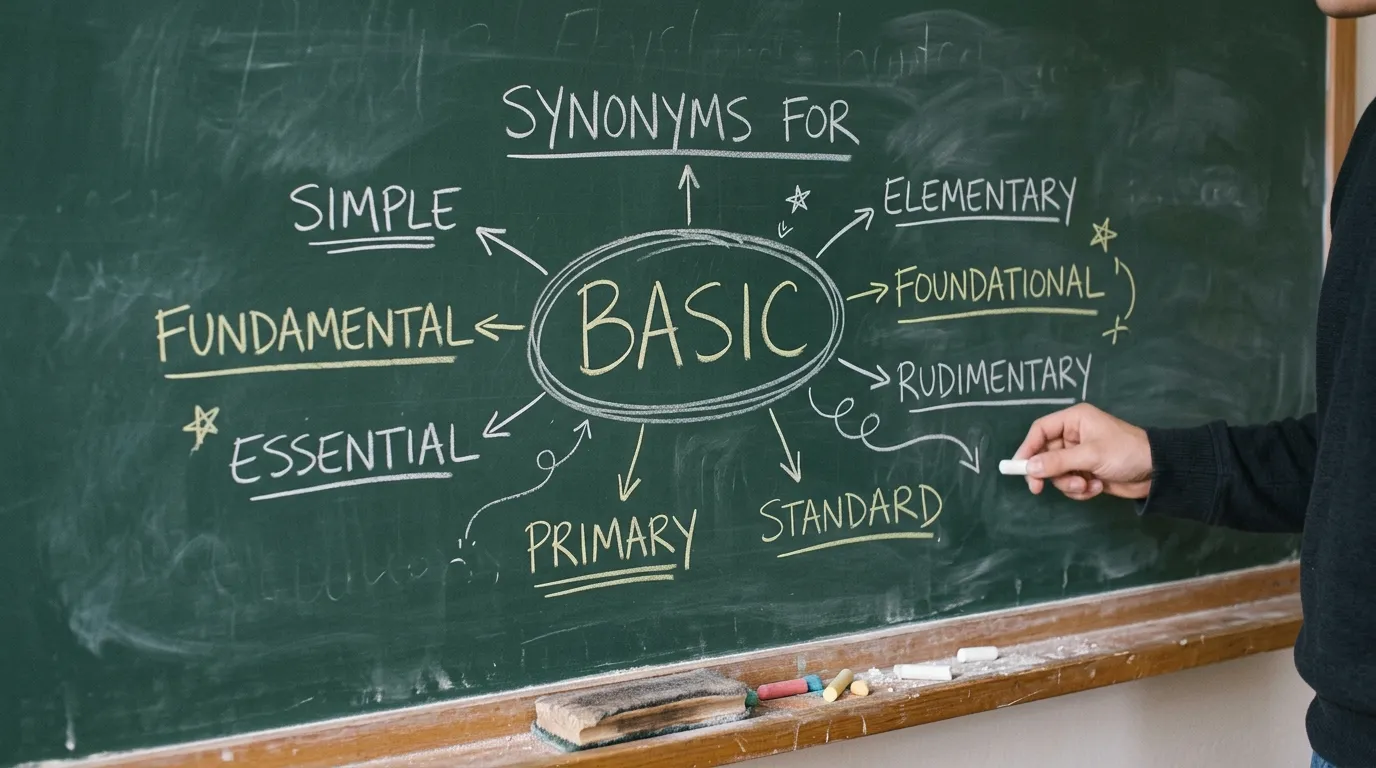
Closest Synonyms for Basic
1. Simple
Meaning: Easy to understand, use, or do; not complicated.
Simple is one of the closest everyday alternatives to basic when describing something uncomplicated.
Example: The guide explains the basic rules of grammar.
Alternative: The guide explains the simple rules of grammar.
Best for: Instructions, explanations, designs, and everyday communication.
Watch out: Simple emphasizes ease or lack of complexity. It does not necessarily mean something is essential or foundational.
2. Fundamental
Meaning: Forming an essential foundation for something.
Use fundamental when describing principles, concepts, skills, or truths that support further learning or understanding.
Example: Reading is a basic skill for academic success.
Alternative: Reading is a fundamental skill for academic success.
Best for: Essays, education, science, philosophy, and professional writing.
Watch out: Fundamental emphasizes importance and foundation rather than simplicity.
3. Essential
Meaning: Absolutely necessary or extremely important.
Use essential when something is needed for a particular purpose or outcome.
Example: Communication is a basic part of teamwork.
Alternative: Communication is an essential part of teamwork.
Best for: Requirements, resources, skills, instructions, and priorities.
Watch out: Something can be basic without being essential. Essential makes a stronger claim about necessity.
4. Elementary
Meaning: Relating to the earliest stage of learning or to the simplest principles of a subject.
Example: The course covers basic science concepts.
Alternative: The course covers elementary science concepts.
Best for: Beginner education, introductory explanations, and foundational subjects.
Watch out: Elementary can suggest a very early or easy level. In some contexts, it may sound as if the material is intended for children or beginners.
5. Primary
Meaning: First in importance, order, or rank.
Use primary when emphasizing the main or first item in a group.
Example: The basic goal is to improve customer service.
Alternative: The primary goal is to improve customer service.
Best for: Goals, responsibilities, causes, objectives, and priorities.
Watch out: Primary means main or first, not necessarily simple.
6. Core
Meaning: Central, most important, or forming the heart of something.
Example: Problem-solving is a basic part of the training.
Alternative: Problem-solving is a core part of the training.
Best for: Skills, values, concepts, business strategies, and academic subjects.
Watch out: Core emphasizes central importance, not beginner-level simplicity.
7. Foundational
Meaning: Providing a base on which further knowledge, skills, or systems can be built.
Example: The program teaches basic writing skills.
Alternative: The program teaches foundational writing skills.
Best for: Education, professional development, research, and long-term learning.
Watch out: Foundational is more specific than basic when the subject supports later learning or development.
8. Introductory
Meaning: Intended to introduce a subject or prepare someone for more advanced learning.
Example: He signed up for a basic programming class.
Alternative: He signed up for an introductory programming class.
Best for: Courses, tutorials, guides, training, and beginner resources.
Watch out: Introductory describes the purpose or level of a resource. It does not mean the information is necessarily easy or unimportant.
9. Rudimentary
Meaning: Existing at an early, simple, or underdeveloped stage.
Example: She has basic knowledge of coding.
Alternative: She has rudimentary knowledge of coding.
Best for: Describing limited skills, early development, or incomplete systems.
Watch out: Rudimentary often suggests that knowledge or development is limited. It can sound negative when describing someone’s abilities.
10. Straightforward
Meaning: Easy to understand or deal with, without unnecessary complications.
Example: The manual provides basic instructions for installation.
Alternative: The manual provides straightforward installation instructions.
Best for: Directions, explanations, procedures, and practical advice.
Watch out: Straightforward emphasizes clarity and ease, not fundamental importance.
Formal and Academic Synonyms for Basic
For essays, reports, and professional writing, choose an alternative that accurately describes the role or level of the subject.
| Synonym | Meaning | Best context |
|---|---|---|
| Fundamental | Essential to understanding or building something | Principles and concepts |
| Foundational | Providing a base for future development | Education and skill-building |
| Essential | Necessary or indispensable | Requirements and resources |
| Primary | First or most important | Goals, causes, and objectives |
| Core | Central or most important | Skills, values, and concepts |
| Elementary | At an early learning stage | Education and introductory material |
| Preliminary | Occurring before a main stage | Research, testing, and preparation |
| Rudimentary | Basic and not fully developed | Limited knowledge or early systems |
| Underlying | Existing beneath or supporting something | Causes, assumptions, and principles |
| Principal | Main or most important | Factors, reasons, and responsibilities |
Examples in Academic Writing
Original: The study examines basic causes of the problem.
Revised: The study examines the underlying causes of the problem.Original: Students need basic knowledge of statistics.
Revised: Students need foundational knowledge of statistics.Original: The report outlines the basic requirements.
Revised: The report outlines the essential requirements.Original: The researcher conducted basic tests before the main experiment.
Revised: The researcher conducted preliminary tests before the main experiment.Original: The course teaches basic principles of economics.
Revised: The course teaches fundamental principles of economics.
Writing tip: Basic is not inherently informal or weak. It is often the clearest word. Use fundamental, foundational, or essential when you need a more precise meaning, not simply a more formal tone.
Synonyms for Basic by Context
Basic Meaning Simple or Easy
When you mean something is uncomplicated, consider:
Simple
Straightforward
Uncomplicated
Plain
Easy
Clear
Simplified
Easy to understand
Example:
Original: The website has a basic design.
Revised: The website has a simple design.
Alternative: The website has a clean, uncomplicated design.
Simple describes a lack of complexity. Plain can suggest that something lacks decoration or visual interest, so it may not always be the best choice.
Basic Meaning Fundamental or Foundational
When describing the principles or skills that support further learning, use:
Fundamental
Foundational
Core
Underlying
Primary
Essential
Building-block
Cornerstone
Example:
Original: Students must learn basic math skills.
Revised: Students must learn fundamental math skills.
Alternative: Students must develop foundational math skills.
Cornerstone is a metaphor for something that provides essential support, rather than a direct replacement for basic in every sentence.
Basic Meaning Necessary or Required
When describing something needed to complete a task or meet a requirement, consider:
Essential
Necessary
Required
Mandatory
Minimum
Indispensable
Key
Vital
Example:
Original: The application requires basic information.
Revised: The application requires essential information.
More precise: The application requires the minimum information needed to process the request.
Mandatory means required by a rule or authority. Vital suggests great importance. Neither is automatically interchangeable with basic.
Basic Meaning Beginner-Level
When describing introductory learning or limited experience, use:
Introductory
Elementary
Beginner-level
Preliminary
Entry-level
Rudimentary
Starting
First-stage
Example:
Original: The workshop teaches basic photography.
Revised: The workshop teaches introductory photography.
Alternative: The workshop is designed for beginner photographers.
Entry-level often refers to the first stage of a job, course, or skill pathway. Rudimentary may suggest that the knowledge is still very limited.
Basic Meaning Ordinary or Unoriginal
In informal conversation, basic can mean conventional, predictable, or lacking originality.
Possible alternatives include:
Ordinary
Conventional
Common
Mainstream
Predictable
Unoriginal
Generic
Unsurprising
Example:
Original: The reviewer called the design basic.
Revised: The reviewer called the design generic.
Alternative: The reviewer found the design conventional and unoriginal.
Watch out: This informal meaning can sound judgmental. Ordinary is usually neutral, while generic and unoriginal suggest a lack of distinctiveness.
Basic Meaning Minimum or Bare
When describing the smallest amount or simplest level that is available, consider:
Minimum
Bare
Minimal
Essential
Most basic
Bare-bones
Limited
Standard
Example:
Original: The package includes basic features.
Revised: The package includes essential features.
If the package is deliberately limited: The package offers only the bare minimum of features.
Bare-bones is informal and suggests that something includes only its most necessary parts.
Basic vs. Simple vs. Fundamental vs. Essential
These common alternatives overlap, but each emphasizes something different.
| Word | Core meaning | Tone | Best use | Interchangeable with basic? |
|---|---|---|---|---|
| Basic | Simple, fundamental, or at an introductory level | Neutral | General descriptions | Original word |
| Simple | Easy or uncomplicated | Neutral, everyday | Instructions and explanations | When ease is meant |
| Fundamental | Essential to a subject or system | Formal, precise | Principles and concepts | When foundational importance is meant |
| Essential | Necessary or indispensable | Strong, direct | Requirements and needs | When necessity is meant |
| Elementary | At an early or simple learning stage | Educational | Beginner instruction | In learning contexts |
| Foundational | Providing a base for later development | Professional, academic | Skills and knowledge | When later development is supported |
| Primary | First or most important | Neutral, formal | Goals and priorities | When main importance is meant |
| Core | Central or most important | Neutral, professional | Skills and concepts | When central importance is meant |
| Rudimentary | Simple or underdeveloped | Formal, sometimes negative | Limited skills or systems | When limited development is meant |
| Preliminary | Coming before the main stage | Formal | Early tests and preparation | Only when sequence is meant |
How to Choose the Right Synonym for Basic
Use this quick decision guide to find the most accurate word.
Do you mean easy to understand? Use simple or straightforward.
Do you mean an important underlying principle? Use fundamental.
Do you mean something necessary? Use essential or necessary.
Do you mean the foundation for future learning? Use foundational.
Do you mean a course for beginners? Use introductory or elementary.
Do you mean the main goal or priority? Use primary or principal.
Do you mean the central part of a system? Use core.
Do you mean an early step before the main stage? Use preliminary.
Do you mean limited or underdeveloped knowledge? Use rudimentary.
Do you mean ordinary or unoriginal? Use generic, conventional, or unoriginal.
Do you mean the smallest amount required? Use minimum or bare minimum.
If none of these alternatives improves the sentence, keep basic. It is clear, common, and useful across many contexts.
10 Sentence Transformations Using Basic Synonyms
These examples show how to replace basic while preserving the intended meaning.
Original: Students must understand basic grammar rules.
Revised: Students must understand fundamental grammar rules.Original: The guide provides basic instructions.
Revised: The guide provides straightforward instructions.Original: The course teaches basic computer skills.
Revised: The course teaches introductory computer skills.Original: Food and water are basic human needs.
Revised: Food and water are essential human needs.Original: The report explains the basic reasons for the change.
Revised: The report explains the underlying reasons for the change.Original: The company offers basic services.
Revised: The company offers essential services.Original: The team discussed the basic goal of the project.
Revised: The team discussed the primary goal of the project.Original: The students learned basic principles of physics.
Revised: The students learned foundational principles of physics.Original: The application asks for basic personal details.
Revised: The application asks for the minimum personal details required.Original: The designer created a basic website.
Revised: The designer created a simple website.
Each change reflects a different emphasis. For example, essential makes a claim about necessity, while simple emphasizes a lack of complexity.
Common Mistakes When Using Synonyms for Basic
1. Treating basic and simple as identical
Basic can mean foundational or introductory. Simple usually means easy or uncomplicated.
Original: Students need basic knowledge of biology.
Better: Students need foundational knowledge of biology.
2. Using essential when you only mean introductory
Essential means necessary, not beginner-level.
Less precise: The course teaches essential French for beginners.
Better if the course covers introductory material: The course teaches introductory French.
3. Using rudimentary as a positive description
Rudimentary can imply limited development or incomplete knowledge.
Neutral: She has basic knowledge of coding.
More positive: She has foundational knowledge of coding.
More critical: She has only rudimentary knowledge of coding.
4. Confusing primary with fundamental
Primary usually means first or most important. Fundamental refers to an underlying principle or necessary foundation.
Primary concern: The main concern.
Fundamental principle: A principle on which understanding depends.
5. Using elementary when the material is not beginner-level
Elementary can suggest a very early stage of learning.
Less precise: The report covers elementary business strategy.
Better: The report covers fundamental business strategy.
6. Using preliminary when you mean simple
Preliminary refers to something that comes before a main stage, not necessarily something easy.
Less precise: The guide provides preliminary instructions for using the software.
Better if the instructions are easy: The guide provides simple instructions.
7. Replacing basic with a technical word unnecessarily
A more formal synonym can make writing less accessible.
Overly technical: The document explains the rudimentary procedures.
Clearer: The document explains the basic procedures.
Choose the technical term only if it communicates a more accurate meaning.
8. Using generic when you mean fundamental
Generic often means ordinary, widely applicable, or lacking distinctiveness. It does not mean necessary or foundational.
Original: The course teaches basic skills.
Better: The course teaches foundational skills.
9. Confusing basic needs with basic features
Basic needs are necessities. Basic features are the simplest or standard functions available.
Basic needs: Food, shelter, and safety.
Basic features: The standard functions included in a product.
10. Replacing basic just to avoid repetition
Repeating a clear word is often better than using a synonym that changes the meaning.
Clear: The course covers basic concepts and basic skills.
Alternative: The course covers foundational concepts and practical skills.
The second version works only if the concepts provide a foundation and the skills are practical.
Grammar and Usage: How to Use Basic Correctly
Basic as an adjective
Basic usually appears before a noun or after a linking verb.
Before a noun:
We learned basic mathematics.
The guide provides basic information.
They offer basic services.
After a linking verb:
The requirements are basic.
The design looks basic.
The process seems basic.
Common phrases with basic
| Phrase | Example |
|---|---|
| Basic skills | The job requires basic computer skills. |
| Basic knowledge | Students need basic knowledge of chemistry. |
| Basic principles | The book explains basic principles of economics. |
| Basic needs | Food and shelter are basic needs. |
| Basic information | Please provide basic information about the project. |
| Basic requirements | The application lists the basic requirements. |
| Basic features | The free plan includes basic features. |
| Basic understanding | The tutorial builds a basic understanding of coding. |
| Basic structure | The report explains the basic structure of the organization. |
| Basic concepts | The lesson introduces basic concepts in physics. |
Basic vs. basically
Basic is an adjective: The course teaches basic skills.
Basically is an adverb: Basically, the process has three steps.
Basically often means “in simple terms” or “for the most part.” It is not a direct grammatical substitute for basic.
Frequently Asked Questions
1. What is the closest synonym for basic?
Simple is a close synonym when basic means uncomplicated. Fundamental is better when the word means essential to understanding a subject, while essential is better when something is necessary.
2. What is a formal word for basic?
Fundamental, foundational, essential, primary, and preliminary can work in formal writing. Choose according to meaning rather than formality alone.
3. What is another word for basic in an essay?
Useful alternatives include fundamental, foundational, essential, underlying, and primary. For example, “basic principles” may become “fundamental principles,” while “basic causes” may become “underlying causes.”
4. What is a positive synonym for basic?
Foundational, essential, and fundamental can sound positive when describing important skills, knowledge, or principles. Simple can also be positive when clarity and ease are desirable.
5. What is a negative synonym for basic?
Rudimentary, limited, generic, and unoriginal may have negative meanings in certain contexts. Rudimentary can suggest underdeveloped knowledge, while generic can imply a lack of originality.
6. Is fundamental the same as basic?
Not always. Both can describe underlying principles, but fundamental more strongly emphasizes importance to a subject or system. Basic can also mean simple, introductory, or minimal.
7. What is another word for basic knowledge?
Depending on the context, use foundational knowledge, elementary knowledge, introductory knowledge, or rudimentary knowledge. Foundational is often positive, while rudimentary may suggest limited understanding.
Editor’s Choice: The Best Alternatives to Basic
These five choices cover the most common meanings:
Simple — best for something easy to understand or use.
Fundamental — best for important underlying principles.
Essential — best for something necessary.
Foundational — best for skills or knowledge that support future learning.
Introductory — best for beginner courses, guides, and lessons.
For a main objective, use primary. For an early stage of preparation, use preliminary. For limited or underdeveloped knowledge, use rudimentary only when that meaning is intended.
Key Takeaways
Simple means easy or uncomplicated, while basic can also mean foundational or introductory.
Fundamental and foundational work well for principles, skills, and knowledge that support further learning.
Essential means necessary; it is stronger than basic in this respect.
Introductory and elementary are useful for beginner-level material, while preliminary means coming before a main stage.
Keep basic when it communicates your meaning more clearly than a more formal alternative.