
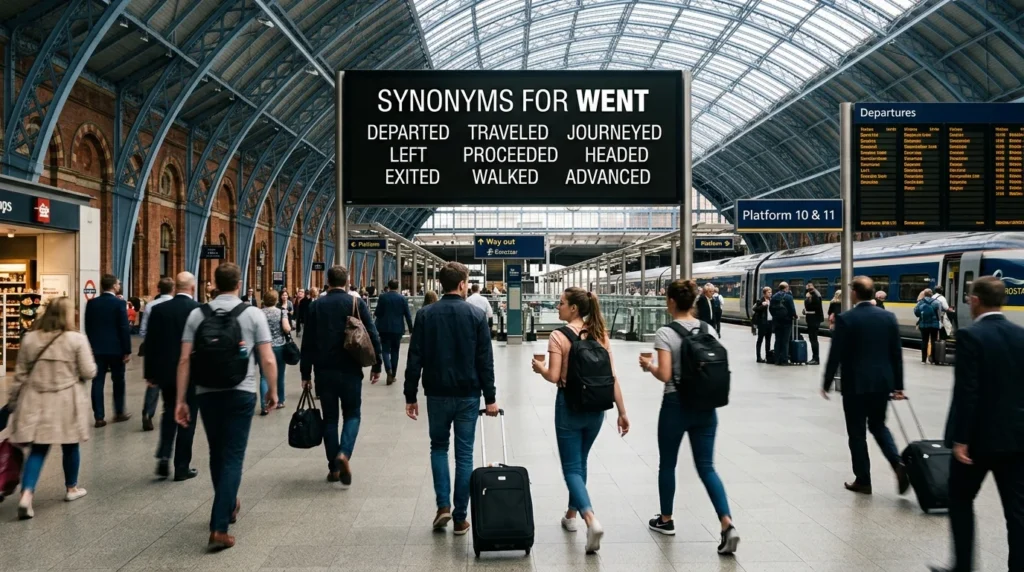
The word went is the past tense of go, but its best synonym depends heavily on what went means in the sentence. You might mean traveled, left, departed, proceeded, visited, attended, moved, or became. These words are related, but they are not interchangeable in every context.
This guide explains the most useful synonyms for went, shows which alternatives work in different situations, and helps you choose a word that preserves the original meaning.
Quick Answer
Common synonyms for went include traveled, departed, left, moved, proceeded, headed, journeyed, visited, attended, advanced, continued, passed, walked, drove, flew, returned, entered, approached, and became, depending on the sentence. There is no single synonym that works in every use of went because go has many different meanings.
Quick Synonym List
Here are useful alternatives to went, grouped by meaning rather than treating them as interchangeable:
Movement or travel
- traveled
- journeyed
- moved
- proceeded
- advanced
- headed
- walked
- drove
- flew
- sailed
- rode
- rushed
- hurried
- wandered
- strolled
Leaving
- left
- departed
- exited
- withdrew
- retreated
- moved on
Going toward a place
- headed
- approached
- entered
- advanced
- proceeded
Visiting or attending
- visited
- attended
- stopped by
- called on
- participated in
Returning
- returned
- came back
- went back
- retraced one’s steps
Change or transition
- became
- turned
- grew
- developed
- transformed
The correct alternative depends on the particular sense of went.
Closest Synonyms for Went
Traveled
Meaning: Moved from one place to another, especially over some distance.
How it differs: Traveled emphasizes the journey itself rather than simply the act of going.
Tone: Neutral.
Best for: Trips, journeys, transportation, and longer distances.
Example:
Original: We went across the country last summer.
Better: We traveled across the country last summer.
Watch out: Traveled can sound less natural when describing a very short movement, such as I went to the kitchen.
Left
Meaning: Went away from a place.
How it differs: Left focuses on departing rather than reaching another destination.
Tone: Neutral.
Best for: Describing departure.
Example:
She went the office at 5 p.m. → She left the office at 5 p.m.
Notice that left can often replace went when the original sentence means “went away from.”
Departed
Meaning: Left a place.
How it differs: Departed is more formal than left and often appears in transportation or formal contexts.
Tone: Formal.
Best for: Travel announcements, schedules, formal writing, and notices.
Example:
The train went at 8:15. → The train departed at 8:15.
Watch out: In everyday conversation, left is usually more natural.
Moved
Meaning: Changed physical position or location.
How it differs: Moved emphasizes physical movement, not necessarily a destination.
Tone: Neutral.
Best for: Physical movement and changes in position.
Example:
He went closer to the window. → He moved closer to the window.
Proceeded
Meaning: Continued or moved forward, usually toward a destination or through a process.
How it differs: Proceeded is more formal and often suggests orderly or deliberate movement.
Tone: Formal or professional.
Best for: Instructions, reports, formal narratives, and processes.
Example:
We went to the next room. → We proceeded to the next room.
Watch out: It can sound unnecessarily formal in casual conversation.
Headed
Meaning: Went in a particular direction.
How it differs: Headed emphasizes direction or destination.
Tone: Neutral to conversational.
Best for: Everyday speech and informal writing.
Example:
We went toward the station. → We headed toward the station.
Journeyed
Meaning: Traveled from one place to another, especially over a significant distance.
How it differs: It gives more emphasis to the journey and can have a literary feel.
Tone: Literary or formal.
Best for: Travel writing and storytelling.
Example:
They went through the mountains. → They journeyed through the mountains.
Advanced
Meaning: Moved forward or toward a particular point.
How it differs: Advanced often implies deliberate forward movement and is less general than went.
Tone: Formal.
Best for: Formal writing, descriptions of movement, and military or strategic contexts.
Example:
The soldiers went toward the town. → The soldiers advanced toward the town.
Continued
Meaning: Went on or kept moving.
How it differs: Continued means the movement or activity was already underway.
Tone: Neutral.
Best for: Narratives and descriptions of ongoing movement.
Example:
After lunch, we went along the trail. → After lunch, we continued along the trail.
Alternatives for Went Meaning “Left”
When went means left a place, these alternatives are especially useful:
| Alternative | Meaning | Tone | Strength | Best Use | Interchangeable? |
|---|---|---|---|---|---|
| left | Went away from a place | Neutral | Normal | Everyday English | Often |
| departed | Left | Formal | Normal | Travel/formal writing | Often |
| exited | Went out of a place | Formal/neutral | Specific | Buildings or spaces | Sometimes |
| withdrew | Moved away or left | Formal | Stronger | Groups, situations | Context-dependent |
| retreated | Moved back or away | Formal | Strong | Conflict/danger | No |
| moved on | Left and continued elsewhere | Conversational | Moderate | Everyday speech | Sometimes |
Example:
- He went the building. ❌
- He left the building. ✓
- He exited the building. ✓
- He departed the building. Possible, but more formal and less natural.
The distinction matters: exited specifically suggests going out, while departed simply means leaving.
Alternatives for Went Meaning “Traveled”
When went describes travel, you have many more precise options.
Traveled
Use this when the journey itself matters.
They traveled through Europe for three months.
Journeyed
Use this when the trip sounds significant, extended, or literary.
The explorers journeyed across the desert.
Drove
Use this when the person traveled by car.
We went to Dallas by car. → We drove to Dallas.
Flew
Use this when someone traveled by airplane.
She went to Chicago by plane. → She flew to Chicago.
Sailed
Use this when someone traveled by boat or ship.
They went across the Atlantic by ship. → They sailed across the Atlantic.
Rode
Use this for travel on a bicycle, motorcycle, horse, or similar means of transport.
He went to work on his bike. → He rode his bike to work.
These are more precise than went, but they cannot replace it unless the method of transportation is known.
Alternatives for Went Meaning “Visited”
Sometimes went means that someone visited a person or place.
Visited
Visited is often the best alternative when the destination is a person, city, attraction, or place someone spent time at.
We went to the museum.
→ We visited the museum.
However, the words are not always identical.
I went to the store. is natural.
I visited the store. suggests that the store itself was a destination worth visiting and may sound more deliberate.
Stopped by
This means visited briefly and casually.
I went to Sarah’s house after work.
→ I stopped by Sarah’s house after work.
Called on
A more formal or somewhat old-fashioned expression meaning visited someone.
The ambassador went to the president’s residence.
→ The ambassador called on the president.
Alternatives for Went Meaning “Attended”
When went to means attended an event, class, meeting, or institution, attended is often more precise.
I went to the meeting.
→ I attended the meeting.
She went to college in California.
→ She attended college in California.
Attended does not simply mean physically moved toward a location. It emphasizes participation or presence.
That is why:
I went to the conference but left early.
cannot always be replaced with:
I attended the conference but left early.
The second version emphasizes participation in the conference.
Alternatives for Went Meaning “Moved Toward”
When went describes movement toward a particular direction, these words can be more precise.
Approached
Means moved closer to someone or something.
She went toward the door.
→ She approached the door.
Advanced
Means moved forward, often deliberately.
The group went toward the enemy.
→ The group advanced toward the enemy.
Headed
Means moved in a particular direction.
We went toward home.
→ We headed home.
Proceeded
Means continued forward, often in a formal context.
The group went down the corridor.
→ The group proceeded down the corridor.
Alternatives for Went Meaning “Became”
One of the most important traps with went is that it does not always describe physical movement.
In expressions such as went crazy, went silent, or went bad, went means became or changed into a particular state.
Became
He went quiet.
→ He became quiet.
Turned
Often works when something changes into a different condition.
The milk went bad.
→ The milk turned bad.
More naturally, however, English speakers often say:
The milk spoiled.
Grew
Can describe gradual change.
She went increasingly anxious. ❌
She grew increasingly anxious. ✓
This illustrates why a thesaurus substitution can fail: went may be grammatical in one expression but require a different construction when replaced.
Formal and Professional Alternatives
For business, professional, or formal writing, the best alternative depends on the intended meaning.
| Word | Best Meaning | Formality | Example |
|---|---|---|---|
| departed | left | Formal | The delegation departed at noon. |
| proceeded | moved/continued | Formal | The team proceeded with the review. |
| traveled | journeyed | Neutral/formal | The representative traveled to Boston. |
| attended | was present at | Neutral/formal | She attended the conference. |
| advanced | moved forward | Formal | The project advanced to the next stage. |
| entered | went into | Neutral/formal | The applicant entered the program. |
| returned | went back | Neutral/formal | The manager returned to the office. |
| proceeded | continued | Formal | The investigation proceeded as planned. |
Professional Example
Instead of:
The manager went to the client meeting.
You might write:
The manager attended the client meeting.
But if you mean physical travel:
The manager traveled to the client’s office.
These sentences are similar, but the focus changes from participation to travel.
Neutral and Everyday Alternatives
For ordinary conversation, you usually do not need a complicated synonym.
Natural alternatives include:
- left
- headed
- moved
- walked
- drove
- traveled
- returned
- stopped by
- came back
- went back
For example:
I went to the store.
Depending on what happened, you could say:
- I walked to the store.
- I drove to the store.
- I headed to the store.
- I stopped by the store.
Each one adds information that went leaves unspecified.
Casual Alternatives
English has several conversational expressions that can sometimes replace went, but they usually change the nuance.
Stopped by
Means visited briefly.
I went to Mike’s place.
→ I stopped by Mike’s place.
Headed out
Means left or started going somewhere.
We went at around six.
→ We headed out around six.
Took off
Informal expression meaning left, often suddenly or promptly.
He went without saying goodbye.
→ He took off without saying goodbye.
Watch out: Took off is informal and can imply a quick or sudden departure.
Moved on
Means continued to another place, activity, or stage.
After discussing the first issue, we went to the next one.
→ After discussing the first issue, we moved on to the next one.
True Synonyms vs Related Alternatives
Not every word in a synonym list has the same relationship with went.
| Alternative | Relationship | Can Replace Original? | Tone | Best Context |
|---|---|---|---|---|
| traveled | Near synonym | Often | Neutral | Journeys |
| left | Contextual synonym | Often | Neutral | Departure |
| departed | Formal synonym | Often | Formal | Travel/formal writing |
| moved | Near synonym | Sometimes | Neutral | Physical movement |
| proceeded | Contextual alternative | Sometimes | Formal | Forward movement |
| headed | Near synonym | Often | Conversational | Direction |
| journeyed | Near synonym | Sometimes | Literary | Long journeys |
| visited | Contextual alternative | Sometimes | Neutral | Places/people |
| attended | Contextual alternative | Sometimes | Neutral/formal | Events/classes |
| drove | Specific alternative | Only when applicable | Neutral | Car travel |
| flew | Specific alternative | Only when applicable | Neutral | Air travel |
| walked | Specific alternative | Only when applicable | Neutral | Travel on foot |
| became | Different word sense | Only for “went” = became | Neutral | Change of state |
| retreated | Narrower alternative | Rarely | Formal | Moving backward |
| approached | Narrower alternative | Sometimes | Neutral | Moving closer |
This is why there is no universal replacement for went.
Comparison Table
| Word/Phrase | Meaning | Tone | Strength | Best Use | Interchangeable? |
|---|---|---|---|---|---|
| went | General movement/action | Neutral | Normal | General English | — |
| traveled | Moved from place to place | Neutral | Normal | Journeys | Often |
| left | Went away | Neutral | Normal | Departure | Often |
| departed | Left | Formal | Normal | Formal/travel contexts | Often |
| headed | Went in a direction | Neutral | Normal | Conversation | Often |
| proceeded | Moved/continued forward | Formal | Moderate | Reports/instructions | Sometimes |
| visited | Went somewhere to spend time there | Neutral | Moderate | Places/people | Sometimes |
| attended | Went to participate or be present | Formal/neutral | Specific | Events/classes | Sometimes |
| journeyed | Made a journey | Literary | Moderate | Travel writing | Sometimes |
| advanced | Moved forward | Formal | Strong | Strategic/formal contexts | Rarely |
| drove | Traveled by car | Neutral | Specific | Transportation | Only when applicable |
| walked | Traveled on foot | Neutral | Specific | Transportation | Only when applicable |
| returned | Went back | Neutral | Specific | Returning | Only when applicable |
| approached | Moved closer | Neutral | Specific | Direction | Only when applicable |
| retreated | Moved back | Formal | Strong | Withdrawal | Only when applicable |
How to Choose the Right Alternative
The easiest way to choose a synonym for went is to ask what the sentence is actually trying to communicate.
If you mean “moved from one place to another”:
Choose traveled, journeyed, or moved.
If you mean “left”:
Choose left or departed.
If you mean “went in a direction”:
Choose headed, proceeded, or advanced.
If you mean “went somewhere as a visitor”:
Choose visited or stopped by.
If you mean “went to an event”:
Choose attended.
If you know the transportation method:
Use walked, drove, rode, flew, or sailed.
If you mean “went back”:
Choose returned.
If you mean “went into”:
Choose entered.
If you mean “became”:
Choose became, grew, turned, or another word that accurately describes the change.
When none of these distinctions matter, went is often the clearest choice.
Sentence Transformations
1. General movement
Original:
She went to the library after class.
Better Alternative:
She walked to the library after class.
Why:
Use walked when you know she traveled on foot.
2. Leaving
Original:
He went the office at five.
Better Alternative:
He left the office at five.
Why:
Left clearly means he departed from the office.
3. Formal departure
Original:
The flight went at 9:30.
Better Alternative:
The flight departed at 9:30.
Why:
Departed is precise and natural for scheduled transportation.
4. Direction
Original:
We went toward the beach.
Better Alternative:
We headed toward the beach.
Why:
Headed emphasizes direction.
5. Professional context
Original:
Maria went to the conference.
Better Alternative:
Maria attended the conference.
Why:
Attended emphasizes her presence and participation rather than simply her travel.
6. Long-distance travel
Original:
They went across the country by train.
Better Alternative:
They traveled across the country by train.
Why:
Traveled highlights the journey.
7. Returning
Original:
He went back to the hotel.
Better Alternative:
He returned to the hotel.
Why:
Returned is concise and slightly more formal.
8. Change of state
Original:
The situation went bad quickly.
Better Alternative:
The situation deteriorated quickly.
Why:
Deteriorated precisely describes a worsening condition and is more appropriate for formal writing.
Grammar and Usage
“Went” is the past tense of “go”
The basic pattern is:
go → went → gone
- Present: I go to work every day.
- Past: I went to work yesterday.
- Past participle: I have gone to work.
A common mistake is using gone as the simple past:
I gone to the store yesterday. ❌
The correct form is:
I went to the store yesterday. ✓
“Went” does not always mean physical travel
Consider:
- The machine went silent.
- The milk went bad.
- He went crazy.
- The lights went out.
In these expressions, went describes a change of state or condition, not travel.
Replacing it with traveled or departed would completely change the meaning.
“Went to” can have different meanings
Compare:
I went to the hospital.
This may simply mean you traveled there.
I went to the hospital for treatment.
Here, the phrase describes visiting the hospital for a purpose.
I went to the meeting.
This usually means you attended it.
The surrounding words determine which alternative is appropriate.
Common Mistakes
1. Treating every synonym as interchangeable
Went, visited, attended, and traveled overlap in some contexts but have different meanings.
Fix: Identify what happened before choosing the replacement.
2. Using formal words in casual conversation
I proceeded to the supermarket.
This is grammatically possible, but:
I went to the supermarket.
is much more natural.
Fix: Use proceeded when its formal or procedural nuance is actually useful.
3. Confusing “left” with “went”
Left focuses on the starting point.
She left the restaurant.
Went can focus on movement toward a destination.
She went to the restaurant.
These sentences describe different directions.
4. Using “attended” for ordinary travel
I attended the store.
This sounds unnatural.
Fix: Use went to the store or visited the store, depending on your meaning.
5. Using “visited” when there was no meaningful stay
I visited the bathroom.
This is possible in some contexts, but I went to the bathroom is the normal everyday expression.
Fix: Choose words based on natural collocation, not just dictionary similarity.
6. Replacing “went” with a transportation verb without evidence
She drove to work.
This tells the reader she used a car.
If you only know that she went to work, drove adds information that may not be true.
7. Using “journeyed” for every trip
I journeyed to the grocery store.
Grammatically understandable, but unnecessarily dramatic in ordinary conversation.
Fix: Reserve journeyed for contexts where the journey itself matters.
When Not to Replace Went
You do not need to replace went simply because you have used it before.
For example:
Sarah went to the store. She went to the pharmacy afterward. Then she went home.
This can be improved if you want to make the sequence more descriptive:
Sarah went to the store, stopped by the pharmacy, and then headed home.
But forcing a different synonym into every sentence can make writing less natural:
Sarah traveled to the store, proceeded to the pharmacy, journeyed home…
That sounds unnatural because the vocabulary is drawing attention to itself.
Use a synonym when it adds precision, changes the tone appropriately, or prevents genuine repetition—not simply because the word has appeared before.
Writing Tips for Using Synonyms for Went
A good synonym should communicate something that went does not.
Instead of asking:
“What is a fancy word for went?”
ask:
“What exactly did the person do?”
If they traveled by car, use drove.
If they left, use left.
If they participated in an event, use attended.
If they moved toward something, use approached or headed.
If they came back, use returned.
This approach produces clearer writing than randomly selecting words from a thesaurus.
Also remember that went is an extremely common and natural English word. Replacing it with a more sophisticated term does not automatically improve your writing.
Editor’s Choice
For most writers, these are five especially useful alternatives:
Left — Best when the important idea is departure.
Traveled — Best when the journey or distance matters.
Headed — Best when you want to emphasize direction in natural everyday English.
Attended — Best when went to means participated in or was present at an event.
Returned — Best when went back can be expressed more precisely.
These are not universally “better” than went. They are useful because each captures a specific meaning that the broad verb went may leave unstated.
Related Questions
What is another word for went?
Depending on the meaning, alternatives include traveled, left, departed, moved, proceeded, headed, journeyed, visited, attended, returned, walked, drove, flew, and approached.
What is a formal word for went?
There is no single formal replacement. Departed, proceeded, traveled, and advanced can work in specific contexts. The correct choice depends on what went means in the sentence.
What is a professional synonym for went?
For professional writing, useful choices include traveled, attended, proceeded, departed, entered, and returned. Choose according to the intended meaning rather than simply trying to sound more formal.
Is “went” formal or informal?
Went is neutral. It is appropriate in casual conversation, professional communication, academic writing, and most other forms of English. It is not inherently informal.
What is the difference between “went” and “traveled”?
Went is broader and simply describes going somewhere. Traveled emphasizes movement from one place to another, especially over a distance. For example, I went to the store is natural, while I traveled across the country emphasizes a journey.
What is the difference between “went” and “left”?
Went can describe movement toward a destination, while left specifically emphasizes moving away from a place. She went to school and she left school therefore communicate different ideas.
Can “attended” replace “went to”?
Sometimes. I went to the meeting and I attended the meeting are both natural, but attended specifically emphasizes being present at or participating in the meeting.
Key Takeaways
- Went has several meanings, so no single synonym works in every sentence.
- Use left for departure, traveled for journeys, and headed for direction.
- Use attended when went to means being present at an event, class, or meeting.
- Transportation verbs such as drove, walked, and flew are more precise but should only be used when the method is known.
- Keep went when it is the clearest and most natural word; synonyms should add precision rather than merely replace repetition.
Conclusion
The best synonym for went depends on what the sentence actually means. Left is useful for departure, traveled highlights a journey, headed emphasizes direction, visited focuses on spending time somewhere, and attended describes being present at an event. More specific verbs such as walked, drove, flew, sailed, and rode can make a sentence more informative when the method of travel is known.
It is also important to remember that went has meanings beyond physical movement. In expressions such as went bad, went silent, and went crazy, it describes a change of state and requires completely different alternatives.
Good writing is not about replacing every repeated word. The strongest vocabulary choice is the one that expresses the intended meaning naturally, clearly, and precisely. When went already does that job well, keeping it is often the best choice.