
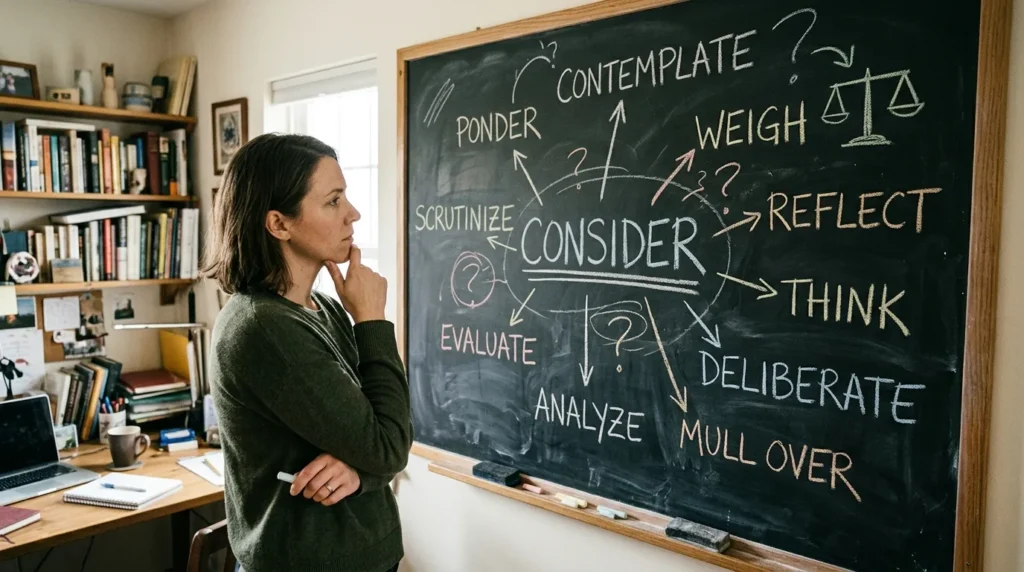
The word consider means to think carefully about something, examine an idea, take something into account, or regard someone or something in a particular way. Its best synonym depends on the context. For example, contemplate suggests deep thought, evaluate means judging the value of something, and regard describes how you view a person or situation.
Quick Answer: What Are the Best Synonyms for Consider?
Some of the best synonyms for consider include think about, contemplate, examine, evaluate, reflect on, review, assess, ponder, explore, regard, deliberate, and take into account. Use contemplate for deep thought, evaluate for judging something, examine for looking closely, and regard when describing how you view someone or something.
Quick List of Synonyms for Consider
| Synonym | Best Use |
|---|---|
| Think about | General thought or reflection |
| Contemplate | Deep or serious thought |
| Ponder | Careful, sometimes prolonged thought |
| Reflect on | Thinking about an experience or idea |
| Examine | Looking at something closely |
| Evaluate | Judging value, quality, or effectiveness |
| Assess | Measuring or judging a situation |
| Review | Looking over information again |
| Analyze | Studying details to understand something |
| Explore | Investigating an idea or possibility |
| Deliberate | Thinking carefully before deciding |
| Weigh | Comparing advantages and disadvantages |
| Regard | Viewing someone or something in a particular way |
| View | Having a particular opinion or perspective |
| Deem | Judge or consider something to be a certain way |
| Regard as | Think of someone or something as |
| Take into account | Include something in a decision |
| Factor in | Include a particular detail when deciding |
| Study | Examine something carefully |
| Inspect | Look closely for details or problems |
| Scrutinize | Examine something very carefully |
| Investigate | Try to discover facts or information |
| Review carefully | Reexamine information before deciding |
| Give thought to | Spend time thinking about something |
| Entertain | Consider an idea or possibility |
| Envision | Imagine a possible situation or outcome |
| Imagine | Form a mental picture or possibility |
| Mull over | Think about something for a while |
| Meditate on | Think deeply and quietly about something |
| Ruminate on | Think about something repeatedly |
| Debate | Consider opposing arguments |
| Question | Examine whether something is true or reasonable |
| Reflect | Think carefully about something |
| Reassess | Consider something again |
| Reevaluate | Judge something again |
| Appraise | Estimate value or quality |
| Judge | Form an opinion or conclusion |
| Account for | Take something into consideration |
| Have regard for | Show consideration or respect |
| Bear in mind | Remember something when making a decision |
Synonyms for Consider by Context
The word consider has several meanings. Choosing an alternative that matches the intended meaning makes your writing clearer and more natural.
1. When You Mean Thinking About Something
Use these alternatives when you want to describe the general act of thinking about an idea, question, or possibility.
Think about: The simplest and most common alternative.
Contemplate: Think deeply or seriously about something.
Ponder: Spend time thinking carefully about a question.
Reflect on: Think about something, often based on experience.
Mull over: Think about something for a while, usually informally.
Give thought to: Spend time considering an idea.
Example:
Original: I will consider your suggestion.
Alternative: I will think about your suggestion.
2. When You Mean Examining Something Carefully
Use these words when you want to look closely at information, evidence, details, or a problem.
Examine: Inspect something closely.
Analyze: Study details to understand how something works.
Scrutinize: Examine something with great attention.
Inspect: Look closely for errors or problems.
Study: Give something careful attention.
Investigate: Examine a matter to discover facts.
Example:
Original: The team considered the evidence.
Alternative: The team examined the evidence.
3. When You Mean Judging or Evaluating Something
These alternatives are useful when deciding whether something is suitable, valuable, effective, or reasonable.
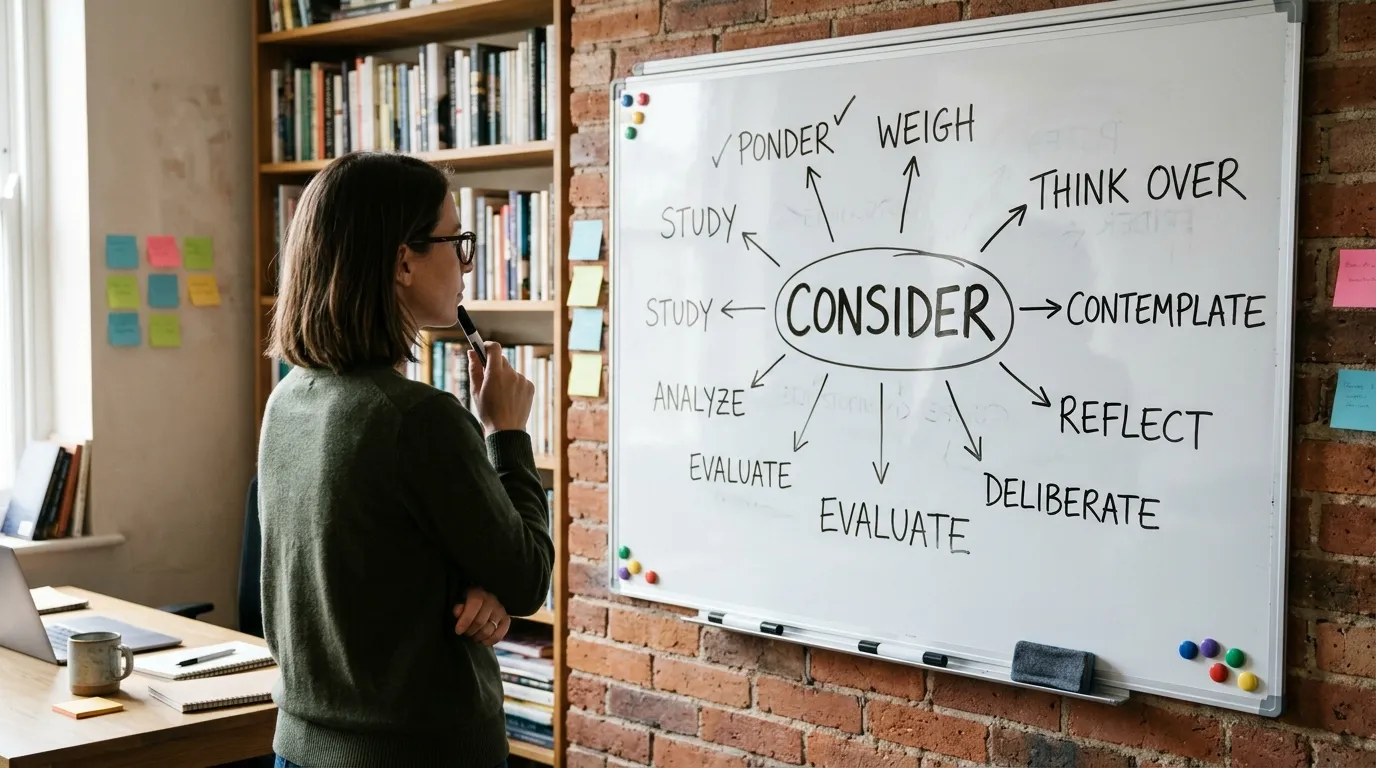
Evaluate: Judge the quality, value, or effectiveness of something.
Assess: Estimate or judge a situation.
Appraise: Estimate the value or quality of something.
Judge: Form an opinion or conclusion.
Review: Examine something to make a judgment.
Weigh: Compare different factors before deciding.
Example:
Original: We need to consider the benefits of this plan.
Alternative: We need to evaluate the benefits of this plan.
4. When You Mean Including Something in a Decision
Use these expressions when you want to show that a particular detail, fact, or circumstance should influence a decision.
Take into account: Include something when making a decision.
Factor in: Include a specific detail in your calculation or judgment.
Bear in mind: Remember something while thinking or deciding.
Account for: Include or allow for a particular factor.
Keep in mind: Remember something as relevant.
Give consideration to: Pay attention to a factor or concern.
Example:
Original: You should consider the cost before buying the car.
Alternative: You should take the cost into account before buying the car.
5. When You Mean Viewing Someone or Something in a Particular Way
Use these alternatives when describing how you think about, classify, or perceive a person, idea, or situation.
Regard: Think of someone or something in a particular way.
View: Have a particular opinion about something.
Deem: Judge or believe something to be a certain way.
See as: Understand or perceive something in a particular way.
Think of as: Have a particular opinion or impression.
Perceive: Become aware of or interpret something in a particular way.
Example:
Original: Many people consider her an expert.
Alternative: Many people regard her as an expert.
6. When You Mean Thinking Before Making a Decision
These words describe careful thought before choosing an option or taking action.
Deliberate: Think carefully before making a decision.
Weigh: Compare the advantages and disadvantages.
Debate: Think about different sides of an issue.
Contemplate: Give serious thought to a possible action.
Explore: Examine different possibilities.
Reassess: Consider a situation again.
Example:
Original: The board will consider the proposal before voting.
Alternative: The board will deliberate on the proposal before voting.
7. When You Mean Considering a Possibility
Use these alternatives when thinking about something that might happen or might be worth doing.
Entertain: Be willing to think about an idea or possibility.
Explore: Investigate a possible option.
Envision: Imagine a possible future situation.
Imagine: Form a mental picture of something.
Contemplate: Think seriously about a possible action.
Look into: Investigate whether something is possible or worthwhile.
Example:
Original: They are considering moving to another city.
Alternative: They are contemplating moving to another city.
20 Detailed Synonyms for Consider
1. Think About
Meaning: To use your mind to reflect on an idea, situation, or possibility.
How it differs: This is the most general and conversational alternative to consider. It does not necessarily suggest deep or careful thought.
Tone: Neutral and conversational.
Best for: Everyday conversations, simple explanations, and informal writing.
Example: Please think about my suggestion before making a decision.
Watch out: Use think about for general reflection, not necessarily for formal evaluation.
2. Contemplate
Meaning: To think deeply or seriously about something.
How it differs: Contemplate suggests more focused or prolonged thought than the general word consider.
Tone: Formal and reflective.
Best for: Serious decisions, personal reflection, philosophical writing, and possible future actions.
Example: She contemplated accepting the position abroad.
Watch out: It can sound overly formal when a simple phrase such as think about would be more natural.
3. Ponder
Meaning: To think carefully about something, especially a difficult question or problem.
How it differs: Ponder emphasizes thoughtful reflection, often when an answer is not immediately clear.
Tone: Reflective and slightly literary.
Best for: Questions, mysteries, difficult decisions, and thoughtful writing.
Example: He pondered the consequences of his decision.
Watch out: Ponder often sounds more thoughtful or literary than everyday consider.
4. Reflect On
Meaning: To think carefully about something, often an experience, action, or lesson.
How it differs: Reflect on often involves looking back at something and thinking about its meaning or consequences.
Tone: Neutral to reflective.
Best for: Personal experiences, mistakes, achievements, and lessons learned.
Example: Take some time to reflect on your progress.
Watch out: Use reflect on when you mean thoughtful examination, especially of something that has already happened.
5. Examine
Meaning: To inspect or study something closely.
How it differs: Examine focuses on looking at details, while consider can involve simply thinking about an idea.
Tone: Neutral and professional.
Best for: Evidence, documents, arguments, problems, and objects.
Example: The researchers examined the available evidence.
Watch out: Examine usually suggests closer investigation than ordinary consideration.
6. Evaluate
Meaning: To judge the value, quality, effectiveness, or importance of something.
How it differs: Evaluate involves forming a judgment based on relevant information or criteria.
Tone: Professional and analytical.
Best for: Plans, performance, products, proposals, and decisions.
Example: The company will evaluate each candidate’s qualifications.
Watch out: Use evaluate when you are judging something, not merely thinking about it.
7. Assess
Meaning: To estimate or judge the nature, value, importance, or quality of something.
How it differs: Assess often involves making a practical judgment about a situation or its effects.
Tone: Professional and neutral.
Best for: Risks, needs, performance, situations, and resources.
Example: We must assess the risks before starting the project.
Watch out: Assess and evaluate overlap, but assess often emphasizes understanding a situation or measuring its condition.
8. Review
Meaning: To examine or look over something, often to check its quality or decide what should happen next.
How it differs: Review often suggests examining existing information, work, or decisions again.
Tone: Neutral and professional.
Best for: Reports, applications, plans, documents, and performance.
Example: The manager will review your application tomorrow.
Watch out: A review can involve consideration, but it may also include checking, correcting, or approving something.
9. Analyze
Meaning: To examine something carefully by studying its parts, details, or structure.
How it differs: Analyze involves breaking information into parts to understand it more fully.
Tone: Academic and professional.
Best for: Data, arguments, research, problems, and complex situations.
Example: The students analyzed the results before reaching a conclusion.
Watch out: Analyze is more specific than consider. It implies detailed examination.
10. Explore
Meaning: To investigate or examine an idea, subject, or possibility.
How it differs: Explore suggests looking into different aspects or options without necessarily reaching a final judgment.
Tone: Neutral and open-minded.
Best for: Ideas, opportunities, solutions, and new possibilities.
Example: We should explore other options before making a final choice.
Watch out: Exploring an idea does not mean accepting or choosing it.
11. Deliberate
Meaning: To think carefully and discuss something before making a decision.
How it differs: Deliberate emphasizes careful decision-making, often involving discussion among several people.
Tone: Formal.
Best for: Meetings, committees, negotiations, and important decisions.
Example: The jury deliberated before announcing its decision.
Watch out: As a verb, deliberate is usually followed by on or over when naming the subject: “They deliberated on the proposal.”
12. Weigh
Meaning: To compare the advantages and disadvantages of different choices.
How it differs: Weigh emphasizes comparing factors before reaching a decision.
Tone: Neutral and practical.
Best for: Decisions, risks, benefits, options, and consequences.
Example: You should weigh the costs and benefits before investing.
Watch out: Weigh is often used figuratively. It does not usually mean physically measuring something in this context.
13. Regard
Meaning: To think of or view someone or something in a particular way.
How it differs: Regard describes an opinion or perception rather than the process of thinking carefully.
Tone: Neutral to formal.
Best for: Describing people, opinions, reputations, and classifications.
Example: Her colleagues regard her as a reliable leader.
Watch out: The common construction is regard someone or something as a particular thing.
14. Deem
Meaning: To judge or consider something to be a certain way.
How it differs: Deem emphasizes reaching a judgment or conclusion rather than simply thinking about something.
Tone: Formal.
Best for: Official decisions, professional writing, rules, and judgments.
Example: The application was deemed incomplete.
Watch out: Deem can sound stiff in everyday conversation. Use consider or think of as when a more natural tone is needed.
15. Scrutinize
Meaning: To examine something very carefully and critically.
How it differs: Scrutinize is stronger than examine and suggests close attention to small details.
Tone: Formal and analytical.
Best for: Evidence, financial records, claims, decisions, and documents.
Example: The auditors scrutinized the company’s financial records.
Watch out: It often suggests looking for errors, weaknesses, or inconsistencies.
16. Investigate
Meaning: To try to discover facts or understand something by examining it.
How it differs: Investigate suggests a deliberate effort to find information or uncover the truth.
Tone: Neutral to formal.
Best for: Problems, complaints, incidents, claims, and unfamiliar situations.
Example: The team investigated several possible causes of the failure.
Watch out: Investigating something is more active and evidence-focused than simply considering it.
17. Entertain
Meaning: To be willing to think about or consider an idea or possibility.
How it differs: Entertain suggests being open to an idea without necessarily accepting it.
Tone: Formal and neutral.
Best for: Proposals, possibilities, suggestions, and hypothetical situations.
Example: The committee is willing to entertain alternative proposals.
Watch out: In this context, entertain does not mean hosting guests or providing amusement.
18. Appraise
Meaning: To estimate the value, quality, or importance of something.
How it differs: Appraise usually involves making a considered judgment, especially about value or quality.
Tone: Professional and formal.
Best for: Property, artwork, performance, skills, and business assets.
Example: An expert appraised the painting before it was sold.
Watch out: Appraise is not a general replacement for consider. Use it when assessing value or quality.
19. Reassess
Meaning: To consider or evaluate something again, often because new information has become available.
How it differs: Reassess emphasizes reviewing an earlier judgment or decision.
Tone: Neutral and professional.
Best for: Plans, risks, priorities, strategies, and previous decisions.
Example: The company needs to reassess its marketing strategy.
Watch out: Use reassess when something has already been evaluated once.
20. Mull Over
Meaning: To think about something carefully for a period of time.
How it differs: Mull over is an informal expression that suggests thoughtful reflection, often before making a decision.
Tone: Informal and conversational.
Best for: Personal decisions, suggestions, offers, and everyday conversations.
Example: I’ll mull over your offer and get back to you.
Watch out: This is an informal phrasal expression, so it may not suit formal academic or business writing.
Comparison Table: Consider vs. Similar Words
| Word or Phrase | Main Meaning | Tone | Interchangeability |
|---|---|---|---|
| Consider | Think about or take into account | Neutral | Original word |
| Think about | Give something mental attention | Conversational | Usually interchangeable |
| Contemplate | Think deeply | Formal/reflective | Context-dependent |
| Ponder | Think carefully | Reflective | Usually interchangeable for deep thought |
| Reflect on | Think carefully, often about the past | Neutral/reflective | Context-dependent |
| Examine | Look at something closely | Neutral | Best for detailed inspection |
| Evaluate | Judge quality or value | Professional | Best for assessment |
| Assess | Judge a situation or condition | Professional | Context-dependent |
| Analyze | Study parts and details | Academic/professional | More specific than consider |
| Explore | Investigate possibilities | Neutral | Best for options and ideas |
| Deliberate | Think carefully before deciding | Formal | Best for decisions |
| Weigh | Compare factors | Neutral | Best for choices |
| Regard | View in a particular way | Neutral/formal | Best for opinions or perceptions |
| Deem | Judge something to be a certain way | Formal | Best for conclusions |
| Scrutinize | Examine very closely | Formal | Stronger than consider |
| Entertain | Be open to an idea | Formal | Best for possibilities |
How to Choose the Right Synonym for Consider
| If You Want to Say… | Choose… | Example |
|---|---|---|
| I will think about your idea. | Think about | I’ll think about your suggestion. |
| I need to think deeply. | Contemplate | She contemplated her next move. |
| I want to inspect the details. | Examine | We examined the report. |
| I need to judge the quality. | Evaluate | They evaluated the proposal. |
| I want to compare the options. | Weigh | We weighed the advantages and disadvantages. |
| I need to include this detail. | Take into account | Take the deadline into account. |
| I view her as a leader. | Regard | I regard her as a strong leader. |
| I am open to the possibility. | Entertain | We can entertain that possibility. |
| I need to think before deciding. | Deliberate | The committee deliberated on the matter. |
| I want to think about it informally. | Mull over | I’ll mull over the offer. |
10 Sentence Transformations Using Synonyms for Consider
Original: I will consider your suggestion.
Alternative: I will think about your suggestion.Original: She considered moving abroad.
Alternative: She contemplated moving abroad.Original: The team considered the evidence.
Alternative: The team examined the evidence.Original: We must consider the risks.
Alternative: We must assess the risks.Original: The manager considered each application.
Alternative: The manager reviewed each application.Original: You should consider the advantages and disadvantages.
Alternative: You should weigh the advantages and disadvantages.Original: They consider her a valuable employee.
Alternative: They regard her as a valuable employee.Original: The board considered the proposal before voting.
Alternative: The board deliberated on the proposal before voting.Original: We should consider other possibilities.
Alternative: We should explore other possibilities.Original: He is considering the job offer.
Alternative: He is mulling over the job offer.
Common Mistakes When Using Synonyms for Consider
1. Confusing Consider With Evaluate
Original: Please consider my idea.
Alternative: Please evaluate my idea.
Difference: Consider can simply mean think about an idea. Evaluate means judge its quality, value, or usefulness. The second sentence asks for a more specific assessment.
2. Using Contemplate for Simple Everyday Thoughts
Awkward: I will contemplate what to eat for lunch.
More natural: I will think about what to eat for lunch.
Why: Contemplate often sounds more serious or reflective than an ordinary decision requires.
3. Confusing Regard With Examine
Incorrect: I regard the report carefully for errors.
Correct: I examine the report carefully for errors.
Why: Regard means view or think of something in a particular way. Examine means inspect it closely.
4. Using Deem When You Mean Think About
Awkward: I will deem your suggestion tonight.
Correct: I will consider your suggestion tonight.
Why: Deem means judge something to be a certain way. It does not normally mean spend time thinking about an idea.
5. Confusing Assess With Accept
Incorrect: She assessed the invitation.
Better: She accepted the invitation.
Why: Assess means judge or evaluate something. Accept means agree to receive or take an offer.
6. Using Scrutinize for Casual Consideration
Awkward: I scrutinized going to the cinema.
Better: I considered going to the cinema.
Why: Scrutinize means examine something very carefully. It is too strong for an ordinary possibility.
7. Confusing Acknowledging With Considering
Incorrect: I acknowledged applying for the position. (when you mean you are thinking about applying)
Correct: I am considering applying for the position.
Why: Acknowledge means recognize or admit something. Consider means think about a possible action.
8. Using Mull Over in Formal Writing
Informal: The committee will mull over the proposal.
More formal: The committee will deliberate on the proposal.
Why: Mull over is conversational. Deliberate is usually more appropriate in formal reports and professional writing.
9. Confusing Take Into Account With Take Into Consideration
Both expressions are correct:
Please take the cost into account.
Please take the cost into consideration.
Why: These expressions have nearly the same meaning. Avoid awkward combinations such as “take into account of.”
10. Forgetting the Correct Preposition After Reflect
Incorrect: She reflected about her experience.
Better: She reflected on her experience.
Why: Reflect on is the standard expression when discussing careful thought about an experience, event, or idea.
Grammar and Usage: How to Use Consider Correctly
The word consider appears in several common grammatical patterns. These patterns can have slightly different meanings.
| Pattern | Meaning | Example |
|---|---|---|
| Consider + noun | Think about something | Consider the proposal. |
| Consider + gerund (-ing) | Think about doing something | She is considering changing jobs. |
| Consider + that + clause | Think that something may be true | Consider that the results may change. |
| Consider + object + adjective | Regard something as having a quality | We consider the plan useful. |
| Consider + object + noun | Regard someone or something as a particular type | They consider her an expert. |
| Consider whether/if | Think about the possibility or truth of something | Consider whether this is the best option. |
| Consider doing something | Think about taking an action | He is considering buying a house. |
Important usage notes:
Consider doing: Use the -ing form after consider when discussing a possible action. Say “consider applying,” not “consider to apply.”
Consider someone something: You can say “I consider him a friend.”
Consider something as: This construction is possible, but it is often more natural to say “consider something useful” or “regard something as useful.”
Consider carefully: Place carefully after the verb or object as appropriate: “Please consider the proposal carefully.”
Frequently Asked Questions
1. What is the best synonym for consider?
Some of the closest alternatives are think about, contemplate, ponder, reflect on, and examine. Think about is the most general choice, while contemplate and ponder suggest deeper thought. The best synonym depends on the sentence.
2. What is a formal word for consider?
Contemplate, deliberate, evaluate, assess, examine, and deem are formal alternatives, but they have different meanings. Use deliberate for careful decision-making and evaluate for judging quality or value.
3. What is an informal way to say consider?
Common informal alternatives include think about, mull over, look into, and give some thought to. For example, “I’ll consider your offer” can become “I’ll think about your offer.”
4. What is another word for consider carefully?
Useful alternatives include examine, scrutinize, evaluate, assess, ponder, and deliberate. Choose scrutinize for very close inspection, evaluate for judging quality, and deliberate for thinking before making a decision.
5. What is another word for consider someone as something?
You can use regard, view, see, or deem. For example, “They consider her a leader” can become “They regard her as a leader.”
6. What is the difference between consider and contemplate?
Consider is a broad word that means think about something or take it into account. Contemplate usually suggests deeper, more serious, or prolonged thought. You can consider a shopping option, but contemplate a major life decision.
7. What is the opposite of consider?
There is no single opposite for every meaning of consider. Depending on the context, possible opposites include ignore, disregard, overlook, dismiss, and neglect. For example, ignore is the opposite of paying attention to something, while dismiss means reject an idea without accepting it.
Key Takeaways
Think about is the simplest and most natural everyday alternative to consider.
Contemplate, ponder, and reflect on describe deeper or more thoughtful reflection.
Examine, analyze, and scrutinize are useful when looking closely at details or evidence.
Evaluate, assess, and appraise focus on judging quality, value, or importance.
Regard, view, and deem describe how you perceive or classify someone or something.