

Quick Answer: What Are Synonyms for Contrast?
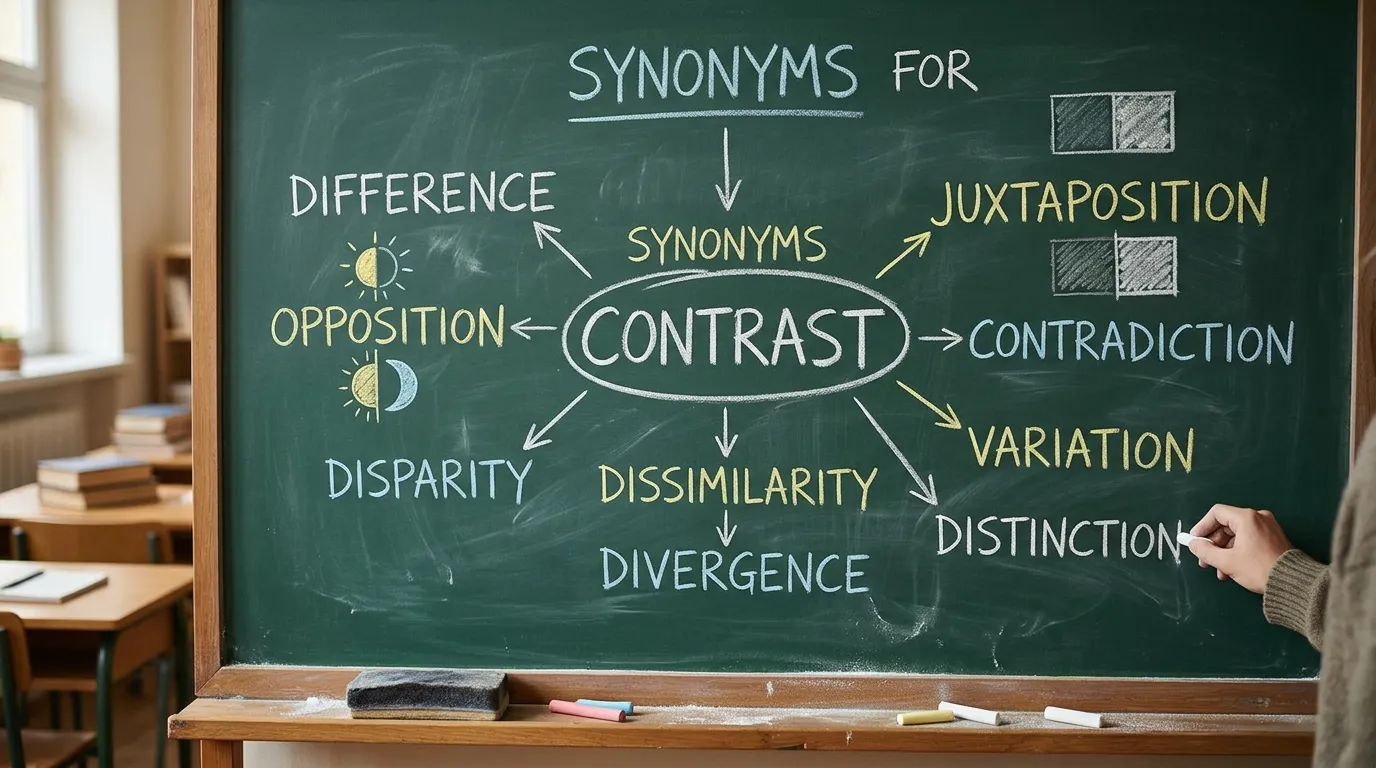
Common synonyms for contrast include difference, distinction, comparison, disparity, variation, opposition, divergence, and distinction. The best alternative depends on the context. Use difference for a general comparison, disparity for a significant gap, opposition for conflicting ideas, and distinction when highlighting how two things differ.
Quick Synonym List for Contrast
Here are useful alternatives grouped by meaning and context.
Everyday synonyms: difference, distinction, variation, comparison, dissimilarity
Strong differences: disparity, divergence, discrepancy, gap, inequality
Opposing ideas or qualities: opposition, contradiction, conflict, antithesis, incompatibility
Academic writing: distinction, disparity, divergence, differentiation, comparison
Visual contrast: difference, variation, separation, juxtaposition, opposition
Contrast as a verb: compare, differentiate, distinguish, juxtapose, set against
Contrast as an adjective-related idea: contrasting, opposing, conflicting, dissimilar, divergent
Formal alternatives: disparity, divergence, discrepancy, differentiation, antithesis
These words are related, but they are not always interchangeable. A difference can be minor or major, while a disparity often suggests a noticeable gap or inequality. A contradiction involves conflicting claims or ideas, not simply different features.
What Does Contrast Mean?
Contrast can be a noun or a verb. It generally refers to a difference between two or more things, especially when comparing their qualities, characteristics, or effects.
1. Contrast as a noun
As a noun, contrast means a noticeable difference between people, objects, ideas, or situations.
Example: There is a sharp contrast between the two neighborhoods.
Possible alternatives include difference, distinction, disparity, and divergence.
2. Contrast as a verb
As a verb, contrast means to compare things in order to highlight their differences.
Example: The essay contrasts traditional education with online learning.
Possible alternatives include compare, differentiate, distinguish, and juxtapose, depending on the sentence.
3. Contrast in academic writing
In essays and research, contrast describes differences between theories, findings, characters, arguments, or historical periods.
Example: The study contrasts the results of two teaching methods.
Possible alternatives include compare, distinguish, differentiate, and highlight the differences between.
4. Contrast in visual design
In art, photography, and design, contrast refers to noticeable differences in color, brightness, size, shape, or texture.
Example: The designer used contrast to make the heading stand out.
Possible alternatives include variation, distinction, opposition, and juxtaposition, depending on the visual effect.
Closest Synonyms for Contrast
1. Difference
Meaning: A way in which two or more things are not the same.
Example:
Original: There is a contrast between the two approaches.
Revised: There is a difference between the two approaches.
Best for: Everyday writing, general comparisons, and simple explanations.
How it differs: Difference is broader and more neutral than contrast. It does not necessarily suggest that the differences are especially noticeable or deliberately compared.
2. Distinction
Meaning: A difference that helps separate or identify two things.
Example:
Original: The contrast between facts and opinions is important.
Revised: The distinction between facts and opinions is important.
Best for: Academic writing, definitions, analysis, and explaining concepts.
How it differs: Distinction often emphasizes the specific feature that separates one thing from another. It is especially useful when two concepts might be confused.
3. Comparison
Meaning: The act of examining two or more things to identify similarities or differences.
Example:
Original: The contrast reveals different approaches to learning.
Revised: The comparison reveals different approaches to learning.
Best for: Essays, research, evaluations, and discussions.
How it differs: A comparison can examine both similarities and differences. Contrast more specifically emphasizes differences.
4. Disparity
Meaning: A noticeable or significant difference, often involving levels, amounts, opportunities, or outcomes.
Example:
Original: The contrast between the two groups’ incomes was substantial.
Revised: The disparity between the two groups’ incomes was substantial.
Best for: Social issues, economics, research, and formal reports.
How it differs: Disparity often suggests a considerable gap or inequality rather than any ordinary difference.
5. Variation
Meaning: A difference or change in form, amount, level, or condition.
Example:
Original: The contrast in test scores was unexpected.
Revised: The variation in test scores was unexpected.
Best for: Science, statistics, design, and descriptions of changing conditions.
How it differs: Variation can describe differences within one group or across multiple examples. It does not always involve two clearly opposing things.
6. Dissimilarity
Meaning: A lack of similarity between two or more things.
Example:
Original: The contrast between the characters is obvious.
Revised: The dissimilarity between the characters is obvious.
Best for: Literary analysis, academic writing, and detailed comparisons.
How it differs: Dissimilarity directly emphasizes that things are unlike one another. It is more formal than difference in many contexts.
7. Divergence
Meaning: A difference or movement away from a shared point, position, or direction.
Example:
Original: The contrast between their opinions became clear.
Revised: The divergence between their opinions became clear.
Best for: Academic analysis, political discussion, research, and changing trends.
How it differs: Divergence often suggests that ideas, paths, or results have moved apart rather than simply being different from the beginning.
8. Discrepancy
Meaning: A difference between facts, figures, statements, or results that might be expected to match.
Example:
Original: The contrast between the two reports needs investigation.
Revised: The discrepancy between the two reports needs investigation.
Best for: Research, accounting, records, and checking accuracy.
How it differs: Discrepancy often implies an inconsistency or unexplained mismatch. It is not the best choice for every ordinary contrast.

9. Opposition
Meaning: A state of being opposite or in conflict with something else.
Example:
Original: The contrast between the characters’ beliefs shapes the story.
Revised: The opposition between the characters’ beliefs shapes the story.
Best for: Conflicting beliefs, competing interests, and opposing forces.
How it differs: Opposition suggests stronger conflict or direct opposites, while contrast can describe differences without conflict.
10. Juxtaposition
Meaning: Placing two or more things close together to emphasize their differences or similarities.
Example:
Original: The contrast between wealth and poverty is striking.
Revised: The juxtaposition of wealth and poverty is striking.
Best for: Literature, art, photography, film, and persuasive writing.
How it differs: Juxtaposition describes how things are placed or presented together to create an effect. It is not simply another word for difference.
11. Antithesis
Meaning: The direct opposite of an idea or quality; also a rhetorical technique that emphasizes opposing ideas.
Example:
Original: The contrast between freedom and oppression is central to the novel.
Revised: The antithesis between freedom and oppression is central to the novel.
Best for: Literary criticism, rhetoric, philosophy, and formal analysis.
How it differs: Antithesis suggests a strong or direct opposition. It is more specific than the general word contrast.
12. Differentiation
Meaning: The process of showing or creating differences between things.
Example:
Original: The contrast between the product categories is important.
Revised: The differentiation between the product categories is important.
Best for: Business, education, science, and technical writing.
How it differs: Differentiation often describes a process of distinguishing things rather than the difference itself.
13. Gap
Meaning: A space or difference between two levels, amounts, positions, or conditions.
Example:
Original: The contrast between students’ achievement levels is concerning.
Revised: The achievement gap between students is concerning.
Best for: Education, income, performance, access, and opportunity.
How it differs: Gap often emphasizes distance or a measurable difference, not merely contrasting qualities.
14. Conflict
Meaning: A disagreement, clash, or incompatibility between ideas, interests, or forces.
Example:
Original: The contrast between their goals creates tension.
Revised: The conflict between their goals creates tension.
Best for: Literature, relationships, workplace issues, and competing priorities.
How it differs: Conflict implies a clash or struggle. Two things can contrast without being in conflict.
15. Contradiction
Meaning: A direct inconsistency between statements, beliefs, or claims.
Example:
Original: There is a contrast between his words and actions.
Revised: There is a contradiction between his words and actions.
Best for: Argument analysis, logic, debates, and evaluating statements.
How it differs: A contradiction occurs when two claims or actions are inconsistent in a meaningful way. Ordinary differences do not necessarily involve contradictions.
Synonyms for Contrast in Academic Writing
When writing an essay, research paper, or formal report, choose an alternative that describes the exact relationship between the ideas.
| Alternative | Meaning | Example |
|---|---|---|
| Distinction | A feature that separates concepts | The distinction between correlation and causation matters. |
| Disparity | A significant gap or inequality | The report examines disparities in access to education. |
| Divergence | A difference in direction, views, or results | The findings show a divergence from earlier research. |
| Discrepancy | An inconsistency between expected or reported values | The researcher investigated the discrepancy in the data. |
| Dissimilarity | A lack of similarity | The analysis highlights dissimilarities between the groups. |
| Differentiation | The process of distinguishing things | The study focuses on differentiation among learning methods. |
| Comparison | An examination of similarities and differences | The comparison reveals strengths in both approaches. |
| Opposition | A relationship of opposing ideas or forces | The novel explores the opposition between duty and desire. |
| Variation | Differences in form, level, or amount | The research considers variation in student performance. |
Essay tip: If your purpose is to show differences, contrast may be the clearest choice. Use disparity for unequal outcomes, discrepancy for mismatched information, and distinction for separating concepts.
Synonyms for Contrast as a Verb
When contrast is an action, you need a verb rather than a noun.
| Verb or phrase | Meaning | Example |
|---|---|---|
| Compare | Examine similarities or differences | The essay compares two leadership styles. |
| Differentiate | Show how things differ | The researcher differentiates the two categories. |
| Distinguish | Recognize or explain differences | The author distinguishes facts from opinions. |
| Juxtapose | Place things together to highlight an effect | The photographer juxtaposes light and shadow. |
| Set against | Present one thing in relation to another | The story sets hope against despair. |
| Highlight differences | Make differences easy to notice | The chart highlights differences in spending. |
| Set apart | Make something distinct from others | These qualities set the two products apart. |
| Oppose | Place ideas or forces in conflict | The author opposes tradition to innovation. |
These verbs have different grammatical patterns. For example, you can compare A with B, distinguish A from B, or juxtapose A and B.
Synonyms for Contrast in Different Contexts
Contrast in an essay
Useful alternatives include difference, distinction, comparison, divergence, and disparity.
Example:
Basic: The contrast between the two theories is important.
Revised: The distinction between the two theories is important.
Use distinction if the goal is to explain how the theories differ. Use comparison if the essay examines both similarities and differences.
Contrast between two characters
Useful alternatives include difference, opposition, dissimilarity, and juxtaposition.
Example:
Basic: The contrast between the characters makes the story interesting.
Revised: The opposition between the characters’ values makes the story interesting.
Use opposition when the characters’ beliefs directly conflict. Use juxtaposition when the author places their characteristics side by side to emphasize the difference.
Contrast in art and design
Useful alternatives include variation, juxtaposition, distinction, and opposition.
Example:
Basic: The designer used contrast to draw attention to the headline.
Revised: The designer used differences in color and brightness to draw attention to the headline.
The specific description is often clearer than a broad synonym. In design, contrast can refer to color, size, shape, texture, or brightness.
Contrast in research and data
Useful alternatives include difference, disparity, discrepancy, variation, and divergence.
Example:
Basic: The contrast between the reported and actual figures was noticeable.
Revised: The discrepancy between the reported and actual figures was noticeable.
Use discrepancy when the figures do not match as expected. Use variation when the values naturally differ across observations.
Contrast in everyday conversation
Useful alternatives include difference, comparison, gap, and opposite.
Example:
Basic: There is a contrast between the two phones.
Revised: There is a clear difference between the two phones.
In casual writing, difference is often more natural than formal terms such as dissimilarity or divergence.
True Synonyms vs. Related Alternatives
Not every word associated with contrast can replace it in every sentence.
| Alternative | Relationship to contrast | Can it replace contrast? | Best context |
|---|---|---|---|
| Difference | Close general synonym | Often | Everyday writing |
| Distinction | Difference that separates concepts | Often | Definitions and analysis |
| Comparison | Examination of similarities and differences | Sometimes | Essays and evaluations |
| Disparity | Significant gap or inequality | Sometimes | Social and economic issues |
| Variation | Difference in form or amount | Sometimes | Science and data |
| Discrepancy | Inconsistency or mismatch | Only when appropriate | Records and research |
| Divergence | Movement or difference away from a shared point | Sometimes | Opinions and trends |
| Opposition | Directly opposing qualities or forces | Sometimes | Conflict and competing ideas |
| Juxtaposition | Placement together to create a contrast or other effect | Not always | Literature and visual art |
| Antithesis | Direct opposite or rhetorical opposition | Only when appropriate | Rhetoric and literary analysis |
| Contradiction | Inconsistency between claims or actions | Only when appropriate | Logic and argument |
| Compare | Verb describing the act of examining things | No, if a noun is required | Sentence-level action |
| Differentiate | Verb meaning to show or identify differences | No, if a noun is required | Analysis and classification |
How to Choose the Right Synonym for Contrast
Ask what kind of difference you want to communicate.
A general difference: Use difference.
A difference between two concepts: Use distinction.
An examination of similarities and differences: Use comparison.
A large gap between groups or outcomes: Use disparity.
An inconsistency in figures or statements: Use discrepancy.
A difference in direction or opinion: Use divergence.
Directly opposing ideas: Use opposition.
Placing two things side by side for effect: Use juxtaposition.
An outright conflict between claims: Use contradiction.
Showing differences as an action: Use differentiate or distinguish.
Making differences noticeable in a design: Describe the specific visual features or use highlight differences.
Choose the word that accurately describes the relationship between the things being compared.
10 Sentence Transformations Using Synonyms for Contrast
Original: There is a contrast between the two lifestyles.
Revised: There is a difference between the two lifestyles.
Why: Uses a simple, neutral alternative.Original: The essay explores the contrast between facts and opinions.
Revised: The essay explores the distinction between facts and opinions.
Why: Emphasizes how the two concepts are separated.Original: The contrast in income levels is significant.
Revised: The disparity in income levels is significant.
Why: Highlights a substantial gap.Original: The contrast between the reports requires attention.
Revised: The discrepancy between the reports requires attention.
Why: Suggests an inconsistency that needs investigation.Original: The contrast between their opinions became clear.
Revised: The divergence between their opinions became clear.
Why: Highlights how their views differ or move apart.Original: The novel uses contrast to show the characters’ values.
Revised: The novel uses juxtaposition to show the characters’ values.
Why: Emphasizes the literary technique of placing contrasting elements together.Original: The chart contrasts the results of two experiments.
Revised: The chart compares the results of two experiments.
Why: Uses a verb that describes examining the results side by side.Original: The author contrasts traditional and modern approaches.
Revised: The author distinguishes between traditional and modern approaches.
Why: Emphasizes the differences between the approaches.Original: The contrast between his claims and actions was obvious.
Revised: The contradiction between his claims and actions was obvious.
Why: Works if his actions directly conflict with his claims.Original: The artist used contrast to make the subject stand out.
Revised: The artist used differences in light and color to make the subject stand out.
Why: Names the actual visual techniques instead of relying on a broad term.
Common Mistakes When Using Synonyms for Contrast
1. Treating contrast and comparison as identical
A comparison can identify similarities and differences. A contrast focuses mainly on differences.
Comparison: The essay examines similarities and differences between two novels.
Contrast: The essay emphasizes the differences between two novels.
2. Using disparity for every difference
Disparity often suggests a significant gap or inequality.
Natural: There is a disparity in access to healthcare.
Often clearer: There is a difference between the two colors.
Use difference for ordinary distinctions unless a meaningful gap is involved.
3. Confusing discrepancy with dissimilarity
Discrepancy usually suggests a mismatch or inconsistency. Dissimilarity simply means that things are unlike each other.
Two paintings may be dissimilar without containing any discrepancy.
4. Using opposition when there is no conflict
Two things can be different without being opposites.
For example, a red car and a blue car contrast in color, but their colors are not necessarily in conflict.
5. Using juxtaposition to mean difference alone
Juxtaposition describes placing things together, often to highlight their differences or create an effect. It does not simply mean that two things are different.
6. Using contradiction for ordinary variation
A contradiction involves conflicting claims, statements, or actions. Different opinions are not automatically contradictions unless they conflict in a relevant way.
7. Confusing contrast and distinguish
Contrast can be a noun or a verb. Distinguish is a verb.
Correct: The contrast between the ideas is clear.
Correct: The author distinguishes the two ideas.
Incorrect: The author distinguish the two ideas.
8. Choosing an overly formal synonym
Words such as dissimilarity, divergence, and antithesis may sound unnatural in simple writing.
“The two plans are different” may be clearer than “The two plans exhibit substantial dissimilarity.”
9. Forgetting the word’s grammatical role
If you need a noun, use difference or distinction. If you need a verb, use compare, distinguish, or differentiate.
10. Replacing contrast when it is already the clearest word
Do not change contrast simply to avoid repetition. It is a precise and natural term when your purpose is to emphasize differences between things.
Grammar and Usage: How to Use Contrast Correctly
Contrast as a noun
Use contrast to describe a difference or the effect created by comparing different elements.
Examples:
The contrast between the two policies is clear.
There is a sharp contrast in their approaches.
The colors create a strong contrast.
In contrast to last year, sales increased.
Common patterns include:
Contrast between A and B: The contrast between the designs is striking.
Contrast with: Her approach contrasts with his.
In contrast to: In contrast to the first study, the second found no effect.
By contrast: The first method is expensive; by contrast, the second is affordable.
Contrast as a verb
Use contrast when highlighting differences between two or more things.
Examples:
The report contrasts two teaching methods.
The author contrasts the characters’ beliefs.
The study contrasts urban and rural outcomes.
Common patterns include:
Contrast A with B: The researcher contrasts the two approaches.
Contrast A and B: The essay contrasts tradition and change.
Contrast vs. comparison
Comparison can include both similarities and differences. Contrast specifically emphasizes differences.
Comparison: The study compares two treatment methods.
Contrast: The study contrasts the outcomes of two treatment methods.
Common collocations with contrast
| Phrase | Example |
|---|---|
| Sharp contrast | There is a sharp contrast between the results. |
| Striking contrast | The photograph creates a striking contrast. |
| Stark contrast | The report reveals a stark contrast in living conditions. |
| Clear contrast | The essay shows a clear contrast between the characters. |
| Direct contrast | The two proposals present a direct contrast in priorities. |
| In contrast to | In contrast to earlier findings, this study found no change. |
| By contrast | The first product is costly; by contrast, the second is affordable. |
| Contrast between | The contrast between the colors is noticeable. |
| Contrast with | The modern building contrasts with its historic surroundings. |
| High contrast | The design uses high contrast to improve visibility. |
Frequently Asked Questions
1. What is the best synonym for contrast?
Difference is the most versatile everyday alternative. Distinction works well for separating concepts, while disparity describes a significant gap and opposition emphasizes conflicting qualities.
2. What is a formal synonym for contrast?
Useful formal alternatives include distinction, disparity, divergence, discrepancy, and dissimilarity. The best choice depends on whether you mean a general difference, an inequality, a change in direction, or an inconsistency.
3. What is another word for contrast in an essay?
Try difference, distinction, comparison, divergence, or disparity. Use juxtaposition when discussing a literary technique that places different elements together for effect.
4. What is the difference between contrast and difference?
Difference is a broad term for anything that is not the same. Contrast often emphasizes the differences between things, particularly when they are compared directly.
5. What is the difference between contrast and juxtaposition?
Contrast refers to the differences themselves or the act of highlighting them. Juxtaposition refers to placing things together so their relationship or differences become noticeable.
6. What is a synonym for contrast that means opposition?
Opposition is a suitable choice when two ideas, qualities, or forces are directly opposed. Antithesis is another option when describing a direct opposite or a rhetorical technique.
7. What is the opposite of contrast?
Depending on the context, possible opposites include similarity, resemblance, likeness, and agreement. If contrast means emphasizing differences, similarity is a natural opposite.
Editor’s Choice: The Best Alternatives to Contrast
Difference — best for general, everyday comparisons.
Distinction — best for explaining how concepts differ.
Disparity — best for significant gaps or inequalities.
Discrepancy — best for inconsistencies in records, figures, or statements.
Juxtaposition — best for literary and visual techniques that place different elements together.
These alternatives cover common uses without treating every related word as an exact synonym. For many sentences, contrast remains the clearest choice.
Key Takeaways
Contrast can mean a difference between things or the act of highlighting those differences.
Use difference for general cases and distinction when separating concepts.
Use disparity for significant gaps and discrepancy for inconsistencies.
Use juxtaposition when discussing elements placed together for effect.
Match the synonym to the meaning, context, and grammatical role of the original word.