

Quick Answer: What Are Synonyms for Content?
Synonyms for content include satisfied, pleased, happy, fulfilled, material, information, substance, subject matter, and media. The best alternative depends on the meaning. When content describes a feeling, use satisfied or pleased. When it refers to information or creative work, consider material, information, or media.
Quick Synonym List for Content
The word content has several meanings, so its alternatives depend on how you use it.
Content meaning satisfied: satisfied, pleased, happy, gratified, fulfilled, comfortable, at ease, appreciative
Content meaning information or material: information, material, substance, subject matter, details, data, facts
Content meaning online or published work: media, posts, articles, videos, publications, resources, creative work
Content meaning what something contains: contents, components, elements, ingredients, items, substances
Content in academic writing: substance, information, subject matter, material, meaning
Content in marketing: media, publications, assets, posts, resources, messaging
Content in education: learning materials, course materials, instructional materials, curriculum material
These words are not all interchangeable. For example, satisfied describes a feeling, while information describes something communicated or learned.
What Does Content Mean?
Content has several meanings in English. Before choosing a synonym, identify which meaning you intend.
1. Content meaning satisfied or happy
As an adjective, content describes someone who feels satisfied with a situation and does not strongly desire more.
Example: She was content with her life.
Possible synonyms include satisfied, pleased, comfortable, and fulfilled.
2. Content meaning information or material
As a noun, content can mean the information, ideas, or material contained in something.
Example: The content of the report was useful.
Possible alternatives include information, substance, subject matter, and material.
3. Content meaning online or published material
In digital marketing, publishing, and social media, content often refers to articles, videos, images, podcasts, posts, and other material created for an audience.
Example: The company publishes educational content.
Possible alternatives include media, articles, posts, publications, and resources, depending on the format.
4. Content meaning what is inside something
The plural noun contents refers to the things inside a container, document, or other item.
Example: She checked the contents of the package.
Possible alternatives include items, components, elements, and materials, depending on what is inside.
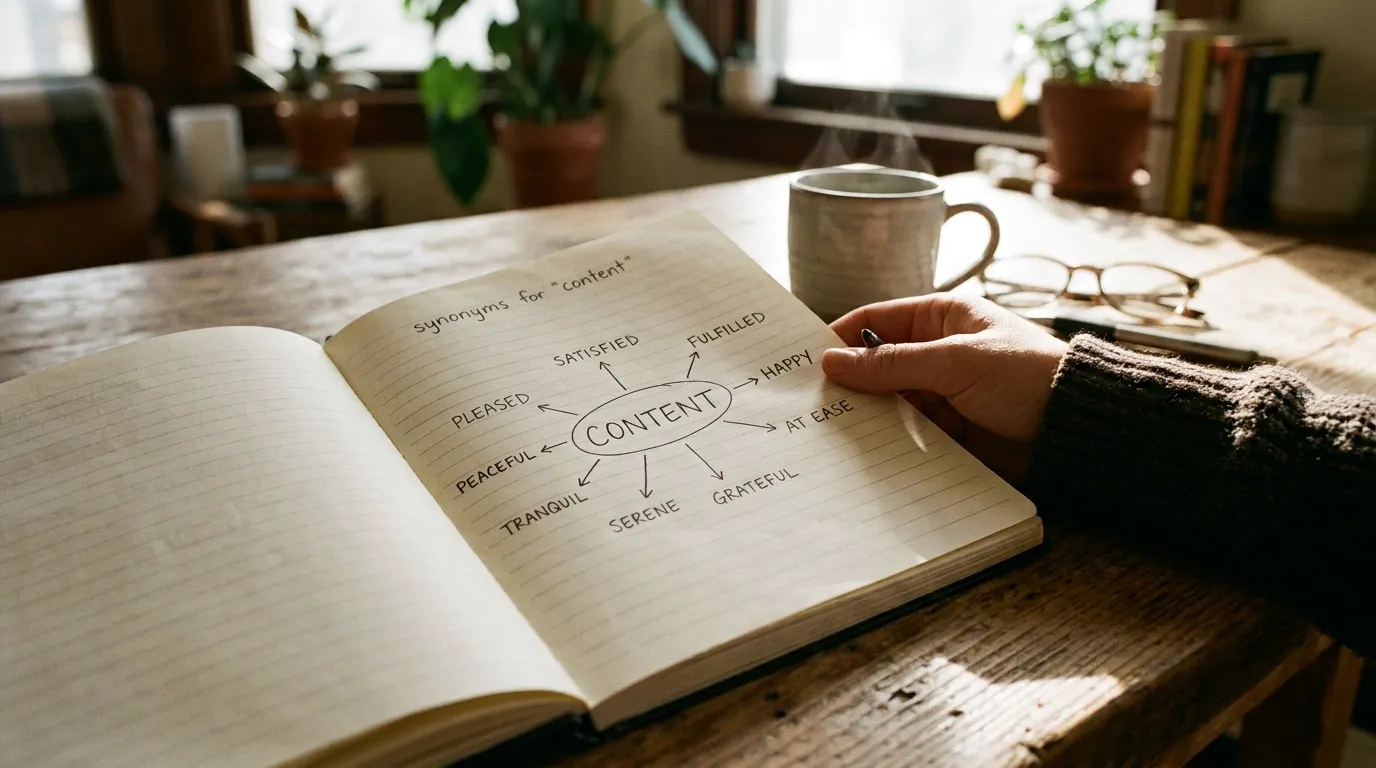
Closest Synonyms for Content
Synonyms for Content Meaning Satisfied
These alternatives describe a person who feels pleased or at peace with a situation.
1. Satisfied
Meaning: Feeling that your needs, expectations, or wishes have been met.
Example:
Original: He was content with the result.
Revised: He was satisfied with the result.
Best for: Everyday conversation, work, relationships, and evaluating results.
How it differs: Satisfied often suggests that a need or expectation has been met. Content can emphasize a calmer sense of acceptance.
2. Pleased
Meaning: Feeling happy or glad about something.
Example:
Original: She was content with her progress.
Revised: She was pleased with her progress.
Best for: Positive reactions, achievements, and professional communication.
How it differs: Pleased often describes a response to something specific, while content can describe a person’s general state of mind.
3. Happy
Meaning: Feeling pleasure, joy, or general well-being.
Example:
Original: They were content with their decision.
Revised: They were happy with their decision.
Best for: Everyday conversation and informal writing.
How it differs: Happy can express stronger excitement or joy. Content usually suggests a quieter, more settled satisfaction.
4. Fulfilled
Meaning: Feeling that your life, work, or experiences provide purpose or satisfaction.
Example:
Original: She felt content in her career.
Revised: She felt fulfilled in her career.
Best for: Personal growth, work, relationships, and meaningful achievements.
How it differs: Fulfilled suggests a deeper sense of purpose or meaning, not simply being satisfied with current circumstances.
5. Gratified
Meaning: Feeling pleased because something desirable has happened.
Example:
Original: He was content to see his students succeed.
Revised: He was gratified to see his students succeed.
Best for: Formal writing, professional settings, and meaningful accomplishments.
How it differs: Gratified often describes satisfaction resulting from a particular event or achievement.
6. Comfortable
Meaning: Feeling at ease with a situation or condition.
Example:
Original: She was content with the arrangement.
Revised: She was comfortable with the arrangement.
Best for: Agreements, living conditions, personal choices, and work situations.
How it differs: Comfortable emphasizes ease or lack of discomfort. It does not necessarily mean someone feels happy or fulfilled.
7. At ease
Meaning: Calm, relaxed, and free from worry or tension.
Example:
Original: He felt content in his new surroundings.
Revised: He felt at ease in his new surroundings.
Best for: Personal experiences, social situations, and emotional descriptions.
How it differs: At ease focuses on relaxation rather than satisfaction with what one has.
8. At peace
Meaning: Feeling calm and accepting of a situation.
Example:
Original: She was content with her past decisions.
Revised: She was at peace with her past decisions.
Best for: Emotional reflection, personal growth, and thoughtful writing.
How it differs: At peace often implies emotional acceptance, while content can describe general satisfaction.
Synonyms for Content Meaning Information or Material
When content refers to what a document, book, website, course, or presentation communicates, choose a word that matches the type of material.
9. Information
Meaning: Facts, details, or knowledge communicated about a subject.
Example:
Original: The website contains useful content.
Revised: The website contains useful information.
Best for: Educational resources, reports, websites, and instructions.
How it differs: Information emphasizes facts and knowledge. It may not fully describe creative or entertaining material.
10. Material
Meaning: Information or resources used for a particular purpose.
Example:
Original: The teacher prepared content for the lesson.
Revised: The teacher prepared material for the lesson.
Best for: Education, training, presentations, and publishing.
How it differs: Material often suggests something prepared or used for a purpose, such as teaching or research.
11. Substance
Meaning: The main ideas, meaning, or important information in something.
Example:
Original: The article has useful content.
Revised: The article has useful substance.
Best for: Essays, reviews, analysis, and professional writing.
How it differs: Substance emphasizes depth and meaningful ideas rather than length or format.
12. Subject Matter
Meaning: The topic or subject being discussed or studied.
Example:
Original: The content of the lecture was difficult.
Revised: The subject matter of the lecture was difficult.
Best for: Academic writing, lessons, research, and technical discussions.
How it differs: Subject matter refers to what something is about, not every detail or element it contains.
13. Details
Meaning: Individual facts or pieces of information.
Example:
Original: The report’s content was incomplete.
Revised: The report’s details were incomplete.
Best for: Reports, instructions, descriptions, and explanations.
How it differs: Details focuses on specific pieces of information rather than the overall message.
14. Data
Meaning: Facts, figures, or observations collected for reference or analysis.
Example:
Original: The content of the spreadsheet was reviewed.
Revised: The data in the spreadsheet was reviewed.
Best for: Research, analytics, business reports, and technical work.
How it differs: Data is appropriate when the material consists of facts or recorded observations, not every kind of written or creative content.
15. Subject
Meaning: The topic being discussed, written about, or studied.
Example:
Original: The content of the meeting was budgeting.
Revised: The subject of the meeting was budgeting.
Best for: Conversations, meetings, essays, and lessons.
How it differs: Subject identifies the topic, while content may include all the information discussed about that topic.
Synonyms for Content in Digital Marketing and Social Media
In digital publishing, content is a broad term. The best alternative often depends on the format or purpose of what is published.
| Alternative | Meaning | Best use |
|---|---|---|
| Media | Communication formats such as images, audio, and video | Digital publishing and marketing |
| Posts | Individual items published on social platforms or websites | Social media |
| Articles | Written pieces about a subject | Blogs and online publications |
| Publications | Material released for readers or audiences | Editorial and professional settings |
| Resources | Material designed to help people learn or complete a task | Educational websites and customer support |
| Assets | Reusable items created for a business or campaign | Marketing teams and content operations |
| Messaging | Words and ideas used to communicate a brand’s message | Advertising and communications |
| Creative work | Material produced through creative effort | Design, writing, video, and arts |
| Videos | Recorded visual material | Video platforms and social media |
| Copy | Written text created for a particular purpose | Advertising, websites, and marketing |
Example:
General: The brand creates content for social media.
More specific: The brand creates videos and posts for social media.
Specific terms often communicate more clearly than the broad word content.
Synonyms for Content in Academic and Professional Writing
If you are writing an essay, report, proposal, or presentation, these alternatives can make your meaning more precise.
| Alternative | Meaning | Example |
|---|---|---|
| Substance | Depth or meaningful ideas | The report lacks substance. |
| Information | Facts or knowledge | The document provides essential information. |
| Material | Resources or prepared information | The training material is easy to follow. |
| Subject matter | The topic being discussed | The subject matter requires careful study. |
| Findings | Results of research or investigation | The findings support the conclusion. |
| Evidence | Information that supports a claim | The evidence strengthens the argument. |
| Details | Specific facts or points | The report includes relevant details. |
| Discussion | The treatment of a topic | The discussion covers several concerns. |
| Coverage | The extent to which topics are addressed | The article provides broad coverage of the issue. |
These words have different meanings. For instance, findings refers to results, while evidence refers to information that supports or challenges a claim. Neither should replace content unless that meaning fits the sentence.
Synonyms for Content Based on Context
Content of a book or article
Useful alternatives include text, material, subject matter, information, substance, and details.
Example:
Basic: The content of the book was interesting.
Revised: The subject matter of the book was interesting.
Use text when referring specifically to written words, and substance when emphasizing the depth of the ideas.
Content of a website
Possible alternatives include information, pages, articles, resources, media, and website material.
Example:
Basic: We need to update the website content.
Revised: We need to update the website’s information and resources.
If you mean the entire collection of website material, website content may still be the clearest phrase.
Content of a lesson or course
Possible alternatives include learning materials, instructional materials, curriculum material, lesson material, and subject matter.
Example:
Basic: The course content needs improvement.
Revised: The course’s learning materials need improvement.
Use curriculum carefully: it often refers to the overall plan of study, not just the information in one lesson.
Content of a message
Possible alternatives include message, meaning, information, wording, and details.
Example:
Basic: I understood the content of her message.
Revised: I understood the meaning of her message.
Use wording when you mean the language used, and meaning when you mean what the message communicates.
Content in marketing
Possible alternatives include posts, articles, media, marketing materials, creative assets, and brand messaging.
Example:
Basic: The team plans next month’s content.
Revised: The team plans next month’s articles, videos, and social media posts.
Naming the actual formats is often more helpful than using a general label.
True Synonyms vs. Related Alternatives
Not every alternative for content means the same thing. This table shows how closely each word matches the original.
| Alternative | Relationship to content | Can it replace content? | Tone or context |
|---|---|---|---|
| Information | Close synonym in informational contexts | Often | Neutral |
| Material | Close synonym for prepared or published resources | Often | Neutral or professional |
| Substance | Contextual alternative emphasizing depth | Sometimes | Formal |
| Subject matter | Related term for the topic | Sometimes | Academic or professional |
| Details | Narrower term for specific facts | Sometimes | Neutral |
| Data | Specific type of information | Only when appropriate | Technical |
| Media | Related term for communication formats | Sometimes | Digital and professional |
| Posts | Specific published items | Only for social publishing | Casual or professional |
| Findings | Research results | Only for results | Academic |
| Evidence | Information supporting a claim | Only for supporting information | Analytical |
| Satisfied | Synonym for the adjective content | Yes, in suitable sentences | Neutral |
| Fulfilled | Near synonym for an emotional state | Sometimes | Personal or reflective |
| Happy | Broader emotional alternative | Sometimes | Everyday |
| Comfortable | Related emotional state | Sometimes | Neutral |
| At peace | Related expression of calm acceptance | Sometimes | Reflective |
How to Choose the Right Synonym for Content
Use these questions to select a word that fits your sentence.
Describing a feeling of satisfaction? Choose satisfied, pleased, or happy.
Describing deep personal satisfaction? Choose fulfilled.
Describing calm acceptance? Choose at peace or comfortable.
Talking about facts or knowledge? Choose information.
Talking about prepared resources? Choose material.
Emphasizing meaningful ideas? Choose substance.
Identifying a topic? Choose subject matter or subject.
Referring to social media publishing? Choose posts, articles, videos, or media.
Discussing research results? Choose findings.
Referring to supporting facts? Choose evidence.
Describing everything inside a package or container? Choose contents or items.
The most effective synonym is the one that preserves your intended meaning and fits the sentence naturally.

10 Sentence Transformations Using Synonyms for Content
These examples show how to replace content with more specific language.
Original: She was content with her new job.
Revised: She was satisfied with her new job.
Why: Emphasizes that the job meets her expectations.Original: He felt content with his achievements.
Revised: He felt fulfilled by his achievements.
Why: Emphasizes a deeper sense of accomplishment.Original: The content of the report was useful.
Revised: The information in the report was useful.
Why: Focuses on the knowledge the report provides.Original: The article has little content.
Revised: The article has little substance.
Why: Suggests that the article lacks meaningful ideas.Original: The teacher prepared content for the class.
Revised: The teacher prepared learning materials for the class.
Why: Specifies the educational purpose of the material.Original: The website needs fresh content.
Revised: The website needs fresh articles and resources.
Why: Names the types of material needed.Original: The content of the presentation was confusing.
Revised: The information in the presentation was confusing.
Why: Emphasizes the information being communicated.Original: The content of the meeting was important.
Revised: The discussion at the meeting was important.
Why: Focuses on what participants discussed.Original: The content of the research was promising.
Revised: The research findings were promising.
Why: Specifies that the results were encouraging.Original: The company creates content for its customers.
Revised: The company creates helpful resources and videos for its customers.
Why: Describes the actual formats and purpose.
Common Mistakes When Using Synonyms for Content
1. Treating content as if it always means information
Content can describe feelings, information, media, or what something contains.
Emotional: She was content with her life.
Informational: The content of the report was useful.
The synonym must match the intended meaning.
2. Using satisfied when you mean information
Incorrect: The satisfied of the report was clear.
Correct: The content or information in the report was clear.
Satisfied is an adjective describing a feeling, not a noun meaning information.
3. Assuming content and substance are identical
Content refers broadly to what something contains or communicates. Substance often emphasizes meaningful ideas, depth, or importance.
A short article can contain little content, but an article with plenty of words may still lack substance.
4. Confusing content with context
Content is what is communicated. Context is the surrounding information or situation that helps explain it.
Example:
Content: The email’s message.
Context: The circumstances that explain why the email was sent.
5. Using media when you mean facts
Media generally refers to communication formats or channels, such as video, audio, images, and publications. It is not always a suitable replacement for information.
6. Using curriculum as a direct synonym for content
A curriculum is usually a planned course of study or educational program. Content may refer to the material within a particular lesson.
Use learning materials when you mean resources students use, and curriculum when you mean the broader educational plan.
7. Replacing content with data in every professional sentence
Data refers to facts, measurements, observations, or recorded information. It is not a natural substitute for creative writing, entertainment, or every kind of educational material.
8. Confusing content and contents
Content: information or material in a book, website, or document.
Contents: the items inside something or, in certain publishing contexts, a list of sections.
Example: The contents of the box were damaged.
9. Using a more formal word when a simple word is clearer
Words such as substance and subject matter can be useful, but they may sound unnecessary in ordinary conversation.
“The information on the page is helpful” is often clearer than “The substance of the page is helpful.”
10. Replacing content without considering the audience
A marketing team may use assets, while students may understand learning materials more easily. Choose terminology that suits the readers and the situation.
Grammar and Usage: How to Use Content Correctly
Content as an adjective
When content means satisfied, it is usually pronounced kuhn-TENT, with stress on the second syllable.
Examples:
She is content with her decision.
They were content to wait.
He seemed content with the outcome.
Common patterns include:
Content with: She is content with her life.
Content to: He was content to remain at home.
Content that: I am content that we made the right choice.
Content as a noun
When content refers to information or material, it is usually pronounced KON-tent, with stress on the first syllable.
Examples:
The content of the article is informative.
We publish educational content online.
The course content needs updating.
Common patterns include:
Content of: the content of the book
Content on: content on social media
Content for: content for students
Content about: content about climate change
Content creation: the process of producing material
Content vs. contents
Use content for the general information or material communicated by something. Use contents when referring to the items inside a container or package, or to the table of contents in a book.
The content of the article is helpful.
The contents of the bag were missing.
Check the table of contents before reading.
Common collocations with content
| Phrase | Example |
|---|---|
| High-quality content | The website publishes high-quality content. |
| Educational content | The channel shares educational content. |
| Digital content | The company produces digital content. |
| Original content | The creator makes original content. |
| Relevant content | The page contains relevant content. |
| Content creation | Content creation takes planning. |
| Content strategy | The team developed a content strategy. |
| Content management | Content management keeps website material organized. |
| Content creator | The content creator posts videos weekly. |
| Content marketing | Content marketing helps a business share useful information. |
Frequently Asked Questions
1. What is the best synonym for content?
It depends on the meaning. Information is useful when content means facts or knowledge. Material works for prepared resources, substance emphasizes depth, and satisfied works when content describes an emotional state.
2. What is another word for content in an essay?
Useful alternatives include information, substance, subject matter, material, and details. For research results, use findings. For supporting facts, use evidence.
3. What is a formal synonym for content?
Depending on the context, formal alternatives include substance, subject matter, information, material, and findings. No single word fits every use of content.
4. What is another word for content in marketing?
Possible alternatives include media, posts, articles, publications, marketing materials, creative assets, and brand messaging. Use a specific format when you know what the material includes.
5. What is a synonym for content that means happy?
Use satisfied, pleased, happy, fulfilled, or gratified. Satisfied is a close everyday alternative, while fulfilled suggests a deeper sense of purpose.
6. What is the difference between content and information?
Information usually refers to facts, details, or knowledge. Content is broader and can include information, stories, images, videos, and other material.
7. What is the difference between content and substance?
Content refers to what something contains or communicates. Substance emphasizes the depth, meaning, or value of the ideas. Something can contain many words but still lack substance.
Editor’s Choice: The Best Alternatives to Content
Choose one of these five alternatives based on your intended meaning:
Satisfied — best for describing a calm feeling of happiness or acceptance.
Information — best for facts, knowledge, and explanations.
Material — best for educational resources, documents, and prepared content.
Substance — best for emphasizing meaningful ideas and depth.
Media — best for discussing formats such as videos, images, audio, and digital publications.
For social media and marketing, naming the format—such as articles, videos, or posts—can be even clearer than using content.
Key Takeaways
Content can mean satisfied, information, published material, or the things something contains.
Use satisfied, pleased, or fulfilled when describing an emotional state.
Use information, material, or substance when referring to written or educational material.
In digital marketing, posts, articles, videos, and media can be more specific than content.
Always choose a replacement that preserves the original meaning and suits your audience.