
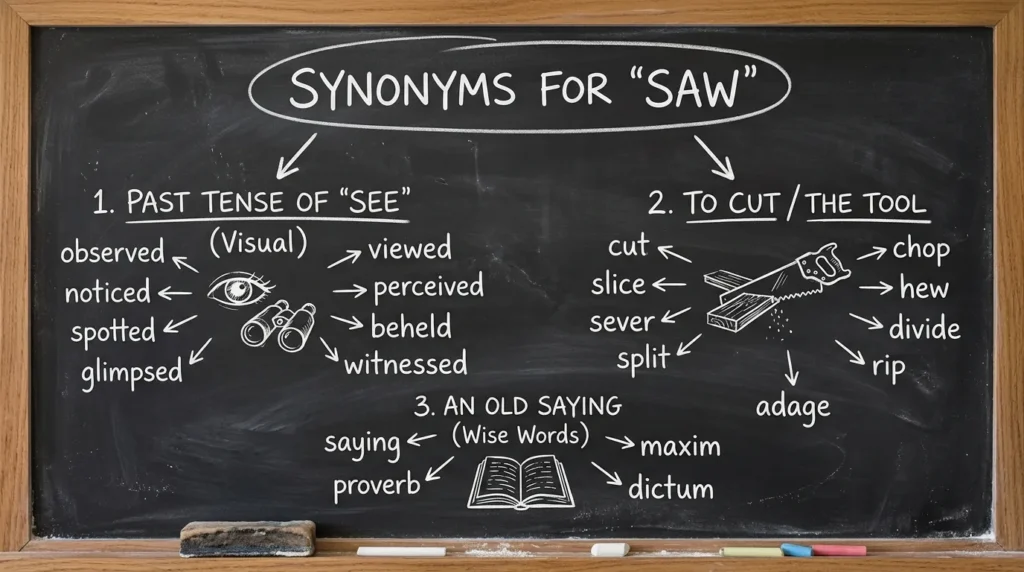
Quick Answer: What Are Synonyms for Saw?
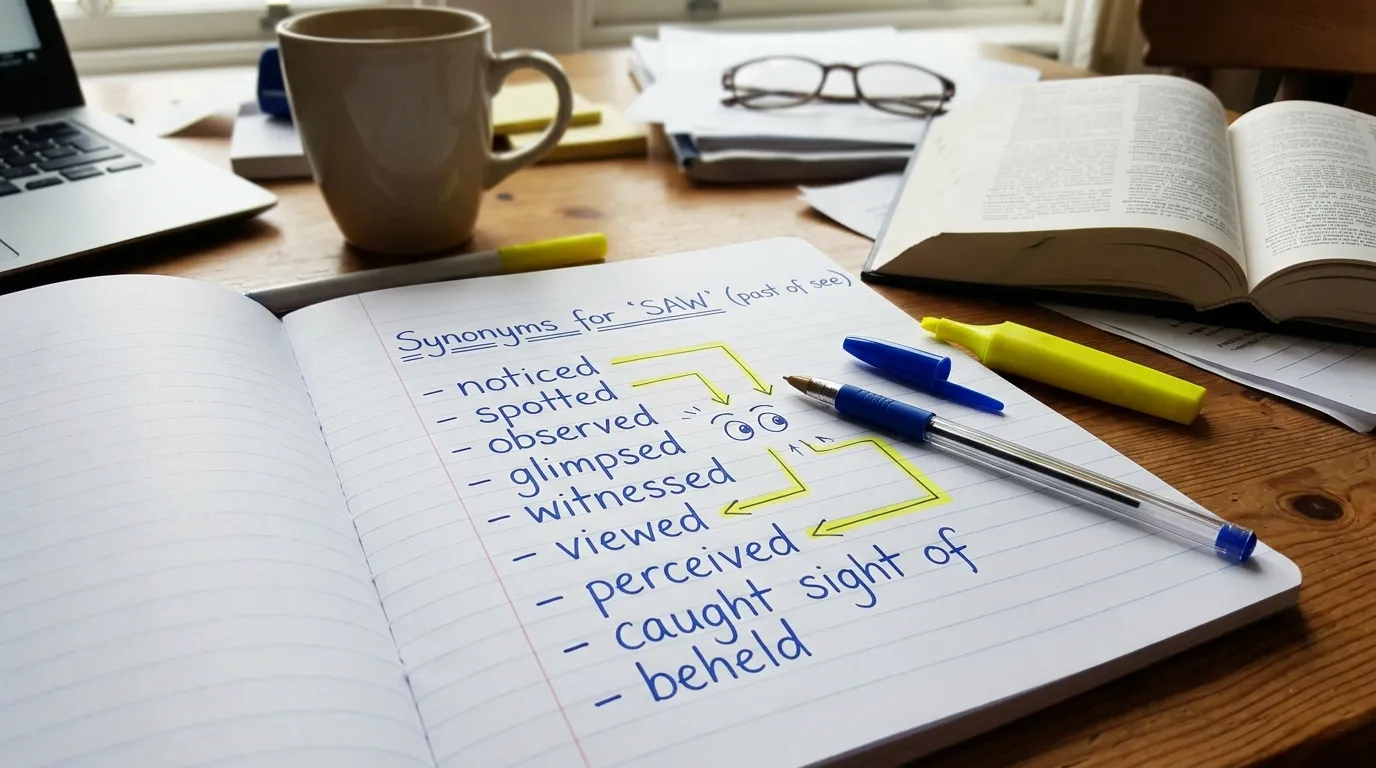
Common synonyms for saw include noticed, observed, viewed, watched, witnessed, spotted, detected, recognized, discovered, and glimpsed. The best alternative depends on what you mean. Use observed for careful attention, witnessed for an event, spotted for finding something, and noticed for becoming aware of something.
Quick Synonym List for Saw
Here are useful alternatives to saw, grouped by meaning and context.
Everyday alternatives: noticed, looked at, viewed, watched, spotted
Careful observation: observed, examined, inspected, studied, monitored
Seeing an event: witnessed, experienced, observed, attended
Finding or discovering: discovered, detected, identified, recognized, uncovered
Seeing briefly: glimpsed, caught sight of, peeped at
Understanding: realized, understood, recognized, perceived
Formal or academic writing: observed, identified, detected, witnessed, perceived
Watching something happen: viewed, watched, followed, witnessed
Not all these words are interchangeable. For example, watched suggests sustained attention, while glimpsed means seeing something briefly.
What Does Saw Mean?
Saw is the past tense of the verb see. It can describe looking at something, noticing something, witnessing an event, or understanding a situation.
The right synonym depends on the intended meaning.
1. Saw something with your eyes
Example: I saw a bird in the garden.
Possible alternatives include noticed, spotted, observed, and glimpsed. Each describes a slightly different way of seeing.
2. Watched something for a period of time
Example: We saw the children play.
Depending on the sentence, watched or observed may be more precise because these words suggest sustained attention.
3. Witnessed an event
Example: She saw the accident.
Witnessed is useful when someone personally sees an event take place, especially an important or serious one.
4. Understood or realized something
Example: I saw that the plan would not work.
In this sense, alternatives include realized, understood, recognized, and perceived.
Closest Synonyms for Saw
These are some of the most useful replacements for saw, with explanations of when each word works best.
1. Noticed
Meaning: Became aware of something through sight or attention.
Example:
Original: I saw a mistake in the report.
Revised: I noticed a mistake in the report.
Best for: Everyday writing, observations, and details that catch someone’s attention.
Difference: Noticed emphasizes becoming aware of something. It does not simply mean looking at it.
2. Observed
Meaning: Watched or examined something carefully.
Example:
Original: The researcher saw changes in the results.
Revised: The researcher observed changes in the results.
Best for: Academic writing, scientific reports, and formal descriptions.
Difference: Observed often implies careful attention. It can sound more formal than saw.
3. Watched
Meaning: Looked at someone or something for a period of time.
Example:
Original: We saw the game last night.
Revised: We watched the game last night.
Best for: Sports, movies, performances, and events.
Difference: Watched emphasizes sustained attention. Use saw when you mean you attended a performance or encountered something, rather than focusing on the act of watching.
4. Viewed
Meaning: Looked at something, often deliberately.
Example:
Original: The committee saw the presentation.
Revised: The committee viewed the presentation.
Best for: Formal communication, presentations, images, and recorded content.
Difference: Viewed can sound more formal or technical than saw.
5. Spotted
Meaning: Saw or noticed something, often quickly or from a distance.
Example:
Original: She saw her friend in the crowd.
Revised: She spotted her friend in the crowd.
Best for: Finding people, objects, or details that may be hard to notice.
Difference: Spotted suggests successfully picking something out from its surroundings.
6. Witnessed
Meaning: Personally saw an event happen.
Example:
Original: Several people saw the accident.
Revised: Several people witnessed the accident.
Best for: Accidents, incidents, historic events, and formal accounts.
Difference: Witnessed emphasizes being present when an event occurred. It can carry a more serious tone than saw.
7. Glimpsed
Meaning: Saw something briefly or for only a moment.
Example:
Original: I saw the deer before it disappeared.
Revised: I glimpsed the deer before it disappeared.
Best for: Stories, descriptions, and brief or incomplete sightings.
Difference: A glimpse is short. It does not suggest that you had time to examine what you saw.
8. Examined
Meaning: Looked at something carefully to learn more about it.
Example:
Original: The doctor saw the patient’s X-ray.
Revised: The doctor examined the patient’s X-ray.
Best for: Medical, scientific, professional, and investigative contexts.
Difference: Examined implies a purposeful and careful review, not just seeing something.
9. Inspected
Meaning: Looked at something closely to check its condition, quality, or accuracy.
Example:
Original: The engineer saw the damaged equipment.
Revised: The engineer inspected the damaged equipment.
Best for: Safety checks, repairs, quality control, and official reviews.
Difference: Inspected implies checking for problems or meeting specific standards.
10. Detected
Meaning: Discovered or noticed something that may be difficult to see or identify.
Example:
Original: The test saw a small change in the sample.
Revised: The test detected a small change in the sample.
Best for: Scientific, technical, medical, and analytical writing.
Difference: A test or instrument can detect a change, but it cannot literally see it in the ordinary human sense.
11. Recognized
Meaning: Identified someone or something as familiar or known.
Example:
Original: I saw her voice actor’s name and knew who it was.
Revised: I recognized the voice actor’s name.
Best for: Identifying familiar people, objects, patterns, or information.
Difference: Recognized means identifying something you already know or can identify, not merely looking at it.
12. Discovered
Meaning: Found something previously unknown, hidden, or unnoticed.
Example:
Original: The team saw a new pattern in the data.
Revised: The team discovered a new pattern in the data.
Best for: Research, problem-solving, exploration, and storytelling.
Difference: Discovered emphasizes finding something meaningful or previously unknown.
13. Perceived
Meaning: Became aware of or interpreted something through the senses or the mind.
Example:
Original: She saw a change in his attitude.
Revised: She perceived a change in his attitude.
Best for: Formal, academic, and analytical writing.
Difference: Perceived may describe an interpretation rather than a directly visible fact. What someone perceives is not always objectively accurate.
14. Realized
Meaning: Became aware of or understood something.
Example:
Original: I saw that I had made a mistake.
Revised: I realized that I had made a mistake.
Best for: Personal reflections, explanations, and writing about new understanding.
Difference: Realized describes understanding, not physical sight.
15. Identified
Meaning: Determined what or who someone or something is.
Example:
Original: The investigators saw the source of the problem.
Revised: The investigators identified the source of the problem.
Best for: Reports, investigations, research, and problem-solving.
Difference: Identified emphasizes reaching a conclusion about the identity or nature of something.
Formal and Academic Synonyms for Saw
When writing essays, research papers, or professional reports, you may want a more specific alternative to saw. Choose a word that accurately describes what happened rather than simply using a more formal-sounding term.
| Alternative | Meaning | Example |
|---|---|---|
| Observed | Watched carefully | The researchers observed a change in behavior. |
| Noted | Recorded or paid attention to a detail | The author noted several limitations. |
| Identified | Determined what something was | The analysis identified three major problems. |
| Detected | Found evidence of something | The instrument detected a slight variation. |
| Examined | Studied something closely | The study examined the effects of sleep. |
| Perceived | Became aware of or interpreted something | Participants perceived the instructions as unclear. |
| Witnessed | Personally saw an event occur | Residents witnessed significant changes in the area. |
| Recognized | Acknowledged or identified something | The report recognized the need for further research. |
Essay tip: Do not replace every instance of saw with a formal alternative. In a sentence such as “I saw a bird,” the original word may be the clearest and most natural choice.
Synonyms for Saw in Different Contexts
Saw in an essay
For academic or analytical writing, consider:
Observed: when describing something noticed through careful attention.
Noted: when mentioning a detail or finding.
Identified: when determining a cause, issue, or pattern.
Recognized: when acknowledging a fact or problem.
Found: when reporting a result.
Demonstrated: when evidence shows something to be true.
Example:
Basic: The study saw a connection between sleep and memory.
Better: The study found a connection between sleep and memory.
Found is often more natural than saw when reporting research results.
Saw in a story
For creative writing, use words that communicate how the character experienced the scene.
Glimpsed: saw something briefly.
Spotted: noticed something unexpectedly.
Stared at: looked at something intensely.
Gazed at: looked at something for a long time, often with admiration.
Witnessed: saw an event happen.
Caught sight of: suddenly or briefly saw something.
Example:
Basic: She saw a shadow near the window.
More vivid: She spotted a shadow near the window.
Saw in everyday conversation
Natural alternatives include:
Noticed
Looked at
Watched
Spotted
Caught sight of
Recognized
Found
Example:
Basic: I saw your message.
Natural alternative: I noticed your message.
However, “I saw your message” is already natural and often means that you received or read it.
Saw in science or research
Consider these alternatives:
Observed
Detected
Measured
Recorded
Identified
Found
Examined
Example:
Basic: Scientists saw a small change in temperature.
More precise: Scientists recorded a small change in temperature.
Use recorded when the change was documented, measured when its amount was quantified, and observed when it was noticed.
Saw meaning understood
When saw means “understood,” use:
Realized
Understood
Recognized
Perceived
Grasped
Appreciated
Example:
Basic: He finally saw why the plan had failed.
Revised: He finally understood why the plan had failed.
Grasped can emphasize a firm understanding, while appreciated may suggest recognizing the importance or value of something.
Comparison Table: Which Synonym for Saw Is Best?
| Word or phrase | Main meaning | Tone | Best use |
|---|---|---|---|
| Noticed | Became aware of | Neutral | Everyday observations |
| Observed | Watched carefully | Formal | Research and analysis |
| Watched | Looked at over time | Neutral | Games, films, events |
| Viewed | Looked at deliberately | Formal or neutral | Presentations and media |
| Spotted | Saw or found something | Casual or neutral | People and objects |
| Witnessed | Saw an event happen | Formal or serious | Accidents and incidents |
| Glimpsed | Saw briefly | Descriptive | Stories and brief sightings |
| Examined | Studied closely | Professional | Detailed inspection |
| Detected | Discovered a signal or change | Technical | Tests and analysis |
| Recognized | Identified as familiar or known | Neutral | Familiar people or patterns |
| Discovered | Found something previously unknown | Neutral | New findings |
| Perceived | Became aware of or interpreted | Formal | Ideas and impressions |
| Realized | Understood something | Neutral | New awareness |
| Identified | Determined what something was | Formal | Reports and investigations |
| Noted | Mentioned or recorded | Formal or neutral | Findings and details |
How to Choose the Right Synonym for Saw
Ask yourself what you want the sentence to communicate.
Did you simply see something? Use saw or viewed.
Did something catch your attention? Use noticed.
Did you find something among other things? Use spotted.
Did you watch carefully? Use observed.
Did you watch over time? Use watched.
Did you see an event take place? Use witnessed.
Did you see something for a moment? Use glimpsed.
Did you study something closely? Use examined.
Did you find a hidden or subtle signal? Use detected.
Did you understand something? Use realized or understood.
Did you determine what something was? Use identified.
Did you find something new? Use discovered.
The best synonym is the word that preserves the meaning of your original sentence.
10 Sentence Transformations Using Synonyms for Saw
These examples show how changing saw can make a sentence more precise.
Original: I saw a strange mark on the wall.
Revised: I noticed a strange mark on the wall.
Why: Emphasizes becoming aware of the mark.Original: We saw the entire football match.
Revised: We watched the entire football match.
Why: Emphasizes watching from beginning to end.Original: She saw her teacher in the hallway.
Revised: She spotted her teacher in the hallway.
Why: Suggests picking someone out from the surroundings.Original: The scientists saw changes in the results.
Revised: The scientists observed changes in the results.
Why: Emphasizes careful observation.Original: Several people saw the fire start.
Revised: Several people witnessed the fire start.
Why: Emphasizes seeing the event happen.Original: I saw the bird before it flew away.
Revised: I glimpsed the bird before it flew away.
Why: Suggests a brief sighting.Original: The mechanic saw the damaged engine.
Revised: The mechanic inspected the damaged engine.
Why: Emphasizes checking the engine’s condition.Original: The instrument saw a slight change in pressure.
Revised: The instrument detected a slight change in pressure.
Why: Uses a more accurate technical verb.Original: She saw that the instructions were confusing.
Revised: She realized that the instructions were confusing.
Why: Emphasizes understanding.Original: The researchers saw a pattern in the data.
Revised: The researchers identified a pattern in the data.
Why: Emphasizes determining what the data revealed.
Common Mistakes When Using Synonyms for Saw
1. Using watched when you mean noticed
Incorrect or less precise: I watched a typo in the document.
Better: I noticed a typo in the document.
Watched generally describes looking at something over time. Noticed describes becoming aware of it.
2. Using witnessed for every ordinary sighting
Less natural: I witnessed a blue car parked outside.
More natural: I saw a blue car parked outside.
Use witnessed when the event itself matters, not simply because you saw an object.
3. Using glimpsed when you had a clear, long look
Less accurate: I glimpsed the painting for an hour.
Better: I examined the painting for an hour.
A glimpse is brief.
4. Confusing observed with examined
Observed usually emphasizes watching or noticing. Examined emphasizes studying something closely.
We observed the birds from a distance.
We examined the bird’s feathers under a microscope.
5. Using perceived when you mean directly saw
Perceived can suggest an interpretation or impression.
Direct sight: I saw a crack in the glass.
Interpretation: I perceived his comment as criticism.
Choose the word that reflects whether the sentence describes a visible fact or an interpretation.
6. Replacing saw with a word that changes the meaning
“I saw the movie” often means you watched it. “I noticed the movie” usually means you became aware of it or noticed its existence.
A synonym should fit the sentence’s intended meaning, not just resemble the original word.
7. Using discovered when nothing was new
Discovered suggests finding something unknown or previously unnoticed. If you merely looked at an ordinary object, saw or noticed may be more accurate.
8. Using identified when you only observed something
Identified implies determining what something is.
Observed: The team observed unusual behavior.
Identified: The team identified the cause of the unusual behavior.
Do not claim a conclusion if the evidence only supports an observation.
Grammar and Usage: How to Use Saw Correctly
Saw vs. Seen
Saw is the simple past tense of see. Seen is the past participle and usually requires a helping verb.
Correct: I saw the bird yesterday.
Correct: I have seen that bird before.
Incorrect: I have saw that bird before.
Saw vs. Looked at
Saw describes the experience of seeing something. Looked at describes directing your eyes toward it.
I saw the sign. — I became visually aware of it.
I looked at the sign. — I directed my attention toward it.
You can look at something without noticing it clearly.
Saw vs. Watched
Watched emphasizes sustained attention, while saw can describe a brief sighting or the experience of viewing something.
I saw a bird in the yard.
I watched the bird build its nest.
Common collocations with saw
| Phrase | Example |
|---|---|
| Saw a difference | I saw a difference in the results. |
| Saw an opportunity | She saw an opportunity to improve. |
| Saw a problem | We saw a problem with the plan. |
| Saw someone arrive | I saw him arrive at the office. |
| Saw the evidence | The jury saw the evidence. |
| Saw the results | The team saw the results of its work. |
| Saw a change | They saw a change in his behavior. |
| Saw the need | The manager saw the need for more training. |
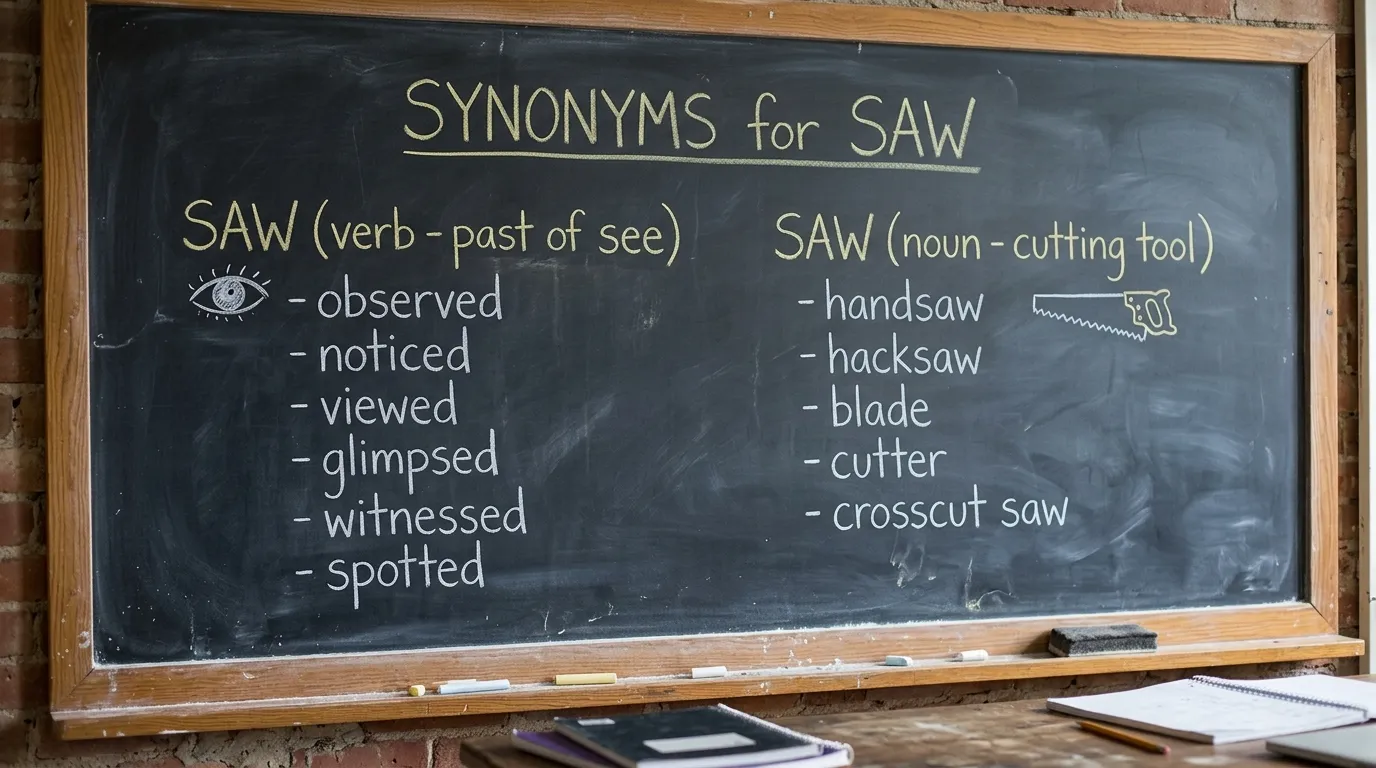
Remember that saw is also a noun referring to a tool used for cutting wood or other materials. In that context, synonyms include handsaw, hacksaw, and circular saw, but these name different types of tools rather than interchangeable alternatives in every sentence.
Frequently Asked Questions
1. What is the best synonym for saw?
Noticed is a useful everyday alternative when you mean becoming aware of something. However, observed, watched, witnessed, or realized may be better depending on the sentence.
2. What is a formal word for saw?
Observed is a common formal alternative. Other choices include examined, identified, detected, and witnessed, depending on what happened.
3. What is another word for saw in an essay?
Try observed, noted, found, identified, or recognized. For research results, found may be more natural than saw. For careful analysis, examined or observed may be more precise.
4. What is a synonym for saw that means noticed?
Noticed is the closest everyday choice. Spotted works when you find something among other things, while detected is useful for subtle changes or signals.
5. What is another word for saw that means understood?
Use realized, understood, recognized, or grasped. For example, “I saw why she was upset” can become “I understood why she was upset.”
6. Are saw and witnessed interchangeable?
Not always. Witnessed usually emphasizes personally seeing an event happen. Saw is broader and works for objects, people, events, and many other situations.
7. What is the difference between saw and observed?
Saw is a general word for visual perception. Observed often suggests watching carefully or paying attention to details, so it is common in research and formal writing.
Editor’s Choice: The Best Alternatives to Saw
If you want a quick recommendation, start with these five words:
Noticed — best for everyday situations when something catches your attention.
Observed — best for careful attention and academic writing.
Watched — best for activities, performances, and events viewed over time.
Witnessed — best for personally seeing an event occur.
Realized — best when saw means understood or became aware of a fact.
These alternatives cover many common uses of saw without forcing an unnatural replacement. For a simple sentence, however, saw may remain the clearest choice.
Key Takeaways
Saw is the past tense of see and has several meanings.
Use noticed when you become aware of something.
Use observed for careful attention and watched for sustained viewing.
Use witnessed for events, glimpsed for brief sightings, and realized for understanding.
Choose a synonym based on meaning and context, not just variety.