

Quick Answer: What Are Synonyms for Way?
Synonyms for way include method, approach, manner, means, path, route, direction, process, and technique. The best alternative depends on the meaning. Use method for how something is done, path for a physical or figurative journey, manner for how someone behaves, and approach for a way of handling a problem.
Quick List of Synonyms for Way
Here are useful alternatives for the different meanings of way:
Method
Approach
Manner
Means
Mode
System
Process
Technique
Procedure
Strategy
Tactic
Style
Practice
Pattern
Routine
Habit
Path
Route
Road
Track
Trail
Direction
Course
Passage
Journey
Avenue
Channel
Option
Alternative
Choice
Solution
Possibility
Opportunity
Opportunity to act
Custom
Tradition
Behavior
Conduct
Attitude
Perspective
Viewpoint
Perspective on a problem
Aspect
Feature
Respect
Degree
Extent
Form
Shape
Fashion
Mechanism
Means of achieving something
Line of action
Plan of action
Working method
Order
Arrangement
Sequence
Habitual practice
State
Condition
Direction of travel
Important: These words are not all interchangeable. Way has several meanings, so the correct synonym depends on whether you mean a method, a physical route, a behavior, a choice, or a particular respect or degree.

What Does “Way” Mean?
Way is a noun with several common meanings. It can describe how something is done, a route from one place to another, someone’s behavior, or a possible course of action.
Examples:
Method: There is a better way to solve the problem.
Route: We took a different way home.
Manner: She spoke in a friendly way.
Option: We need to find a way to reduce costs.
Degree: The new design is way better than the old one. (Informal use of way meaning “much” or “far.”)
Custom: This is the way we celebrate the holiday.
Because the word has so many meanings, choosing a precise alternative can make your writing clearer and more natural.
Closest Synonyms for Way
1. Method
Meaning: A particular procedure or set of steps used to do something.
Example: This method helps students remember new vocabulary.
Best for: Essays, research, instructions, and problem-solving.
How it differs: Method is one of the closest alternatives when way means how something is done. It often suggests a more organized or deliberate process.
2. Approach
Meaning: A way of dealing with a task, problem, or situation.
Example: The teacher used a creative approach to teaching grammar.
Best for: Academic writing, business, education, and decision-making.
How it differs: An approach usually describes the overall way someone thinks about or handles a problem, rather than a specific set of steps.
3. Manner
Meaning: The way someone does something or behaves.
Example: He answered the question in a polite manner.
Best for: Formal writing, descriptions of behavior, and professional communication.
How it differs: Manner focuses on how an action is performed, including its tone or style.
4. Means
Meaning: A method, resource, or process used to achieve something.
Example: Education can be a means of improving people’s opportunities.
Best for: Academic writing, formal arguments, and discussions of goals.
How it differs: Means often emphasizes how an outcome is achieved, rather than the details of the process.
5. Technique
Meaning: A particular skill or procedure used to perform a task.
Example: The writer learned a new technique for developing characters.
Best for: Art, sports, education, research, and practical skills.
How it differs: A technique is usually more specific than a general way and often involves a learned skill.
6. Approach to a Problem
Meaning: A particular way of thinking about or handling a challenge.
Example: We need a different approach to this problem.
Best for: Academic essays, workplace discussions, and planning.
How it differs: This phrase emphasizes the strategy or perspective used to address a problem.
7. Process
Meaning: A series of actions or steps that lead to a result.
Example: The application process takes about two weeks.
Best for: Business, education, science, and instructions.
How it differs: A process emphasizes the steps involved, while way can refer to a broader method or general possibility.
8. System
Meaning: An organized set of rules, steps, or connected parts.
Example: The school introduced a new system for tracking attendance.
Best for: Organizations, education, technology, and administration.
How it differs: A system usually involves several connected parts, not just one action or technique.
9. Style
Meaning: A distinctive way of doing, creating, or presenting something.
Example: Her writing style is clear and engaging.
Best for: Writing, art, communication, fashion, and personal expression.
How it differs: Style emphasizes distinctive qualities or presentation rather than the practical steps used.
10. Strategy
Meaning: A planned approach designed to achieve a goal.
Example: The company developed a new strategy to attract customers.
Best for: Business, academic writing, sports, and long-term planning.
How it differs: A strategy usually involves a goal and deliberate planning. It is not a suitable replacement when way simply means a physical route.
11. Route
Meaning: A path or course taken to reach a destination.
Example: We chose a shorter route to the airport.
Best for: Travel, directions, transportation, and navigation.
How it differs: Route is a close synonym when way refers to physical travel, but not when it means a method.
12. Path
Meaning: A physical trail or a figurative course toward a goal.
Example: She found a path toward a successful career.
Best for: Travel writing, personal development, and figurative language.
How it differs: Path often suggests a journey or progression, especially when discussing life, learning, or careers.
13. Direction
Meaning: The course in which someone or something moves, or guidance about what to do.
Example: The team needed clear direction before starting the project.
Best for: Navigation, leadership, planning, and guidance.
How it differs: Direction emphasizes orientation or guidance rather than a specific procedure.
14. Option
Meaning: One of several possible choices.
Example: Taking an online course is another way to improve your skills.
Revised example: Taking an online course is another option for improving your skills.
Best for: Decision-making, recommendations, and problem-solving.
How it differs: An option is a choice available to someone, not necessarily the method they will use.
15. Solution
Meaning: A way to solve a problem or deal with a difficulty.
Example: We need to find a way to reduce waste.
Revised example: We need to find a solution to reduce waste.
Best for: Essays, technical writing, business, and everyday problem-solving.
How it differs: A solution emphasizes resolving a problem, while way may describe any possible method, including one that does not work.
Synonyms for “Way” Based on Context
When “Way” Means Method
Use these words when describing how to complete a task or achieve a result:
Method
Approach
Technique
Process
Procedure
System
Strategy
Means
Practice
Mode
Example:
Original: There is a better way to organize your notes.
Revised: There is a better method for organizing your notes.
Best choice: Use method for a specific procedure, approach for an overall plan, and technique for a particular skill.
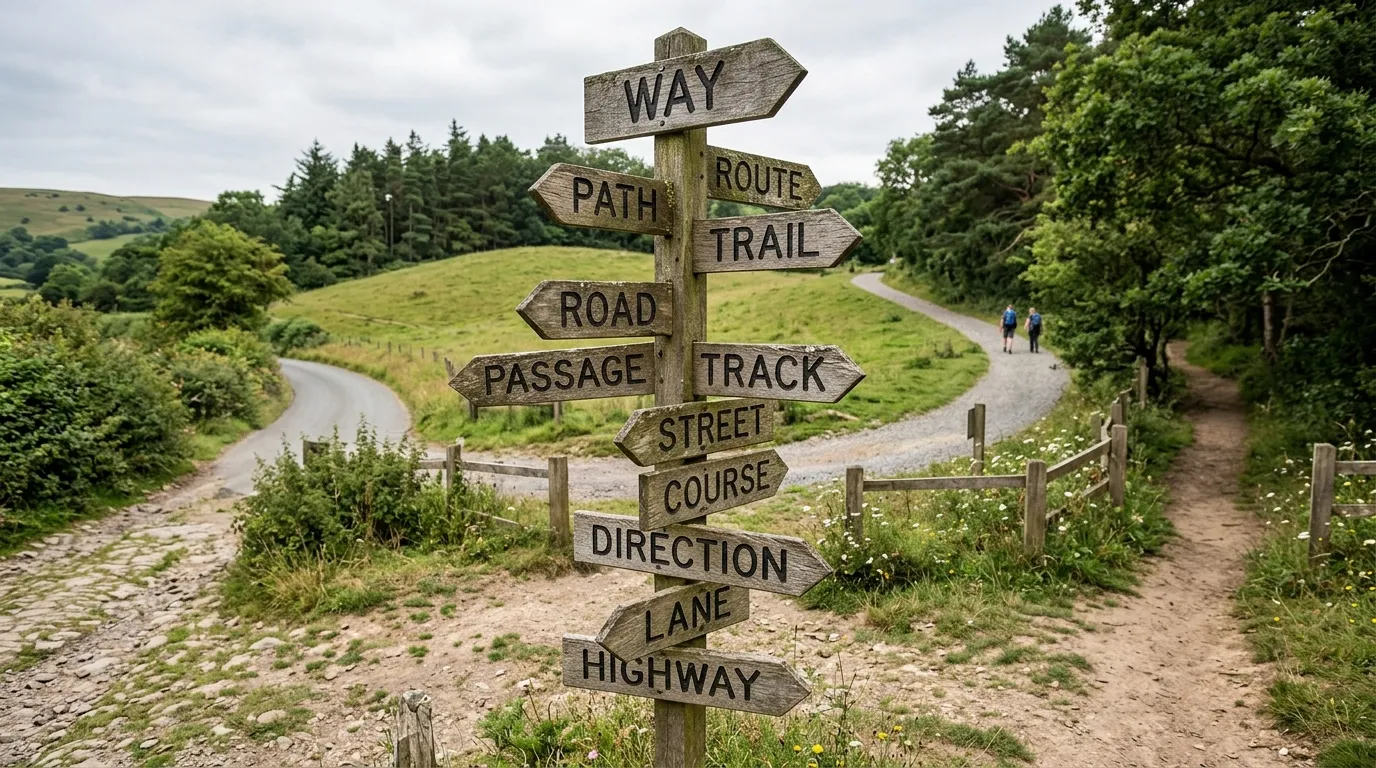
When “Way” Means Route or Path
Use these alternatives when talking about movement or a journey:
Path
Route
Road
Trail
Track
Course
Passage
Direction
Avenue
Journey
Example:
Original: We found a new way through the forest.
Revised: We found a new trail through the forest.
Best choice: Use route for a planned course, trail for a path through a natural area, and road for a route designed for vehicles.
When “Way” Means Manner or Behavior
These words describe how someone acts or performs an action:
Manner
Style
Fashion
Behavior
Conduct
Attitude
Demeanor
Custom
Habit
Practice
Example:
Original: She handled the complaint in a professional way.
Revised: She handled the complaint in a professional manner.
Best choice: Use manner for how an action is performed, behavior for how someone acts, and style for a distinctive approach or presentation.
When “Way” Means Choice or Possibility
Use these words when referring to something someone can do or choose:
Option
Alternative
Choice
Possibility
Solution
Opportunity
Course of action
Plan
Means
Method
Example:
Original: Is there another way to complete the assignment?
Revised: Is there another option for completing the assignment?
Best choice: Use alternative when comparing different possibilities and solution when the goal is to resolve a problem.
When “Way” Means Degree or Extent
In informal English, way can mean “much,” “far,” or “considerably.”
Examples:
This route is way shorter.
The new version is way more useful.
She arrived way too early.
Possible alternatives include:
Much
Far
Considerably
Significantly
Substantially
Extremely (in some contexts)
Example:
Informal: This option is way better.
Neutral: This option is much better.
Formal: This option is significantly better.
Usage note: Way as an intensifier is informal. In academic and professional writing, much, considerably, or significantly may be more appropriate.
Formal and Academic Alternatives for Way
If you are writing an essay, research paper, or professional report, these alternatives can help you be more precise.
| Alternative | Meaning | Best context |
|---|---|---|
| Method | A procedure for doing something | Research and instructions |
| Approach | An overall way of handling a subject | Essays and analysis |
| Means | A way to achieve a result | Formal arguments |
| Procedure | An established series of steps | Technical and professional writing |
| Process | A sequence of actions or changes | Research and business |
| Technique | A specific skill or procedure | Practical or specialized tasks |
| Strategy | A planned approach toward a goal | Planning and analysis |
| Framework | A structure for organizing ideas or work | Academic and professional writing |
| Mechanism | A process or structure through which something works | Science and technical writing |
| Course of action | A planned set of steps | Decisions and recommendations |
Writing tip: Do not replace way with a formal word unless the meaning fits. For example, framework means an organizing structure, not just any method.
Comparison Table: Which Synonym for Way Should You Choose?
| Word | Main meaning | Tone | Interchangeable with way? |
|---|---|---|---|
| Method | How something is done | Neutral | Often, for procedures |
| Approach | How a problem is handled | Neutral to formal | Often, for problem-solving |
| Manner | How an action is performed | Formal | In behavior-related contexts |
| Means | How a goal is achieved | Formal | In goal-related contexts |
| Technique | A specific skill or procedure | Neutral to technical | In practical tasks |
| Strategy | A planned approach | Professional | When planning is involved |
| Route | A course to a destination | Neutral | For physical travel |
| Path | A physical or figurative course | Neutral | For routes or progress |
| Option | A possible choice | Neutral | When way means possibility |
| Solution | An answer to a problem | Neutral | When a way resolves a problem |
| Style | A distinctive way of doing something | Neutral | For expression or presentation |
| Procedure | An established series of steps | Formal | For structured tasks |
How to Choose the Right Synonym for Way
Ask what you mean by way before choosing a replacement.
If you mean how something is done, use method or approach.
If you mean a specific skill or procedure, use technique.
If you mean a series of steps, use process or procedure.
If you mean a planned route to a goal, use strategy.
If you mean a physical route, use path, route, or road.
If you mean how someone behaves, use manner or behavior.
If you mean a possible choice, use option or alternative.
If you mean an answer to a problem, use solution.
If you mean a structure for organizing ideas, use framework.
If you mean “much” or “considerably” in informal speech, use much or significantly in more formal writing.
When the meaning is broad or the context is unclear, way may be the clearest word. It is common, natural, and flexible.
10 Sentence Transformations Using Synonyms for Way
1. A better method
Original: There is a better way to solve this problem.
Revised: There is a better method for solving this problem.
Why it works: Method emphasizes the procedure used to reach an answer.
2. A different approach
Original: We need a new way to teach the topic.
Revised: We need a new approach to teaching the topic.
Why it works: Approach emphasizes the overall teaching plan.
3. A physical route
Original: We took a different way to the station.
Revised: We took a different route to the station.
Why it works: Route clearly identifies a course of travel.
4. A person’s behavior
Original: He spoke in a rude way.
Revised: He spoke in a rude manner.
Why it works: Manner describes how he performed the action.
5. A possible choice
Original: Is there another way to contact the manager?
Revised: Is there another option for contacting the manager?
Why it works: Option highlights an available alternative.
6. A practical solution
Original: We need to find a way to reduce expenses.
Revised: We need to find a solution for reducing expenses.
Why it works: Solution focuses on resolving the problem.
7. A specific skill
Original: She learned a new way to improve her drawing.
Revised: She learned a new technique to improve her drawing.
Why it works: Technique suggests a specific skill or procedure.
8. A planned course of action
Original: The team discussed the best way to reach its goal.
Revised: The team discussed the best strategy for reaching its goal.
Why it works: Strategy emphasizes planning toward a desired result.
9. A person’s distinctive expression
Original: I admire her way of writing.
Revised: I admire her writing style.
Why it works: Style describes distinctive features of her writing.
10. An informal intensifier
Original: This version is way better than the previous one.
Revised: This version is significantly better than the previous one.
Why it works: Significantly is more suitable for formal writing, though it can imply a meaningful difference rather than merely an enthusiastic comparison.
Common Mistakes When Using Synonyms for Way
1. Treating “method” and “approach” as identical
A method is often a specific procedure. An approach is usually the broader way of thinking about or handling a task.
Better: Use method for steps and approach for an overall plan or perspective.
2. Using “route” for an abstract method
A route normally describes a course of travel, although it can be used figuratively.
Better: Write “a method for improving performance” rather than “a route for improving performance” unless you intend a metaphor.
3. Confusing “process” with “technique”
A process is a series of steps; a technique is a particular way to perform a task.
Better: Use process for a workflow and technique for a skill or procedure.
4. Using “strategy” for every action
A strategy involves planning toward a goal. It may not fit a simple action or routine.
Better: Use method or procedure for straightforward tasks.
5. Replacing “way” with “manner” in every sentence
Manner can sound formal or stiff in casual writing.
Better: “She explained it in a clear way” is natural. “She explained it clearly” is often even more direct.
6. Confusing “option” with “solution”
An option is a possible choice. A solution is intended to resolve a problem.
Better: Use option when discussing alternatives and solution when focusing on an answer.
7. Using “way” as an intensifier in formal writing
Phrases such as “way too expensive” and “way better” are common in conversation but informal.
Better: Use much more expensive or significantly better in formal documents.
8. Replacing a simple word with an unnecessarily complex one
A longer synonym does not automatically improve your writing.
Better: Keep way if it expresses the meaning clearly. Use a more specific alternative only when it adds useful information.
Grammar and Usage: How to Use Way
Way is a countable noun in most of its common uses. Its plural form is ways.
Common grammatical patterns
A way to do something: There is a better way to organize the files.
A way of doing something: She found a new way of explaining the concept.
In a particular way: He answered in a friendly way.
By way of: They traveled by way of the coast.
On the way: We stopped at a store on the way home.
In the way: The chair is in the way.
Under way: The project is now under way.
No way: No way am I missing the event. (Informal expression of refusal or disbelief.)
By the way: By the way, I sent you the document.
Way too much: The repair cost way too much. (Informal intensifier.)
“Way to” vs. “way of”
Both are correct, but they are used differently.
A way to do something: a method or possibility for completing an action.
A way of doing something: a manner, method, or style of performing an action.
Examples:
There is a better way to learn vocabulary.
There is a better way of learning vocabulary.
Both sentences are natural.
Common collocations with way
A better way
A different way
A new way
An effective way
A practical way
A simple way
A possible way
A way to improve
A way of thinking
A way of life
Find a way
Show the way
Lead the way
Make way
Get in the way
Frequently Asked Questions
What is the closest synonym for way?
Method is one of the closest synonyms when way means how something is done. Other options include approach, manner, and means, depending on the sentence.
What is a formal synonym for way?
Method, approach, procedure, process, and means can be suitable formal alternatives. Use the one that accurately describes the action, plan, or process.
What is another word for way in an essay?
Useful alternatives include method, approach, means, process, technique, and strategy. For example, “a way to address the issue” could become “an approach to addressing the issue.”
What is a synonym for “in this way”?
Depending on the context, use in this manner, by doing so, through this process, or as a result. These phrases have different meanings, so choose carefully.
What is another word for “way of thinking”?
Possible alternatives include mindset, perspective, outlook, viewpoint, and approach. Mindset refers to a person’s established way of thinking, while perspective emphasizes how someone views a subject.
What is the difference between way, method, and approach?
Way is broad and informal. Method usually describes a specific procedure, while approach describes an overall way of handling a problem or subject.
What is the opposite of way?
There is no single antonym for way because the word has several meanings. If it means a route, dead end may be an opposite in some contexts. If it means a method, you might contrast it with inaction or the absence of a method, depending on the sentence.
Editor’s Choice: The Best Synonyms for Way
If you need only five alternatives, start with these:
Method — best for describing how something is done.
Approach — best for handling a problem or subject.
Manner — best for describing how someone behaves or performs an action.
Path — best for physical routes and figurative journeys.
Means — best for describing how a goal can be achieved.
These words cover the most common meanings of way. For more specific contexts, use strategy for a planned course of action, option for a choice, and solution for an answer to a problem.
Key Takeaways
Way has several meanings, so the best synonym depends on the context.
Use method for procedures, approach for problem-solving, and manner for behavior.
Use path or route for travel and option or alternative for choices.
In formal writing, replace informal intensifiers such as way better with much better or significantly better when appropriate.
Keep way when it is clear and natural; a more specific word is useful only when it improves precision.