
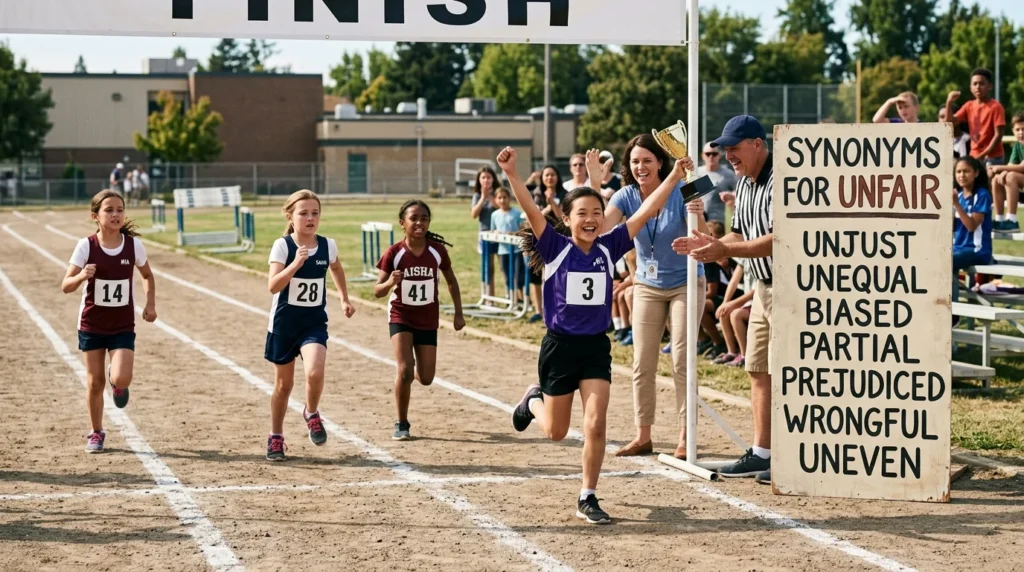
Quick Answer
Common synonyms for unfair include unjust, inequitable, biased, prejudiced, discriminatory, unreasonable, partial, one-sided, unequal, disproportionate, undeserved, unjustified, unwarranted, harsh, and arbitrary. The best alternative depends on what makes something unfair: unequal treatment, personal bias, discrimination, excessive punishment, lack of justification, or violation of a reasonable standard.
Quick Synonym List
Closest alternatives
- unjust
- inequitable
- unjustified
- unreasonable
- unequal
- biased
- partial
- one-sided
Formal and professional
- inequitable
- unjust
- disproportionate
- unwarranted
- arbitrary
- prejudicial
- unreasonable
- unjustified
When bias is involved
- biased
- partial
- prejudiced
- one-sided
- slanted
- predisposed
When people receive unequal treatment
- discriminatory
- unequal
- inequitable
- prejudicial
- exclusionary
When a decision or punishment is excessive
- disproportionate
- unreasonable
- excessive
- unwarranted
- unjustified
- arbitrary
Everyday alternatives
- wrong
- unreasonable
- one-sided
- biased
- not right
- undeserved
Not all of these can directly replace unfair in every sentence.
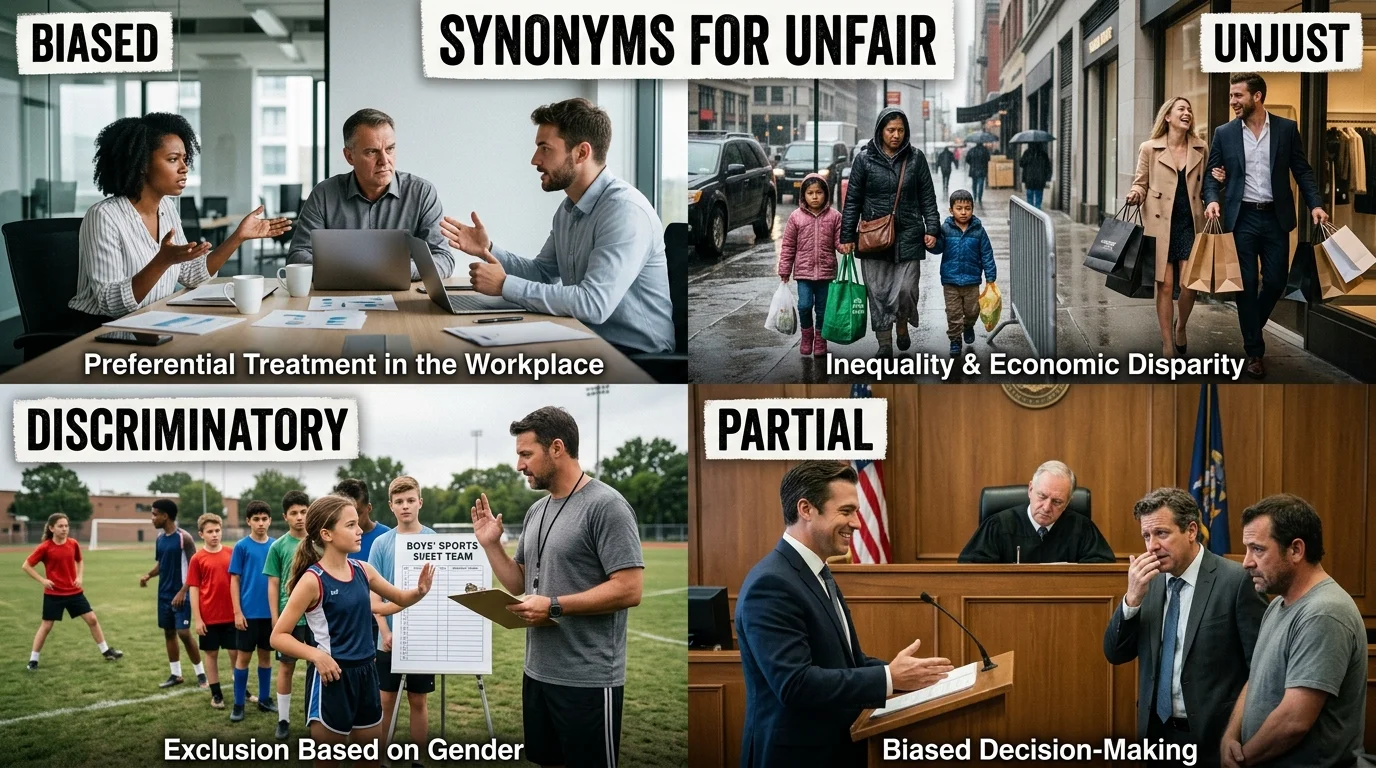
Closest Synonyms for Unfair
Unjust
Meaning: Not based on justice, fairness, or what is morally right.
How it differs: Unjust is one of the closest formal synonyms for unfair, but it often carries a stronger moral or legal implication.
Tone: Formal and serious.
Best for: Laws, decisions, treatment, systems, and serious criticism.
Example:
The workers considered the policy unfair.
→ The workers considered the policy unjust.
Watch out: Unjust can sound stronger and more morally charged than unfair.
Inequitable
Meaning: Not fair or equal, especially in the distribution of benefits, resources, opportunities, or burdens.
How it differs: Inequitable focuses strongly on an imbalance in fairness.
Tone: Formal.
Best for: Policies, systems, resources, education, healthcare, taxation, and social conditions.
Example:
The system creates unfair outcomes.
→ The system creates inequitable outcomes.
Watch out: This word is more formal than everyday unfair.
Biased
Meaning: Showing an unfair preference for or against someone or something.
How it differs: Biased identifies a likely source or mechanism of unfairness: a preference that affects judgment.
Tone: Neutral to formal.
Best for: Judges, reviews, reporting, decisions, opinions, and evaluations.
Example:
The referee’s decision seemed unfair.
→ The referee’s decision seemed biased.
Watch out: A decision can be unfair without being biased. Biased suggests partiality.
Unreasonable
Meaning: Not sensible, fair, practical, or justified.
How it differs: Unreasonable focuses on whether a demand, expectation, decision, or behavior is excessive or lacking good justification.
Tone: Neutral.
Best for: Demands, expectations, rules, requests, and behavior.
Example:
The landlord’s demands were unfair.
→ The landlord’s demands were unreasonable.
Unequal
Meaning: Not equal in amount, treatment, opportunity, or status.
How it differs: Unequal describes an imbalance but does not automatically say that the imbalance is morally wrong.
Tone: Neutral.
Best for: Opportunities, treatment, distribution, resources, and outcomes.
Example:
The students received unfair treatment.
→ The students received unequal treatment.
Watch out: Something can be unequal without being unfair. Different treatment may sometimes be justified.
Synonyms for Unfair Treatment
When unfair describes how someone is treated, the best alternatives depend on the reason for the unfairness.
Discriminatory
Means treating people unfairly because of a characteristic or group membership.
The employee complained about unfair treatment.
→ The employee complained about discriminatory treatment.
This is much more specific than unfair.
Prejudiced
Means influenced by an unreasonable preconceived opinion or hostility toward a person or group.
The comments were unfair.
→ The comments were prejudiced.
Use this when prejudice is actually involved.
Biased
Works when someone’s personal preference or partiality affects treatment.
The manager’s evaluation was unfair.
→ The manager’s evaluation was biased.
Partial
Means favoring one person, group, or side over another.
The judge appeared unfair.
→ The judge appeared partial.
Partial is particularly useful when neutrality is expected.
One-sided
Means presenting or favoring only one side of an issue.
The article gave an unfair account of the dispute.
→ The article gave a one-sided account of the dispute.
It is particularly useful for arguments, reports, discussions, and media coverage.
Formal Alternatives for Unfair
For formal writing, these alternatives can provide greater precision:
| Alternative | Main Idea | Tone | Best Context |
|---|---|---|---|
| unjust | Violates fairness or justice | Formal | Decisions, laws, treatment |
| inequitable | Produces an unfair imbalance | Formal | Systems and distribution |
| unjustified | Lacks adequate reason | Formal | Decisions, criticism |
| unwarranted | Not justified or necessary | Formal | Actions, criticism, restrictions |
| disproportionate | Excessive relative to the situation | Formal | Punishment, responses |
| arbitrary | Based on personal choice rather than consistent principles | Formal | Decisions, rules |
| prejudicial | Showing harmful bias | Formal | Treatment, decisions |
| partial | Favoring one side | Formal | Judgment, evaluation |
| unreasonable | Not fair or sensible | Neutral/formal | Demands and expectations |
Unjustified
Unjustified means lacking a good reason or sufficient basis.
The employee received an unfair warning.
→ The employee received an unjustified warning.
This works particularly well when you mean that the warning was not warranted by the circumstances.
Unwarranted
Similar to unjustified, but often used for criticism, concern, action, restrictions, or reactions.
The criticism was unfair.
→ The criticism was unwarranted.
The difference is subtle: unwarranted often means there was insufficient reason for something to occur, while unjust focuses more directly on fairness or justice.
Disproportionate
Means too large, severe, or significant in relation to what caused it.
The punishment was unfair.
→ The punishment was disproportionate.
This is particularly precise when the problem is excessive severity rather than general unfairness.
Arbitrary
Means based on personal preference, inconsistent judgment, or no clear principle.
The decision seemed unfair.
→ The decision seemed arbitrary.
Use this only when the decision appears to lack a consistent or reasonable basis.
Professional Alternatives for Unfair
Professional communication usually benefits from describing why something is unfair.
Instead of:
That policy is unfair.
consider:
- That policy creates inequitable outcomes.
- That requirement appears unreasonable.
- The decision seems disproportionate.
- The process may be biased.
- The criteria are not applied consistently.
- The outcome does not appear justified.
- The policy creates unequal opportunities.
These alternatives are often more useful in workplace writing because they identify the specific problem instead of making a broad accusation.
Example
Rather than writing:
I think the manager’s decision was unfair.
A professional message might say:
I believe the decision may have been inconsistent with the criteria applied to similar cases.
This is not simply a synonym substitution. It explains what makes the decision unfair.
Academic Alternatives
In academic writing, avoid replacing unfair with a stronger word unless the evidence supports it.
Useful choices include:
- inequitable
- unjust
- biased
- discriminatory
- disproportionate
- unequal
- prejudicial
- unjustified
- inconsistent
- exclusionary
Example
Less precise:
The policy is unfair to low-income families.
More academic:
The policy may produce inequitable outcomes for low-income families.
The second version is more analytical because inequitable focuses on the distribution of outcomes.
Casual Alternatives
In everyday speech, people often use simple expressions rather than formal synonyms.
Useful options include:
- wrong
- unreasonable
- biased
- one-sided
- not right
- undeserved
- unfair to someone
- playing favorites
“Playing favorites”
This informal expression means treating some people better because you favor them.
The teacher is unfair.
→ The teacher is playing favorites.
This is not a general synonym for unfair. It applies specifically when favoritism is the cause.
“Not right”
This is a broad conversational expression.
That doesn’t seem fair.
→ That doesn’t seem right.
It is less precise but very natural in conversation.
Synonyms for an Unfair Decision
If a decision is unfair, the best alternative depends on the underlying problem.
Biased decision — the decision favors one side.
Arbitrary decision — the decision appears to lack a consistent principle.
Unjust decision — the decision violates a standard of justice.
Unreasonable decision — the decision does not make practical or rational sense.
Disproportionate decision — the response is excessive compared with the circumstances.
Unjustified decision — there is insufficient reason or evidence for it.
For example:
The committee made an unfair decision.
could become:
The committee made a biased decision.
if favoritism caused the problem.
Or:
The committee made a disproportionate decision.
if the penalty was excessive.
Synonyms for an Unfair Advantage
An unfair advantage can sometimes be described more precisely as:
- undue advantage
- disproportionate advantage
- preferential treatment
- special treatment
- privileged position
- competitive advantage
However, these expressions are not identical.
Undue advantage suggests an advantage that is excessive or inappropriate.
Preferential treatment means someone receives favorable treatment.
Competitive advantage is not automatically unfair. It can be completely legitimate.
For example, having better technology may provide a competitive advantage without being unfair.
True Synonyms vs Related Alternatives
| Alternative | Relationship | Can Replace Original? | Tone | Best Context |
|---|---|---|---|---|
| unjust | Close synonym | Often | Formal | Justice and serious decisions |
| inequitable | Close contextual synonym | Often | Formal | Systems and distribution |
| biased | Near synonym | Sometimes | Neutral/formal | Judgment and evaluation |
| unreasonable | Near synonym | Sometimes | Neutral | Demands and expectations |
| unequal | Contextual alternative | Sometimes | Neutral | Treatment and distribution |
| discriminatory | Narrower alternative | Only when discrimination exists | Formal | Group-based treatment |
| prejudiced | Narrower alternative | Only when prejudice exists | Strong | Bias toward groups |
| partial | Contextual synonym | Sometimes | Formal | Judgment |
| one-sided | Contextual alternative | Sometimes | Neutral | Arguments and reporting |
| disproportionate | Narrower alternative | Only for imbalance | Formal | Punishment/responses |
| unwarranted | Contextual alternative | Sometimes | Formal | Criticism/actions |
| unjustified | Contextual alternative | Sometimes | Formal | Decisions/claims |
| arbitrary | Narrower alternative | Only when lacking principle | Formal | Rules/decisions |
| cruel | Stronger contextual alternative | Rarely | Strongly negative | Treatment |
| excessive | Narrower alternative | Only when too much | Neutral/formal | Punishment/demands |

Comparison Table
| Word/Phrase | Meaning | Tone | Strength | Best Use | Interchangeable? |
|---|---|---|---|---|---|
| unfair | Not fair or reasonable | Neutral | Moderate | General use | — |
| unjust | Contrary to justice | Formal | Strong | Decisions, laws | Often |
| inequitable | Unfairly distributed | Formal | Moderate/strong | Systems | Often |
| biased | Favoring one side | Neutral/formal | Moderate | Judgment | Sometimes |
| unreasonable | Not sensible or fair | Neutral | Moderate | Demands | Sometimes |
| unequal | Not equal | Neutral | Neutral | Treatment/outcomes | Sometimes |
| discriminatory | Unfair based on group identity | Formal | Strong | Treatment/policies | Only when applicable |
| prejudiced | Influenced by prejudice | Formal | Strong | People/groups | Only when applicable |
| one-sided | Favoring one side | Neutral | Moderate | Arguments/reports | Sometimes |
| disproportionate | Excessive relative to circumstances | Formal | Strong | Punishment | Sometimes |
| unjustified | Without adequate reason | Formal | Moderate | Decisions/actions | Sometimes |
| unwarranted | Not justified or necessary | Formal | Moderate | Criticism/actions | Sometimes |
| arbitrary | Without consistent principle | Formal | Strong | Rules/decisions | Sometimes |
| partial | Favoring one side | Formal | Moderate | Judgment | Sometimes |
| excessive | More than reasonable | Neutral/formal | Moderate | Costs, punishment | Context-dependent |
How to Choose the Right Alternative
Choose unjust when the issue is fundamentally about justice or moral fairness.
Choose inequitable when benefits, opportunities, resources, or burdens are distributed unfairly.
Choose biased when someone’s preference affects their judgment.
Choose discriminatory when people receive unfair treatment because of a protected or group-related characteristic.
Choose unreasonable when a demand, expectation, or decision is excessive or not sensible.
Choose disproportionate when the response is too severe compared with the situation.
Choose unjustified when there is not enough evidence or reason to support something.
Choose unwarranted when an action, criticism, concern, or restriction is not justified or necessary.
Choose arbitrary when a rule or decision appears inconsistent or based on personal choice rather than a clear principle.
Choose one-sided when only one perspective is being favored or represented.
Keep unfair when you want a broad, straightforward word and the exact cause of the unfairness is not important.
Sentence Transformations
1. General unfairness
Original:
The decision was unfair.
Better Alternative:
The decision was unjust.
Why:
Unjust gives the statement a stronger moral or justice-related meaning.
2. Bias
Original:
The review seemed unfair.
Better Alternative:
The review seemed biased.
Why:
Use biased when the reviewer appears to favor one side.
3. Strict workplace requirement
Original:
The new requirement is unfair.
Better Alternative:
The new requirement seems unreasonable.
Why:
Unreasonable is useful when the requirement is excessive or impractical.
4. Unequal distribution
Original:
The system is unfair.
Better Alternative:
The system is inequitable.
Why:
Inequitable is particularly appropriate when resources or opportunities are distributed unfairly.
5. Excessive punishment
Original:
The punishment was unfair.
Better Alternative:
The punishment was disproportionate.
Why:
This specifically says the punishment was too severe for the offense.
6. Unjustified criticism
Original:
Her criticism was unfair.
Better Alternative:
Her criticism was unwarranted.
Why:
Unwarranted emphasizes that the criticism lacked sufficient justification.
7. One-sided reporting
Original:
The article presented an unfair view of the dispute.
Better Alternative:
The article presented a one-sided view of the dispute.
Why:
One-sided identifies the problem as favoring one perspective.
8. Favoritism
Original:
The coach’s treatment of the players was unfair.
Better Alternative:
The coach was playing favorites.
Why:
This informal expression is appropriate when certain players are being favored over others.
Common Mistakes
Calling something “biased” when it is simply unequal
Unequal outcomes do not automatically prove bias.
Fix: Use unequal or inequitable unless there is evidence of partiality.
Using “discriminatory” too casually
Discriminatory has a specific meaning involving unfair treatment connected to a characteristic or group.
Fix: Do not use it merely to mean “unfair.”
Assuming unequal always means unfair
Two people may receive different treatment for legitimate reasons.
For example, different levels of support may be appropriate when people’s needs differ.
Fix: Use unequal to describe the difference and unfair when you are making a judgment about its fairness.
Using “unjust” for minor inconveniences
It was unjust that the restaurant ran out of my favorite dessert.
This sounds unnecessarily dramatic.
Fix: Use unfortunate, disappointing, or simply explain the problem.
Confusing “unreasonable” with “unjust”
A request can be unreasonable because it is impractical without necessarily being morally unjust.
Fix: Use unreasonable for demands and expectations; use unjust for stronger judgments about fairness or justice.
Using “arbitrary” without evidence
A decision being unpopular does not make it arbitrary.
Fix: Use arbitrary when there is a genuine lack of consistent standards or reasoning.
Using “disproportionate” without comparing two things
Disproportionate implies a relationship between the response and the situation.
Fix: Make sure the sentence involves an imbalance in scale, severity, cost, or effect.
Replacing every use of “unfair” with a more formal word
This can make ordinary writing sound unnatural.
Fix: Keep unfair when it is the clearest word.
Commonly Confused Words
Unfair vs Unjust
These overlap substantially.
Unfair is broader and more common in everyday English.
Unjust is more formal and often carries a stronger moral or legal judgment.
Unfair vs Biased
Unfair describes the outcome or treatment.
Biased often describes the preference or partiality that causes an unfair outcome.
A person can be biased without every resulting decision necessarily being unfair, although bias often creates unfairness.
Unfair vs Unequal
Unequal means different in amount or treatment.
Unfair means the difference is considered unjust or unreasonable.
Different treatment is not automatically unfair.
Unfair vs Discriminatory
Discriminatory is a much narrower term. It identifies unfair treatment based on a relevant characteristic or group distinction.
Do not use it simply because something seems unfair.
Unfair vs Unreasonable
Unreasonable means lacking good sense, practicality, or justification.
Unfair focuses more directly on equity or justice.
Unfair vs Unjustified
Unjustified means lacking adequate reason or evidence.
Something can be unfair because it is unjustified, but the two words emphasize different aspects.
Grammar and Usage
Unfair is an adjective.
Common patterns include:
- unfair to someone
- unfair treatment
- unfair decision
- unfair advantage
- unfair criticism
- unfair rule
- unfair system
- unfair comparison
“Unfair to” vs “unfair for”
Both can occur, but they often serve different purposes.
Unfair to someone is especially common when describing treatment:
The decision was unfair to the employees.
Unfair for someone can describe an arrangement or situation that puts someone at a disadvantage:
The schedule is unfair for parents with young children.
In many ordinary situations, unfair to is the more direct construction when a person is the recipient of the unfair treatment.
“It’s unfair” vs “That’s unfair”
Both are natural.
It’s unfair that she was excluded.
That’s unfair.
The first can introduce a specific situation; the second is a direct reaction.
When Not to Use an Alternative
Sometimes unfair is more accurate precisely because you do not know why something is unfair.
Consider:
The decision was unfair.
If you do not know whether the decision resulted from bias, excessive punishment, discrimination, inconsistent standards, or another problem, choosing a more specific word may overstate what you know.
For example:
- biased claims partiality.
- discriminatory claims discriminatory treatment.
- arbitrary claims a lack of consistent reasoning.
- unjustified claims insufficient justification.
- disproportionate claims excessive scale.
- cruel claims harmful lack of compassion.
If none of those specific meanings is established, unfair may be the most responsible choice.
Writing Tips
When replacing unfair, focus on the source of the unfairness.
Instead of writing:
The policy is unfair.
ask:
- Does it favor one group? → biased
- Does it distribute resources unequally? → inequitable
- Does it discriminate? → discriminatory
- Is the requirement excessive? → unreasonable
- Is the punishment too severe? → disproportionate
- Does it lack justification? → unjustified
- Does it lack a consistent basis? → arbitrary
- Does it favor one perspective? → one-sided
This approach makes writing more precise without making it unnecessarily complicated.
Also, don’t assume that a more sophisticated synonym is automatically better. Unfair is short, familiar, and immediately understood. In many situations, especially conversation and general writing, it is the best word.
Editor’s Choice
Unjust — The strongest broad formal alternative when fairness and justice are the central issue.
Inequitable — Best for systems, policies, resources, and opportunities that create unfair disparities.
Biased — Best when favoritism or partiality is responsible for the unfairness.
Unreasonable — Best for demands, expectations, rules, or decisions that go beyond what is sensible.
Disproportionate — Best when a punishment, response, or consequence is excessive relative to the situation.
These choices are not interchangeable in every sentence. Their value comes from identifying what kind of unfairness you mean.