
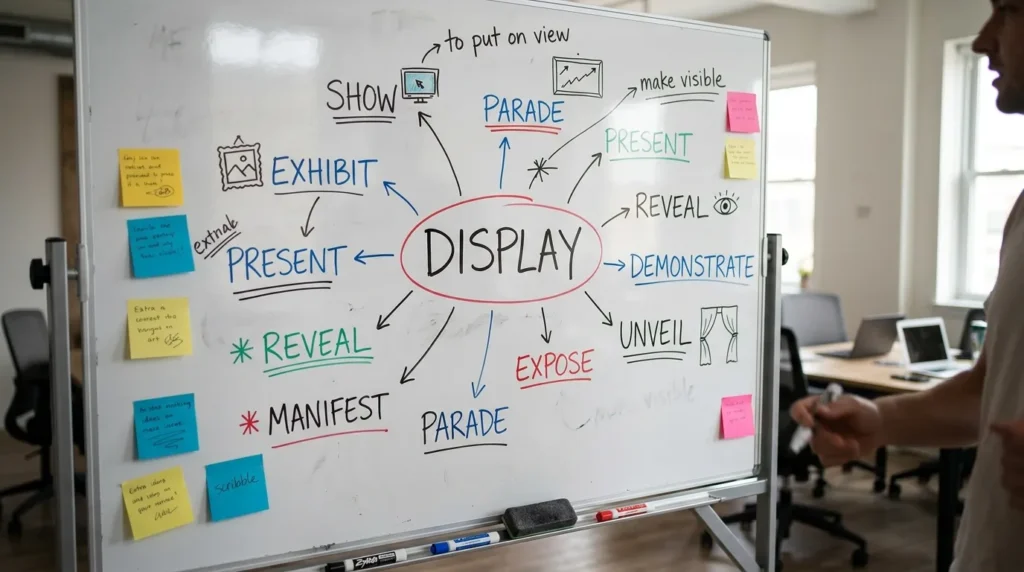
The best synonyms for display include show, present, exhibit, demonstrate, reveal, showcase, illustrate, and feature. The right choice depends on context. Use show for everyday situations, exhibit for objects presented publicly, demonstrate to explain how something works, and showcase to highlight strengths or achievements.
Quick Synonym List
Here are useful alternatives to display, grouped by meaning and use.
Show
Present
Exhibit
Showcase
Demonstrate
Reveal
Expose
Illustrate
Feature
Arrange
Put on view
Make visible
Unveil
Uncover
Express
Manifest
Indicate
Signal
Depict
Portray
Represent
Convey
Highlight
Emphasize
Promote
Advertise
Broadcast
Publish
Project
Render
Screen
Present publicly
Lay out
Set out
Bring to light
Not all these words are interchangeable. For example, broadcast usually involves sending information to an audience, while reveal means making something known that was previously hidden or unknown.
What Does Display Mean?
Display can function as both a verb and a noun.
As a verb, it means to show, present, or make something visible so people can see it. It can also mean to express a quality, feeling, or behavior.
The store displays its newest products near the entrance.
She displayed great patience during the discussion.
As a noun, display means an arrangement or presentation of objects, information, or images. It can also refer to an electronic screen.
The museum has a display of historical photographs.
The phone has a bright, high-resolution display.
The best synonym depends on which meaning you intend.
Closest Synonyms for Display
These alternatives work in many common contexts, but each has a slightly different meaning.
1. Show
Meaning: To make something visible or let someone see it.
Show is the most common everyday alternative to display. It works for objects, information, emotions, skills, and results.
Example: The website displays the latest news.
Alternative: The website shows the latest news.
Best for: Everyday writing, conversation, and simple explanations.
Watch out: Show is broader and less formal than display. In a museum or gallery context, exhibit may be more precise.
2. Present
Meaning: To put something before an audience or make information available for consideration.
Use present when you introduce information, evidence, products, or ideas to others.
Example: The report displays the findings of the study.
Alternative: The report presents the findings of the study.
Best for: Academic writing, business communication, reports, and presentations.
Watch out: Present can mean formally introducing something, not simply making it visible.

3. Exhibit
Meaning: To show something publicly or to demonstrate a particular quality or behavior.
Use exhibit for museum objects, artwork, evidence, or noticeable traits.
Example: The gallery displays paintings by local artists.
Alternative: The gallery exhibits paintings by local artists.
Best for: Museums, galleries, formal descriptions, and behavioral observations.
Watch out: Exhibit often suggests a public presentation or an observable characteristic. It may sound overly formal in casual conversation.
4. Showcase
Meaning: To present something in a way that highlights its best qualities.
Use showcase when the goal is to attract attention to talent, features, products, or achievements.
Example: The event displays the work of young designers.
Alternative: The event showcases the work of young designers.
Best for: Marketing, portfolios, events, product descriptions, and achievement-focused writing.
Watch out: Showcase implies that something is being highlighted, not merely made visible.
5. Demonstrate
Meaning: To show clearly through evidence, actions, or examples.
Use demonstrate when you want to prove a point, explain a process, or make a quality clear.
Example: The experiment displays how temperature affects the reaction.
Alternative: The experiment demonstrates how temperature affects the reaction.
Best for: Science, education, research, instructions, and arguments.
Watch out: Demonstrate usually involves showing how something works or providing evidence. It is not a general replacement for every use of display.
6. Reveal
Meaning: To make something known or visible that was previously hidden or unknown.
Example: The chart displays a surprising trend.
Alternative: The chart reveals a surprising trend.
Best for: Discoveries, results, hidden details, and new information.
Watch out: Reveal suggests that something becomes known or discovered. A chart that simply lists routine information may not reveal anything new.
7. Illustrate
Meaning: To explain or clarify something using examples, images, or evidence.
Example: The diagram displays the process of photosynthesis.
Alternative: The diagram illustrates the process of photosynthesis.
Best for: Educational writing, explanations, diagrams, and examples.
Watch out: Illustrate emphasizes helping the audience understand something, not just showing it.
8. Feature
Meaning: To include or give special attention to something as an important part of a presentation.
Example: The magazine displays interviews with leading scientists.
Alternative: The magazine features interviews with leading scientists.
Best for: Websites, magazines, product pages, events, and promotional content.
Watch out: Feature means something is included or given prominence. It does not simply mean that something is visible.
9. Express
Meaning: To communicate a feeling, thought, or quality through words, actions, or behavior.
Example: His face displayed disappointment.
Alternative: His face expressed disappointment.
Best for: Emotions, opinions, attitudes, and personal reactions.
Watch out: Use express for communicating an emotion or idea, not for presenting a physical object on a shelf.
10. Indicate
Meaning: To point out, signal, or suggest that something is true or present.
Example: The results display a steady improvement.
Alternative: The results indicate a steady improvement.
Best for: Reports, data analysis, research, and evidence-based writing.
Watch out: Indicate can suggest a conclusion without proving it. It is especially useful when the evidence points toward something rather than showing it directly.
Formal and Academic Synonyms for Display
For professional, academic, or technical writing, the best alternative depends on what the sentence is trying to communicate.
| Alternative | Meaning or emphasis | Best context |
|---|---|---|
| Present | Put information before an audience | Reports and presentations |
| Exhibit | Show publicly or demonstrate a quality | Art, evidence, behavior |
| Demonstrate | Make clear through evidence or action | Research and education |
| Illustrate | Explain through examples or visuals | Essays and teaching |
| Indicate | Suggest or point toward a conclusion | Data and analysis |
| Manifest | Make a quality or condition apparent | Formal or technical writing |
| Depict | Represent something visually or descriptively | Art and literature |
| Portray | Represent a person, situation, or quality | Literature and media |
| Convey | Communicate a message, feeling, or meaning | Essays and communication |
| Render | Represent or produce an image or result | Design, computing, and art |
Examples in Academic Writing
Original: The findings display a connection between sleep and memory.
Revised: The findings indicate a connection between sleep and memory.Original: The graph displays changes in population.
Revised: The graph illustrates changes in population.Original: The study displays the effects of stress.
Revised: The study demonstrates the effects of stress.Original: The author displays the character’s fear.
Revised: The author portrays the character’s fear.Original: The evidence displays the problem clearly.
Revised: The evidence reveals the problem clearly.
Writing tip: Don’t choose a formal word just because it sounds more academic. Show is often clear and natural. Use a more specific alternative when it expresses your meaning more accurately.
Synonyms for Display by Context
Display Information or Data
When a website, report, chart, or system makes information visible, consider:
Show — the clearest general choice.
Present — emphasizes organized information.
Illustrate — explains a point with visuals or examples.
Indicate — suggests a finding or pattern.
Reveal — brings an important or previously unknown detail to light.
Report — communicates findings or facts.
Provide — makes information available.
Render — produces or draws information on a screen in a technical context.
Example:
Original: The dashboard displays sales figures.
Better: The dashboard shows sales figures.
More formal: The report presents sales figures.
If the figures expose an unexpected pattern: The dashboard reveals an unexpected sales trend.
Display Products or Artwork
When objects are arranged for people to see, use:
Exhibit
Showcase
Present
Arrange
Set out
Lay out
Put on view
Feature
Example:
Original: The store displays handmade jewelry.
Revised: The store showcases handmade jewelry.
Revised: The store sets out handmade jewelry near the entrance.
Showcase highlights the products; sets out emphasizes their physical arrangement.
Display Feelings or Emotions
When a person reveals an emotion through facial expressions, words, or behavior, use:
Express
Show
Reveal
Convey
Exhibit
Manifest
Example:
Original: He displayed anger during the meeting.
Revised: He expressed anger during the meeting.
Revised: She showed genuine excitement about the results.
Express emphasizes communicating a feeling, while exhibit often sounds more formal or observational.
Display Skills or Qualities
When describing someone’s ability, character, or behavior, consider:
Demonstrate
Show
Exhibit
Display — often remains the most natural choice.
Exemplify — serve as a strong example of a quality.
Reflect — indicate or reveal a characteristic.
Showcase — highlight an ability or achievement.
Example:
Original: The employee displayed excellent leadership.
Revised: The employee demonstrated excellent leadership.
Revised: Her work exemplifies careful attention to detail.
Exemplify is not a direct substitute in every sentence; it means that someone or something serves as an example of a quality.
Display on a Screen
For computers, phones, televisions, and other digital devices, use:
Show
Render
Present
Output
Project
Visualize — make information easier to understand visually.
Example:
Original: The app displays the user’s location.
Revised: The app shows the user’s location.
Technical: The software renders the image on the screen.
In technology, render often refers to generating an image or visual output. Output emphasizes the information or result produced by a system.
Display Something Hidden or Unknown
When the meaning is about bringing something to light, consider:
Reveal
Uncover
Expose
Unveil
Bring to light
Make known
Example:
Original: The investigation displayed serious problems.
Revised: The investigation uncovered serious problems.
Revised: The company unveiled its new product.
Expose can suggest wrongdoing or an unpleasant truth. Unveil often describes a planned public announcement or first presentation.
Display as a Noun: Alternatives and Examples
The noun display has several meanings, so the best substitute depends on the sentence.
| Noun synonym | Meaning | Example |
|---|---|---|
| Exhibition | A public presentation of objects or artwork | The exhibition features local artists. |
| Showcase | A presentation highlighting the best of something | The festival is a showcase for new talent. |
| Presentation | An organized showing or explanation | The presentation covers the latest results. |
| Arrangement | Objects organized in a particular way | The floral arrangement looks elegant. |
| Demonstration | A practical showing of how something works | The demonstration explains the new tool. |
| Exhibition of emotion | A visible expression of a feeling | His outburst was an unusual exhibition of anger. |
| Screen | An electronic surface showing images or information | The phone has a bright screen. |
| Dashboard | A screen or panel presenting key information | The dashboard summarizes monthly sales. |
| Spectacle | A striking or impressive public scene | The fireworks created a spectacular display. |
| Array | A broad or impressive range of things | The shop offers an array of colors. |
Important distinction: Display can mean the screen itself, what appears on the screen, or an arrangement of items. Screen, image, exhibition, and arrangement refer to different things, so they are not always interchangeable.
Display vs. Show vs. Exhibit vs. Showcase
These four words are among the most useful alternatives, but they emphasize different things.
| Word | Meaning | Tone | Best use | Interchangeable with display? |
|---|---|---|---|---|
| Show | Make something visible | Neutral, everyday | General communication | Often |
| Exhibit | Present publicly or demonstrate a quality | Formal | Art, objects, behavior | In some contexts |
| Showcase | Highlight strengths or features | Promotional, positive | Products, skills, achievements | When emphasis matters |
| Demonstrate | Show through action or evidence | Professional, explanatory | Processes, abilities, claims | When proof or explanation is intended |
| Reveal | Make something known | Neutral to dramatic | Discoveries and hidden facts | When something becomes known |
| Present | Put before an audience | Neutral to formal | Reports, ideas, information | When introducing information |
| Illustrate | Explain using examples or visuals | Educational | Diagrams, arguments, explanations | When clarification is intended |
| Feature | Give prominence or include | Neutral to promotional | Publications, websites, events | When something is highlighted |
How to Choose the Right Synonym for Display
Use this quick decision guide to find the most natural alternative.
Do you simply mean “make visible”? Use show.
Are you introducing information or findings? Use present.
Are objects being shown publicly? Use exhibit.
Do you want to highlight strengths or achievements? Use showcase.
Are you explaining how something works? Use demonstrate.
Has something hidden or unknown become known? Use reveal or uncover.
Are you explaining an idea with a diagram or example? Use illustrate.
Are you describing an emotion? Use express or show.
Does evidence point toward a conclusion? Use indicate.
Are you talking about a digital image being generated? Use render.
Are you talking about a physical or electronic screen? Use screen.
Are you describing an organized public collection? Use exhibition.
When none of these alternatives improves the sentence, keep display. It is a versatile and widely understood word.
10 Sentence Transformations Using Display Synonyms
These examples show how to replace display without changing the intended meaning more than necessary.
Original: The website displays the current price.
Revised: The website shows the current price.Original: The museum displays ancient pottery.
Revised: The museum exhibits ancient pottery.Original: The presentation displays the team’s progress.
Revised: The presentation highlights the team’s progress.Original: The experiment displays how the chemical reacts.
Revised: The experiment demonstrates how the chemical reacts.Original: The chart displays a rise in costs.
Revised: The chart indicates a rise in costs.Original: Her face displayed disappointment.
Revised: Her face revealed her disappointment.Original: The store displays its new collection.
Revised: The store showcases its new collection.Original: The illustration displays the structure of a cell.
Revised: The illustration depicts the structure of a cell.Original: The report displays several weaknesses in the plan.
Revised: The report reveals several weaknesses in the plan.Original: The software displays the image on the screen.
Revised: The software renders the image on the screen.
Notice that these are context-sensitive revisions. For instance, highlights adds emphasis, while renders describes a technical process. The replacement should match the intended meaning rather than simply sound different.
Common Mistakes When Using Synonyms for Display
1. Using showcase when you only mean show
Showcase suggests that something is being presented to emphasize its value or strengths.
Less suitable: The screen showcases the time.
Better: The screen shows the time.
Use showcase for a talent, achievement, product, or feature that deserves special attention.
2. Using reveal for information that is already known
Reveal often suggests a discovery or disclosure.
Less suitable: The schedule reveals the meeting time.
Better: The schedule lists the meeting time.
Use reveal when the information is newly discovered, unexpected, or previously hidden.
3. Replacing display with demonstrate in every sentence
Demonstrate usually means showing something through evidence, action, or a practical example.
Less suitable: The website demonstrates the weather forecast.
Better: The website displays the weather forecast.
Use demonstrate when you are explaining or proving something.
4. Confusing exhibit with exhibition
Exhibit can be a verb or a noun, while exhibition is a noun.
Correct verb: The gallery exhibits modern paintings.
Correct noun: The gallery hosts an exhibition of modern paintings.
5. Using expose when you mean present
Expose can imply that something harmful, secret, or wrong has been uncovered.
Less suitable: The shop exposes its new products.
Better: The shop displays its new products.
Use expose when something hidden or concealed is brought to light, often in a negative context.
6. Using indicate when you mean prove
Indicate means suggest or point toward. It does not always mean that something has been conclusively established.
Original: The results indicate a possible link.
Overstated: The results prove a link.
Choose verbs that reflect the strength of your evidence.
7. Using depict for every kind of display
Depict usually means representing something in an image, artwork, or description.
Less suitable: The app depicts the temperature as 72 degrees.
Better: The app displays the temperature as 72 degrees.
8. Replacing a clear word with an unnecessarily formal one
A sentence can become harder to understand if you choose a rare or formal alternative without a good reason.
Wordy: The screen manifests the current time.
Clear: The screen shows the current time.
Choose precision and naturalness over complexity.
Grammar and Usage: How to Use Display Correctly
Display as a verb
Display is usually a transitive verb, meaning it takes an object.
Common patterns:
Display + noun: The gallery displays photographs.
Display + information: The page displays the results.
Display + quality or emotion: She displayed confidence.
Display + something + to someone: The guide displayed the artifact to visitors.
Display as a noun
The noun is commonly used in these patterns:
A display of + noun: a display of flowers
On display: The paintings are on display.
A digital display: The device has a digital display.
A product display: The store created a product display.

Common collocations with display
A collocation is a word combination that sounds natural to fluent speakers.
| Common phrase | Example |
|---|---|
| Display information | The app displays information about the route. |
| Display confidence | The speaker displayed confidence. |
| Display emotions | He rarely displays his emotions. |
| Display products | The store displays products near the entrance. |
| Display data | The chart displays monthly data. |
| On display | The sculpture is on display until June. |
| Public display | The event included a public display of artwork. |
| Digital display | The digital display shows the temperature. |
| Impressive display | The team put on an impressive display of skill. |
| Display case | The medal is kept in a glass display case. |
Frequently Asked Questions
1. What is the closest synonym for display?
Show is the closest general synonym in everyday English. However, exhibit, present, showcase, and demonstrate may be more accurate in specific contexts.
2. What is a formal word for display?
Exhibit, present, demonstrate, indicate, and illustrate can work in formal writing. The best option depends on whether you mean showing objects, presenting information, explaining a process, or pointing to evidence.
3. What is another word for display in an essay?
Useful options include show, demonstrate, illustrate, indicate, reveal, and present. For example, “The results indicate a clear pattern” may be more precise than “The results display a clear pattern.”
4. What is another word for display feelings?
Use express, show, reveal, or exhibit. Express emphasizes communicating a feeling, while exhibit can sound more formal or observational.
5. What is a synonym for display on a screen?
Use show for general situations and render for technical contexts where software generates an image. Present may also work when the focus is on making information available to users.
6. What is the noun form of display?
Display is already a noun. Depending on context, alternatives include exhibition, presentation, showcase, arrangement, screen, and demonstration.
7. Is showcase a synonym for display?
Yes, in some contexts. Showcase means to present something in a way that highlights its strengths or value. It is not a perfect substitute when display simply means making something visible.
Editor’s Choice: The Best Alternatives to Display
For most writing tasks, these five choices cover the most common meanings:
Show — the best all-purpose, everyday alternative.
Present — best for information, findings, and ideas.
Exhibit — best for artwork, objects, and observable qualities.
Showcase — best for highlighting products, skills, or achievements.
Demonstrate — best for explaining how something works or supporting a claim with evidence.
Choose reveal when the emphasis is on discovery, illustrate when the goal is explanation, and indicate when evidence points toward a conclusion.
Key Takeaways
Show is the most versatile everyday synonym for display.
Use exhibit for public presentations and observable qualities.
Choose showcase to emphasize strengths, features, or achievements.
Use demonstrate, illustrate, or indicate when explaining evidence or information.
Keep display when it is already the clearest and most natural word.