

The best synonyms for argument include disagreement, dispute, debate, quarrel, conflict, discussion, claim, reasoning, and case. The right word depends on the meaning. Use dispute for a serious disagreement, debate for a structured exchange of views, quarrel for a heated personal disagreement, and claim for a statement supported by reasons or evidence.
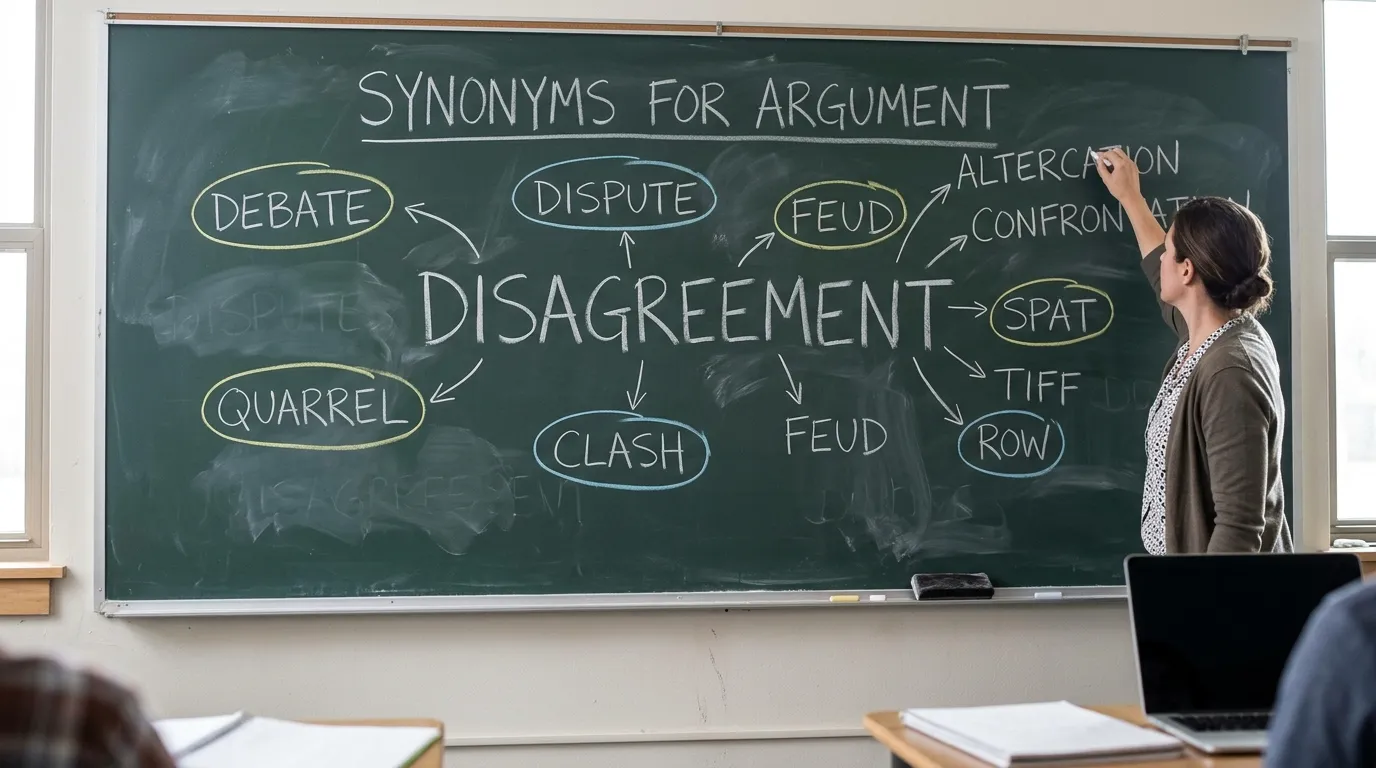
Quick List of Synonyms for Argument
Here are useful alternatives for different meanings of argument.
Disagreement — a difference of opinion
Dispute — a disagreement that may be serious or prolonged
Debate — a discussion involving different viewpoints
Quarrel — an angry or personal disagreement
Conflict — a clash between opposing interests or ideas
Altercation — a heated or angry exchange
Controversy — a subject that causes public disagreement
Clash — a strong disagreement or opposition
Feud — a long-lasting conflict
Confrontation — a direct encounter involving disagreement
Exchange — a conversation or series of remarks, sometimes heated
Discussion — a conversation about a subject
Negotiation — a discussion aimed at reaching an agreement
Difference of opinion — a situation in which people disagree
Contention — a disagreement or a strongly held claim
Objection — an expression of opposition
Protest — a statement or action showing opposition
Criticism — an expression of disapproval or an evaluation of faults
Claim — a statement presented as true
Assertion — a confident statement
Position — a person’s viewpoint on an issue
Thesis — the central claim of an essay or academic work
Point — a particular idea or reason in a discussion
Reasoning — the process of using reasons to reach a conclusion
Rationale — the explanation behind a decision or belief
Justification — a reason offered to explain or defend something
Evidence — information that supports or challenges a claim
Case — a set of reasons supporting a position
Line of reasoning — a connected sequence of logical ideas
Counterargument — an argument that challenges another argument
Rebuttal — a response that challenges a claim or argument
Contention — a claim or position put forward for consideration
Rationale — the underlying reason for a position or action
Squabble — a petty or minor argument
Spat — a brief, usually minor quarrel
Row — an argument, especially in British English
Important: Argument has two major meanings: a disagreement between people and a set of reasons supporting a claim. A quarrel may replace the first meaning, but it cannot usually replace the second. Likewise, reasoning or claim may fit an essay but not a heated disagreement.
What Does Argument Mean?
The noun argument has several related but distinct meanings.
1. A disagreement between people
An argument can be a verbal disagreement in which people express opposing opinions, often with strong emotions.
Example: They had an argument about how to spend the money.
Related words: disagreement, dispute, quarrel, clash, and altercation.
2. A reasoned case supporting a position
An argument can also be a group of reasons or pieces of evidence used to support a claim.
Example: The student presented a strong argument for renewable energy.
Related words: case, reasoning, claim, rationale, and line of reasoning.
3. A claim or point made during a discussion
In some contexts, an argument refers to a particular statement or point used to persuade someone.
Example: Her main argument was that the policy would cost too much.
Related words: claim, assertion, contention, point, and position.
Choosing a synonym starts with identifying which meaning you intend.
Closest Synonyms for Argument
1. Disagreement
Meaning: A difference of opinion, belief, or judgment.
Example: The team had a disagreement about the deadline.
How it differs: Disagreement is usually more neutral than argument. People can disagree without arguing angrily.
Best for: Everyday conversations, workplace issues, and differences of opinion.
2. Dispute
Meaning: A disagreement that may involve competing claims, interests, or rights.
Example: The neighbors had a dispute over the property line.
How it differs: A dispute often suggests a more serious or sustained disagreement than a simple difference of opinion.
Best for: Legal matters, business conflicts, ownership issues, and formal disagreements.
3. Debate
Meaning: A discussion in which people present different views and reasons.
Example: The class held a debate about school uniforms.
How it differs: A debate is often organized and focused on examining different positions. An argument can be informal, emotional, or confrontational.
Best for: Academic discussions, public policy, politics, and structured discussions.
4. Quarrel
Meaning: An angry or personal disagreement, often between people who know each other.
Example: The siblings had a quarrel over the borrowed phone.
How it differs: Quarrel emphasizes personal tension or anger. It is less suitable for a formal argument in an essay.
Best for: Family disagreements, friendships, and personal conflicts.
5. Conflict
Meaning: A serious clash between opposing needs, interests, beliefs, or goals.
Example: The disagreement developed into a conflict between the departments.
How it differs: Conflict can include verbal arguments, but it can also describe a broader struggle that does not involve a conversation.
Best for: Relationships, workplaces, politics, and competing priorities.
6. Altercation
Meaning: A heated or angry exchange, often involving harsh words.
Example: The meeting ended after an altercation between two participants.
How it differs: Altercation is more formal and often suggests a brief but intense confrontation. In some contexts, it can imply a physical confrontation.
Best for: News reports, incident descriptions, and formal accounts.
7. Clash
Meaning: A strong disagreement or opposition between people, ideas, or interests.
Example: The managers clashed over the new budget.
How it differs: Clash can describe a direct disagreement or a broader incompatibility between positions.
Best for: Workplace disagreements, political differences, and conflicting ideas.
8. Controversy
Meaning: A subject or issue that causes substantial public disagreement.
Example: The proposed law sparked controversy.
How it differs: An argument can occur between two people. A controversy usually concerns a wider issue that attracts disagreement from multiple people or groups.
Best for: Public debates, social issues, media, and politics.
9. Confrontation
Meaning: A direct encounter in which people address a disagreement or problem.
Example: She avoided a confrontation with her supervisor.
How it differs: A confrontation suggests directly facing someone about an issue. It does not necessarily involve a prolonged argument.
Best for: Difficult conversations, workplace tension, and interpersonal disputes.
10. Squabble
Meaning: A petty or relatively unimportant argument.
Example: The children had a squabble over a toy.
How it differs: Squabble suggests that the disagreement is minor, childish, or not worth much attention.
Best for: Small domestic disputes, casual writing, and informal speech.
11. Spat
Meaning: A brief, usually minor argument.
Example: The coworkers had a brief spat over the seating arrangement.
How it differs: Spat usually describes a short-lived disagreement. It is informal and often suggests that the issue is not especially serious.
Best for: Casual conversations and descriptions of minor quarrels.
12. Exchange
Meaning: A conversation or series of remarks between people; it can be friendly, tense, or argumentative.
Example: A heated exchange took place during the meeting.
How it differs: Exchange is neutral on its own. Words such as heated or angry show that the conversation involved conflict.
Best for: News reports, professional writing, and descriptions of conversations.
Synonyms for Argument in Essays and Academic Writing
When argument means a reasoned case supporting an idea, these alternatives can make your writing more precise.
| Alternative | Meaning | Best use |
|---|---|---|
| Claim | A statement presented as true | Introducing a central idea |
| Thesis | The main claim of an essay or research paper | Academic writing |
| Reasoning | The logic used to reach a conclusion | Explaining how an idea follows |
| Rationale | The reasons behind a decision or position | Reports and proposals |
| Case | A collection of reasons supporting a position | Persuasive writing |
| Assertion | A confident statement or claim | Analyzing a writer’s position |
| Contention | A claim or position that may be disputed | Formal or academic writing |
| Justification | Reasons explaining or defending an action or belief | Evaluations and decisions |
| Line of reasoning | A connected sequence of logical steps | Essays and critical analysis |
| Evidence | Information supporting or challenging a claim | Research and analysis |
| Counterargument | A position that challenges the main argument | Balanced essays |
| Rebuttal | A response that challenges another claim | Debate and persuasive writing |
Examples for essays
Original: The author’s argument is convincing.
Revised: The author’s case is convincing.
Original: Her argument is that public transportation should be improved.
Revised: Her central claim is that public transportation should be improved.
Original: The report explains the argument behind the new policy.
Revised: The report explains the rationale behind the new policy.
Original: The writer’s argument lacks support.
Revised: The writer’s claim lacks sufficient evidence.
Original: The essay presents an argument against the proposal.
Revised: The essay presents a case against the proposal.
Original: The argument follows a clear sequence of ideas.
Revised: The line of reasoning follows a clear sequence of ideas.
Writing tip: In academic work, argument is often the best word for the overall case a writer makes. Use claim for a specific statement, evidence for supporting information, and reasoning for the logic connecting them.
Formal and Professional Synonyms for Argument
In professional writing, select a term that describes the actual disagreement or reasoning.
Dispute — a disagreement over a decision, contract, or responsibility.
Contention — a formal claim or position.
Objection — a specific expression of opposition.
Difference of opinion — a neutral way to describe differing views.
Discussion — a conversation aimed at examining an issue.
Negotiation — a discussion intended to reach agreement.
Rationale — the reasoning behind a proposal or decision.
Justification — the reasons used to defend a decision or action.
Counterargument — an opposing case that challenges a position.
Rebuttal — a response that disputes a claim or supporting reasons.
Examples:
Instead of “The two teams had an argument,” write “The two teams had a disagreement over resource allocation.”
Instead of “The argument for the proposal was weak,” write “The case for the proposal lacked sufficient evidence.”
Instead of “He gave an argument against the decision,” write “He raised an objection to the decision.”
Instead of “The argument behind the policy was unclear,” write “The rationale behind the policy was unclear.”
Use negotiation only when the parties are trying to reach an agreement. A negotiation may involve disagreement, but it is not simply another word for an argument.
Synonyms for Argument by Context
Argument Between Friends or Family
Use these words when describing a personal disagreement:
Quarrel
Spat
Squabble
Disagreement
Clash
Falling-out
Row
Examples:
They had a quarrel about household chores.
The friends had a brief spat over a misunderstanding.
The children got into a squabble over the game.
A falling-out usually means a breakdown in a relationship, often after a disagreement. It is not just a single argument.
Heated or Angry Argument
Use these words when the disagreement is intense:
Altercation
Confrontation
Heated exchange
Clash
Row
Verbal dispute
Examples:
A heated exchange interrupted the meeting.
The two drivers had an altercation after the collision.
The employee had a direct confrontation with the manager.
Choose altercation for an intense exchange, confrontation for directly facing someone, and clash for a strong disagreement.
Argument in a Debate or Essay
Use these terms when presenting or examining ideas:
Claim
Thesis
Case
Reasoning
Contention
Assertion
Position
Counterargument
Rebuttal
Supporting point
Examples:
The author’s thesis appears in the introduction.
Her claim is supported by recent research.
The opposing team presented a strong counterargument.
His reasoning connects the evidence to the conclusion.
Argument About a Problem or Decision
Use these alternatives for workplace, policy, or practical disagreements:
Dispute
Difference of opinion
Objection
Conflict
Discussion
Negotiation
Contention
Examples:
The departments had a dispute over the budget.
Several employees raised an objection to the schedule.
The managers entered negotiations to settle the disagreement.
Public Argument or Controversial Issue
Use these words when a disagreement attracts wider attention:
Controversy
Debate
Dispute
Public disagreement
Clash
Political conflict
Examples:
The decision sparked a public controversy.
The policy remains the subject of heated debate.
The proposal caused a clash between political parties.
Comparison Table: Which Synonym for Argument Should You Choose?
| Word | Main meaning | Tone | Can it replace argument? |
|---|---|---|---|
| Disagreement | Difference of opinion | Neutral | Often, for interpersonal differences |
| Dispute | Serious or sustained disagreement | Neutral/formal | Often, for a conflict over an issue |
| Debate | Exchange of opposing views | Neutral/formal | When ideas are being examined |
| Quarrel | Angry personal disagreement | Informal | For a personal argument |
| Conflict | Broader clash of interests or goals | Neutral/formal | When the disagreement is part of a wider struggle |
| Altercation | Heated exchange | Formal | For an intense confrontation |
| Controversy | Public disagreement about an issue | Neutral/formal | For a disputed public topic |
| Claim | Statement presented as true | Neutral/formal | When argument means a specific assertion |
| Case | Reasons supporting a position | Neutral/formal | When argument means a reasoned position |
| Reasoning | Logic connecting ideas | Neutral/formal | When focusing on the logic |
| Rationale | Reasons behind a decision | Formal | When explaining why a position was taken |
| Counterargument | Opposing case | Formal/academic | When presenting an opposing position |
| Rebuttal | Response that challenges a claim | Formal | When directly answering an argument |
| Squabble | Minor argument | Informal | For a petty disagreement |
| Spat | Brief, minor argument | Informal | For a short-lived quarrel |
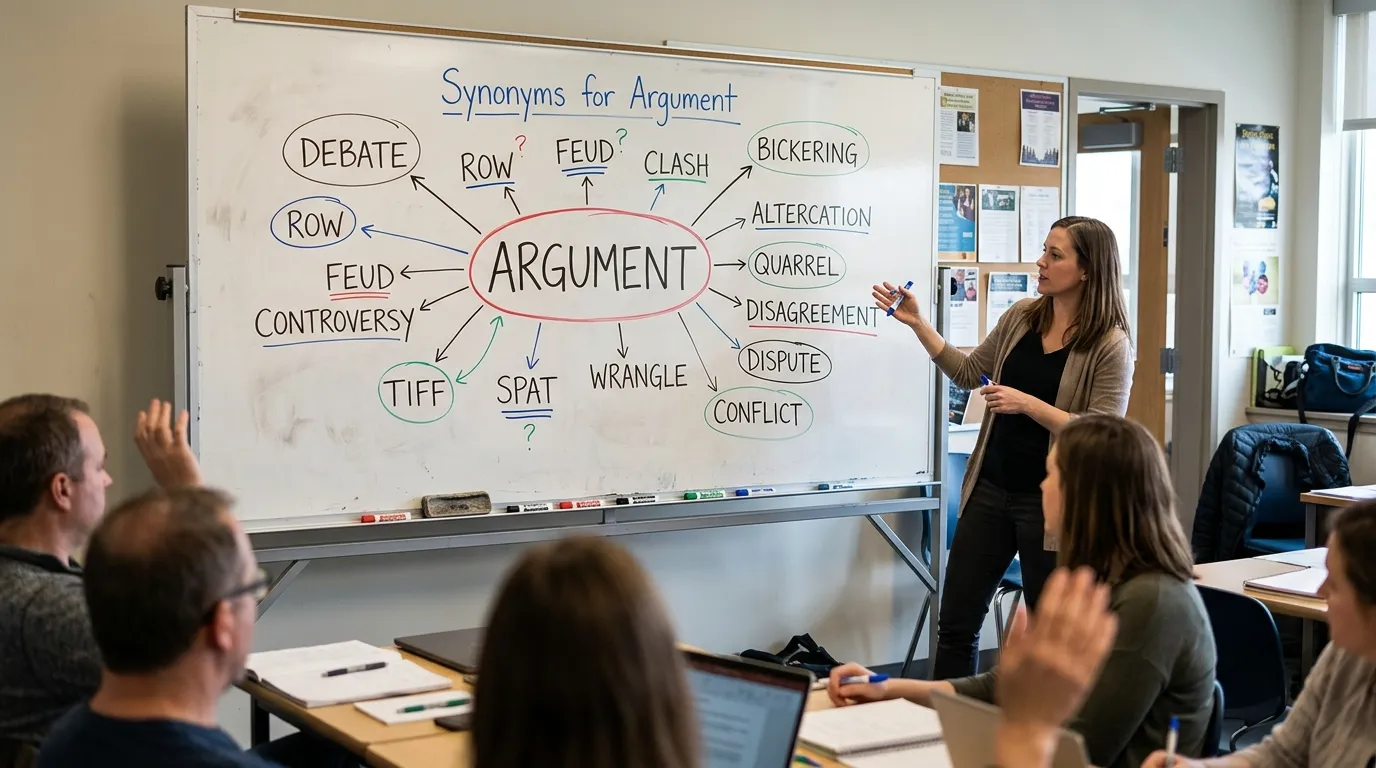
How to Choose the Right Synonym for Argument
Use this quick guide to find the most suitable word.
If people simply have different opinions, use disagreement.
If the disagreement is serious or sustained, use dispute.
If people present opposing views in an organized discussion, use debate.
If people are angry with each other, use quarrel or altercation.
If the disagreement involves wider competing interests, use conflict.
If the issue causes public disagreement, use controversy.
If you are writing an essay and mean a statement, use claim.
If you mean the reasons supporting a position, use case or reasoning.
If you mean the explanation behind a decision, use rationale.
If you are responding to an opposing position, use counterargument or rebuttal.
If the disagreement is brief and minor, use spat or squabble.
If you are unsure, argument is a flexible, familiar word that works in both everyday speech and formal writing.
Sentence Transformations: Replacing Argument with More Precise Words
These examples show how the best alternative depends on the intended meaning.
Original: The two coworkers had an argument about the schedule.
Revised: The two coworkers had a disagreement about the schedule.
Why: A neutral term avoids suggesting that the exchange was heated.Original: The neighbors had an argument over the fence.
Revised: The neighbors had a dispute over the fence.
Why: Dispute suits a disagreement over a specific issue that may continue.Original: The students had an argument about climate policy.
Revised: The students held a debate about climate policy.
Why: Debate emphasizes the exchange of different views.Original: The siblings had an argument over the television remote.
Revised: The siblings had a squabble over the television remote.
Why: Squabble suggests a minor, petty disagreement.Original: The argument between the drivers became heated.
Revised: The exchange between the drivers became a heated altercation.
Why: Altercation emphasizes an intense confrontation.Original: The author’s argument is that education should be free.
Revised: The author’s central claim is that education should be free.
Why: Claim identifies the specific point being advanced.Original: She presented an argument in favor of the proposal.
Revised: She presented a strong case in favor of the proposal.
Why: Case emphasizes the supporting reasons.Original: The argument behind the decision was difficult to understand.
Revised: The rationale behind the decision was difficult to understand.
Why: Rationale focuses on the reasons for the decision.Original: His argument did not address the opposing view.
Revised: His essay did not address the counterargument.
Why: Counterargument specifically means an opposing case.Original: She gave an argument against the proposed change.
Revised: She raised an objection to the proposed change.
Why: Objection works when someone expresses opposition to a proposal.Original: Their argument affected the whole department.
Revised: Their conflict affected the whole department.
Why: Conflict suggests a wider problem beyond a single conversation.Original: The argument over the new law attracted national attention.
Revised: The controversy over the new law attracted national attention.
Why: Controversy is more suitable for a public issue that divides opinion.
Common Mistakes When Using Synonyms for Argument
1. Treating argument and debate as exact synonyms
A debate can be structured and respectful. An argument may be spontaneous or emotional.
Less precise: They had a debate and started shouting at each other.
Better: They had an argument and started shouting at each other.
Use debate when the focus is on examining opposing views, not simply on people arguing angrily.
2. Using quarrel in formal academic writing
Awkward: The author’s quarrel is that the policy is ineffective.
Better: The author’s argument is that the policy is ineffective.
Quarrel usually describes a personal disagreement, not a reasoned academic position.
3. Confusing an argument with a claim
A claim is one statement that someone presents as true. An argument is often a broader set of reasons supporting that statement.
Example: The claim is that exercise improves sleep. The argument includes evidence and reasoning that support the claim.
4. Using conflict for every disagreement
Less precise: We had a conflict about which restaurant to choose.
More natural: We had a disagreement about which restaurant to choose.
Conflict can imply a broader or more serious clash. Disagreement is usually better for a small difference of opinion.
5. Confusing dispute with controversy
A dispute is often a disagreement between people or groups. A controversy usually involves a topic that causes wider public disagreement.
Example: The companies had a dispute over a contract. The proposed law caused a national controversy.
6. Using rebuttal when you mean any response
A rebuttal directly challenges a claim or argument.
Less precise: She gave a rebuttal to his greeting.
Better: She responded to his greeting.
Use rebuttal when the response contests a position, not when someone simply replies.
7. Assuming every argument is angry
An argument can be a logical case for a position without any anger.
Example: The researcher presented a convincing argument for the new method.
Do not replace this use with quarrel or altercation. Those words imply personal tension or confrontation.
8. Choosing complicated words just to sound professional
Awkward: The team engaged in a contention regarding the deadline.
Better: The team had a disagreement about the deadline.
Formal vocabulary is useful when it adds precision. Otherwise, simple words are often clearer.
Grammar and Usage: How to Use Argument Correctly
Argument as a countable noun
Argument is usually countable when referring to a particular disagreement or a specific case supporting a position.
We had an argument yesterday.
She presented a strong argument.
The article contains three main arguments.
Common expressions with argument
Have an argument: engage in a disagreement
They had an argument about money.Make an argument: present reasons for a position
The researcher made an argument for reform.Present an argument: formally explain a case
He presented an argument against the proposal.Win an argument: prevail in a disagreement
She won the argument with clear evidence.Lose an argument: fail to prevail in a disagreement
He lost the argument after the facts emerged.Get into an argument: begin arguing with someone
I got into an argument with my colleague.Argument about something: a disagreement concerning a subject
They had an argument about the budget.Argument for or against something: reasons supporting or opposing a position
She developed an argument for affordable housing.A heated argument: an angry or intense disagreement
The meeting ended in a heated argument.A convincing argument: a case that persuades people
The report offers a convincing argument for change.
Common collocations with argument
| Phrase | Example |
|---|---|
| Strong argument | She made a strong argument for the change. |
| Convincing argument | He presented a convincing argument. |
| Logical argument | The writer developed a logical argument. |
| Valid argument | The student offered a valid argument. |
| Main argument | The main argument appears in the introduction. |
| Counterargument | The essay addresses a common counterargument. |
| Heated argument | They had a heated argument about the decision. |
| Verbal argument | The verbal argument ended quickly. |
| Argument against | She made an argument against the proposal. |
| Argument in favor of | He presented an argument in favor of reform. |
Frequently Asked Questions
1. What is the best synonym for argument?
The best synonym depends on the context. Disagreement is a good neutral alternative, dispute suits a more serious disagreement, debate fits an exchange of views, and case or reasoning works when argument means reasons supporting a position.
2. What is a formal word for argument?
Dispute, contention, rationale, case, assertion, and reasoning are useful formal alternatives. Use dispute for a disagreement, rationale for the reasons behind a decision, and case for a set of reasons supporting a position.
3. What is another word for argument in an essay?
Useful alternatives include claim, thesis, case, reasoning, contention, and position. Use claim for a specific statement, thesis for the central idea of an essay, and reasoning for the logic supporting a conclusion.
4. What is a synonym for a heated argument?
Altercation, quarrel, confrontation, clash, and heated exchange can describe an intense disagreement. Altercation is more formal, while quarrel is more personal and conversational.
5. What is a positive or neutral synonym for argument?
Discussion, debate, and exchange of views can sound more neutral than argument. For example, “The team held a discussion about the proposal” sounds less confrontational than “The team had an argument about the proposal.”
6. What is the difference between argument and disagreement?
A disagreement is a difference of opinion. An argument can mean that difference expressed through a verbal dispute, or it can mean a reasoned case supporting an idea. People can disagree without having an argument.
7. What is the opposite of argument?
There is no single opposite for every meaning. For a personal argument, possible opposites include agreement, harmony, and reconciliation. For an argument in an essay, the opposite may be an opposing argument or counterargument, depending on the sentence.
Editor’s Choice: The Best Alternatives to Argument
If you need a quick recommendation, start with these five:
Disagreement — best for a neutral difference of opinion.
Dispute — best for a serious or ongoing disagreement.
Debate — best for a structured exchange of different views.
Claim — best for a specific statement in an essay or discussion.
Case — best for a set of reasons supporting a position.
These alternatives cover the most common uses of argument. Choose based on whether you mean a personal disagreement or a reasoned position.
Key Takeaways
Argument can mean a personal disagreement or a reasoned case supporting an idea.
Use disagreement for a neutral difference of opinion, dispute for a serious disagreement, and debate for an exchange of views.
Use claim for a specific statement and case or reasoning for the reasons supporting a position.
Quarrel, squabble, and altercation describe different kinds or levels of personal conflict.
Keep argument when it expresses your meaning clearly; a synonym should improve precision, not merely change the wording.