
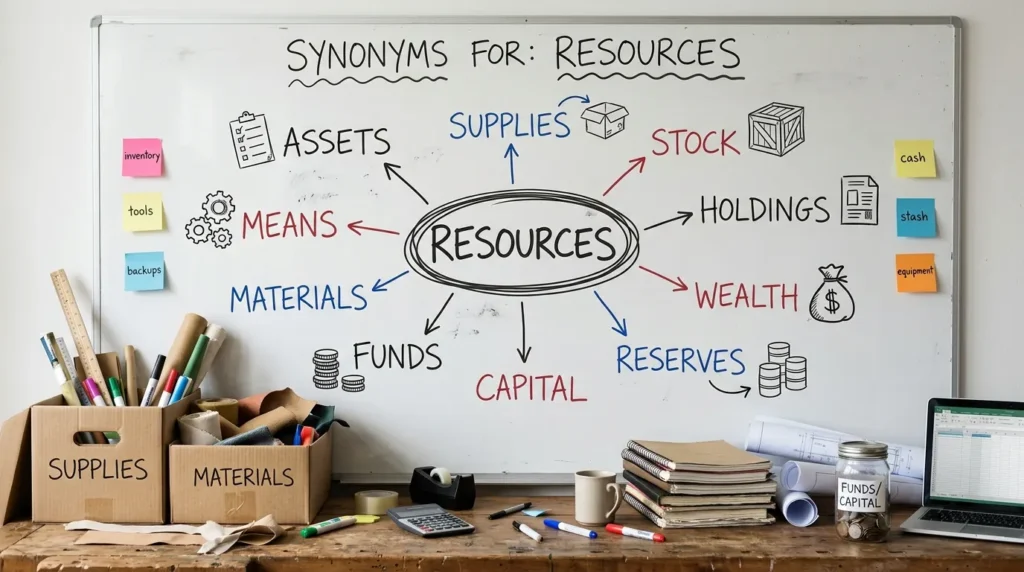
The best synonyms for resources include assets, supplies, materials, tools, funds, means, support, and provisions. The right choice depends on context. Use assets for valuable things a person or organization owns, supplies for items needed to complete a task, funds for available money, and materials for items used to create or learn something.
Quick List of Synonyms for Resources
Here are useful alternatives to resources, grouped by common meanings and contexts.
Assets
Supplies
Materials
Tools
Equipment
Funds
Money
Capital
Means
Support
Provisions
Reserves
Inventory
Stock
Facilities
Services
Personnel
Staff
Workforce
Manpower
Expertise
Skills
Knowledge
Information
References
Sources
Data
Technology
Infrastructure
Capacity
Opportunities
Options
Assistance
Aid
Funding
Financial backing
Raw materials
Learning materials
Teaching aids
Natural wealth
Reserves of energy
Not all these words mean exactly the same thing. Some refer to physical items, others to money, people, knowledge, or available support.
What Does Resources Mean?
Resources is a plural noun that refers to things, people, skills, or forms of support that can be used to achieve a goal, meet a need, or solve a problem.
Resources commonly fall into several categories:
Physical resources: Materials, supplies, tools, and equipment.
Financial resources: Money, funds, capital, and funding.
Human resources: Employees, staff, skills, and expertise.
Information resources: Data, references, research, and knowledge.
Natural resources: Water, forests, minerals, and other materials found in nature.
Personal resources: Time, energy, abilities, and support that help someone handle a challenge.
Examples:
The school provides resources for students who need extra help.
The company needs more financial resources to expand.
Farmers depend on natural resources such as water and fertile soil.
The team used its available resources to complete the project.
The best synonym depends on what kind of resource you mean.
Closest Synonyms for Resources
1. Assets
Meaning: Valuable things, abilities, or advantages that a person or organization owns or can use.
Example: The company invested in new assets to improve its operations.
How it differs: Assets often refers to valuable property, financial holdings, or useful strengths. It is not always a good replacement for supplies or reference materials.
Best for: Business, finance, organizations, and personal strengths.
2. Supplies
Meaning: Items kept or provided for a particular activity or need.
Example: The volunteers collected supplies for families affected by the storm.
How it differs: Supplies usually means physical items that people use or consume, such as food, paper, or medical products.
Best for: Schools, offices, healthcare, emergencies, and everyday tasks.
3. Materials
Meaning: Physical substances or items used to make, build, study, or complete something.
Example: The teacher shared learning materials with the class.
How it differs: Materials is more specific than resources when referring to items used for a particular purpose.
Best for: Education, construction, manufacturing, research, and creative work.
4. Tools
Meaning: Objects, methods, or software used to perform a task.
Example: The organization gave employees tools to manage their projects more effectively.
How it differs: Tools emphasizes how something helps people perform work. Resources may include tools but can also include money, staff, and information.
Best for: Technology, productivity, education, and problem-solving.
5. Funds
Meaning: Money available for a particular purpose.
Example: The nonprofit raised funds to provide meals to children.
How it differs: Funds specifically refers to money, while resources has a much broader meaning.
Best for: Budgets, charities, business projects, education, and public services.
6. Means
Meaning: The money, methods, or abilities available to achieve something.
Example: The community lacked the means to repair the damaged road.
How it differs: Means is broad and can refer to financial capacity or practical ways to achieve a goal.
Best for: Formal writing, problem-solving, and discussions of ability or access.
7. Support
Meaning: Help, assistance, or backing that makes an activity possible.
Example: Students need adequate support to succeed in school.
How it differs: Support emphasizes help rather than the actual items, money, or people providing it.
Best for: Education, healthcare, community programs, and personal development.
8. Equipment
Meaning: The tools, machines, and devices needed for a task or activity.
Example: The laboratory purchased new equipment for its experiments.
How it differs: Equipment refers mainly to physical items used to perform work.
Best for: Laboratories, construction, sports, healthcare, and technical work.
9. Provisions
Meaning: Supplies or arrangements made to meet future needs.
Example: The rescue team carried provisions for the long journey.
How it differs: Provisions often suggests food, essential supplies, or preparations for a particular situation.
Best for: Travel, emergencies, logistics, and formal writing.
10. Capital
Meaning: Money or other assets used to start, operate, or expand a business.
Example: The startup needs additional capital to develop its product.
How it differs: Capital is specifically associated with investment and economic activity, rather than resources in general.
Best for: Business, economics, investment, and finance.
11. Information
Meaning: Facts, details, or knowledge that help someone understand or decide something.
Example: The website offers information about local health services.
How it differs: Information is a suitable alternative when resources primarily provide facts or guidance.
Best for: Research, education, websites, and decision-making.
12. Expertise
Meaning: Specialized knowledge or skill in a particular field.
Example: The project benefited from the expertise of experienced engineers.
How it differs: Expertise describes advanced knowledge and ability, not physical items or money.
Best for: Professional writing, consulting, research, and technical projects.
13. Personnel
Meaning: The people employed by an organization or assigned to a task.
Example: The hospital added personnel to meet growing patient needs.
How it differs: Personnel refers to people working for an organization, while resources may include staff alongside equipment and funding.
Best for: Business, healthcare, government, and organizational planning.
14. Reserves
Meaning: Supplies, money, or other resources saved for future use.
Example: The company maintained financial reserves for unexpected expenses.
How it differs: Reserves emphasizes what is kept available for later rather than what is currently being used.
Best for: Finance, emergency planning, energy, and natural resource management.
15. Infrastructure
Meaning: The basic systems, facilities, and structures needed for an organization or community to function.
Example: Reliable internet infrastructure helps rural schools access digital learning.
How it differs: Infrastructure refers to foundational systems rather than every available resource.
Best for: Technology, transportation, public services, and economic development.

Synonyms for Resources in Different Contexts
Resources in Education
Useful alternatives include:
Learning materials
Teaching materials
Educational tools
Reference materials
Study aids
Instructional materials
Research sources
Learning support
Teaching aids
Educational technology
Example
Original: The school provides resources to help students improve their reading skills.
Alternative: The school provides learning materials to help students improve their reading skills.
Difference: Learning materials emphasizes items such as books, worksheets, and digital lessons. If the school also offers tutoring or counseling, resources may be more accurate.
Resources in Business
Useful alternatives include:
Assets
Capital
Funding
Personnel
Workforce
Equipment
Infrastructure
Expertise
Operational capacity
Available funds
Example
Original: The company needs more resources to launch the new product.
Alternative: The company needs more funding and personnel to launch the new product.
Difference: The revised sentence identifies the specific needs. It is clearer when you know which resources are missing.
Financial Resources
Useful alternatives include:
Funds
Money
Capital
Funding
Financial assets
Budget
Financial backing
Reserves
Financing
Monetary support
Example
Original: The project requires additional financial resources.
Alternative: The project requires additional funding.
Difference: Funding emphasizes money provided for a project. Capital is often more suitable for business investment, while budget refers to a financial plan or allocated amount.
Human Resources
Useful alternatives include:
Staff
Personnel
Employees
Workforce
Team members
Human capital
Skilled workers
Expertise
Professional talent
Example
Original: The organization lacks the human resources needed to complete the project.
Alternative: The organization lacks the staff needed to complete the project.
Difference: Staff refers directly to the people available. Human resources can also refer to workforce capacity and, in business, the department responsible for employee matters.
Natural Resources
Useful alternatives include:
Natural assets
Raw materials
Mineral reserves
Water supplies
Forest resources
Energy sources
Natural wealth
Environmental assets
Example
Original: The country depends on its natural resources.
Alternative: The country depends on its natural wealth.
Difference: Natural wealth highlights the value of nature’s assets. It is broader and less technical than natural resources.
Online Resources
Useful alternatives include:
Websites
Digital materials
Online tools
Information sources
Digital libraries
Databases
Reference websites
Learning platforms
Online guides
Example
Original: Students can use online resources to prepare for exams.
Alternative: Students can use digital learning materials to prepare for exams.
Difference: Digital learning materials specifically describes content such as lessons, videos, and worksheets. Online resources can also include tools, services, and databases.
Resources for an Essay
Useful alternatives include:
Sources
References
Research materials
Supporting evidence
Background information
Academic literature
Data
Reading materials
Scholarly publications
Example
Original: The researcher used several resources to support the argument.
Alternative: The researcher used several scholarly sources to support the argument.
Difference: Sources is more precise when referring to books, articles, studies, or documents used to support a claim.
Personal Resources
Useful alternatives include:
Skills
Strengths
Abilities
Knowledge
Experience
Time
Energy
Coping strategies
Support networks
Example
Original: She relied on her personal resources to overcome the challenge.
Alternative: She relied on her skills, experience, and support network to overcome the challenge.
Difference: Naming the specific resources helps readers understand what made the difference.
Resources vs. Assets vs. Materials vs. Supplies
These words overlap, but each emphasizes something different.
| Word | Main Meaning | Best Context | Interchangeable with Resources? |
|---|---|---|---|
| Resources | Anything useful for achieving a goal | General use | Original broad term |
| Assets | Valuable property, strengths, or holdings | Business and finance | Sometimes |
| Materials | Items used to create, build, or learn | Education and production | When physical or learning items are meant |
| Supplies | Items provided for a task or need | Offices, schools, emergencies | When consumable or practical items are meant |
| Tools | Items or methods used to do work | Technology and tasks | When practical aids are meant |
| Funds | Money available for a purpose | Finance and projects | Only for financial resources |
| Staff | People working for an organization | Business and services | Only for human resources |
| Sources | Places or documents from which information comes | Research and writing | Only for information resources |
| Infrastructure | Basic systems and facilities | Public services and technology | When foundational systems are meant |
| Support | Help or assistance | Education and community services | When help is the main meaning |
How to Choose the Right Synonym for Resources
Choose the word that names the type of resource you mean.
Use assets for valuable property, holdings, or useful strengths.
Use supplies for physical items needed to complete a task.
Use materials for items used to build, create, teach, or learn.
Use tools for objects, software, or methods that help someone work.
Use funds when the resource is money.
Use capital when discussing money invested in a business.
Use staff or personnel when referring to people available for work.
Use expertise when specialized knowledge or skill is the key resource.
Use sources when referring to documents or publications used in research.
Use infrastructure for foundational systems and facilities.
Use support when the emphasis is on assistance rather than the things providing it.
Keep resources when you want a broad term that includes several kinds of useful things.
10 Sentence Transformations Using Synonyms for Resources
1. Educational Resources
Original: The teacher shared useful resources with the students.
Revised: The teacher shared useful learning materials with the students.
Difference: The revision suggests books, worksheets, videos, or other educational content.
2. Financial Resources
Original: The nonprofit needs more resources to continue its work.
Revised: The nonprofit needs more funding to continue its work.
Difference: Funding specifies that the organization needs money.
3. Business Resources
Original: The company invested its resources in a new project.
Revised: The company invested its assets in a new project.
Difference: Assets emphasizes valuable property or holdings, so it may be too narrow if the original includes employees, time, or expertise.
4. Research Resources
Original: The student consulted several resources for the assignment.
Revised: The student consulted several academic sources for the assignment.
Difference: Academic sources makes it clear that the student used publications or research documents.
5. Emergency Resources
Original: The town distributed resources to families affected by the flood.
Revised: The town distributed emergency supplies to families affected by the flood.
Difference: Emergency supplies specifies practical items provided during the crisis.
6. Human Resources
Original: The hospital needs additional resources to serve more patients.
Revised: The hospital needs additional staff to serve more patients.
Difference: The revision focuses on the number of people available to provide care.
7. Natural Resources
Original: The region has valuable natural resources.
Revised: The region has valuable mineral deposits and water reserves.
Difference: Naming the specific resources provides more detail and precision.
8. Digital Resources
Original: Employees use digital resources to manage their work.
Revised: Employees use digital tools to manage their work.
Difference: Digital tools emphasizes software and applications used to perform tasks.
9. Personal Resources
Original: He used his resources to solve the problem.
Revised: He used his knowledge and experience to solve the problem.
Difference: The revision identifies the personal abilities that helped him succeed.
10. Limited Resources
Original: The team completed the project with limited resources.
Revised: The team completed the project with limited funding and equipment.
Difference: The revised sentence identifies the specific limitations. Use it only if those were the actual constraints.
Common Mistakes When Using Synonyms for Resources
1. Treating all synonyms as exact replacements
Funds, staff, materials, and information describe different types of resources.
Better approach: Name the specific resource when you know what it is.
2. Using assets when you mean supplies
A company’s assets may include buildings, investments, or equipment. Supplies are usually items needed for ongoing tasks.
Better approach: Use supplies for practical items such as paper, food, or medical products.
3. Confusing resources with sources
Resources can refer to many kinds of useful things. Sources usually means where information or evidence comes from.
Better approach: Use sources for books, articles, studies, and documents that support research.
4. Using funds when the meaning is broader
A team may need time, skills, staff, and equipment—not just money.
Better approach: Keep resources if several types of support are involved.
5. Confusing resources with opportunities
An opportunity is a chance to do something. A resource is something useful that helps make it possible.
Better approach: Use opportunities for available chances and resources for the means to act on them.
6. Using manpower in every professional context
Manpower is understood, but it can sound dated or overly focused on labor.
Better approach: Prefer staff, personnel, workforce, or team members when appropriate.
7. Using resource when you mean resources
Resource is singular; resources is plural.
Correct: The school provides several resources.
Correct: The school provides a useful resource.
Better approach: Match the noun to the number of items or types you are describing.
8. Replacing resources just to avoid repetition
The broad word resources may be the clearest choice when many kinds of support are involved.
Better approach: Keep the original word unless a more specific alternative improves accuracy.
Grammar and Usage: How to Use Resources Correctly
Resources + verb
Resources is a plural count noun and generally takes a plural verb.
Resources are available online.
These resources help students learn.
The resources were used effectively.
Resource vs. resources
Use resource for one item or source of help and resources for two or more.
The library is a valuable resource.
The library provides several valuable resources.
Resource for + noun
Use this structure to describe what something helps with.
A resource for teachers
Resources for students
A resource for small businesses
Resources for mental well-being
Resource to + verb
Use this pattern when explaining what a resource helps someone do.
Resources to support learning
Tools to improve productivity
Funds to expand the program
Materials to prepare for exams

Useful collocations
These combinations are common in American English:
Educational resources
Learning resources
Financial resources
Human resources
Natural resources
Online resources
Digital resources
Community resources
Available resources
Limited resources
Additional resources
Valuable resources
Resource allocation
Resource management
Resource development
Access to resources
Frequently Asked Questions
1. What is the best synonym for resources?
Assets is a useful alternative when referring to valuable things or strengths. However, supplies, funds, materials, tools, or sources may be more accurate depending on the context.
2. What is another word for resources in an essay?
Good choices include sources, materials, evidence, references, data, and supporting information. Use sources for documents, evidence for information supporting a claim, and materials for items used in research or study.
3. What is a professional word for resources?
Assets, personnel, funding, infrastructure, capacity, and expertise can be suitable professional alternatives. Choose one that identifies the specific resource being discussed.
4. What is a synonym for limited resources?
Depending on the context, you can use scarce supplies, insufficient funding, limited capacity, inadequate staffing, or constrained means. These phrases explain what is limited rather than leaving the meaning broad.
5. What is the difference between resources and assets?
Resources includes anything useful for achieving a goal, such as money, people, time, and information. Assets usually refers to valuable property, holdings, or strengths that a person or organization owns or can use.
6. What is the difference between resources and materials?
Materials generally refers to physical items or content used to create, build, teach, or learn. Resources is broader and can include materials, equipment, money, staff, knowledge, and support.
7. What is the opposite of resources?
There is no single exact opposite. Depending on context, useful contrasts include shortage, scarcity, lack, deficit, and deprivation. For example, a lack of resources means that the necessary support or materials are unavailable or insufficient.
Editor’s Choice: The Best Alternatives to Resources
These five options work well when you want more precise writing:
Assets — best for valuable property, holdings, and organizational strengths.
Materials — best for items used in learning, research, or production.
Funds — best for financial resources.
Tools — best for practical methods, devices, and software.
Support — best when assistance is the main idea.
Editorial recommendation: In an essay or report, replace resources with a specific term whenever possible. “The school needs more resources” is broad. “The school needs more computers, updated textbooks, and trained teachers” tells readers exactly what is missing.
Key Takeaways
Resources is a broad term for useful things, people, skills, money, or support.
Assets refers to valuable property or strengths, while supplies and materials usually refer to items.
Funds and capital are financial alternatives, but they differ in how money is used.
Sources is often more precise when discussing research documents and references.
Keep resources when several types of useful support are involved and a narrower word would change the meaning.