

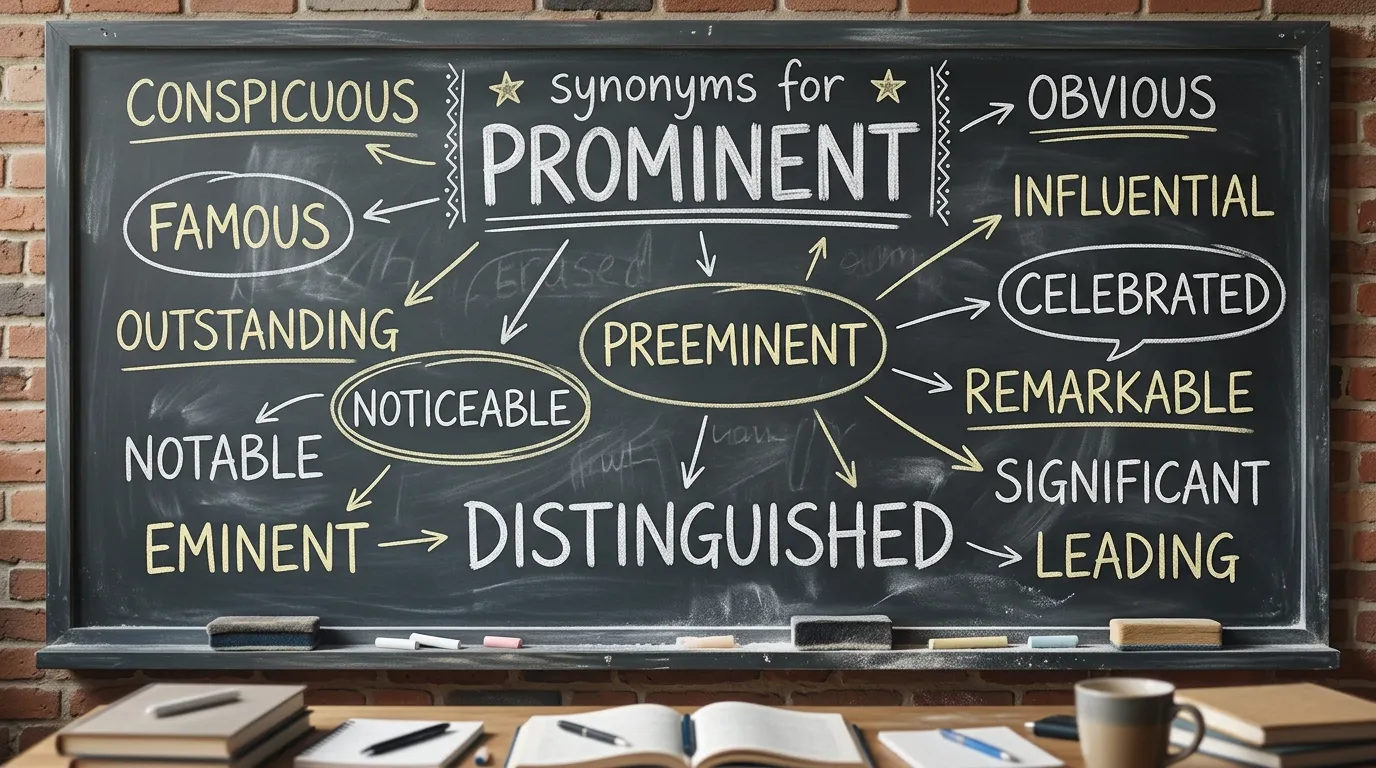
The best synonyms for prominent include notable, well-known, important, distinguished, influential, famous, outstanding, conspicuous, and leading. The right choice depends on context. Use notable for something worthy of attention, influential for someone who affects decisions, distinguished for an impressive reputation, and conspicuous for something that stands out visually.
Quick List of Synonyms for Prominent
Here are useful alternatives grouped by meaning and context:
Notable
Well-known
Famous
Renowned
Celebrated
Distinguished
Influential
Important
Significant
Outstanding
Leading
Respected
Prestigious
Eminent
Acclaimed
Recognized
Remarkable
Outstanding
Foremost
Principal
Major
Key
Central
High-profile
Celebrated
Preeminent
Exceptional
Conspicuous
Noticeable
Obvious
Striking
Salient
Outstanding
Dominant
Distinguished
Renowned
Highly regarded
Well-established
Front-and-center
Widely recognized
Not every word is interchangeable with prominent. Some describe fame, others describe importance, influence, visual visibility, or professional reputation.
What Does Prominent Mean?
Prominent is an adjective that describes someone or something that is easily noticed, important, well-known, or in a leading position.
It has several related meanings:
Well-known or respected: A person has a strong public reputation.
Important or influential: Someone or something plays a major role.
Noticeable or easy to see: A feature stands out visually.
Leading or central: A person or thing occupies an important position in a group, field, or situation.
Examples:
She is a prominent scientist known for her research.
Education is a prominent issue in the election.
A prominent sign stood above the entrance.
He played a prominent role in the negotiations.
The best synonym depends on which meaning you intend.
Closest Synonyms for Prominent
1. Notable
Meaning: Worthy of attention because of importance, achievement, or unusual qualities.
Example: The researcher made a notable contribution to medical science.
How it differs: Notable means deserving attention, but it does not always suggest widespread fame or strong influence.
Best for: Academic writing, reports, achievements, and important events.
2. Well-known
Meaning: Familiar to many people or widely recognized.
Example: She is a well-known author whose books have reached readers worldwide.
How it differs: Well-known focuses on recognition rather than importance. Someone can be well-known without being influential or highly respected.
Best for: General writing, biographies, public figures, and familiar brands.
3. Influential
Meaning: Able to affect opinions, decisions, behavior, or events.
Example: He is an influential leader in the technology industry.
How it differs: Influential specifically emphasizes the power to create change. A prominent person may be famous but have little influence.
Best for: Leadership, politics, business, culture, and social issues.
4. Distinguished
Meaning: Respected or admired because of achievements, skill, or character.
Example: The university invited a distinguished professor to deliver the lecture.
How it differs: Distinguished conveys a strong sense of achievement and respect. It is often more formal than prominent.
Best for: Academic writing, professional biographies, awards, and formal introductions.
5. Famous
Meaning: Known by many people.
Example: The city is famous for its historic architecture.
How it differs: Famous emphasizes public recognition. It does not necessarily mean important, respected, or influential.
Best for: Everyday writing, entertainment, celebrities, landmarks, and cultural references.
6. Significant
Meaning: Important enough to have an effect or deserve attention.
Example: The study found a significant increase in reading comprehension.
How it differs: Significant emphasizes importance or impact. In research, it can also have a specific statistical meaning.
Best for: Reports, research, academic essays, and analysis.
7. Outstanding
Meaning: Exceptionally good or impressive.
Example: She received an award for her outstanding work in education.
How it differs: Outstanding usually expresses excellence, while prominent can simply mean well-known, important, or noticeable.
Best for: Achievements, performance reviews, awards, and professional profiles.
8. Renowned
Meaning: Widely known and admired for a particular quality or achievement.
Example: The city is home to a renowned art museum.
How it differs: Renowned suggests a strong positive reputation, often in a specific field.
Best for: Professional profiles, institutions, artists, experts, and formal writing.
9. Eminent
Meaning: Highly respected and recognized for expertise or achievement.
Example: The conference brought together eminent scholars from several countries.
How it differs: Eminent is formal and usually describes people with exceptional status or expertise.
Best for: Academic writing, expert biographies, formal speeches, and professional introductions.
10. Leading
Meaning: Among the most important, successful, or influential in a field.
Example: The company is a leading provider of educational software.
How it differs: Leading suggests a top position or strong standing within a particular area. It does not necessarily mean the subject is famous to the general public.
Best for: Business writing, industry descriptions, professional profiles, and reports.
11. Conspicuous
Meaning: Easy to notice, often because something looks different or stands out.
Example: A conspicuous crack appeared in the wall.
How it differs: Conspicuous emphasizes visibility, not reputation or importance. It can also suggest that something is unusually obvious.
Best for: Physical descriptions, observations, and visual details.
12. Remarkable
Meaning: Unusual or impressive enough to attract attention.
Example: The team made remarkable progress in just three months.
How it differs: Remarkable suggests that something is surprising or impressive, while prominent does not always express praise.
Best for: Achievements, discoveries, progress, and notable events.
13. Principal
Meaning: First in importance or the main one among several.
Example: Cost was the principal reason for the project’s delay.
How it differs: Principal identifies the main factor or person, not necessarily someone famous or publicly recognized.
Best for: Formal writing, reports, explanations, and lists of causes.
14. Prestigious
Meaning: Respected and admired because of high status or reputation.
Example: She received a scholarship from a prestigious university.
How it differs: Prestigious emphasizes status and reputation, often associated with institutions, awards, and positions.
Best for: Education, careers, awards, organizations, and professional achievements.
15. Salient
Meaning: Most noticeable or important in a particular situation.
Example: The report summarizes the salient points of the discussion.
How it differs: Salient usually refers to the most relevant or noticeable details rather than a famous person or institution.
Best for: Academic essays, analysis, reports, and presentations.
Formal and Academic Synonyms for Prominent
When writing an essay, research paper, report, or professional document, these alternatives can be more precise than prominent.
| Synonym | Meaning | Best Context |
|---|---|---|
| Notable | Worthy of attention | Achievements and findings |
| Significant | Important or impactful | Research and analysis |
| Distinguished | Highly respected for achievement | Experts and professionals |
| Eminent | Recognized as an authority | Academic and professional writing |
| Salient | Most relevant or noticeable | Main points and findings |
| Principal | Most important or primary | Causes, factors, and roles |
| Preeminent | More distinguished or important than others | Leading experts and institutions |
| Influential | Able to affect decisions or events | Leaders and social movements |
| Substantial | Considerable in amount or importance | Evidence, changes, and contributions |
| Foremost | Among the leading or most important | Experts, priorities, and positions |
Writing tip: In academic writing, choose the word that explains why something matters. Use significant for importance, salient for relevance, influential for impact, and distinguished for an impressive reputation.
Synonyms for Prominent in Different Contexts
Prominent Person
Useful alternatives include:
Well-known person
Notable figure
Influential figure
Distinguished individual
Renowned expert
Leading figure
Respected leader
High-profile personality
Example
Original: A prominent scientist spoke at the conference.
Alternative: A renowned scientist spoke at the conference.
Difference: Renowned emphasizes the scientist’s reputation. If the scientist’s influence matters more than fame, influential scientist may be more accurate.
Prominent Role
Useful alternatives include:
Important role
Leading role
Central role
Key role
Major role
Significant role
Principal role
Influential role
Example
Original: She played a prominent role in the campaign.
Alternative: She played a central role in the campaign.
Difference: Central emphasizes how essential her involvement was. Prominent may emphasize visibility or importance.
Prominent Issue
Useful alternatives include:
Major issue
Important issue
Key issue
Significant concern
Central concern
Leading issue
Pressing issue
Example
Original: Housing has become a prominent issue in the debate.
Alternative: Housing has become a major issue in the debate.
Difference: Major emphasizes importance or scale, while prominent may suggest that the issue receives considerable attention.
Prominent Feature
Useful alternatives include:
Noticeable feature
Conspicuous feature
Striking feature
Distinctive feature
Obvious feature
Salient feature
Standout feature
Example
Original: The building’s prominent feature is its glass roof.
Alternative: The building’s most striking feature is its glass roof.
Difference: Striking suggests a strong visual impression. Noticeable simply means easy to see.
Prominent Position
Useful alternatives include:
Leading position
Influential position
High-profile position
Senior position
Prestigious position
Foremost position
Example
Original: She holds a prominent position in the organization.
Alternative: She holds a senior position in the organization.
Difference: Senior specifically suggests rank or authority. Prominent can refer to visibility, reputation, or influence.
Prominent in an Essay
If you are writing an essay, the best alternative depends on the sentence.
Significant — when something has an important effect.
Notable — when something deserves attention.
Central — when something is essential to the argument.
Influential — when someone or something affects events or opinions.
Salient — when a point is especially relevant.
Widely recognized — when public recognition is the focus.
Example:
Original: Technology plays a prominent role in modern education.
Alternative: Technology plays a significant role in modern education.
Use central role if technology is essential to the argument, or influential role if the sentence focuses on its effect on teaching and learning.
Prominent vs. Notable vs. Influential vs. Distinguished
These words overlap, but each emphasizes a different quality.
| Word | Main Meaning | Tone | Can It Replace Prominent? |
|---|---|---|---|
| Prominent | Important, well-known, or noticeable | Neutral-positive | Original word |
| Notable | Worthy of attention | Neutral, often formal | Often |
| Influential | Able to affect decisions or events | Neutral-positive | When impact matters |
| Distinguished | Respected for achievement | Formal, positive | When reputation matters |
| Famous | Known by many people | Everyday | When public recognition matters |
| Significant | Important or impactful | Neutral, analytical | When importance matters |
| Conspicuous | Easy to notice visually | Neutral, sometimes negative | When visibility matters |
| Outstanding | Exceptionally good or impressive | Positive | When excellence matters |
| Leading | Among the most important in a field | Professional | When rank or standing matters |
| Renowned | Widely known and admired | Formal, positive | When an excellent reputation matters |
How to Choose the Right Synonym for Prominent
Use this quick guide to find the best word for your sentence.
Use notable when something deserves attention.
Use well-known when many people recognize a person or thing.
Use famous for broad public recognition in everyday writing.
Use influential when someone or something affects decisions, beliefs, or events.
Use distinguished when highlighting achievements and respect.
Use significant when emphasizing importance or impact.
Use conspicuous when describing something that stands out visually.
Use outstanding when highlighting exceptional quality.
Use leading when describing a top organization, expert, or product in a field.
Use central when something is essential to a role, argument, or process.
Use salient when a point is especially relevant or noticeable.
Keep prominent when the word naturally combines visibility, importance, or recognition.
10 Sentence Transformations Using Synonyms for Prominent
1. Prominent Scientist
Original: She is a prominent scientist.
Revised: She is a renowned scientist.
Difference: Renowned emphasizes that she is widely known and admired for her work.
2. Prominent Role
Original: He played a prominent role in the project.
Revised: He played a central role in the project.
Difference: Central suggests his involvement was essential to the project’s progress.
3. Prominent Issue
Original: Climate change is a prominent issue in public debate.
Revised: Climate change is a major issue in public debate.
Difference: Major emphasizes importance, while prominent may also imply public visibility.
4. Prominent Feature
Original: A prominent crack appeared in the ceiling.
Revised: A conspicuous crack appeared in the ceiling.
Difference: Conspicuous highlights how easily the crack can be seen.
5. Prominent Leader
Original: She is a prominent leader in the community.
Revised: She is an influential leader in the community.
Difference: Influential emphasizes her ability to affect people or decisions.
6. Prominent Achievement
Original: The award recognized his prominent achievements.
Revised: The award recognized his outstanding achievements.
Difference: Outstanding highlights exceptional quality. However, “prominent achievements” may be less natural than “notable achievements” in this context.
7. Prominent University
Original: He studied at a prominent university.
Revised: He studied at a prestigious university.
Difference: Prestigious emphasizes the institution’s reputation and status.
8. Prominent Finding
Original: A prominent finding of the study was the link between sleep and memory.
Revised: A significant finding of the study was the link between sleep and memory.
Difference: Significant emphasizes the importance of the finding. If the point is simply one of the most relevant results, key finding may be more natural.
9. Prominent Public Figure
Original: The event attracted several prominent public figures.
Revised: The event attracted several high-profile public figures.
Difference: High-profile emphasizes public attention and visibility.
10. Prominent Point in an Essay
Original: One prominent point in the argument is the cost of healthcare.
Revised: One key point in the argument is the cost of healthcare.
Difference: Key is more natural when identifying an essential point in an argument.

Common Mistakes When Using Synonyms for Prominent
1. Assuming prominent always means famous
A prominent issue may be important or widely discussed without being famous.
Better choice: Use famous only when public recognition is the main idea.
2. Using influential when you mean noticeable
A bright sign can be prominent without influencing anyone.
Better choice: Use noticeable, conspicuous, or striking for visual visibility.
3. Using distinguished when you mean merely well-known
Distinguished suggests respect earned through achievement, skill, or service.
Better choice: Use well-known when recognition alone is intended.
4. Using significant when you mean visually obvious
Significant usually describes importance or impact, not physical visibility.
Better choice: Use conspicuous or noticeable for visible features.
5. Choosing a complicated word unnecessarily
Words such as preeminent and salient can be precise but may sound overly formal in everyday writing.
Better choice: Use important, notable, or key when they express the meaning clearly.
6. Confusing prominent with predominant
Prominent means important, well-known, or noticeable. Predominant means most common, powerful, or widespread.
Example: A prominent opinion receives attention; a predominant opinion is the opinion held by most people.
7. Using outstanding when no praise is intended
Outstanding often implies exceptional quality, while prominent can be neutral.
Better choice: Use notable or significant if you want to avoid adding praise.
8. Replacing prominent in every sentence
Changing a clear word for variety can make writing less precise.
Better choice: Keep prominent when it expresses the intended meaning naturally.
Grammar and Usage: How to Use Prominent Correctly
Prominent + noun
Use prominent before a noun to describe a person, issue, feature, or position.
Examples:
A prominent scientist
A prominent political figure
A prominent issue
A prominent feature
A prominent role
A prominent landmark
Prominent in
Use prominent in when describing someone or something that is important or well-known within a field, group, or activity.
Examples:
She is prominent in the field of medicine.
The organization is prominent in environmental research.
He became prominent in local politics.
Prominent for
Use prominent for less often than known for or renowned for. In most cases, one of those alternatives sounds more natural.
Less natural: The city is prominent for its museums.
More natural: The city is renowned for its museums.
Prominent role in
This is a common and natural phrase.
Examples:
She played a prominent role in the investigation.
Technology has a prominent role in modern communication.
Depending on the meaning, central role, key role, or major role may be more precise.
Useful collocations
Common combinations include:
Prominent figure
Prominent leader
Prominent scientist
Prominent role
Prominent position
Prominent issue
Prominent feature
Prominent landmark
Prominent example
Prominent member
Prominent place
Prominent name
Frequently Asked Questions
1. What is the best synonym for prominent?
Notable is a strong general alternative when something deserves attention. Use influential for impact, distinguished for a respected reputation, and conspicuous for visual visibility.
2. What is a more formal word for prominent?
Eminent, distinguished, renowned, and preeminent are formal alternatives, but they have different meanings. Eminent usually describes respected experts, while preeminent suggests a leading or superior position.
3. What is another word for prominent in an essay?
Good choices include significant, notable, central, key, influential, and salient. Choose based on whether you mean important, relevant, central to an argument, or influential.
4. What is a synonym for prominent person?
Use notable figure, influential person, distinguished individual, renowned expert, or high-profile personality. The best phrase depends on whether the person is known for achievements, influence, expertise, or public attention.
5. What is the difference between prominent and significant?
Prominent often means noticeable, well-known, or important. Significant emphasizes importance, meaning, or impact. A prominent person may attract attention, while a significant discovery has meaningful consequences.
6. What is the difference between prominent and conspicuous?
Prominent can describe importance, reputation, or visibility. Conspicuous specifically emphasizes being easy to notice, often visually. A prominent leader is important or well-known; a conspicuous stain is easy to see.
7. What is the opposite of prominent?
Possible antonyms include obscure, unknown, insignificant, inconspicuous, and minor. Use obscure for something little-known, inconspicuous for something hard to notice, and insignificant for something unimportant.
Editor’s Choice: The Best Alternatives to Prominent
For most writing tasks, these five alternatives offer clear and useful distinctions:
Notable — best all-purpose choice for something worthy of attention.
Influential — best for people or groups that affect decisions and events.
Distinguished — best for someone respected for achievement.
Significant — best for an important issue, change, or result.
Conspicuous — best for a feature that stands out visually.
Editorial recommendation: In essays and reports, choose the synonym that makes your claim more precise. “A significant change” highlights impact; “a notable change” highlights attention; “a conspicuous change” suggests the difference is easy to see.
Key Takeaways
Notable is a versatile synonym for something worthy of attention.
Influential emphasizes the power to affect people, decisions, or events.
Distinguished and renowned suggest a strong reputation or recognized achievement.
Significant emphasizes importance, while conspicuous emphasizes visibility.
Keep prominent when it communicates importance, recognition, or visibility more naturally than its alternatives.