

The best synonym for reality depends on what you mean. Truth refers to what is true, actuality emphasizes what exists or happens in fact, fact refers to something that can be established as true, and existence describes the state of being real. Choosing the right alternative makes your writing more accurate and natural.
Quick Answer: What Are the Best Synonyms for Reality?
Some of the best synonyms for reality are truth, actuality, fact, existence, real life, the real world, authenticity, certainty, substance, and situation. Use truth when discussing what is true, actuality for what really exists or happens, real life for everyday experience, and existence for the state of being real.
Quick List of Synonyms for Reality
Here are useful alternatives grouped by meaning and context.
Truth and facts: truth, fact, actuality, certainty, verity
What really exists: existence, being, presence, substance, realness
Everyday experience: real life, the real world, lived experience, practical life
Authenticity: genuineness, authenticity, legitimacy, credibility
The way things are: circumstances, situation, state of affairs, conditions
Practical considerations: practicality, feasibility, real-world conditions
Philosophical or abstract contexts: being, existence, actuality, objective reality
Informal expressions: the facts of life, how things really are, the way things stand
These words are related but not always interchangeable. For example, authenticity refers to whether something is genuine, while reality refers more broadly to what exists or is true.
What Does Reality Mean?
Reality is the state of things as they actually exist, rather than how people imagine, believe, wish, or pretend they are.
The word is a noun. It can refer to the world around us, actual circumstances, or the distinction between what is true and what is imagined.
Examples:
She had to accept the reality of the situation.
His dream was exciting, but reality proved more difficult.
The novel blends fantasy with reality.
The documentary shows the harsh reality of life in the region.
The word can have several related meanings:
What exists: The reality of the physical world.
What is true: The reality behind the rumors.
Actual circumstances: They faced the reality of rising costs.
Everyday experience: Moving away from home introduced her to adult reality.
The best synonym depends on which meaning you want to express.
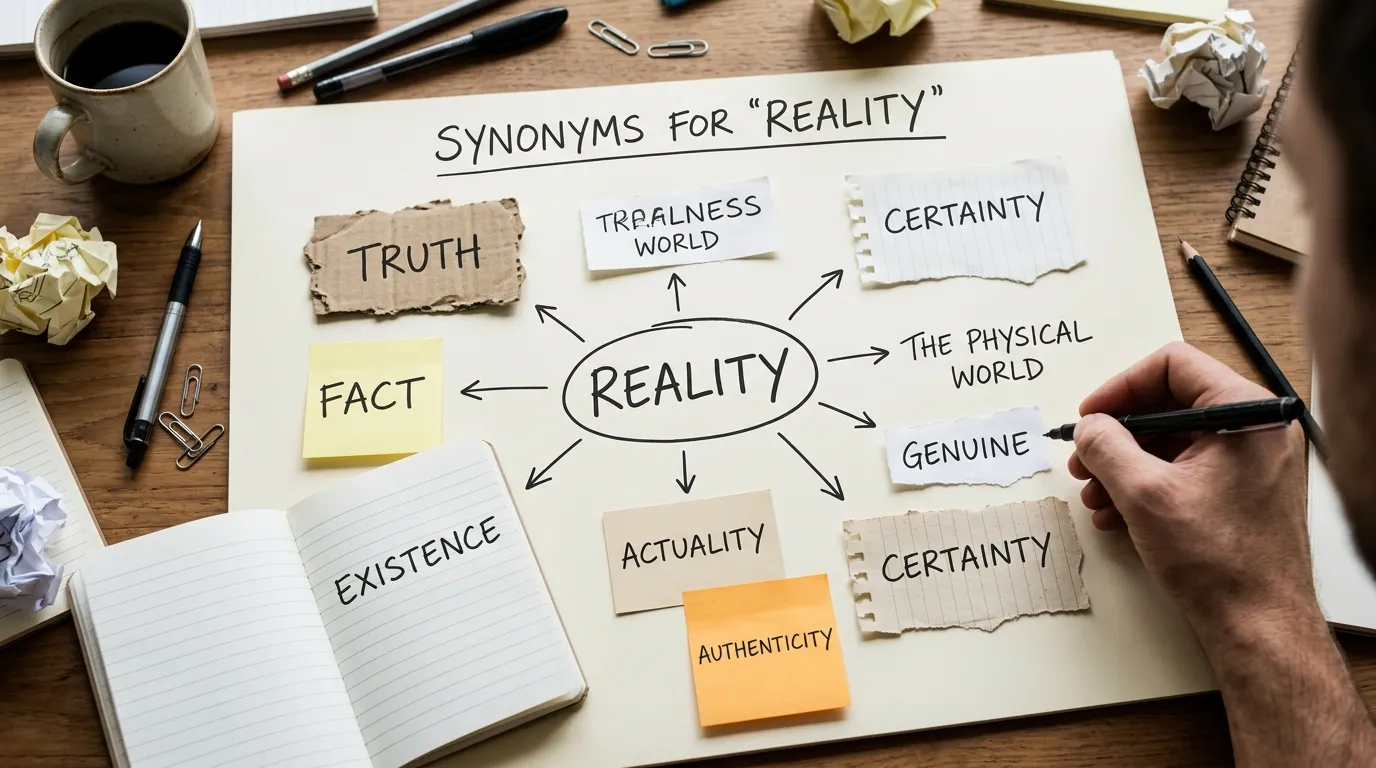
Closest Synonyms for Reality
1. Truth
Meaning: The quality or state of being true; what is consistent with the facts.
Example: She wanted to know the truth about what happened.
Best for: Honest communication, evidence, explanations, and factual claims.
Difference: Truth focuses on whether something is true. Reality is broader and can include the entire world or a set of actual circumstances.
2. Actuality
Meaning: The state of being actual or existing in fact.
Example: The plan sounded simple, but the actuality was much more complicated.
Best for: Formal writing, analysis, philosophy, and comparisons between expectations and facts.
Difference: Actuality often emphasizes what exists or happens in practice, rather than what is imagined or expected.
3. Fact
Meaning: Something that is known or established to be true.
Example: The facts of the case changed their understanding of the situation.
Best for: Research, reporting, debates, explanations, and evidence-based writing.
Difference: A fact is a specific piece of information. Reality is broader and may include many facts, experiences, and conditions.
4. Existence
Meaning: The state of being real or present.
Example: The discovery provided evidence for the existence of the ancient settlement.
Best for: Science, philosophy, abstract discussions, and questions about whether something is real.
Difference: Existence emphasizes whether something is or is not. Reality can also describe the nature and conditions of what exists.
5. Real Life
Meaning: Actual everyday experience, especially in contrast with fiction, imagination, or idealized situations.
Example: In real life, learning a new language takes time and practice.
Best for: Conversations, personal experiences, education, entertainment, and practical advice.
Difference: Real life is more conversational than reality and usually refers to everyday human experience.
6. The Real World
Meaning: The practical world as people experience it, often contrasted with theory, fantasy, or sheltered environments.
Example: The internship helped students understand the real world of business.
Best for: Careers, education, practical challenges, and discussions of everyday responsibilities.
Difference: This phrase often highlights practical demands rather than reality in its broadest sense.
7. Authenticity
Meaning: The quality of being genuine, original, or true to one’s identity.
Example: Readers appreciated the authenticity of the author’s personal account.
Best for: Art, culture, personal expression, identity, and genuine experiences.
Difference: Authenticity describes genuineness. It is not a direct substitute for reality in every sentence.
8. Verity
Meaning: A truth or principle regarded as true.
Example: The essay explores a basic verity about human behavior.
Best for: Literary, philosophical, or formal writing.
Difference: Verity is relatively uncommon and often sounds literary. In everyday writing, truth is usually clearer.
9. Realness
Meaning: The quality of being real rather than fake, imaginary, or artificial.
Example: The actor brought a sense of realness to the character.
Best for: Informal writing, creative work, and descriptions of believable experiences.
Difference: Realness is less formal than reality and often emphasizes how genuine or believable something feels.
10. Substance
Meaning: The essential or meaningful content of something, rather than its appearance alone.
Example: The proposal looked impressive but lacked substance.
Best for: Arguments, ideas, discussions, and evaluations of meaningful content.
Difference: Substance can refer to what is substantial or meaningful. It does not generally mean reality itself.
11. Circumstances
Meaning: The conditions or facts surrounding a situation.
Example: Under the circumstances, postponing the event was the most sensible decision.
Best for: Personal situations, work, decisions, and explanations of events.
Difference: Circumstances describe the conditions that shape reality, not reality as a whole.
12. State of Affairs
Meaning: The current situation or condition of things.
Example: The report revealed the true state of affairs in the organization.
Best for: Formal reports, business writing, politics, and analysis.
Difference: This phrase emphasizes how things currently stand.
13. Being
Meaning: The state of existing; sometimes the essential nature of something.
Example: The philosopher questioned the nature of being.
Best for: Philosophy, literature, and abstract discussions.
Difference: Being focuses on existence or nature, rather than the full range of circumstances described by reality.
14. Certainty
Meaning: The state of being sure that something is true or will happen.
Example: She treated the prediction as a certainty, even though the evidence was weak.
Best for: Arguments, decisions, predictions, and discussions of knowledge.
Difference: Certainty concerns confidence or lack of doubt. Something can be part of reality even when people are uncertain about it.
15. Legitimacy
Meaning: The quality of being lawful, justified, accepted, or genuine.
Example: The investigation raised questions about the legitimacy of the claim.
Best for: Law, authority, institutions, arguments, and claims.
Difference: Legitimacy concerns whether something is valid or justified, not simply whether it exists.
Formal and Academic Synonyms for Reality
In academic writing, the most appropriate alternative depends on the subject and the exact claim you are making.
| Word or phrase | Meaning | Best use |
|---|---|---|
| Actuality | What exists or happens in fact | Formal analysis and philosophy |
| Objective reality | Reality independent of individual beliefs or perceptions | Philosophy and scientific discussion |
| Existence | The state of being real | Philosophy and science |
| Empirical evidence | Evidence based on observation or experience | Research and scientific writing |
| State of affairs | The current situation | Reports and analytical writing |
| Verity | A truth or principle | Literary and philosophical writing |
| Real-world conditions | Practical circumstances as they exist | Business, policy, and applied research |
| Truth | What is true | General academic writing |
Important distinction: Empirical evidence is not a synonym for reality. It is evidence gathered through observation or experience that can help us understand reality.
Example in academic writing:
Basic: The study examined the reality of workplace inequality.
More specific: The study examined the actual extent of workplace inequality.
If discussing evidence: The study examined empirical evidence of workplace inequality.
If describing conditions: The study examined the real-world conditions affecting workers.
The best revision depends on what the study actually investigates.
Synonyms for Reality in Different Contexts
Synonyms for Reality and Truth
Use these alternatives when discussing facts, honesty, or what is genuinely true.
Truth
Fact
Actuality
Verity
What really happened
The facts of the matter
Example: The investigation uncovered the truth behind the allegations.
Fact works best for a specific established detail, while truth can refer to a broader understanding of what happened.
Synonyms for Reality in Everyday Life
Use these expressions when describing ordinary experiences and practical circumstances.
Real life
The real world
Everyday experience
Actual circumstances
Practical life
The way things are
Example: Her first job taught her what working life was really like.
These expressions are often more natural than reality when discussing daily responsibilities or practical experiences.
Synonyms for Reality in Academic Writing
Use precise terms when discussing abstract concepts, observations, or evidence.
Actuality
Existence
Objective reality
State of affairs
Actual conditions
Observable conditions
Example: The researchers compared theoretical predictions with actual conditions.
Use objective reality only when you mean reality considered independently of individual perception. It has a more specific philosophical meaning than the general word reality.
Synonyms for a Harsh Reality
Use these phrases when describing difficult or unpleasant facts.
Harsh truth
Unpleasant truth
Difficult circumstances
Stark reality
Sobering facts
Hard facts
The facts of life
Example: The family had to face the harsh reality of rising living costs.
Stark reality emphasizes a difficult truth that is impossible to ignore. Hard facts focuses on evidence that may be unpleasant but cannot easily be dismissed.
Synonyms for Reality Versus Imagination
Use these expressions to distinguish what exists from what is invented, imagined, or idealized.
Actual existence
The real world
What is real
Objective reality
Actual events
Real-life experience
Example: The film blurs the line between imagination and reality.
In this context, actual events is useful when referring to things that really happened, while the real world emphasizes the world outside fantasy.
Synonyms for Someone’s Perception of Reality
Use these terms when discussing how people interpret or experience the world.
Perspective
Perception
Worldview
Understanding
Interpretation
Personal experience
Example: Their different perspectives led them to interpret the same event in different ways.
These are related concepts, not exact synonyms. Perception describes how someone experiences or understands reality; it does not mean reality itself.
Reality vs. Similar Words: What’s the Difference?
| Word or phrase | Main meaning | Tone | Interchangeable with reality? |
|---|---|---|---|
| Truth | What is true | Neutral | Sometimes |
| Fact | An established detail | Factual | Only for specific claims |
| Actuality | What exists or happens in fact | Formal | Often in suitable contexts |
| Existence | The state of being real | Abstract | Only when discussing being or existence |
| Real life | Everyday experience | Conversational | Often in daily-life contexts |
| Authenticity | Genuineness | Neutral or formal | Rarely |
| Circumstances | Conditions surrounding a situation | Neutral | Sometimes, when referring to a specific situation |
| Certainty | Confidence that something is true | Neutral | No |
| Perspective | A particular way of viewing something | Neutral | No |
| State of affairs | The current condition of things | Formal | Often when discussing a situation |
| Objective reality | Reality independent of personal beliefs | Academic | Only in specific philosophical contexts |
| Harsh truth | An unpleasant fact | Emphatic | When the context is negative |
How to Choose the Right Synonym for Reality
Use the word that matches your intended meaning.
Use truth when you mean what is true or honest.
Use fact when you mean a specific detail that can be established.
Use actuality when contrasting what really happens with what is imagined or expected.
Use existence when discussing whether something is real or present.
Use real life for everyday experience.
Use the real world when contrasting practical experience with theory or fantasy.
Use authenticity when discussing whether something is genuine.
Use circumstances when describing the conditions surrounding a situation.
Use state of affairs for a formal description of current conditions.
Use harsh reality when emphasizing a difficult or unpleasant truth.
Use perspective when discussing how someone interprets reality, rather than reality itself.
If none of these distinctions matters, reality may remain your clearest and most natural choice.

Before-and-After Examples: Replacing Reality in Sentences
Each revision changes the meaning slightly to show when an alternative fits.
Original: She struggled to accept the reality of the situation.
Revised: She struggled to accept the truth about the situation.
Why: Truth emphasizes accepting what is true.Original: The reality was different from what we expected.
Revised: The actual situation was different from what we expected.
Why: Actual situation focuses on the conditions that existed.Original: He needed to understand the reality of adult life.
Revised: He needed to understand real life.
Why: Real life sounds more conversational and emphasizes everyday experience.Original: The report revealed the reality of poverty in the area.
Revised: The report revealed the actual conditions faced by people living in poverty in the area.
Why: Actual conditions is more specific about what the report describes.Original: The story mixes reality with fantasy.
Revised: The story mixes real-life events with fantasy.
Why: Real-life events emphasizes things that actually happened.Original: They questioned the reality of the witness’s account.
Revised: They questioned the truthfulness of the witness’s account.
Why: Truthfulness focuses on whether the account is honest or accurate.Original: She finally faced the reality of her financial problems.
Revised: She finally faced the harsh truth about her financial problems.
Why: Harsh truth emphasizes the unpleasant nature of the situation.Original: The research explored the reality of human existence.
Revised: The research explored the nature of human existence.
Why: Existence fits a philosophical discussion about being.Original: The reality in the organization was worse than expected.
Revised: The state of affairs in the organization was worse than expected.
Why: State of affairs is appropriate for a formal description of current conditions.Original: Our reality changed after the announcement.
Revised: Our circumstances changed after the announcement.
Why: Circumstances is more precise when external conditions change.Original: The character’s reality was shaped by past experiences.
Revised: The character’s perception of the world was shaped by past experiences.
Why: Perception is the better choice when referring to how someone understands their surroundings.Original: The reality of the problem became clear after the investigation.
Revised: The facts of the matter became clear after the investigation.
Why: Facts of the matter emphasizes the details established by the investigation.
Common Mistakes When Using Synonyms for Reality
1. Treating truth and reality as identical
Truth concerns what is true. Reality can refer to the entire set of things and circumstances that exist.
2. Using fact for an entire situation
A fact is usually one established detail. When referring to a broader situation, reality, actual conditions, or state of affairs may fit better.
3. Confusing reality with perception
People can perceive the same situation differently. Their perceptions are interpretations of reality, not necessarily reality itself.
4. Using authenticity when you mean existence
Authenticity means genuineness or originality. It does not usually mean the state of existing.
5. Using actuality in casual conversation unnecessarily
Actuality is valid but more formal than reality. In everyday speech, “the actual situation” or “what really happened” often sounds more natural.
6. Using certainty when you mean truth
Certainty describes being sure about something. A person can feel certain and still be wrong.
7. Confusing real life with objective reality
Real life commonly refers to everyday human experience. Objective reality is a more technical expression used in philosophical or theoretical discussions.
8. Using harsh truth for neutral information
Harsh truth implies something unpleasant. Use fact or actual situation for neutral information.
9. Replacing reality with perspective incorrectly
A perspective is a way of viewing something. It may shape someone’s understanding of reality, but it is not the same thing.
Grammar and Usage: How to Use Reality Correctly
Reality is generally an uncountable noun when referring to the condition of things as they actually exist. It can also be used in the plural, realities, when discussing different circumstances, aspects, or experiences.
Common collocations with reality
| Expression | Example |
|---|---|
| Face reality | We must face reality and adjust our plans. |
| Accept reality | He found it difficult to accept reality. |
| The reality of | She understood the reality of the situation. |
| In reality | In reality, the process takes several weeks. |
| A harsh reality | Unemployment became a harsh reality for many families. |
| The reality is that | The reality is that we have limited time. |
| Escape from reality | Reading helps her escape from reality. |
| Reality check | The unexpected costs gave us a reality check. |
| Distorted reality | The film presents a distorted reality. |
| Reality and fantasy | The novel explores the boundary between reality and fantasy. |
Is it “reality” or “realities”?
Use reality when referring to reality generally or to one broad situation.
We need to accept reality.
The reality of the situation was difficult to face.
Use realities when referring to different conditions, experiences, or aspects of life.
The book explores the realities of working-class life.
The two communities face different economic realities.
What is the adjective form of reality?
The most common adjective is real.
Noun: The reality of the situation became clear.
Adjective: The problem is real.
Other related forms include:
Realistic: Based on what is practical or likely.
Realistic: The plan is realistic.
Realized: Made real or brought into existence, as in “a realized ambition” (less common in everyday American English).
Realistically: In a way that considers actual conditions or practical limits.
Use realistic when discussing whether an idea or plan is practical, not as a direct substitute for reality.
Frequently Asked Questions
1. What is the best synonym for reality?
Truth is a strong alternative when reality means what is true. Actuality works when emphasizing what exists or happens in fact, while real life is often better for everyday experiences.
2. What is a formal word for reality?
Actuality is a formal alternative. Depending on the context, existence, objective reality, or state of affairs may be more precise.
3. What is another word for reality in an essay?
Useful choices include truth, actuality, actual conditions, real-world circumstances, and state of affairs. Choose based on whether your essay discusses facts, experiences, or broader conditions.
4. What is another way to say “in reality”?
You can say in fact, actually, in truth, or as things really are. For example: “In reality, the project needed more time” can become “In fact, the project needed more time.”
5. What is a synonym for harsh reality?
Common alternatives include harsh truth, stark reality, unpleasant truth, hard facts, and sobering facts. Each emphasizes the difficult or uncomfortable nature of what is being acknowledged.
6. What is the difference between reality and actuality?
Reality is the broad state of things as they exist. Actuality often emphasizes what exists or happens in fact, particularly in contrast with what is possible, imagined, or expected.
7. Is reality the opposite of imagination?
Not always. Reality is often contrasted with imagination or fantasy, but imagination can be based on real experiences. The most direct contrast depends on the sentence, such as real events versus imaginary events.
Editor’s Choice: The 5 Best Synonyms for Reality
Truth: Best when discussing what is true, honest, or accurate.
Actuality: Best for formal writing and contrasts between expectations and facts.
Fact: Best for a specific detail established by evidence.
Real life: Best for everyday experiences and practical situations.
State of affairs: Best for describing current conditions in formal or analytical writing.
These alternatives cover many common meanings without treating related words as exact replacements.
Key Takeaways
Truth refers to what is true; fact refers to a specific established detail.
Actuality emphasizes what exists or happens in fact.
Real life and the real world are useful for everyday experiences and practical conditions.
Authenticity, certainty, and perspective have distinct meanings and are not general substitutes for reality.
Choose the word that matches your intended meaning; reality is often the clearest option.