
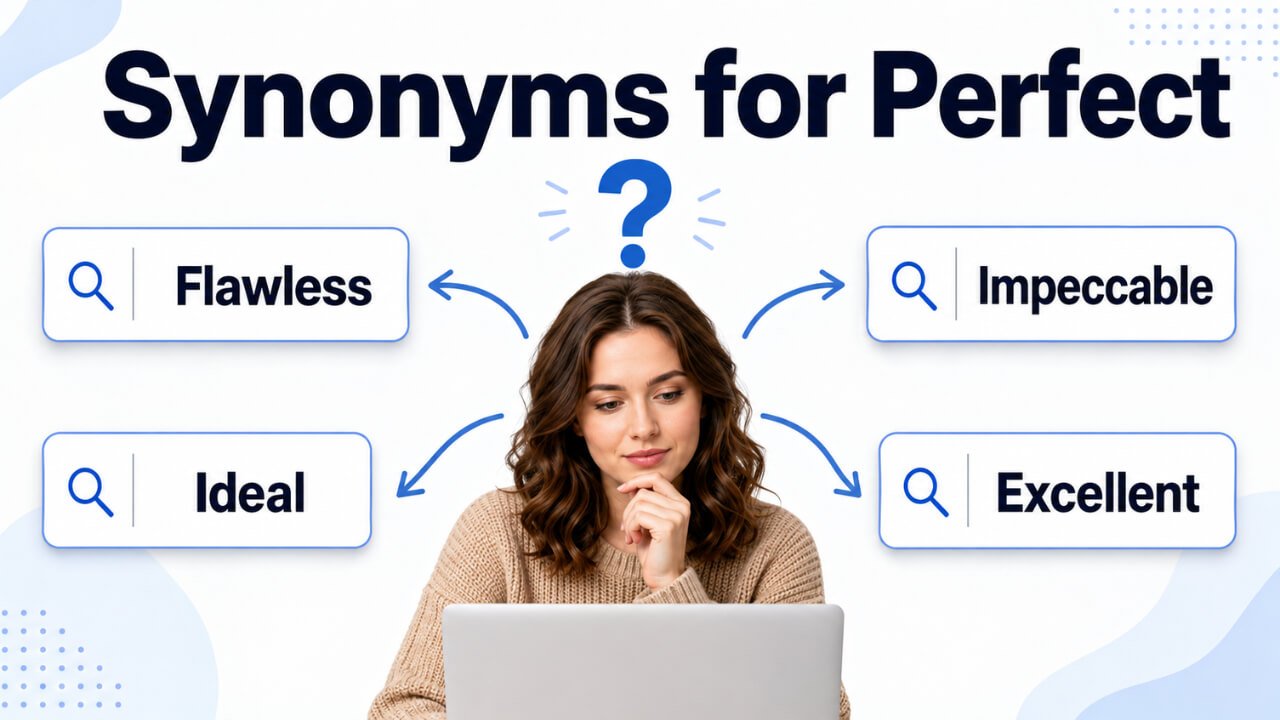
Quick Answer: The best synonyms for perfect include flawless, ideal, excellent, impeccable, faultless, complete, supreme, polished, outstanding, and pristine. Use flawless when something has no mistakes, ideal when something is the best fit for a purpose, excellent for general praise, impeccable for formal approval, faultless for accuracy, complete for wholeness, and polished for refined writing, work, style, or performance.
Pronunciation and Word Details
Word: Perfect.
Pronunciation: /ˈpɜːrfɪkt/.
Part of Speech: Adjective, verb, and noun in rare use.
Meaning: Perfect means having no faults, errors, missing parts, or weaknesses, or being as good as possible for a purpose.
US Pronunciation:
UK Pronunciation:
What Does “Perfect” Mean?
Perfect means complete, correct, ideal, or free from faults. It is most commonly used as an adjective to describe something that meets the highest standard or fits a situation extremely well.
You can use perfect for people, plans, timing, answers, results, designs, weather, grammar, behavior, beauty, and performance. In some contexts, perfect means without mistakes. In others, it means suitable, complete, or exactly right for a need.
Example: Her answer was perfect for the question.
Example: This room is perfect for a quiet study space.
Perfect can also work as a verb, meaning to improve something until it becomes very good or nearly faultless.
Example: He practiced daily to perfect his speech.
Meaning, Tone, and Context of “Perfect”
Perfect is usually positive, strong, and clear. It can be formal, casual, emotional, academic, or conversational depending on the sentence.
In everyday speech, perfect often means “very good” or “exactly right.” In formal writing, it can suggest completeness, accuracy, or the highest standard. In emotional contexts, perfect can sound warm and approving. In technical or academic contexts, it may be too absolute unless something is truly without error.
Neutral Use: A perfect fit for the role.
Formal Use: The report provides a complete and accurate summary.
Casual Use: That idea sounds perfect.
Emotional Use: It was a perfect moment.
Technical Use: The system requires precise alignment.
Perfect is powerful, but it can sound exaggerated if overused. For more exact writing, choose a synonym that matches the reason something is perfect.
When and How to Use “Perfect”
For Suitability: Use perfect when something fits a purpose, need, person, time, or situation very well.
Example: This table is perfect for a small kitchen.
For Accuracy: Use perfect when an answer, score, match, or result has no error.
Example: She gave a perfect answer in the test.
For Quality: Use perfect when something reaches an excellent standard.
Example: The final design looked perfect.
For Completion: Use perfect when something has all required parts and feels finished.
Example: The plan is perfect now that every detail is included.
For Timing: Use perfect when something happens at the right moment.
Example: Your message came at the perfect time.
For Praise: Use perfect when giving strong approval in speech or writing.
Example: That solution is perfect for this problem.
Best Synonyms for Perfect
Flawless: Having no visible mistakes, defects, or weaknesses.
Example: Her performance was flawless from start to finish.
Ideal: Best suited for a purpose, person, or situation.
Example: This schedule is ideal for students who study at night.
Excellent: Extremely good in quality, value, or performance.
Example: He gave an excellent explanation of the rule.
Impeccable: Perfect in quality, behavior, style, or detail.
Example: Her writing style is clear, elegant, and impeccable.
Faultless: Completely free from mistakes or blame.
Example: The final copy was faultless after careful editing.
Complete: Having all necessary parts, details, or information.
Example: The guide is complete and easy to follow.
Polished: Refined, smooth, and improved through careful work.
Example: The presentation sounded polished and professional.
Pristine: Clean, fresh, pure, and untouched by damage.
Example: The white dress looked pristine.
Outstanding: Much better than average or expected.
Example: The team delivered outstanding results.
Supreme: Highest in quality, power, rank, or importance.
Example: The chef showed supreme skill in every dish.
50 Synonyms for Perfect with Short Meanings
- Flawless: Free from faults or mistakes.
- Ideal: Best suited for a purpose.
- Excellent: Very high in quality.
- Impeccable: Perfect in style, behavior, or detail.
- Faultless: Without errors or defects.
- Complete: Having all necessary parts.
- Polished: Refined and carefully improved.
- Pristine: Clean, pure, and undamaged.
- Outstanding: Exceptionally good.
- Superb: Impressively excellent.
- Supreme: Highest in quality or rank.
- Splendid: Very impressive or pleasing.
- Exceptional: Unusually good or rare.
- First rate: Of very high quality.
- Prime: Best in quality or importance.
- Model: Worth copying as an example.
- Exemplary: Serving as an excellent example.
- Accurate: Correct and free from error.
- Precise: Exact and carefully detailed.
- Correct: Right and without mistake.
- Exact: Matching fully or completely.
- Spotless: Clean or free from fault.
- Unblemished: Not damaged or spoiled.
- Unspoiled: Still pure, fresh, or natural.
- Pure: Free from anything unwanted.
- Finished: Fully completed and ready.
- Whole: Complete and not lacking parts.
- Total: Full or entire.
- Absolute: Complete and not limited.
- Ultimate: Best or highest possible.
- Matchless: Having no equal.
- Peerless: Better than all others.
- Incomparable: Too good to compare.
- Unsurpassed: Not exceeded by anything else.
- Unequaled: Better than any competitor.
- Consummate: Highly skilled or complete.
- Masterly: Showing great skill.
- Expert: Done with skill and knowledge.
- Skilled: Showing ability and control.
- Refined: Improved, graceful, or elegant.
- Elegant: Graceful and tasteful.
- Seamless: Smooth and without interruption.
- Harmonious: Well balanced and pleasing.
- Balanced: Even, steady, and well arranged.
- Suitable: Right for a need or purpose.
- Appropriate: Proper for the situation.
- Fitting: Suitable and natural in context.
- Accurate: Correct in fact or detail.
- Well made: Created with care and skill.
- Spot on: Exactly right or correct.
Read Also:
Synonyms for Powerful
Synonyms for Perfect by Context
When Perfect Means Without Faults
Use these synonyms when something has no errors, defects, or weaknesses.
Flawless: Her makeup looked flawless.
Faultless: The grammar in the essay was faultless.
Impeccable: His manners were impeccable during the meeting.
Spotless: The room was spotless after cleaning.
Unblemished: The record remained unblemished.
When Perfect Means Ideal or Suitable
Use these synonyms when something fits a situation, person, plan, or purpose.
Ideal: This location is ideal for a family picnic.
Suitable: The example is suitable for beginners.
Appropriate: Her tone was appropriate for a formal message.
Fitting: The title was fitting for the story.
Right: That answer feels right for the question.
When Perfect Means Excellent in Quality
Use these words when you want to praise quality, skill, performance, or results.
Excellent: The article gives an excellent explanation.
Superb: The singer gave a superb performance.
Outstanding: His results were outstanding this year.
Exceptional: She has exceptional talent.
Splendid: The room had a splendid view.
When Perfect Means Complete
Use these synonyms when nothing is missing and the thing feels whole.
Complete: The file contains a complete record.
Whole: The story gives a whole picture of the event.
Finished: The final draft is finished and ready.
Total: The plan requires total attention.
Entire: The entire process was explained clearly.
When Perfect Means Refined or Polished
Use these words for writing, design, speech, style, or performance that has been carefully improved.
Polished: His speech sounded polished and confident.
Refined: The design became more refined after editing.
Elegant: The solution was simple and elegant.
Masterly: The artist showed masterly control.
Seamless: The transition between ideas was seamless.
Another Word for Perfect
Another word for perfect is flawless when you mean without mistakes. However, the best single replacement depends on context. Use ideal for suitability, excellent for general quality, impeccable for formal praise, and complete when nothing is missing.
Original: This answer is perfect.
Better Option: This answer is flawless.
Original: The room is perfect for guests.
Better Option: The room is ideal for guests.
Original: She gave a perfect performance.
Better Option: She gave an outstanding performance.
Original: The final report is perfect now.
Better Option: The final report is complete now.
When Not to Use “Perfect”
Do not use perfect when the meaning needs more precision. Perfect can sound too broad, too emotional, or too absolute. In formal writing, it may sound exaggerated if the subject is only good, useful, or suitable.
Use accurate for facts, ideal for suitability, complete for wholeness, polished for refined work, and excellent for strong but realistic praise.
Weak: The data is perfect.
Better: The data is accurate.
Weak: This candidate is perfect.
Better: This candidate is ideal for the role.
Weak: The essay is perfect.
Better: The essay is polished and well organized.
Weak: The room is perfect.
Better: The room is suitable for small meetings.
Weak: His behavior was perfect.
Better: His behavior was impeccable.
Words Commonly Confused With Perfect
Perfect vs Flawless: Perfect can mean ideal, complete, or excellent. Flawless means having no faults or mistakes.
Perfect vs Ideal: Perfect is broader. Ideal means best suited for a specific purpose or situation.
Perfect vs Excellent: Perfect suggests the highest standard or no faults. Excellent means very good but not always faultless.
Perfect vs Complete: Perfect may describe quality or suitability. Complete means nothing is missing.
Perfect vs Accurate: Perfect can describe many things. Accurate is mainly used for facts, numbers, reports, measurements, and information.
Perfect vs Impeccable: Perfect is common and flexible. Impeccable is more formal and often describes taste, manners, quality, style, or conduct.
Perfect vs Pristine: Perfect can describe quality, timing, and fit. Pristine usually means clean, pure, fresh, or undamaged.
Which Synonym Should You Choose?
Choose flawless when something has no mistakes, marks, or weaknesses.
Choose ideal when something is the best fit for a purpose, plan, person, or situation.
Choose excellent when you want a natural, strong word for high quality.
Choose impeccable when writing formally about style, behavior, manners, work, or detail.
Choose faultless when you mean completely free from errors.
Choose complete when all parts, details, or requirements are included.
Choose polished when writing about refined speech, writing, design, or performance.
Choose pristine when describing something clean, pure, fresh, or undamaged.
Choose outstanding when something is much better than normal.
Choose accurate when writing about facts, figures, reports, measurements, or descriptions.
Real Life Examples of “Perfect” in Sentences
Original: The answer was perfect.
Better Option: The answer was accurate.
Original: She found the perfect dress for the event.
Better Option: She found the ideal dress for the event.
Original: His speech was perfect.
Better Option: His speech was polished.
Original: The room looked perfect after cleaning.
Better Option: The room looked spotless after cleaning.
Original: The final design is perfect.
Better Option: The final design is flawless.
Original: Her manners were perfect.
Better Option: Her manners were impeccable.
Original: This example is perfect for beginners.
Better Option: This example is suitable for beginners.
Original: The report is perfect now.
Better Option: The report is complete now.
Original: The timing was perfect.
Better Option: The timing was ideal.
Original: His performance was perfect.
Better Option: His performance was outstanding.
Synonym Groups and Usage Differences
Faultless Quality Group
This group includes flawless, faultless, impeccable, spotless, and unblemished. Use these words when something has no errors, marks, defects, or weak points.
Example: The edited article was flawless.
Suitability Group
This group includes ideal, suitable, appropriate, fitting, and right. Use these words when something matches a purpose, audience, need, or situation.
Example: The lesson is ideal for new learners.
High Quality Group
This group includes excellent, outstanding, superb, exceptional, and splendid. Use these synonyms when you want to praise strong quality or impressive performance.
Example: The writer gave an excellent explanation.
Completion Group
This group includes complete, whole, finished, entire, and total. Use these when something has all required parts or details.
Example: The checklist is complete.
Refinement Group
This group includes polished, refined, elegant, seamless, and masterly. Use these words for work that feels smooth, careful, tasteful, or professionally improved.
Example: Her presentation was polished and clear.
Antonyms of Perfect
Opposite words for perfect depend on meaning. If perfect means without mistakes, the opposite may be flawed or faulty. If it means complete, the opposite may be incomplete. If it means ideal, the opposite may be unsuitable.
Flawed: Having mistakes, weaknesses, or defects.
Faulty: Not working correctly or not made properly.
Imperfect: Not perfect or having some faults.
Incomplete: Missing parts, details, or information.
Defective: Having a problem or fault.
Poor: Low in quality.
Weak: Not strong, convincing, or effective.
Unsuitable: Not right for a purpose or situation.
Inaccurate: Not correct or not true.
Rough: Not polished, refined, or finished.
Comparison: Perfect vs Related Words
Perfect vs Flawless
Perfect can mean excellent, complete, suitable, or without faults. Flawless focuses mainly on having no mistakes or defects.
Example With Perfect: The plan is perfect for our schedule.
Example With Flawless: Her final performance was flawless.
Perfect vs Ideal
Perfect is a general word for the highest standard or best fit. Ideal means best suited for a specific purpose or need.
Example With Perfect: That answer is perfect.
Example With Ideal: That answer is ideal for a beginner level explanation.
Perfect vs Excellent
Perfect can sound absolute. Excellent means very good and is often safer in reviews, comments, and formal writing.
Example With Perfect: The solution is perfect.
Example With Excellent: The solution is excellent and practical.
Perfect vs Complete
Perfect describes quality, correctness, or suitability. Complete means all parts are present.
Example With Perfect: The final image looks perfect.
Example With Complete: The final image is complete.
Perfect vs Accurate
Perfect can describe many qualities. Accurate describes correctness in facts, numbers, details, and information.
Example With Perfect: The answer is perfect.
Example With Accurate: The answer is accurate.
Perfect vs Impeccable
Perfect is common in everyday speech. Impeccable is more formal and refined.
Example With Perfect: Her work was perfect.
Example With Impeccable: Her work was impeccable.
Common Phrases and Expressions With Perfect
Perfect Fit: Something that matches a person, purpose, or situation very well.
Perfect Timing: Something happening at the best possible moment.
Perfect Match: Two things or people that suit each other extremely well.
Perfect Example: A clear and complete example of something.
Perfect Score: A result with no mistakes or lost points.
Perfect Condition: A state with no damage or visible problems.
Perfect Choice: The best option for a particular need.
Perfect Balance: A pleasing mix of different qualities.
Perfect Sense: A clear and logical meaning.
Perfect Opportunity: The best chance to do something.
Common Mistakes to Avoid
Avoid using perfect too often in the same paragraph. Repetition can make writing sound weak and less precise.
Do not use perfect when you mean accurate. Facts, numbers, records, and reports are usually accurate, not perfect.
Do not use perfect when you mean complete. A document can be complete even if it is not flawless.
Avoid calling people perfect in serious writing. It can sound unrealistic. Use ideal, suitable, skilled, or well suited depending on the meaning.
Do not use flawless for suitability. A plan may be ideal for a situation, but flawless means it has no faults.
Avoid using pristine for timing, ideas, or answers. Pristine usually describes clean, fresh, pure, or undamaged things.
Choose the synonym that explains why something is perfect, not just that it is very good.
Conclusion
Learning synonyms for perfect helps you write with more accuracy, variety, and natural style. Perfect is useful, but different contexts need different alternatives. Use flawless for no mistakes, ideal for suitability, excellent for quality, impeccable for formal praise, complete for wholeness, accurate for facts, and polished for refined work. The best synonym depends on what you want to describe, such as quality, timing, correctness, condition, skill, or fit.
FAQs About Synonyms for Perfect
What are the best synonyms for perfect?
The best synonyms for perfect are flawless, ideal, excellent, impeccable, faultless, complete, polished, pristine, outstanding, and superb.
What is another word for perfect in writing?
Another word for perfect in writing is flawless when you mean error free. Use polished when you mean refined and well written.
What is a formal synonym for perfect?
Impeccable is a strong formal synonym for perfect. It works well for manners, style, work quality, behavior, and attention to detail.
What is a casual synonym for perfect?
Great, excellent, spot on, and just right are natural casual alternatives. Use spot on when something is exactly correct.
Is flawless the same as perfect?
Flawless is close to perfect, but it is more specific. Flawless means having no mistakes, defects, or weak points.
What is the best synonym for perfect fit?
Ideal is usually the best synonym for perfect fit. Suitable, appropriate, fitting, and right can also work depending on tone.
What is the opposite of perfect?
The opposite of perfect can be imperfect, flawed, faulty, incomplete, inaccurate, defective, poor, weak, or unsuitable depending on the meaning.
