
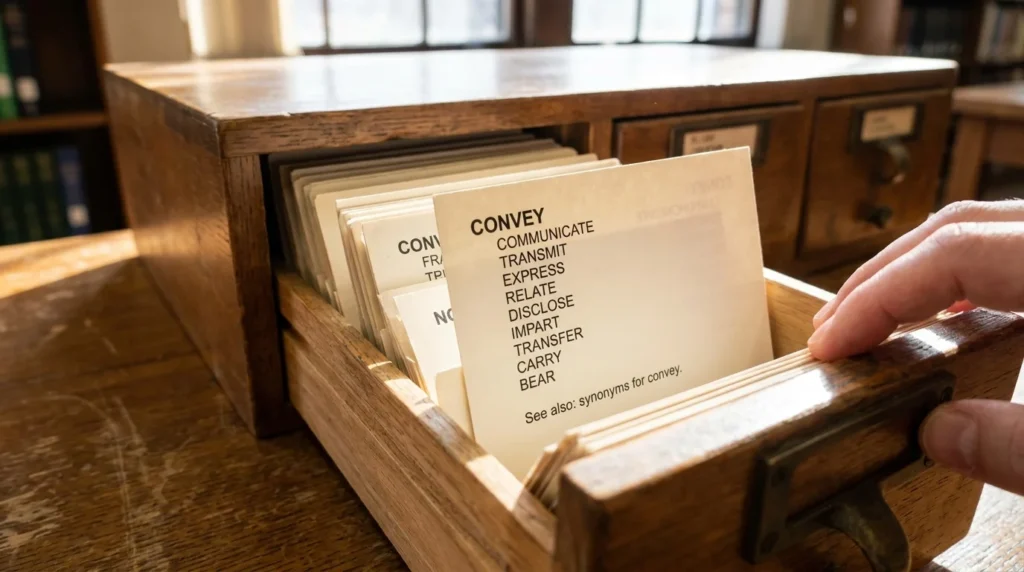
Quick Answer
The best synonym for convey depends on what you mean. For communicating an idea, use communicate, express, articulate, state, or explain. For passing along information, ** 전달?** No—natural English choices include communicate, transmit, relay, or pass on. For moving something, use transport, carry, or deliver. For transferring property, transfer, assign, or grant may fit better.
Quick Synonym List
Here are useful alternatives to convey, grouped by meaning rather than simply listed as dictionary equivalents:
When convey means “communicate or express”
- communicate
- express
- articulate
- state
- explain
- impart
- indicate
- signal
- demonstrate
- reveal
- show
- describe
- present
- put across
- get across
- make known
- voice
- share
- report
- relay
- transmit
- pass on
When convey means “transport or carry”
- transport
- carry
- move
- deliver
- take
- bring
- transfer
- ship
- haul
- ferry
When convey means “transfer ownership or property”
- transfer
- assign
- grant
- pass
- sell
- deed
- alienate
Not all of these are direct synonyms. The correct choice depends heavily on the sense of convey being used.
What Does “Convey” Mean?
Convey is a verb with several important meanings.
- To communicate an idea, feeling, or message:
Her expression conveyed disappointment. - To communicate information or meaning:
The report conveys the seriousness of the problem. - To transport or carry something:
Pipes convey water from the reservoir to the city. - To transfer property or legal rights:
The deed conveys ownership of the land to the buyer.
The first two meanings are especially common in everyday and professional writing. The transportation and legal meanings require different alternatives.
Closest Synonyms for “Convey” When You Mean “Communicate”
1. Communicate
Meaning: To share information, thoughts, feelings, or ideas with another person.
How it differs: Communicate is probably the safest general alternative when convey means “make something known.” It emphasizes the act of sharing information rather than the particular impression created.
Tone: Neutral to professional.
Best for: Messages, information, ideas, instructions, feelings, and workplace communication.
Example:
The manager communicated the new policy clearly to the staff.
Watch out: Communicate does not always preserve the subtle sense of conveying an impression. If you mean that someone’s appearance or behavior creates a particular impression, convey may be more natural.
2. Express
Meaning: To show or communicate a thought, feeling, opinion, or idea.
How it differs: Express is particularly strong for emotions, opinions, attitudes, and personal thoughts.
Tone: Neutral.
Best for: Feelings, opinions, concerns, gratitude, enthusiasm, and ideas.
Example:
She expressed her concern about the proposed changes.
Watch out: You would not normally say that a pipe expresses water. Convey has a much broader range of meanings.
3. Articulate
Meaning: To express an idea clearly and effectively in words.
How it differs: Articulate suggests that the speaker or writer puts an idea into clear, organized language.
Tone: Formal or professional.
Best for: Arguments, complex ideas, opinions, goals, and professional or academic writing.
Example:
The report articulates a clear strategy for reducing costs.
Watch out: It can sound unnecessarily formal in casual conversation.
4. State
Meaning: To express something clearly and directly.
How it differs: State is more direct and factual than convey. It is useful when the information is explicitly said rather than indirectly communicated.
Tone: Neutral to formal.
Best for: Facts, opinions, rules, positions, and conclusions.
Example:
The company stated that the service would continue.
Watch out: If the message is communicated through tone, body language, or imagery rather than words, convey may be better.
5. Explain
Meaning: To make an idea, situation, or process understandable.
How it differs: Explain goes beyond simply communicating information. It suggests providing enough detail to make something clear.
Example:
The instructor explained the process to the new employees.
Watch out: Do not use explain when you only mean “communicate.” An image can convey an emotion, but it does not normally explain it.
6. Impart
Meaning: To give information, knowledge, or a particular quality to someone or something.
Tone: Formal.
Best for: Knowledge, wisdom, information, and qualities.
Example:
The course imparts practical skills that students can use at work.
Watch out: Impart is less natural for ordinary messages and casual conversation.
7. Indicate
Meaning: To show or point to something, often indirectly.
How it differs: Indicate is useful when evidence, behavior, or a sign suggests something rather than directly communicating it.
Example:
His silence indicated that he disagreed.
Watch out: Indicate often focuses on evidence or signs. Convey can emphasize the message or impression received.
8. Signal
Meaning: To communicate a message, intention, or warning through words, actions, or signs.
Tone: Neutral; sometimes strategic or analytical.
Best for: Intentions, warnings, changes, attitudes, and public or social signals.
Example:
The decision signaled a major change in the company’s strategy.
Watch out: Signal often implies that the message is a clue or indication rather than a fully stated message.
9. Demonstrate
Meaning: To show something clearly through evidence, behavior, or an example.
How it differs: Demonstrate is stronger than convey when evidence or observable action is involved.
Example:
The results demonstrate the effectiveness of the new approach.
Watch out: It is not a universal replacement for convey. A smile may convey warmth, but saying it demonstrates warmth changes the emphasis.
10. Reveal
Meaning: To make something previously hidden or unknown known.
Example:
The interview revealed the extent of the problem.
Watch out: Reveal implies disclosure. It is inappropriate when the information was already openly known.
Professional and Formal Alternatives
For business reports, presentations, academic writing, and formal communication, these alternatives can be more precise than repeatedly using convey.
| Alternative | Meaning | Tone | Strength | Best Use | Interchangeable? |
|---|---|---|---|---|---|
| Communicate | Share information or ideas | Neutral/professional | Medium | General communication | Usually |
| Articulate | Express clearly | Formal/professional | Medium | Ideas and arguments | Sometimes |
| State | Say directly | Neutral/formal | Direct | Facts and positions | Sometimes |
| Explain | Make something understandable | Neutral | Medium | Processes and concepts | Sometimes |
| Impart | Give knowledge or information | Formal | Medium | Knowledge and wisdom | Context-dependent |
| Communicate | Make information known | Neutral | Medium | Reports and emails | Usually |
| Indicate | Show or suggest | Neutral/formal | Medium | Evidence and signs | Context-dependent |
| Demonstrate | Show through evidence or action | Formal | Strong | Results and evidence | Context-dependent |
| Relay | Pass information from one person to another | Neutral/professional | Medium | Messages and updates | Context-dependent |
| Transmit | Send or pass something onward | Technical/formal | Medium | Data, signals, information | Context-dependent |
A note about “relay”
Relay is especially useful when information travels from one person or source to another:
Please relay the message to the rest of the team.
That is different from:
The photograph conveys a sense of calm.
Here, relay would not sound natural because the photograph is creating an impression rather than passing a message from one person to another.
Neutral and Everyday Alternatives
In ordinary English, communicate, express, show, tell, explain, share, and get across are often more natural than a formal-sounding synonym.
Show
Use show when something communicates a feeling, quality, or fact through visible evidence or behavior.
Her smile conveyed her relief.
→ Her smile showed her relief.
Show is simpler and more conversational.
Tell
Use tell when someone directly gives another person information.
She conveyed the news to her parents.
→ She told her parents the news.
Tell is often much more natural in conversation.
Share
Use share when information, thoughts, experiences, or feelings are offered to others.
He shared his concerns with the team.
It is warmer and more personal than convey.
Get across
Get across is an informal phrasal verb meaning to communicate something successfully.
I don’t think I got my point across.
It works well in conversation but is usually less suitable for formal reports.
Put across
Put across means to communicate an idea or message effectively.
She put her argument across clearly.
It is conversational and emphasizes how successfully an idea is presented.
Synonyms for “Convey” When It Means “Transport”
The meaning changes completely when convey refers to physically moving something.
Transport
Transport means to move people or goods from one place to another.
Trucks transport goods across the country.
This is one of the strongest alternatives when convey refers to physical movement.
Carry
Carry means to take something from one place to another, often by holding or supporting it.
The workers carried the equipment into the building.
It is more ordinary and concrete than convey.
Deliver
Deliver emphasizes taking something to its intended destination.
The company delivers packages throughout the region.
Use deliver when the destination or recipient matters.
Move
Move is the broadest everyday choice.
The pipes move water through the system.
It is simple but less specific than transport or convey.
Ferry
Ferry means to transport people or things repeatedly between two places.
The boats ferry passengers across the river.
It is much narrower than convey.
Pipe
In technical contexts, pipe can describe moving liquids or gases through pipes.
The system pipes water to nearby buildings.
This is not a general synonym, but it may be the most natural alternative in a specific engineering context.
Synonyms for “Convey” in Legal or Property Contexts
In legal language, convey can mean transfer ownership, rights, or property from one person to another.
Possible alternatives include:
- transfer
- assign
- grant
- sell
- pass
- deed
Transfer
The broadest choice:
The owner transferred the property to his daughter.
Assign
Usually refers to transferring a right, interest, responsibility, or contractual benefit.
The contract allows the company to assign its rights to another party.
Grant
Often used when one party formally gives a right or interest to another.
The agreement grants the tenant access to the property.
Sell
Use sell when the transfer happens in exchange for money.
The owner sold the property to a local developer.
Do not automatically substitute sell for convey. A property can be conveyed without being sold.
Synonyms vs. Near Synonyms
The most important distinction is that similar meaning does not always mean interchangeable usage.
| Alternative | Relationship to “convey” | Can Replace It? | Main Difference |
|---|---|---|---|
| Communicate | Close synonym | Usually | Focuses on sharing information |
| Express | Close synonym | Often | Strong for feelings and opinions |
| Articulate | Near synonym | Sometimes | Emphasizes clear verbal expression |
| State | Contextual alternative | Sometimes | More direct and explicit |
| Explain | Contextual alternative | Sometimes | Adds the idea of making something clear |
| Impart | Formal synonym in some contexts | Sometimes | Often used for knowledge |
| Indicate | Near synonym | Sometimes | Suggests or points to something |
| Signal | Near synonym | Sometimes | Often communicates indirectly |
| Show | Contextual alternative | Often | Simpler and more concrete |
| Relay | Contextual alternative | Sometimes | Passes information onward |
| Transmit | Contextual alternative | Sometimes | Emphasizes sending or transmission |
| Transport | Synonym for one sense | Only for physical movement | Means physically moving something |
| Carry | Contextual alternative | Sometimes | More ordinary physical movement |
| Transfer | Synonym for property sense | Sometimes | Focuses on changing possession or ownership |
| Assign | Narrower legal alternative | Context-dependent | Usually transfers rights or responsibilities |
Editor’s Choice
If you need a practical shortlist, these are among the most useful alternatives:
Communicate — the safest general replacement for conveying information.
Express — best for feelings, opinions, and personal reactions.
Articulate — useful when emphasizing clear, well-organized expression.
Show — a simple choice for everyday English when something communicates an impression.
Relay — ideal when information is passed from one person or source to another.
These choices are not interchangeable in every sentence. The intended meaning should determine the word.
How to Choose the Right Alternative
Instead of asking, “What synonym can I use for convey?” ask what you are actually trying to communicate.

If you mean “communicate information”
Choose communicate.
The email conveyed the new requirements.
The email communicated the new requirements.
If you mean “express a feeling”
Choose express.
She conveyed her gratitude.
She expressed her gratitude.
If you mean “make an idea clear”
Choose articulate or explain, depending on the sentence.
He articulated his concerns clearly.
The teacher explained the process.
If you mean “show an impression”
Choose show, indicate, or suggest.
Her tone conveyed frustration.
Her tone showed frustration.
If you mean “pass information to someone else”
Choose relay or pass on.
Please relay my message to the manager.
If you mean “move something physically”
Choose transport, carry, move, or deliver.
The trucks transport the materials to the construction site.
If you mean “transfer ownership”
Choose transfer, assign, or grant, depending on what is being transferred.
The deed transfers ownership of the property.
Sentence Transformations
1. General communication
Original:
The report conveys important information about the project.
Better Alternative:
The report communicates important information about the project.
Why:
Communicates is direct and natural when the subject is a report and the object is information.
2. Expressing emotion
Original:
Her voice conveyed sadness.
Better Alternative:
Her voice expressed sadness.
Why:
Expressed works naturally with an emotion. Conveyed is also correct and can emphasize the impression received by the listener.
3. Making an idea clear
Original:
The speaker conveyed his argument clearly.
Better Alternative:
The speaker articulated his argument clearly.
Why:
Articulated emphasizes putting an argument into clear, organized words. It is more formal.
4. Passing along information
Original:
Please convey the message to Sarah.
Better Alternative:
Please relay the message to Sarah.
Why:
Relay specifically suggests passing information from one person to another.
5. Everyday conversation
Original:
I wasn’t able to convey what I meant.
Better Alternative:
I wasn’t able to get across what I meant.
Why:
Get across is more conversational. In a formal document, communicate would usually be preferable.
6. Showing an impression
Original:
The photograph conveys a feeling of warmth.
Better Alternative:
The photograph creates a feeling of warmth.
Why:
Creates changes the emphasis slightly: instead of simply communicating the feeling, the photograph is presented as producing that response.
7. Physical transportation
Original:
The pipeline conveys water to the treatment plant.
Better Alternative:
The pipeline transports water to the treatment plant.
Why:
Transports makes the physical movement explicit and is often clearer to general readers.
8. Property transfer
Original:
The deed conveys the property to the buyer.
Better Alternative:
The deed transfers the property to the buyer.
Why:
Transfers is more accessible to general readers, while conveys has a specific legal sense in property contexts.
9. Formal writing
Original:
The results convey the importance of early intervention.
Better Alternative:
The results demonstrate the importance of early intervention.
Why:
Demonstrate is stronger when the results provide evidence supporting the conclusion.
10. Direct communication
Original:
The manager conveyed his decision to the staff.
Better Alternative:
The manager announced his decision to the staff.
Why:
Announced is more precise if the manager formally made the decision known to a group.
Grammar and Usage of “Convey”
Convey is normally a transitive verb, so it commonly takes a direct object.
Common patterns
convey + information
The report conveys useful information.
convey + idea
The image conveys the idea of freedom.
convey + feeling/emotion
Her expression conveyed relief.
convey + message
He conveyed the message to his colleagues.
convey + impression
The design conveys an impression of simplicity.
convey + something + to + someone
She conveyed her concerns to the director.
“Convey to” vs. “convey”
When identifying the recipient, to is commonly used:
He conveyed the information to his team.
But the recipient is not always necessary:
The article conveys an important message.
Avoid adding to when the sentence does not need a recipient.
Common Mistakes With “Convey”
1. Treating every synonym as interchangeable
Incorrect approach: Replace convey with any word that appears in a thesaurus.
Better: Identify the intended meaning first. Transport and communicate are both related to different senses of convey, but they cannot replace each other.
2. Using “articulate” for every type of communication
Articulate is especially appropriate for expressing ideas clearly in words.
She articulated her concerns.
But:
Her facial expression articulated sadness.
This is possible in unusual contexts, but conveyed or showed would normally be more natural.
3. Using “explain” when no explanation is involved
The painting conveys a sense of peace.
Not:
The painting explains a sense of peace.
Explain means to make something understandable, not simply to communicate an impression.
4. Confusing “indicate” and “convey”
Indicate often means that something serves as a sign or evidence.
The results indicate that demand is increasing.
Convey focuses more broadly on communicating a message, meaning, or impression.
5. Using “tell” in formal writing without considering tone
Tell is perfectly correct English:
She told the team about the changes.
But in a formal report, informed, notified, or communicated may be more appropriate depending on the exact meaning.
6. Assuming “transfer” always means “convey”
Transfer works well for moving ownership, money, data, responsibility, or something from one place or person to another.
But:
Her smile conveyed happiness.
cannot normally become:
Her smile transferred happiness.
The meanings are different.
7. Choosing an impressive word instead of a precise one
A complicated alternative is not automatically better.
The manager communicated the instructions clearly.
is often better than:
The manager articulated the instructions clearly.
If the instructions were simply communicated, communicated is enough.
When Not to Replace “Convey”
Sometimes convey is already the best word.
Keep it when you want to emphasize that something creates or communicates a particular meaning or impression without necessarily stating it directly.
For example:
The minimalist design conveys a sense of calm.
Here, conveys is concise and natural.
You could say:
The minimalist design creates a sense of calm.
But the focus shifts toward the emotional effect.
Similarly:
His expression conveyed disappointment.
is different from:
His expression announced disappointment.
The second version is much stronger and may sound unnatural.
You should also keep convey when the sentence deliberately allows a broad meaning. Replacing it with state, tell, or explain can make the sentence more specific than the original.
Writing Tips: Avoid Thesaurus Abuse
Synonyms are useful when they improve precision, clarity, or tone. They are not useful simply because a word appears more than once.

Repeat a word when repetition improves clarity
If you are discussing a technical concept, repeating the same term can prevent confusion.
The study examines memory. The study then compares memory across age groups.
Replacing the second memory with an unrelated synonym could make the meaning less precise.
Use a synonym when the meaning genuinely changes
For example:
- communicate — share information
- articulate — express clearly
- relay — pass information onward
- demonstrate — show through evidence
- indicate — point toward or suggest
- express — communicate a thought or feeling
These differences are more valuable than simply making every sentence sound different.
Prefer familiar words when they work
In many situations, show, tell, say, and communicate are clearer than more formal alternatives.
The goal is not to sound sophisticated. The goal is to say exactly what you mean.