

Quick Answer
Common synonyms for hungry include starving, famished, ravenous, peckish, empty, craving food, and having an appetite. Starving and famished express stronger hunger, while peckish is informal and usually means mildly hungry. In figurative contexts, hungry can mean eager or ambitious, so the best alternative depends on the sentence.
Quick Synonym List
Here are useful alternatives, grouped by meaning and tone:
Closest and common alternatives
- Starving
- Famished
- Ravenous
- Very hungry
- Peckish
- Hungry for food
- In need of food
- Ready for a meal
- Having an appetite
- Empty
Stronger alternatives
- Famished
- Ravenous
- Starving
- Voracious
- Extremely hungry
- Desperate for food
- Craving food
Informal alternatives
- Peckish
- Starving
- Famished
- Ready to eat
- I could eat a horse
- My stomach is growling
Formal or neutral alternatives
- In need of nourishment
- Lacking food
- Experiencing hunger
- Having an appetite
- In need of sustenance
Figurative alternatives
- Eager
- Ambitious
- Driven
- Aspiring
- Desirous
- Keen
- Hungry for success
- Thirsty for achievement
Closest Synonyms for Hungry
Not every word in a thesaurus can replace hungry naturally. The following are among the most useful choices when you mean that someone wants or needs food.
Starving
Meaning: Extremely hungry or feeling as though you urgently need food.
How it differs: Starving is much stronger than ordinary hungry. In everyday English, people often use it as an exaggeration rather than to describe literal starvation.
Tone: Informal and conversational.
Best for: Everyday speech, texts, casual writing, and dramatic emphasis.
Example:
“I’m starving after that long hike.”
Watch out: In a literal medical or humanitarian context, starving can describe serious deprivation of food. Don’t automatically assume it is merely a casual synonym.
Famished
Meaning: Extremely hungry.
How it differs: Famished communicates intense hunger without necessarily sounding as exaggerated as starving.
Tone: Neutral to slightly expressive.
Best for: Conversation and general writing when you want to emphasize hunger.
Example:
“We were famished by the time we reached the restaurant.”
Ravenous
Meaning: Extremely hungry and ready to eat a large amount of food.
How it differs: Ravenous often suggests a particularly powerful appetite.
Tone: Strong but natural; sometimes vivid.
Best for: Descriptive writing and conversation.
Example:
“After swimming for two hours, the children were ravenous.”
Peckish
Meaning: Slightly hungry.
How it differs: Unlike starving or ravenous, peckish describes relatively mild hunger.
Tone: Informal; especially associated with British English.
Best for: Casual conversation.
Example:
“I’m feeling a little peckish. Want to grab a snack?”
For American English readers, a little hungry or ready for a snack is usually more natural.
Voracious
Meaning: Having an unusually large or eager appetite.
How it differs: Voracious does not simply mean “hungry.” It emphasizes an intense appetite or eagerness to consume something.
Tone: Strong and descriptive.
Best for: Describing eating habits or appetites.
Example:
“He has a voracious appetite after training.”
Watch out: You can say someone has a voracious appetite, but “I am voracious” is generally not a natural replacement for “I am hungry.”
Having an Appetite
Meaning: Being interested in or ready to eat food.
How it differs: This expression focuses on one’s desire or capacity to eat rather than the physical sensation of hunger.
Tone: Neutral.
Best for: Polite conversation, descriptions of eating, and health-related contexts.
Example:
“I have a good appetite this morning.”
Formal and Professional Alternatives
There is usually no reason to replace hungry with an elaborate word in ordinary professional communication. Still, certain expressions are useful when discussing nutrition, food access, health, or social conditions.
Experiencing Hunger
Meaning: Feeling hunger or being affected by a lack of food.
Tone: Formal and neutral.
Best for: Reports, research, public policy, education, and formal discussions.
Example:
“Children experiencing hunger may have difficulty concentrating at school.”
In Need of Nourishment
Meaning: Needing food or nutritional support.
Tone: Formal.
Best for: Descriptive or humanitarian writing.
Example:
“The program provides meals to people in need of nourishment.”
Watch out: This is not a natural substitute for hungry in casual speech. “I’m in need of nourishment” sounds unusually formal if you simply want to say that you want lunch.
In Need of Sustenance
Meaning: Needing food or something that supports life and health.
Tone: Very formal or literary.
Best for: Formal, literary, or deliberately elevated writing.
Example:
“After days without supplies, the travelers were in need of sustenance.”
Watch out: This phrase is much less natural than hungry in everyday English.
Lacking Food
Meaning: Not having enough food available.
Tone: Neutral to formal.
Best for: Situations involving food shortages or deprivation.
Example:
“Families lacking food may require immediate assistance.”
This describes a lack of food, which is not always the same as the personal feeling of being hungry.
Neutral and Everyday Alternatives
Sometimes you do not need a single synonym. A natural phrase may communicate the idea more clearly.
Ready for a Meal
This means you feel sufficiently hungry that you would like to eat.
Example:
“I’m ready for a meal. Is there anything nearby?”
It is gentler than I’m starving and works well in everyday conversation.
Ready to Eat
This emphasizes that someone wants to eat now.
Example:
“We’ve been driving for hours, and we’re ready to eat.”
It does not necessarily imply severe hunger.
Craving Food
This means having a strong desire to eat, often with a particular food in mind.
Example:
“I’m craving something salty.”
Watch out: A craving is not exactly the same as hunger. You can crave chocolate even when you are not physically hungry.
My Stomach Is Growling
This is an informal way to describe a physical sign associated with hunger.
Example:
“My stomach is growling, so let’s get lunch.”
It is an expression rather than a direct synonym.
Empty
In expressions such as my stomach is empty, this can communicate hunger indirectly.
Example:
“My stomach feels empty after that workout.”
However, empty does not itself mean hungry.
Casual Alternatives and Expressions
Informal English has many ways to communicate hunger without using the word hungry.
I Could Eat a Horse
Meaning: You are extremely hungry.
Tone: Humorous and exaggerated.
Example:
“I skipped breakfast and lunch. I could eat a horse.”
This is an idiomatic expression, not a literal statement.
I’m Starving
This is one of the most common casual ways to emphasize hunger.
Example:
“Let’s order now. I’m starving.”
Although starving can have a literal meaning involving severe deprivation, this expression is commonly used hyperbolically in casual speech.
I Need Something to Eat
This is direct and natural.
Example:
“I need something to eat before we leave.”
It can describe hunger without exaggerating its intensity.
I’m Ready to Eat
A simple conversational alternative that works in many situations.
Example:
“Dinner’s almost ready, and I’m definitely ready to eat.”
Figurative Synonyms for Hungry
Hungry has an important figurative sense. It can describe someone who strongly wants achievement, knowledge, attention, experience, or success.
In these contexts, starving is not always the best substitute.
Eager
Meaning: Very interested in doing or obtaining something.
Example:
“She is eager to learn new skills.”
Difference: Eager expresses enthusiasm or strong interest, not physical hunger.
Ambitious
Meaning: Strongly motivated to achieve success or reach a goal.
Example:
“He is ambitious and wants to lead the team someday.”
This can replace hungry for success in some contexts, but it does not mean the same thing in every sentence.
Driven
Meaning: Highly motivated to achieve something.
Example:
“She is driven to improve her performance.”
Difference: Driven emphasizes motivation and determination rather than desire alone.
Aspiring
Meaning: Wanting to become or achieve something.
Example:
“He is an aspiring filmmaker.”
This is more specific than figurative hungry.
Keen
Meaning: Very interested, enthusiastic, or willing.
Example:
“She’s keen to take on the new project.”
Watch out: Keen has several meanings and is not a direct replacement for physical hungry.
Desirous
Meaning: Wanting something strongly.
Example:
“He was desirous of greater responsibility.”
This is formal and often less natural than eager, keen, or motivated.
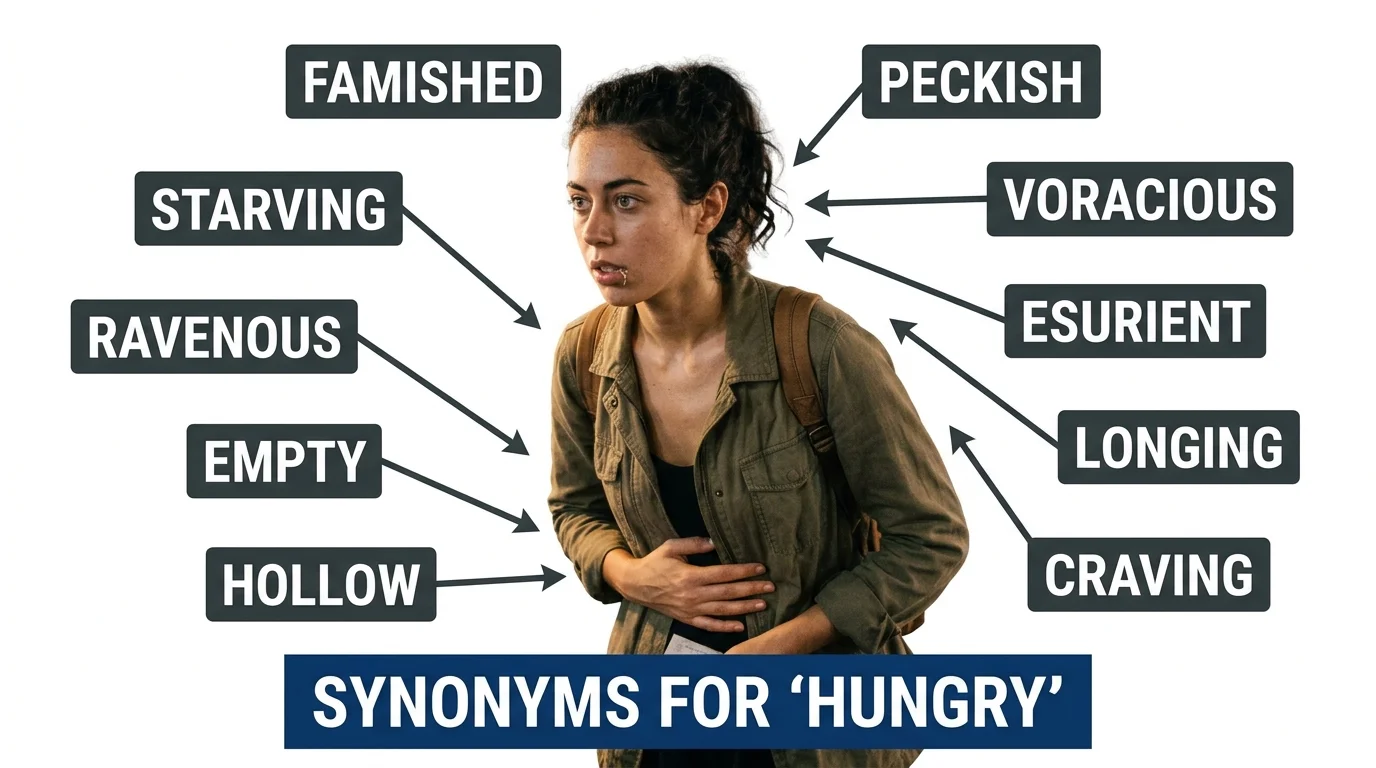
Synonyms vs. Near Synonyms
The following distinctions help prevent incorrect substitutions:
| Alternative | Relationship | Can Replace “Hungry”? | Tone | Best Context |
|---|---|---|---|---|
| Starving | Strong synonym | Usually | Informal | Casual speech |
| Famished | Strong synonym | Usually | Neutral/expressive | Conversation and writing |
| Ravenous | Strong synonym | Usually | Strong/descriptive | Strong physical hunger |
| Peckish | Narrower synonym | Yes, for mild hunger | Informal | Casual conversation |
| Voracious | Related term | Sometimes | Strong | Appetite or eating habits |
| Craving | Related concept | No | Neutral/informal | Strong desire for specific food |
| Having an appetite | Related expression | Usually, depending on sentence | Neutral | Eating and food |
| Ready to eat | Phrase-level alternative | Context-dependent | Conversational | Everyday speech |
| Experiencing hunger | Formal equivalent | In formal contexts | Formal | Reports and analysis |
| Eager | Figurative alternative | No for physical hunger | Neutral | Strong interest |
| Ambitious | Figurative alternative | No for physical hunger | Neutral | Goals and achievement |
| Driven | Figurative alternative | No for physical hunger | Neutral/professional | Motivation |
| Thirsty | Related but different | No | Neutral | Desire for liquid or figurative desire |
Comparison Table
| Word/Phrase | Meaning | Tone | Strength | Best Use | Interchangeable? |
|---|---|---|---|---|---|
| Hungry | Wanting or needing food | Neutral | Moderate | Almost any ordinary context | Yes |
| Starving | Extremely hungry | Informal | Very strong | Casual conversation | Usually |
| Famished | Extremely hungry | Neutral | Very strong | General writing and speech | Usually |
| Ravenous | Extremely hungry | Expressive | Very strong | Descriptive contexts | Usually |
| Peckish | Slightly hungry | Informal | Mild | Casual conversation | Yes, for mild hunger |
| Voracious | Having a huge appetite | Strong | Very strong | Eating habits | Sometimes |
| Ready for a meal | Wanting a meal | Neutral | Moderate | Conversation | Context-dependent |
| Craving food | Strongly desiring food | Neutral | Strong | Specific desires | No |
| Experiencing hunger | Feeling hunger | Formal | Variable | Reports and formal writing | Context-dependent |
| Eager | Strongly interested | Neutral | Strong | Figurative use | No |
| Ambitious | Wanting achievement | Neutral | Strong | Goals and careers | No |
| Driven | Highly motivated | Professional/neutral | Strong | Work and achievement | No |
How to Choose the Right Alternative
The simplest rule is to choose based on intensity, context, and meaning.
For ordinary hunger:
Use hungry, ready for a meal, or ready to eat.
For very strong hunger:
Use famished, ravenous, or starving.
For mild hunger:
Use peckish or a little hungry.
For a strong desire for a particular food:
Use craving or craving food.
For formal writing about food deprivation:
Use experiencing hunger, lacking food, or another precise phrase that describes the situation.
For figurative desire for success:
Use ambitious, driven, eager, or hungry for success, depending on the intended meaning.
When in doubt:
Keep hungry. It is clear, common, natural, and versatile.
Sentence Transformations
Example 1
Original:
“I’m hungry after work.”
Better Alternative:
“I’m starving after work.”
Why:
Starving adds intensity and sounds natural in casual conversation.
Example 2
Original:
“We were hungry after the long walk.”
Better Alternative:
“We were famished after the long walk.”
Why:
Famished creates a stronger sense of physical hunger.
Example 3
Original:
“I’m hungry, but I don’t want a full meal.”
Better Alternative:
“I’m a little peckish, but I don’t want a full meal.”
Why:
Peckish communicates mild hunger and fits the situation better than starving.
Example 4
Original:
“She was hungry for success.”
Better Alternative:
“She was driven to succeed.”
Why:
Here, hungry is figurative. Driven emphasizes determination rather than physical appetite.
Example 5
Original:
“He is hungry for knowledge.”
Better Alternative:
“He is eager to learn.”
Why:
Eager to learn is more direct and natural when the intended meaning is a strong desire for knowledge.
Example 6
Original:
“I’m hungry for pizza.”
Better Alternative:
“I’m craving pizza.”
Why:
Craving is more precise when you have a strong desire for a particular food.
Example 7
Original:
“The children were hungry after school.”
Better Alternative:
“The children were ready for a meal after school.”
Why:
This version focuses on their practical need for food without implying severe hunger.
Example 8
Original:
“Many families are hungry because they cannot afford enough food.”
Better Alternative:
“Many families are experiencing food insecurity because they cannot afford enough food.”
Why:
The alternative identifies the broader condition rather than merely describing the physical sensation of hunger. It should be used when that broader concept is actually what the writer means.
Grammar and Usage
Hungry is primarily an adjective.
Common structures include:
- be hungry — “I am hungry.”
- feel hungry — “I feel hungry.”
- get hungry — “I get hungry after exercising.”
- hungry for + noun — “She is hungry for knowledge.”
- hungry to + verb — “He is hungry to succeed.”
The figurative construction hungry for is especially important because its meaning changes with the object.
“I’m hungry for lunch” concerns food.
“I’m hungry for success” expresses a strong desire for achievement.
“I’m hungry for knowledge” expresses a strong desire to learn.
Hungry vs. Starving
Hungry is the normal, neutral word.
Starving is much stronger and is often hyperbolic in casual English.
“I’m hungry” is a straightforward statement.
“I’m starving” suggests, often dramatically, that you are extremely hungry.
Hungry vs. Famished
Both can describe strong physical hunger, but famished often sounds slightly more expressive or literary.
“We were hungry after the movie” is ordinary.
“We were famished after the hike” emphasizes the intensity.
Hungry vs. Ravenous
Ravenous is particularly strong and often suggests a powerful appetite.
“She was hungry after class” is neutral.
“She was ravenous after the marathon” makes the physical intensity much clearer.
Hungry vs. Craving
These words should not automatically be exchanged.
Hungry means you want or need food generally.
Craving means you have a strong desire for something specific, often a particular food.
You can be hungry without craving anything.
You can also crave something without being physically hungry.
Common Mistakes
Using “starving” when mild hunger is meant
“I skipped a snack, so I’m starving” may sound exaggerated.
If the hunger is mild, a little hungry or peckish is more precise.
Treating “craving” as an exact synonym
“I’m craving” usually requires an object or context.
“I’m craving pizza” is natural.
“I’m craving” by itself may sound incomplete unless the context makes the object obvious.
Using “voracious” as a direct adjective for a hungry person
“I am voracious” is generally not the natural way to say “I am very hungry.”
Use I have a voracious appetite or I am ravenous instead.
Confusing physical and figurative hunger
“He is hungry for success” does not mean he needs food.
It means he strongly desires success. Depending on the sentence, ambitious, driven, or eager may express the idea more precisely.
Assuming “peckish” is equally common everywhere
Peckish is informal and is especially associated with British English. American speakers may understand it, but a little hungry or ready for a snack is often more natural in U.S. English.
Using formal expressions in casual conversation
“I am in need of nourishment” is grammatically understandable but unnecessarily formal when you simply mean “I’m hungry.”
Choose natural language over complicated vocabulary.
Replacing “hungry” just to avoid repetition
There is nothing wrong with repeating hungry when it is the clearest word.
For example:
“I was hungry before dinner, and I became even hungrier after exercising.”
Changing every occurrence to famished, ravenous, or another word could make the writing less precise rather than better.
When Not to Use an Alternative
The original word hungry is often the best choice.
Use hungry when you mean ordinary physical hunger and do not need to emphasize anything else.
For example:
- “Are you hungry?”
- “I’m hungry.”
- “The baby is hungry.”
- “We were hungry after the game.”
Replacing these with elaborate expressions can make simple communication less natural.
Also keep hungry when the exact intensity is uncertain. Starving, ravenous, and famished all add emphasis that may not be intended.
Use a different word only when it adds useful information—such as peckish for mild hunger, ravenous for extreme hunger, or craving for a specific desire.
Writing Tips
Good synonym use is not about making every sentence sound different.
If you are writing an article, story, essay, or email, first decide what you actually mean:
- Hungry = ordinary physical need or desire for food
- Starving = extremely hungry, often exaggerated
- Famished = extremely hungry
- Ravenous = extremely hungry with a powerful appetite
- Peckish = slightly hungry
- Craving = strongly wanting a particular food
- Voracious = having an unusually strong appetite
- Eager = strongly interested in something
- Ambitious = strongly motivated to achieve something
- Driven = strongly motivated to act or succeed
Precision matters more than variety.
For example, changing “She was hungry for knowledge” to “She was famished for knowledge” would be unnatural because famished normally describes physical hunger. Eager to learn would communicate the figurative meaning more naturally.
Editor’s Choice
These are five of the most useful alternatives, chosen for practical word choice rather than simply for sounding sophisticated:
1. Famished — Best when you want a strong but widely understandable expression for extreme hunger.
2. Ravenous — Best for vivid descriptions of intense appetite.
3. Starving — Best for casual conversation when you want strong emphasis.
4. Peckish — Best for mild hunger in informal English, especially British usage.
5. Craving — Best when the issue is a strong desire for a particular food rather than hunger in general.